Why Phoenix chemical plants are revisiting DAF vs clarifier in 2026
40 CFR Part 414 — the Organic Chemicals, Plastics, and Synthetic Fibers effluent guideline — sets the federal floor for most NAICS 325 facilities in metro Phoenix, with subcategory-specific limits on TSS, BOD, COD, and a long list of priority pollutants that any primary clarifier must hand off to polishing (per EPA 40 CFR 414). On the state side, the Arizona Aquifer Protection Permit (APP) and the 2018 ADEQ aquifer water quality standards push Phoenix plants toward reuse-quality effluent in the Phoenix Active Management Area, where groundwater is the long-term supply. The 2026 driver is hydrology: Phoenix is in a Tier 1 Colorado River shortage, and Salt River Project allocations are constrained, so every 1,000 m³/day of process water a plant can recycle reduces its exposure to municipal and groundwater surcharges.
Climate changes the equipment math. Phoenix summer ambient temperatures sit at 100–115 °F, and primary influent routinely lands at 100–110 °F from process heat exchangers. Warmer water holds less dissolved oxygen but actually dissolves more nitrogen and air at a given pressure, which raises DAF recycle saturation efficiency and improves bubble yield. The same heat accelerates biological growth in clarifier launders and weirs — a Phoenix operations headache that DAF sidesteps by design. Three converging forces are pushing the 2026 decision: a stricter effluent guideline, a reuse-or-pay water market, and an ambient that quietly favors microbubble flotation over gravity settling.
What each technology actually does to a chemical-plant wastewater matrix
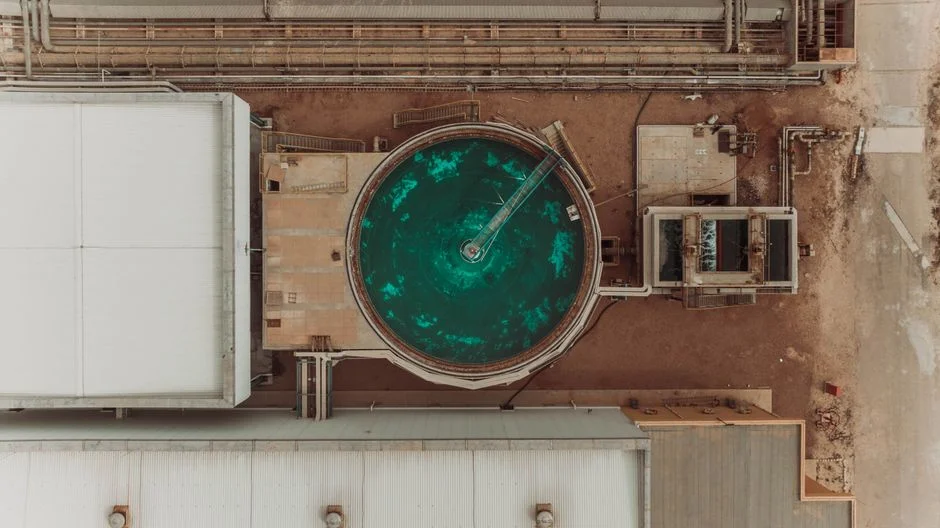
A dissolved air flotation system saturates a pressurized recycle stream with air at 60–80 psig, then releases that stream through needle valves or a micro-bubble generator at atmospheric pressure inside a flotation tank. The pressure drop nucleates 20–40 micron microbubbles that attach to oil droplets, FOG, and pre-flocculated solids, reducing their effective density and floating them to the surface for skimming (per Komline-Sanderson DAF product literature and DAF Corp's micro-bubble generator specification). A gravity clarifier does the opposite: flow enters a quiescent basin at low surface overflow rates of 800–1,200 gpd/ft², denser particles drop to a sludge bed, and a slowly rotating rake mechanism drives the sludge to a center hopper.
Chemical-plant streams break the generic "oils vs solids" framing because the contaminants are often emulsified by surfactants, solvents, and pH swings. Density-neutral floc and oil-in-water emulsions resist gravity settling but attach readily to microbubbles, which is the mechanism DAF exploits. The trade-off is that neither technology works on raw influent without chemical pretreatment — coagulant, flocculant, and pH adjustment are prerequisites, not accessories, and a properly sized PLC-controlled chemical dosing system determines whether the upstream unit actually performs (per Komline-Sanderson, "chemical conditioning is often used to increase the effectiveness of the dissolved air flotation process").
DAF vs clarifier: removal performance for chemical-plant contaminants
The headline numbers come from manufacturer data and the Ecologix 2026 selection guide. On the same oily feed, DAF removes 95% of FOG and oil versus about 70% for a clarifier (Ecologix 2026). On TSS, the geometry matters: a circular FC-style DAF hits 92–98% removal at 10–11,000 gpm, while a rectangular DAF lands at 85–90% (DAF Corp). A conventional gravity clarifier in chemical service removes 50–80% of TSS, depending on particle density, and reaches 90% on heavy mineral sediment (Ecologix 2026 mining case). Both technologies address the particulate fraction only; dissolved metals require precipitation upstream, which matters for any Phoenix plating-adjacent chemical line carrying nickel, copper, or chromium.
BOD and COD reduction in either primary unit is 30–60% — neither technology is meant to be a standalone discharge solution, and downstream biological polishing is the norm. Footprint is the second decision axis: a DAF needs roughly 5–10 ft² per m³/h of hydraulic capacity, while a clarifier needs 15–25 ft² per m³/h. DAF is also largely temperature-insensitive, which fits Phoenix summer influent, while clarifier hydraulic performance drifts with viscosity and the launder biology problems mentioned earlier.
| Parameter | DAF (FC / Rectangular) | Gravity Clarifier (incl. Lamella) |
|---|---|---|
| TSS removal | 92–98% (FC) / 85–90% (rectangular) | 50–80% (chemical service); up to 90% on heavy mineral solids |
| FOG / oil removal | ~95% | ~70% on same oily feed |
| Surface loading / SOR | Not SOR-limited; sized on hydraulic & bubble contact | 800–1,200 gpd/ft² (primary); lamella up to 20–40 m/h |
| Footprint per m³/h | ~5–10 ft² | ~15–25 ft² (conventional); lamella ~1/5 of conventional |
| Typical polymer dose | 5–20 mg/L polyacrylamide | 1–5 mg/L for heavy sludge |
| Sludge consistency | 2–4% thickened float | 0.5–2% underflow; rake-driven |
| Energy drivers | Recycle pump, air compressor, skimmer drive | Rake drive only; no compressed air |
When to choose a DAF for Phoenix chemical wastewater
DAF is the right primary when the stream carries emulsified oil or FOG above 200 mg/L, when TSS is dominated by light floc or low-density solids, or when influent temperature runs hot — the Phoenix summer norm, where DAF's temperature insensitivity is a real operational advantage. Footprint is often the deciding factor in older Phoenix plants with tight treatment bays: a 100 m³/h DAF fits in roughly one-third the floor area of an equivalent conventional clarifier, and a DAF system ships as a skid that can be commissioned in days rather than weeks.
DAF also makes sense when the downstream goal is water reuse. Cooling-tower and boiler-feed makeup under the Arizona Aquifer Protection Permit need low TSS, low oil, and stable SDI before RO, and DAF effluent at 50 mg/L TSS and less than 15 mg/L oil is a proven RO pretreatment guard. For Phoenix specialty chemical plants considering ZLD or high-recovery RO, DAF can be coupled with biological polishing — MMBBR or an MBR membrane bioreactor — and the SSRN 2024 work on DAF plus MMBBR for synthetic oily wastewater confirms the train's viability for petrochemical and specialty-chemical matrices.
When a clarifier still wins for Phoenix chemical plants
Gravity clarification is the right call when the dominant solids are dense and fast-settling — calcium sulfate slurries, catalyst fines, lime sludge from acid-neutralization, or precipitated metal hydroxides. Those chemistries are common in Phoenix batch plants producing inorganic pigments, water-treatment chemicals, and fertilizer intermediates. A lamella or tube-settler clarifier compresses the conventional footprint by roughly 5×, hits 20–40 m/h surface loading, and captures the same heavy solids in a fraction of the bay space, which is why the high-efficiency lamella clarifier remains a strong fit for footprint-constrained retrofits.
Clarifiers also win on energy. There is no recycle pump, no air-dissolving tube, and no compressor — only a slow rake drive. For a Phoenix plant paying industrial electricity rates and running a tight OPEX budget, that single fact can carry the decision. A clarifier also serves as the secondary step downstream of a DAF, capturing any settleable carryover in a mixed stream — exactly the role Komline-Sanderson's bottom collectors play inside a DAF tank when the influent contains both floating and settling fractions.
The 2026 Phoenix selection matrix: match your influent to a configuration
Most Phoenix chemical plants don't get a clean "oils only" or "solids only" stream. Batch reactors dump, campaign changeovers swing pH, and a single equalization tank sees surfactant-bearing wash water one hour and catalyst slurry the next. The 2026 answer for that variability is almost always a hybrid train, and the Ecologix 2026 guide explicitly supports combining DAF and clarifier for complex streams. The matrix below maps four influent profiles to the configuration most Phoenix NAICS 325 plants will end up specifying in 2026.
| Influent profile | Recommended 2026 configuration | Expected effluent quality |
|---|---|---|
| Oil / FOG-rich, TSS < 1,500 mg/L | Configuration A — DAF only (FC or rectangular) | TSS < 50 mg/L; oil < 15 mg/L |
| Heavy inorganic solids, no significant FOG | Configuration B — Lamella clarifier only | TSS 100–200 mg/L; metal-bearing sludge to filter press |
| Mixed (oils + dense solids, batch plant) | Configuration C — DAF followed by lamella clarifier (hybrid) | DAF 90–98% TSS first; lamella polishes carryover to < 30 mg/L TSS |
| Reuse-grade (cooling tower / boiler feed) | Configuration D — DAF + MBR or DAF + RO polish under APP standards | TSS < 5 mg/L, SDI < 3 before RO |
Configuration C is the one we see most often in 2026 site visits around Phoenix: a DAF system ahead of a high-efficiency lamella clarifier, with polymer fed from a PLC-controlled chemical dosing system sized for the 100–110 °F summer influent. The same logic shows up in adjacent industries — see our mining wastewater DAF vs clarifier guide for Claremore and the chemicals wastewater DAF vs clarifier guide for Fredericksburg plants — and in petroleum service, where the trade-offs shift but the hybrid logic holds (see the petroleum bulk wastewater DAF vs clarifier guide).
CAPEX, OPEX, and ROI considerations for a 2026 Phoenix install
Frame CAPEX and OPEX as relative bands rather than fabricated Phoenix dollar figures, because treatment-train cost is site-specific. DAF systems have higher upfront cost: recycle pump, air-dissolving tube or micro-bubble generator, skimmer drive, and stainless wetted parts all add to the skid price. Clarifiers are cheaper to buy and install — a steel tank, a rake mechanism, a center drive — and the Ecologix 2026 guide is explicit that clarifiers "generally have lower operational costs."
OPEX runs the other direction. DAF OPEX is driven by compressed air and polymer at 5–20 mg/L polyacrylamide, plus a recycle pump that runs continuously. Clarifier OPEX is dominated by sludge hauling and rake maintenance, with polymer as low as 1–5 mg/L for heavy inorganic sludge. The ROI lever in 2026 Phoenix is reuse, not energy: every 1,000 m³/day a plant diverts from discharge to cooling-tower or scrubber makeup offsets the marginal cost of Tier 1-shortage Colorado River municipal and groundwater supply, and APP-compliant reuse generally avoids aquifer protection fees that apply to deep-well disposal. Pilot testing remains the right sizing step — Komline-Sanderson explicitly offers rental pilot units, and a 60-day on-site jar-and-pilot run typically locks in the polymer dose, recycle ratio, and air-to-solids loading that the CAPEX line item will be built around. For deeper equipment context, the industrial pressure flotation system selection guide walks through the engineering specs that drive those numbers.
Frequently Asked Questions
Which is cheaper for a small Phoenix batch chemical plant: DAF or clarifier?
A lamella clarifier wins on CAPEX and on energy, because it needs only a rake drive and no compressed-air system. A DAF wins on effluent quality and on whether the plant can reuse the water downstream — for a 50–100 m³/h batch plant targeting cooling-tower reuse under the Arizona APP, the DAF's higher TSS and oil removal usually pays for itself through avoided water and discharge fees (Ecologix 2026 selection guide).
Can a DAF and a clarifier be used together?
Yes. Hybrid DAF followed by clarifier trains are explicitly supported for complex streams with both oils and heavy settleable solids, and the configuration is the most common 2026 answer for Phoenix batch chemical plants that see both FOG and catalyst fines in the same equalization tank (Ecologix 2026; Komline-Sanderson bottom-collector practice).
What removal rate can a DAF hit on oil and grease in a chemical stream?
A DAF typically achieves about 95% FOG and oil removal on an oily feed, versus roughly 70% for a clarifier on the same stream (Ecologix 2026). Chemical-plant FOG is often more emulsified than the food-processing case the 95% figure is drawn from, so conservative designs target 85–90% to allow for surfactant-stabilized emulsions.
Does Phoenix heat affect DAF performance?
Warmer influent slightly increases dissolved-air capacity at a given saturation pressure, which often improves DAF efficiency in summer. The same heat accelerates biological growth in clarifier launders and weirs, so summer operations tend to push plant managers toward DAF-based or hybrid configurations (per Komline-Sanderson's notes on DAF's temperature insensitivity and ADEQ operational guidance for APP-permitted systems).
Do Phoenix chemical plants need 40 CFR 414 pretreatment?
Most NAICS 325 facilities — organic chemicals, plastics, and synthetic fibers — fall under 40 CFR Part 414 with subcategory-specific effluent limits on TSS, BOD, COD, and priority pollutants. Confirm applicability through the plant's individual NPDES permit and the Arizona APP issued by ADEQ, because the subcategory determination drives both the numerical limits and the monitoring schedule (per EPA 40 CFR 414).