What Fabricated Metals Wastewater in Decatur Actually Looks Like in 2026
For fabricated metals wastewater in Decatur, US in 2026, choose a DAF (Dissolved Air Flotation) system when the stream carries emulsified oils, cutting fluids, and tramp oils — DAF typically removes 85–95% of oils and greases using 20–40 micron micro-bubbles. Choose a gravity clarifier (or lamella clarifier) when the dominant load is heavy metal fines and settable solids at 1,000+ mg/L TSS, where sedimentation achieves 80–90% solids removal at lower OPEX. Most Decatur shops run a hybrid: DAF first, then clarifier polish.
NAICS 332 covers shops that cut, stamp, machine, coat, and weld metal — and each operation donates a different contaminant signature to the floor drain. Stamping presses and machining cells discharge emulsified cutting fluids and tramp oils at 50–2,000 mg/L oil & grease. Grinding, sawing, and shot-blast booths contribute ferrous and non-ferrous metal fines that push TSS into the 200–5,000 mg/L range. Parts-washing and alkaline degreasing tanks run rinsewater at pH 8–11 with surfactant carryover that keeps oils emulsified rather than free-floating. Weld fume scrubbers add another load of fine metallic particulates. The combined matrix — emulsified oil + heavy fines + alkaline pH — is what separates fabricated metals from food or mining wastewater that most generic comparison articles discuss.
Decatur's fabricated metals plants sit largely inside the Decatur Industrial Park and discharge to the Tennessee River watershed under Alabama Department of Environmental Management (ADEM) industrial pretreatment rules, which incorporate the federal categorical standards of 40 CFR 433 (Metal Finishing). For 2026, that means daily compliance with lead, cadmium, total chromium, and oil & grease limits, and pretreatment design must follow the sizing logic in the EPA Process Design Manual for Suspended Solids Removal (EPA 625/1-75-003a, 1975) — the same document still cited for primary clarifier surface loading rates and air-to-solids ratios. Operators in 2026 are sizing primary separators against tighter enforcement and tighter internal recycling targets, which is why the DAF-vs-clarifier choice has stopped being academic. For a 50 m³/h shop, the first unit on the flow path will set the tone for every downstream process — and the right unit depends on which contaminant fraction dominates your stream. See the HydropureWater DAF system for the dissolved air flotation envelope discussed in this article.
How a DAF System Removes Oils and Fines
A DAF unit separates contaminants by attaching fine air bubbles to oil droplets and suspended solids so their bulk density drops below water and they float. The mechanism is straightforward: a side-stream of clarified effluent is saturated with air in a pressure vessel at 60–80 psig, then released through needle valves into the main tank. The pressure drop generates micro-bubbles in the 20–40 µm range (per DAF Corp's Micro Bubble Generator spec) or 30–50 µm range (per SigmaDAF clarifier documentation) — small enough to adhere to emulsified oil droplets that would never settle in a clarifier.
Performance numbers from the two established DAF platforms help frame the envelope. DAF Corp's round FC Maximizer delivers 92–98% TSS removal at flows from 10 GPM up to 11,000 GPM, with effluent TSS below 20 ppm of filterable solids on a 2,000 ppm feed (DAF Corp). The rectangular RC UniMax runs 85–90% TSS removal at 10–1,000 GPM (DAF Corp). The HydropureWater DAF line occupies the 4–300 m³/h window — roughly 18–1,320 GPM — which covers most Decatur mid-sized fabricated metals plants. Skimmers on top remove the floated oil layer continuously; heavier fines drop through the sludge cone and auger out at 2–4% dry solids (DAF Corp operating data, 2025).
Chemical conditioning precedes the DAF. Coagulant (typically a cationic polymer or ferric-based coagulant) neutralizes the emulsion charge, then flocculant builds a floc large enough for bubble attachment. Skipping this step is the single most common reason DAF units underperform in metalworking — emulsified oils will pass through untouched without proper charge neutralization. Pair the DAF with the HydropureWater automatic chemical dosing system for polymer injection to keep the charge neutralization consistent across shift changes.
How a Gravity Clarifier Settles the Heavy Solids
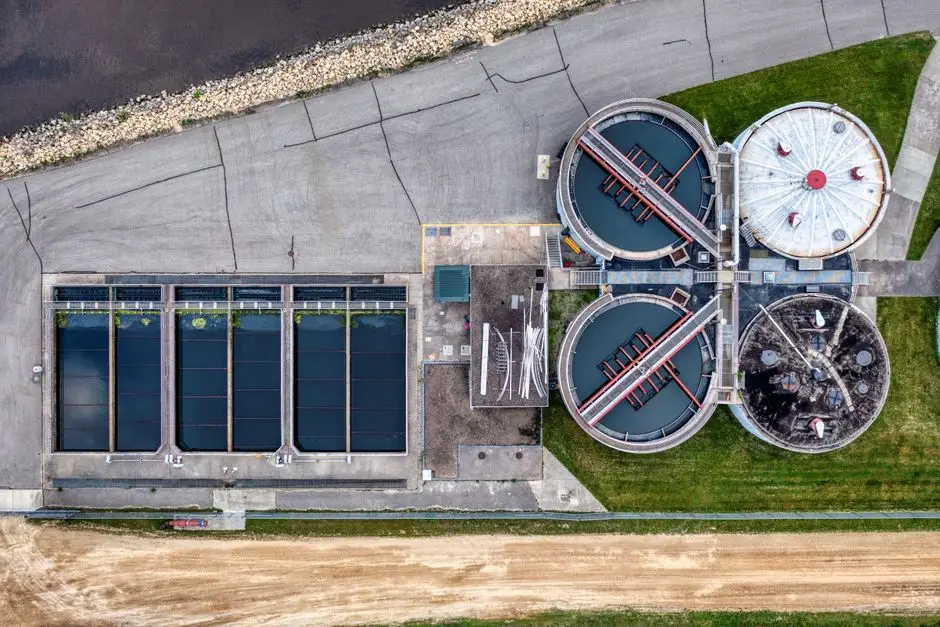
A clarifier does the opposite job from a DAF: it lets gravity pull heavy particles out of suspension. A conventional clarifier does this slowly — surface overflow rates of 1–2 m/h are typical — which is why a lamella (inclined-plate) clarifier is the right choice for fabricated metals shops. The lamella design stacks plates at 55–60° inside the tank, multiplying the effective settling area inside a small footprint. The HydropureWater high-efficiency sedimentation tank operates at 20–40 m/h surface loading, roughly 20× a conventional unit, by using those inclined plates.
For metal fines and grinding swarf, a lamella clarifier routinely hits 80–90% TSS removal — the heavy, fast-settling fraction that a DAF would just as happily float, but at higher operating cost. The weak spot is emulsified oil: a clarifier typically removes only 60–70% of oil & grease because emulsified droplets are too small and too close to water density to settle without very long residence times (Ecologix benchmark, 2025). The lamella geometry also reduces coagulant consumption by up to 30% versus a conventional clarifier because the inclined plates provide more efficient solids contact in less volume.
Sludge from a clarifier is heavier and wetter than DAF float — typically 1–2% dry solids versus 2–4% from a DAF — and it still needs dewatering before disposal. A small fabricated metals plant running a lamella clarifier will normally pair it with a HydropureWater plate and frame filter press to bring that sludge to 25–35% dry solids for hauling. See the HydropureWater lamella clarifier for the inclined-plate geometry referenced here.
DAF vs Clarifier: Head-to-Head on Fabricated Metals Streams
The single biggest decision a Decatur plant engineer faces in 2026 is whether the primary separator should be a DAF or a clarifier. The answer sits in the contaminant mix, not in vendor literature. The table below puts the two technologies side by side on the parameters a buyer actually negotiates: removal efficiency, footprint, hydraulic loading, sludge character, capital band, operating cost band, and operator skill required.
| Parameter | DAF (Dissolved Air Flotation) | Lamella / Gravity Clarifier |
|---|---|---|
| Primary target contaminant | Emulsified oil, free oil, light TSS | Heavy metal fines, swarf, settable TSS |
| Oil & grease removal | 85–95% (up to 95% in oily streams; Ecologix 2025) | 60–70% (Ecologix 2025) |
| TSS removal | 85–98% (DAF Corp FC Maximizer 92–98%, RC UniMax 85–90%) | 80–90% on settleable fines |
| Surface / hydraulic loading | 5–25 m/h depending on bubble attachment time | 20–40 m/h (lamella); 1–2 m/h (conventional) |
| Footprint at 50 m³/h | ~6–15 m² (round or rectangular tank + saturator) | ~10–25 m² (lamella tank) |
| Sludge dryness | 2–4% dry solids float + bottom cone fines | 1–2% dry solids, requires dewatering press |
| CAPEX band (qualitative) | USD 40k–180k unit-only at 2026 pricing | USD 25k–120k unit-only; plate press adds USD 15k–80k |
| OPEX driver | Air compressor 5–15 kW + polymer USD 0.02–0.06/m³ | Low power 1–3 kW + polymer USD 0.01–0.03/m³ |
| Operator skill | Moderate (saturator pressure, bubble quality, skimmer speed) | Lower (sludge blowdown, plate cleaning) |
| Best-fit NAICS 332 stream | Stamping, machining, parts washing, coolant blowdown | Grinding swarf, shot blast dust, weld fume scrubber |
The Ecologix 2025 case data anchors the efficiency claim: a food plant with high oil content hit 95% oil removal on a DAF versus 70% on a clarifier, while a mining operation with heavy sediment load hit 90% solids removal on a clarifier at lower cost. For Decatur fabricated metals — which sits between those two extremes — the same trade-off holds: DAF wins on oil, clarifier wins on heavy fines, and cost favors the clarifier when oil is not the constraint.
When to Choose DAF, When to Choose Clarifier, When to Use Both
The decision tree is short enough to apply on a Monday morning with last week's wastewater characterization in hand.
Choose DAF when oil & grease exceeds 100 mg/L, when free oil and emulsified cutting fluid dominate the stream, or when the plant runs stamping, machining, or parts-washing cells that discharge coolant. DAF is also the right pick when the discharge limit is tight on oil & grease and the plant cannot afford a downstream polishing step just for oil. A 50–150 m³/h DAF covers most Decatur mid-sized fabricated metals plants in a single unit (HydropureWater field data, 2025).
Choose lamella clarifier when TSS exceeds 1,000 mg/L from grinding swarf, shot-blast dust, weld fume scrubber water, or pre-coagulated casting wash. If oil is below 100 mg/L and the plant does not run parts washers, a clarifier alone will hit compliance at lower OPEX. The trade-off you accept is weaker oil removal — a downstream coalescer or a small DAF polish may still be required for the O&G limit.
Run hybrid DAF → clarifier when the plant does both — full-service metal finishers, plating-adjacent lines, EV component shops, or any Decatur fabricator that runs machining cells and surface treatment under one roof. The DAF pulls oil and light TSS off the top, the lamella clarifier catches the heavy fines that slip through the DAF bottom cone, and a HydropureWater DAF system followed by a lamella clarifier is the 2026 default train for these operations. Pair it with equalization upstream and a plate-and-frame press downstream, and the train hits both 40 CFR 433 oil & grease and TSS limits without a polishing filter. The hybrid is the configuration none of the generic top-ranking comparison articles discuss, because their reference streams (food and mining) don't have the same oil-plus-fines matrix that defines NAICS 332.
2026 Cost Reality and Compliance Notes for Decatur Operators
For 2026, the regulatory frame is straightforward: ADEM administers the Industrial Pretreatment Program in Decatur, and fabricated metals plants discharging to the Tennessee River watershed must meet 40 CFR 433 Metal Finishing categorical limits for lead, cadmium, total chromium, copper, nickel, zinc, and oil & grease. Lead and oil & grease are the two parameters most likely to drive a 2026 upgrade decision in a Decatur shop — both are tighter than typical local limits, and both respond to different primary separation technologies (precipitation/coagulation for metals, flotation for oil). See the 2026 guide to zinc removal from industrial wastewater for the metals-side design numbers.
The energy gap is real. A DAF's air compressor on a 50 m³/h unit draws 5–15 kW continuously, while a lamella clarifier on the same flow draws 1–3 kW — mostly sludge pumps. At 2026 industrial power rates, that gap is the largest single OPEX line between the two technologies, and it is exactly why oil-dominant shops accept the DAF power cost and fines-dominant shops do not. Chemical spend tracks the same logic: polymer plus coagulant runs USD 0.02–0.06 per m³ treated on a DAF versus USD 0.01–0.03 per m³ on a clarifier (qualitative 2026 ranges, vendor-specific).
Before committing capital in 2026, run a 5–10 GPM pilot on the actual stream for at least two shifts. DAF Corp and SigmaDAF both offer pilot rentals, and a two-week pilot typically answers 80% of the questions a desk study cannot. Jar tests alone are not enough for DAF sizing — the air-to-solids ratio and the bubble attachment kinetics only show up under continuous flow. For chromium and lead removal downstream of the primary separator, follow the 2026 process guide on chromium removal and the 2026 process guide on lead removal once the primary separator is selected.
Frequently Asked Questions
Which is better for oil — DAF or clarifier — in a fabricated metals plant?
DAF is the better choice. A DAF removes 85–95% of emulsified oil and tramp oil using 20–40 µm micro-bubbles, while a lamella clarifier typically removes only 60–70% of oil & grease because emulsified droplets are too small and near water density to settle (Ecologix 2025). For stamping, machining, and parts-washing lines where oil & grease exceeds 100 mg/L, DAF should be the primary unit.
Can a clarifier alone meet 40 CFR 433 metal finishing limits?
Usually not, unless the stream is low in oil. 40 CFR 433 sets oil & grease limits that a clarifier alone struggles to meet on a stream with significant cutting fluid or tramp oil carryover. Most Decatur NAICS 332 plants that run only a clarifier add a small DAF polish, or move to a hybrid DAF → clarifier train to hit both TSS and oil & grease in one pass.
What is the smallest DAF size that makes sense for a Decatur fabricated metals shop?
A 10–25 m³/h DAF is the practical floor for a full-scale fabricated metals operation. Below that flow, the saturator and skimmer become inefficient, and the economics favor renting a pilot unit (5–10 GPM, available from DAF Corp and SigmaDAF) to characterize the stream before committing. The HydropureWater DAF line covers 4–300 m³/h in standard configurations.
Do I need both a DAF and a clarifier?
Yes, if your plant does both machining and grinding/welding. The DAF handles the oil and light TSS, the lamella clarifier catches the heavy metal fines that pass through or settle in the DAF bottom cone. For a Decatur full-service metal finisher or EV component shop in 2026, the hybrid DAF → clarifier → plate press train is the default that meets both oil & grease and TSS limits without tertiary filtration.