
Why Christchurch Rebuilt with Activated Sludge — Not Ponds or MBR
The 2021 fire at the Christchurch wastewater treatment plant necessitated a transition away from the legacy trickling filter and pond system, which had become a source of chronic community odour complaints (per Christchurch City Council, April 2024). Activated sludge was selected for this rebuild because it provides consistent year-round nitrification, whereas pond systems frequently fail to maintain biological stability during the Christchurch winter (where ambient temperatures drop to 6–11°C). Compared to membrane bioreactor (MBR) technology, activated sludge offers a lower CapEx profile—typically 3–4 times less expensive—and avoids the significant OPEX associated with periodic membrane replacement, which is unnecessary given the plant's current discharge requirements into an estuarine environment rather than direct potable reuse.
The project, currently under construction, utilizes stone column foundations to ensure seismic resilience, with a placement rate of 10 columns per day during the initial 4-month site preparation phase (source: CCC April 2024 update). Based on the pipe diameters and foundation intensity, the plant is sized for a population equivalent (PE) of 60,000–80,000. This capacity aligns with the need for a robust, operator-familiar system that can reliably meet discharge standards without the complexity of advanced membrane filtration. For engineers comparing staging options or future-proofing, the MBR deep-dive for future staging comparison provides a technical baseline for why traditional activated sludge was prioritized for this specific scale and location.
Activated Sludge Reactor Design Parameters for Christchurch Conditions
Design parameters for the Christchurch facility account for cold-weather nitrification requirements to ensure consistent compliance with nitrogen limits. To achieve full nitrification at winter temperatures of 10–12°C, the system is designed with a Solids Retention Time (SRT) of 12–15 days and a Hydraulic Retention Time (HRT) of 6–8 hours, consistent with established Water NZ guidelines for municipal facilities. The reactor configuration includes an anoxic zone comprising 30–40% of the total volume to facilitate pre-denitrification and meet the strict Total Nitrogen (TN) targets.
| Parameter | Design Target / Range |
|---|---|
| Design PE | 60,000 – 80,000 |
| MLSS Concentration | 3,000 – 4,000 mg/L |
| F/M Ratio | 0.08 – 0.12 kg BOD/kg MLSS·d |
| Aeration Demand | 1.8 – 2.2 kg O₂/kg BOD removed |
| Dissolved Oxygen (DO) | 1.5 – 2.0 mg/L (fine bubble diffusers) |
| Total Reactor Volume | 16,000 m³ (distributed in parallel trains) |
Process control relies on automated DO management to minimize energy consumption while maintaining the biological health of the biomass. Following these core design specifications, the secondary process components must be sized to handle the resulting sludge volumes efficiently.
Secondary Clarifier Sizing and Sludge Handling Chain
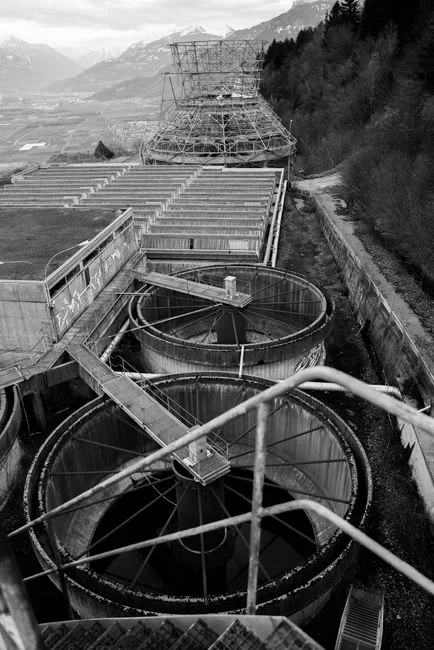
Secondary clarifier design is governed by surface loading rates of 1.5–2.0 m/h, as specified in the NZ Water Industry Guidelines, necessitating diameters of 33–45 m for each of the 2–3 parallel units. The discharge piping connecting the reactor to the clarifiers is sized for a velocity of 0.2 m/s, requiring 2–4 m diameter conduits to accommodate the 16,000 m³/d design flow. Effective sludge management is critical, with waste activated sludge (WAS) generated at a rate of 0.8–1.0 kg TSS per kg of BOD removed.
| Unit Process | Equipment Specification |
|---|---|
| WAS Thickening | DAF for WAS thickening to 3–5% DS |
| Dewatering | Filter press for 18–22% DS cake |
| Clarifier Load | 1.5 – 2.0 m/h surface loading |
| Recycle Ratio | 50 – 100% of influent flow (Q) |
To address the odour issues experienced between 2021 and 2024, all sludge thickening and dewatering equipment is fully enclosed with dedicated air extraction systems routed to a biofilter. The use of a covered headworks screening with odour containment is mandatory to ensure that H₂S emissions remain within the <1 OU/m³ boundary limit.
NZ Discharge Limits Mapped to Tertiary Treatment Requirements
Compliance with the NES-FW (2020) discharge limits requires a multi-stage approach beyond secondary biological treatment. Typical activated sludge effluent in this climate results in BOD levels of 10–20 g/m³ and TN of 8–15 g/m³, necessitating tertiary polishing to meet the strict Canterbury regional thresholds.
| Parameter | NES-FW Limit (Canterbury) | Treatment Strategy |
|---|---|---|
| BOD₅ | ≤20 g/m³ | Biological Activated Sludge |
| TSS | ≤30 g/m³ | Secondary Clarification |
| TN | ≤10 g/m³ | Anoxic Zone Optimization |
| TP | ≤1 g/m³ | PLC-controlled alum/ferric dosing |
| E. coli | ≤126 cfu/100mL | ClO₂ generator for estuarine-safe disinfection |
Chemical phosphorus removal is achieved through precise dosing of alum or ferric salts (15–25 mg/L), while disinfection via chlorine dioxide is preferred over UV to prevent the formation of trihalomethanes (THMs) in the sensitive estuarine receiving environment. Industrial dischargers must also remain aware of NZ trade waste limits for industrial dischargers to prevent shock loads that could compromise these biological and chemical targets.
Odour Control Strategy: Learning from 2021–2024 Failures
Transitioning from pond-based treatment to an activated sludge process serves as the primary engineering response to the odour complaints recorded since 2021. The new plant architecture eliminates the seasonal destabilisation inherent in pond systems by utilizing fully contained biological reactors and covered headworks. The biofilter design adheres to an Empty Bed Contact Time (EBCT) of 60–90 seconds, specifically dimensioned to handle inlet H₂S concentrations of up to 5 ppm. Real-time monitoring, utilizing an e-nose sensor network at the site fence-line, ensures that odour levels are continuously verified against the target of <1 OU/m³ at the boundary, as required by NZS 4404 standards.
Procurement Checklist: 2026 Commissioning Window
Successful commissioning in 2026–2027 requires a strictly phased procurement schedule to account for current lead times and the seismic design requirements of NZS 1170.5 (Ss = 1.3g). Budget benchmarks for a plant of this size (60,000–80,000 PE) in the New Zealand market are estimated at NZ$45–65M.
- Long-Lead (Q1 2026): Aeration blowers, clarifier bridge mechanisms, and tertiary disinfection skids.
- Medium-Lead (Q2 2026): High-efficiency sedimentation tank components, chemical dosing skids, and WAS thickening systems.
- Short-Lead (Q3 2026): Instrumentation (DO, MLSS, nitrate probes), valves, and SCADA integration hardware.
All equipment must be sourced from the Water NZ approved products register to ensure compatibility and long-term supportability. Preference should be given to local fabrication for structural steel and tanks to minimize logistics delays and ensure compliance with seismic standards.
Frequently Asked Questions
When will Christchurch's new wastewater treatment plant be operational?
Commissioning is targeted for the 2026–2027 window. The project is currently in the construction phase, following the foundational stone column installation that began in early 2024.
What technology does the new Christchurch plant use?
The plant utilizes an activated sludge process with dedicated anoxic and aerobic zones, secondary clarifiers, chemical phosphorus removal, and chlorine dioxide disinfection, avoiding the reliance on pond systems or membrane bioreactors.
What are the discharge limits for Christchurch wastewater?
The plant is designed to meet NES-FW (Canterbury) requirements: BOD₅ ≤20 g/m³, TSS ≤30 g/m³, TN ≤10 g/m³, TP ≤1 g/m³, and E. coli ≤126 cfu/100mL (95th percentile).
Why did Christchurch choose activated sludge over membrane bioreactors?
Activated sludge was chosen for its lower CapEx (3–4 times lower than MBR), lack of membrane replacement OPEX, and its suitability for the required discharge quality into the local estuary.
How is odour controlled at the new plant?
Odour is controlled through covered headworks, sealed sludge thickening/dewatering, biofiltration (60–90s EBCT), and real-time fence-line monitoring, eliminating the seasonal destabilisation risks associated with the previous pond system.