What the Oil and Grease Discharge Standard Actually Regulates
Oil and grease discharge standards cap effluent O&G at 10–100 mg/L depending on jurisdiction and receiving water: China GB 8978-1996 sets 10 mg/L for Tier-1 second-class pollutants, US EPA categorical pretreatment typically limits O&G to 100 mg/L (40 CFR 469 for metal finishing, 100 mg/L daily max), and most municipal FOG ordinances cap discharges at 100 mg/L. DAF systems routinely hit 90–95% removal to bring 500–2,000 mg/L influent below 50 mg/L.
Analytically, "oil and grease" is the hexane-extractable material (HEM) measured by EPA Method 1664 — a gravimetric, n-hexane extraction of everything that partitions into a non-polar solvent at pH ≤ 2. That fraction is operationally distinct from total petroleum hydrocarbons (TPH), BTEX, or individual PAHs, which are measured by GC/MS or HPLC. A high O&G result tells the regulator the discharge carries floatable, emulsified, or soluble animal, vegetable, or petroleum lipids; it does not distinguish crude oil from tallow or cutting fluid from olive oil. For trade-effluent negotiations that distinction matters, because petroleum refineries and slaughterhouses can hit the same 100 mg/L cap from very different waste streams.
Utilities and national regulators use O&G as a surrogate for pollution load because it fouls collection systems, creates SSO events when solidified fat plugs siphons, and smothers the biological activity in activated-sludge plants. The Western Virginia Regional Authority's ordinance (WRA §52.048) defines household-type wastewater as not exceeding 100 mg/L O&G at a discharge rate of 100 gallons per capita per day, which has become the de facto cap adopted by hundreds of US POTWs for non-categorical industrial users. At the analytical reference-material level, certified standards such as the GBW(E)110147 series from China's National Institute of Metrology cover acid-number ranges of 0.050–3.000 mg/g with 1.8–5% expanded uncertainty, anchoring trace-level work in oil matrices and supporting the calibration of GC and HPLC methods that run alongside Method 1664 in permit laboratories.
Oil and Grease Limits by Major Jurisdiction (2026)
No two regulators phrase the O&G limit identically, but the working range collapses to a tight band: 10 mg/L for direct discharge to sensitive receiving waters, 100 mg/L for categorical pretreatment to sewer, and 100–200 mg/L for non-categorical municipal discharges. The table below consolidates the major industrial frameworks an EHS lead or procurement engineer is likely to encounter in 2026.
| Jurisdiction / Standard | Daily Max Limit (mg/L) | Scope / Applicability |
|---|---|---|
| China GB 8978-1996, Tier-1 second-class pollutants | 10 | Direct discharge to surface water; second-class receiving waters |
| China GB 8978-1996, Tier-2 / Tier-3 (inland, some receiving waters) | 30 | Discharge to municipal sewer or designated inland waters |
| US EPA 40 CFR 469 (Metal Finishing) | 100 | Categorical pretreatment daily max, 38 mg/L monthly avg |
| US EPA 40 CFR 435 (Oil & Gas / Petroleum Refining — central treatment) | 100 | Categorical pretreatment, 65 mg/L monthly avg |
| US EPA categorical (40 CFR 405 food, 414 organic chemicals, 471 metal molding) | 100 | Most food, organic chemicals, and metalworking categories |
| EU Industrial Emissions Directive / member-state BAT-AEL (e.g., BREF on Food, Drink & Milk, Common Waste Water) | 10–25 | Direct discharge after on-site treatment; tighter values in national permits |
| India CPCB GSR 422(E) / State PCB variations | 10 | Inland surface water discharge |
| Middle East (KSA PME, UAE FED) — industrial discharge to sea | 10–15 | Marine outfall or cooling-water return |
| Typical US municipal FOG ordinance (POTW) | 100–200 | Non-categorical commercial/industrial discharge to sewer, instantaneous max typically 200 mg/L |
Engineers working across borders should treat 10 mg/L as the floor for any surface-water discharge and 100 mg/L as the ceiling for any sewer discharge. The 100 mg/L daily max in 40 CFR 469 sits alongside a 38 mg/L monthly average, which is the number that drives DAF sizing for metal-finishing lines that run continuously. Saudi Arabia's Presidency of Meteorology and Environment (PME) and the UAE Federal Environmental Agency both default to 10–15 mg/L for marine outfalls, with surfactant and sheen limits layered on top.
How Oil and Grease Are Measured in a Permit Lab
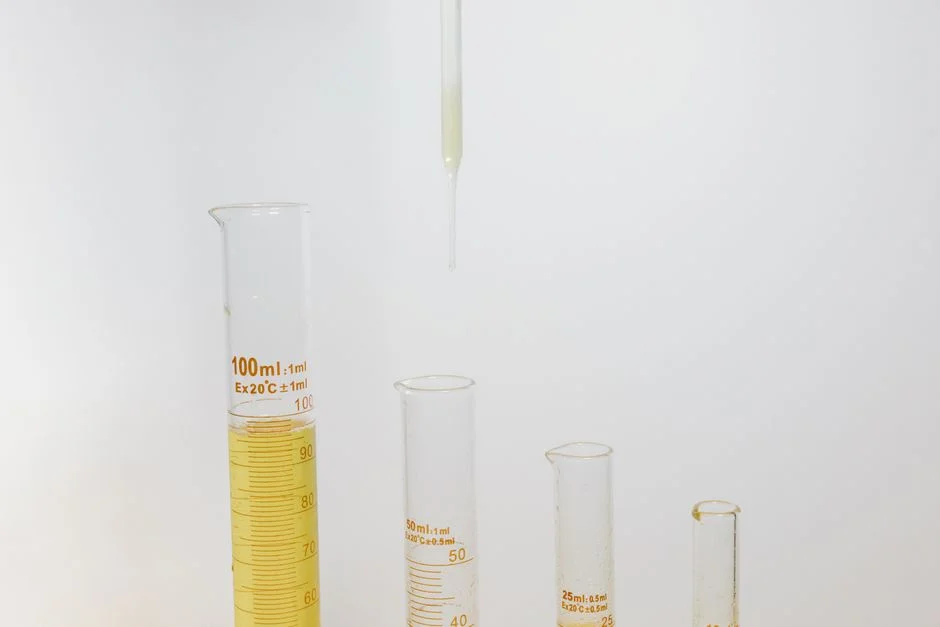
EPA Method 1664 is the workhorse: n-hexane extraction of an acidified (pH ≤ 2) sample, phase separation, solvent evaporation, and gravimetric weighing of the residue. The published working range is 5–1,000 mg/L, the method detection limit sits near 1.5 mg/L, and most accredited commercial labs report to a 5 mg/L reporting limit. Method 1664 replaced the older 413.1 (Freon extraction) in 1999 specifically to eliminate Freon-113 — a change worth knowing if a permit appendix still cites 413.1 by name.
Calibration and matrix spikes rely on certified reference materials such as AccuStandard CB9619467, the standard oil-and-grease stock used to spike laboratory blanks and confirm recovery between 80–120%. Accredited labs will run a blank, a laboratory control sample, and a matrix spike on every batch of 20 or fewer field samples, and a duplicate every tenth sample.
Two operational caveats matter for permit defense. First, Method 1664 cannot distinguish petroleum-derived O&G from animal or vegetable fats — a rendering plant and a refinery can produce identical numbers. Second, the method's n-hexane solvent does not extract very light hydrocarbons below the C8 cutoff, so dissolved BTEX, gasoline-range organics, and short-chain silicones can pass through the O&G window entirely. If a permit's hydrocarbon language includes those fractions explicitly, you also need Method 8015 (TPH-GRO/DRO) or 8260 (BTEX) on the same sample batch.
Designing a Treatment Train to Meet the O&G Limit
A defensible O&G treatment train starts with characterization, not equipment selection. Pull representative 24-hour composite samples across at least three operating days and separate the free oil layer, the emulsified fraction, and the dissolved fraction by jar test. Free oil can be skimmed in a corrugated-plate interceptor at 50–70% removal; emulsified oil — the dominant fraction in most metalworking, food, and petrochemical streams — requires coagulation followed by dissolved air flotation. The table below maps the typical influent bands to the equipment and removal efficiency you can expect.
| Influent O&G (mg/L) | Source Examples | Recommended Unit Operation | Expected Removal | Effluent O&G (mg/L) |
|---|---|---|---|---|
| 500–2,000 | Food processing, rendering washwater | Coagulation + industrial DAF system for oil and grease removal | 90–95% | 25–100 |
| 2,000–10,000 | Petrochemical, oil refinery desalter effluent | API separator + DAF + walnut shell filter | 95–99% | 20–100 |
| 10,000–100,000 | Drilling cuttings wash, bilge water | Hydrocyclone + DAF + centrifuge | 99%+ | <100 |
| 50–500 | Metalworking coolant blowdown | Chemical break (PAC + polymer) + DAF | 85–95% | 5–50 |
The DAF covers 4–300 m³/h across 13 models with micro-bubble contact (typically 20–80 µm), automatic surface skimming, and an integrated saturator recycle loop. Operating surface loadings run 5–20 m/h, hydraulic residence time 15–30 minutes, and air-to-solids ratios of 0.02–0.05 (mass of air per mass of floatable solids). Polishing to below 10 mg/L for direct surface-water discharge typically requires either a walnut shell filter (0.5–2 m/h filtration velocity, 3–10 mg/L effluent) or a coalescing plate pack downstream of the DAF, with an MBR as a third stage where space allows.
For a related design reference, the DAF system engineering guide walks through the same selection logic for cold-climate sites, and the high-turbidity wastewater treatment solution covers the coagulation chemistry that drives DAF performance. Sludge handling is the step most permits forget: floated skimmings out of a DAF typically run 2–5% dry solids and must be dewatered through a plate-and-frame filter press for skimmings dewatering to 25–35% DS before landfill or incinerator disposal. Automated coagulant and polymer dosing keeps the flocculation pH and charge demand inside the operating envelope that the DAF was designed for — drift of more than 0.5 pH units or 20% off the polymer setpoint will drop removal by 10–20 percentage points within an hour.
Costs and Payback for Oil and Grease Compliance in 2026
For a 2026 CAPEX ballpark, treat the DAF unit itself as roughly 35–45% of the packaged system cost, with coagulation skid, sludge handling, and controls making up the balance. The table below summarizes the order-of-magnitude ranges an EHS lead should put in front of procurement.
| System Scope | Capacity | 2026 CAPEX (USD) | OPEX Drivers |
|---|---|---|---|
| Containerized DAF skid, basic controls | 10–50 m³/h | $60,000–$180,000 | Polymer, energy, periodic pump seal |
| Full packaged system, coagulation + DAF + sludge | 50–200 m³/h | $150,000–$450,000 | PAC + polymer, pH trim, sludge disposal |
| Multi-stage train, DAF + walnut shell + filter press | 100–500 m³/h | $400,000–$1,200,000 | Media replacement, filter cake disposal |
OPEX breaks into three line items. Chemical — polyaluminum chloride (PAC) at 50–200 mg/L dose or cationic polymer at 2–10 mg/L — runs $0.02–$0.06 per cubic meter treated. pH trim with NaOH or H₂SO₄ adds another $0.01–$0.03/m³ when the influent is outside the 6.5–8.5 flocculation window. Sludge disposal at $80–$200 per wet ton is the single largest variable cost; a 100 m³/h DAF running at 95% oil removal can generate 1.5–3 wet tons per day of skimmings. Energy for the recycle pump and saturator sits at 0.2–0.4 kWh/m³ — material only at flows above ~100 m³/h. Payback is straightforward: most US POTWs levy surcharges above 100 mg/L O&G, and staying under the cap typically saves $0.30–$0.80 per cubic meter in surcharge fees, giving a 50 m³/h DAF a 12–24 month payback against avoided surcharges alone. Comparable CAPEX/OPEX ranges for chemical-industry effluents are detailed in the chemical wastewater discharge standard reference page.
Frequently Asked Questions
What is the oil and grease discharge standard for industrial effluent in China?
GB 8978-1996 sets 10 mg/L O&G as the daily maximum for Tier-1 second-class pollutants discharging to surface water, and 30 mg/L for the second and third tiers discharging to inland waters or municipal sewers. The 10 mg/L number drives DAF sizing for any plant with direct surface-water discharge in China.
What is the US EPA oil and grease limit for metal finishing?
40 CFR 469 (Metal Finishing Point Source Category) sets a 100 mg/L daily maximum and a 38 mg/L monthly average for O&G. This is the categorical pretreatment standard most often cited when a metalworking shop discharges to a US POTW.
Which analytical method is used to measure O&G in a permit lab?
EPA Method 1664 (n-hexane extraction, gravimetric) is the standard, with a working range of 5–1,000 mg/L and a method detection limit near 1.5 mg/L. It replaced Method 413.1 in 1999 and does not distinguish petroleum O&G from animal or vegetable fats.
What removal efficiency does a DAF system achieve for oil and grease?
A well-tuned DAF with coagulation removes 90–95% of emulsified O&G, taking influent at 1,000 mg/L to 50–100 mg/L in a single stage. Adding a walnut shell filter or coalescer downstream can push effluent below 10 mg/L for direct surface-water discharge.
How much does an industrial DAF system cost in 2026?
A containerized DAF skid rated 10–50 m³/h runs $60,000–$180,000, while a full packaged system with coagulation and sludge handling at 50–200 m³/h runs $150,000–$450,000 in 2026 USD. Most plants recover CAPEX in 12–24 months through avoided POTW surcharges above 100 mg/L O&G.
Can DAF skimmings be dewatered for disposal?
Yes. DAF floated skimmings typically run 2–5% dry solids and are dewatered to 25–35% DS with a plate-and-frame filter press before landfill or incinerator disposal. A 100 m³/h DAF at 95% oil removal generates 1.5–3 wet tons of skimmings per day.