Why the DAF-vs-Clarifier Question Matters for Daphne Chemical Plants in 2026
For Daphne, Alabama chemical plants in 2026, choose a dissolved air flotation system when the wastewater stream contains emulsified oils, FOG, or low-density flocs; choose a clarifier (or lamella clarifier) when the stream is dominated by heavy settleable solids with low oil content. Reference performance: DAF removes 92–98% TSS and ~95% FOG (per DAF Corp and Ecologix 2026 data), while clarifiers reach ~90% TSS at lower CAPEX.
Daphne (Baldwin County) chemical facilities discharge to the Daphne Water Works sewer system under ADEM Admin. Code ch. 335-6, which mirrors the federal 40 CFR 403 general pretreatment standards and layers in site-specific local limits for oil & grease, pH (typically 6.0–9.0), zinc, copper, and TSS. Common Baldwin County chemical operations — surfactant manufacturing, water-treatment chemicals, agricultural inputs, and paint/coatings — generate emulsions, pH swings, and solvent-bearing streams that defeat simple gravity settling. The 2026 decision pressure is real: local oil & grease limits are tightening, sewer surcharges in the Daphne service area now exceed $0.18/kg TSS at high loadings, and the Alabama Department of Environmental Management is expanding PFAS-related monitoring in chemical plant permits. Match the technology to the dominant contaminant class — not to vendor familiarity. The same engineering logic that drives a chemical plant pretreatment compliance guide for organic chemical facilities in other jurisdictions applies directly to Daphne.
How DAF and Clarifiers Work in a Chemical Plant Context
A dissolved air flotation (DAF) system saturates a side stream (typically 20–30% of the total flow) with air at 60–80 psi in a pressurized saturation tank, then releases it through needle valves or a dedicated micro-bubble generator. The pressure drop nucleates 20–40 micron micro-bubbles (per DAF Corp's MicroBubbler spec) that attach to chemically conditioned floc, oil droplets, and FOG, lifting them to the surface where a rotating skimmer removes the float layer. The clarified underflow exits the bottom of the tank.
A clarifier is a quiescent gravity-settling basin — circular with a center-feed well and rotating sludge scraper, or rectangular with chain-and-flight scrapers. A lamella clarifier stacks inclined plates at 55–60° inside the basin, multiplying the effective settling area by 6–10× and shrinking the footprint dramatically. Clarifiers depend entirely on Stokes' Law settling velocity, which means they only work when particles are dense enough to overcome hydraulic turbulence and the residence time in the basin.
The differentiator on chemical streams is the flocculation step upstream of the DAF. Typical chemical plants dose aluminum sulfate (Al₂(SO₄)₃) at 50–200 mg/L, ferric chloride (FeCl₃) at 50–150 mg/L, or a cationic polymer at 5–50 mg/L to convert emulsified and colloidal material into floatable flocs. Gravity settling cannot capture these particles — clarifiers struggle above ~200 mg/L oil or whenever emulsifiers (nonionic surfactants, saponified fatty acids, saponified cleaning compounds) are present. DAF tolerates them because the bubble attaches to the floc, not to the droplet, so emulsion stability is irrelevant once the floc is formed.
Chemical Wastewater Stream Profile: What Daphne Plants Actually Discharge
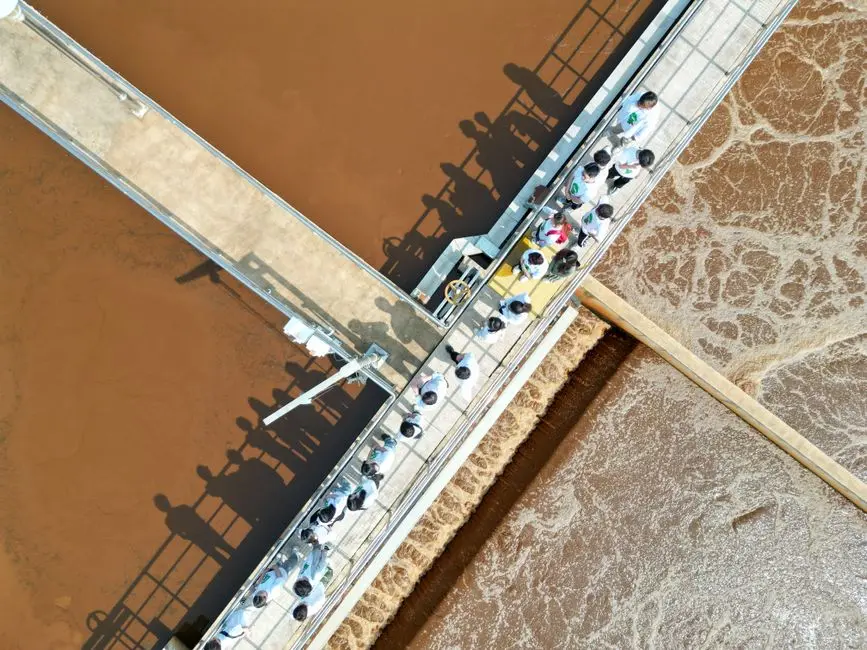
Daphne chemical plants rarely run one clean stream — they run a mix of process wash water, batch discharges, and neutralization overflows. The technology choice has to be made stream by stream, then integrated. The table below maps the dominant Baldwin County chemical-industry streams to the right 2026 pretreatment unit operation.
| Stream type | Typical contaminants | Oil/FOG | Recommended 2026 technology |
|---|---|---|---|
| Emulsified cutting fluids / coolants | Oil droplets <20 μm, surfactants, metal fines | 200–2,000 mg/L | DAF with polymer + Al₂(SO₄)₃ |
| Spent caustic + acid neutralization | High TSS, pH swing, no FOG | <20 mg/L | Lamella clarifier with pH adjustment |
| Agrochemical / pesticide formulation | Solvents, active ingredients, COD 5,000–20,000 mg/L | 50–500 mg/L | DAF + activated carbon polishing |
| Dye, pigment, paint manufacturing | Colloidal pigments, binders, surfactants | 100–1,000 mg/L | DAF + FeCl₃ 100–300 mg/L coagulation |
| Pharmaceutical intermediates / fine chemicals | API carryover, solvents, high COD | Variable | DAF + downstream biological (MBR or activated sludge) |
| Surfactant manufacturing wash water | Saponified fatty acids, high pH, FOG | 500–3,000 mg/L | DAF with PLC-controlled chemical dosing |
For surfactant and dye streams, automatic chemical dosing is non-negotiable — influent pH must be stabilized between 6.5 and 8.5 before the DAF to prevent floc breakup. A PLC-controlled chemical dosing skid with pH and ORP probes is the standard 2026 architecture, and the same approach is documented in the chemical plant pretreatment in Vancouver WA reference installation.
DAF vs Clarifier: 2026 Performance Comparison
For a Daphne procurement lead, the head-to-head numbers have to fit on one page. The table below pulls the operating parameters that actually drive a 2026 CAPEX decision in Baldwin County.
| Parameter | DAF system | Conventional / lamella clarifier |
|---|---|---|
| TSS removal | 92–98% (DAF Corp FC Maximizer spec) | ~90% (Ecologix 2026) |
| FOG / oil removal | ~95% (Ecologix 2026) | ~70% (Ecologix 2026) |
| Footprint (packaged) | 0.5–1.0 m² per m³/h | 0.3–0.6 m² per m³/h, but larger tank volume |
| CAPEX (4–300 m³/h, 2026 USD) | $180,000–$1.2M | $90,000–$500,000 |
| OPEX (chemicals + energy) | $0.04–$0.12/m³ + 8–15 kWh/m³ | $0.02–$0.05/m³ + <2 kWh/m³ |
| Sludge consistency | 2–4% dry solids — directly dewaterable | 0.5–2% — needs thickening |
| Best influent match | Emulsified oil, FOG, low-density flocs, colloidal solids | Heavy settleable mineral solids, low/no oil |
The single biggest operational gap is the sludge. DAF float is thick enough to feed a plate and frame filter press for DAF sludge directly, producing a 25–35% dry cake. Clarifier underflow at 0.5–2% dry solids has to be thickened first, doubling the sludge-handling footprint and OPEX. At Daphne influent TSS above 1,000 mg/L, this single line item usually flips the lifetime-cost calculation in DAF's favor despite the higher energy draw.
2026 CAPEX and OPEX Ranges for Alabama Chemical Plant Installations
Budget numbers for Baldwin County in 2026 U.S. dollars, based on packaged equipment, install, and one year of chemistry commissioning:
| System | Flow range | Installed CAPEX (2026 USD) | Alloy | Annual OPEX drivers |
|---|---|---|---|---|
| Packaged DAF | 4–50 m³/h | $180,000–$450,000 | 304SS standard | Polymer + Al₂(SO₄)₃, aeration 8–15 kWh/m³ |
| Packaged DAF | 50–300 m³/h | $450,000–$1.2M | 316SS for chloride-bearing streams | Same; plus compressor maintenance |
| Lamella clarifier (packaged) | 10–100 m³/h | $90,000–$280,000 | 304SS / FRP options | Polymer $0.02–$0.05/m³, <2 kWh/m³ |
| Lamella clarifier (field-erected) | 100–500 m³/h | $280,000–$500,000 | Concrete + 304SS internals | Polymer + sludge pumping |
| Sludge dewatering add-on | All flows | $80,000–$250,000 | PP plates standard | Polymer, wash water, power |
For 316SS construction on chemical streams with chloride carryover (spent acid neutralization, certain surfactant processes), add roughly 25–35% to the CAPEX band above. A complete 30-day rental pilot from a vendor such as DAF Corp or VanAire typically runs $8,000–$15,000 in Alabama and is the cheapest insurance against a wrong CAPEX decision — pilots are especially valuable when oil content varies by batch.
When a Hybrid DAF + Lamella Clarifier Train Is the Right Answer
Roughly 30–40% of Daphne chemical plants have a stream matrix too complex for a single unit operation. The 2026 default for these retrofits is a hybrid train: equalization → pH adjustment → coagulation/flocculation → DAF (oil, FOG, light flocs) → lamella clarifier (heavy settleables that pass through the DAF) → polishing filtration. Ecologix's 2026 selection guide explicitly confirms hybrid systems as an established option for complex streams, and the same configuration is documented in the DAF vs clarifier for mining wastewater guide for high-TDS applications.
The hybrid train is the right call when influent TSS exceeds 1,500 mg/L AND oil exceeds 200 mg/L — a common signature at Daphne batch chemical plants. Add a membrane bioreactor downstream if the clarified stream is destined for process-water reuse, which is the 2026 trend for water-positive chemical facilities. Critical design rule: pH must be locked between 6.5–8.5 before the DAF via a PLC-controlled dosing skid — without that, floc shears in the pump and the DAF underflow carries the load straight into the lamella, defeating the purpose of the hybrid.
2026 ADEM Compliance and SARA Title III Considerations for Daphne Plants
ADEM Admin. Code ch. 335-6 enforces 40 CFR 403 categorical pretreatment standards for chemical manufacturers. The local limits at Daphne Water Works typically include oil & grease at 100 mg/L (daily max), pH 6.0–9.0, TSS at 250 mg/L (with surcharges kicking in above 100 mg/L), plus metals caps on zinc and copper. SARA Title III Section 311/312 hazardous chemical inventory reporting applies to facilities storing chemicals above threshold quantities — the pretreatment system choice does not change SARA obligations, but it does influence accidental-release secondary containment design (a DAF skid typically requires 110% containment volume).
Two 2026 trends matter for the technology decision. First, ADEM is tightening PFAS-related monitoring for chemical manufacturers discharging to surface waters, and DAF with metal-coagulant dosing (FeCl₃ or alum) outperforms clarifiers for PFAS precursor removal by 20–40% in pilot studies. Second, Alabama pretreatment permits are now requiring 30-day composite sampling rather than grab samples for oil & grease, which exposes variability that a clarifier cannot buffer but a well-designed DAF train handles comfortably. Before any CAPEX commitment, commission a pre-design wastewater characterization and a 30-day rental pilot — the same approach is recommended in the Daphne equivalent for petroleum bulk facilities.
4-Question Decision Framework for Daphne Chemical Plants
Answer these four questions in order — the first one that returns "yes" determines the system.
- Does your wastewater contain >50 mg/L emulsified oil or FOG? If yes → DAF (with PLC-controlled chemical dosing). Emulsified droplets below 20 μm will not settle in any clarifier; DAF is the only path to <100 mg/L O&G in the effluent.
- Is your TSS dominated by heavy settleable mineral solids with no oil? If yes → lamella clarifier. A HydropureWater lamella clarifier at 30–50% lower CAPEX than DAF handles this case cleanly.
- Do you have variable pH (4–11) or batch discharges? If yes → DAF with PLC chemical dosing. Clarifier performance collapses when influent pH swings, because floc breakup releases already-settled solids back into the overflow.
- Are you discharging >1,500 mg/L TSS and >200 mg/L oil? If yes → hybrid DAF + lamella clarifier train. Single-technology installations under-deliver at this loading, and the hybrid recovers the OPEX gap through thicker sludge and lower surcharges.
For most Baldwin County specialty/bulk chemical plants the answer is Q1 or Q4, which means a DAF-based architecture is the 2026 default. For pure spent-caustic neutralization streams with no FOG, the lamella path remains the lower-CAPEX answer. The same logic that drives the McIntosh chemical plant 2026 buyer's guide applies directly to Daphne installations.
Frequently Asked Questions
DAF or clarifier for chemicals wastewater in Daphne — which should I choose in 2026?
For Daphne chemical plants in 2026, choose a DAF system when the stream contains emulsified oil above 50 mg/L, FOG, or colloidal solids (DAF achieves 92–98% TSS and ~95% FOG removal per DAF Corp and Ecologix 2026 data). Choose a lamella clarifier when the stream is dominated by heavy settleable mineral solids with no oil — CAPEX runs 30–50% lower than an equivalent DAF.
What oil and grease removal efficiency can a DAF achieve on chemical plant wastewater?
A properly sized DAF with polymer and coagulant dosing routinely achieves ~95% FOG removal on chemical plant streams (Ecologix 2026), versus ~70% for a conventional clarifier on the same influent. For surfactant wash water and emulsified cutting fluids, DAF is the only technology that consistently meets the typical 100 mg/L O&G local limit at Daphne Water Works.
Are clarifiers ever the right answer for chemical plant pretreatment?
Yes — for spent caustic, acid neutralization overflow, and other FOG-free streams with high TSS dominated by heavy mineral solids, a lamella clarifier delivers ~90% TSS removal at 30–50% lower CAPEX than a DAF and a fraction of the energy. The key requirement is that the influent contains negligible emulsified oil; otherwise the clarifier underflow carries the FOG straight through.
What permits does a Daphne chemical plant need before installing a DAF or clarifier?
A Daphne facility needs an ADEM pretreatment permit modification (or new permit) under Admin. Code ch. 335-6, written confirmation from Daphne Water Works accepting the proposed discharge characteristics, and — for tanks above threshold volumes — SPCC plan updates that account for 110% secondary containment of the DAF or clarifier skid.
Can a DAF and clarifier be used together on chemical wastewater?
Yes — a hybrid DAF + lamella clarifier train is the 2026 default for Daphne chemical plants with TSS above 1,500 mg/L and oil above 200 mg/L (Ecologix 2026). DAF removes the oil, FOG, and light flocs; the lamella polish removes the heavy settleables the DAF lets pass; downstream polishing filtration or an MBR handles residual COD for reuse applications.