Why Billings Chemical Plants Face a Real DAF-vs-Clarifier Decision in 2026
Billings-area chemical manufacturers — agrichemical blenders, chlor-alkali-adjacent specialty intermediates, and biodiesel operators along the Yellowstone County corridor — generate waste streams that combine emulsified oils, fats-oils-greases (FOG), heavy inorganic settleables, high total dissolved solids (TDS), and intermittent solvent traces, with pH swinging from 2 to 12 across batch cycles. That mixed character is precisely where dissolved air flotation (DAF) and gravity or lamella clarifier performance diverges: a DAF unit on the same oily stream typically removes 90–95% of oil and grease (Hahn, 2010), while a clarifier on the same feed removes only about 70% (Ecologix, 2026). Conversely, on heavy inorganic sediment a clarifier achieves roughly 90% solids removal at lower operating cost (Ecologix, 2026). The 2026 regulatory layer sharpens the choice further: any new or upgraded primary treatment system must be defensible against Montana DEQ Circular WQB-7 numeric criteria and mixing-zone rules, the MPDES pretreatment program, and the applicable EPA Effluent Guidelines — 40 CFR Part 414 for organic chemicals, Part 415 for inorganic chemicals, Part 417 for soap and detergent, and Part 418 for fertilizer manufacturing where the plant SIC code overlaps (per EPA 40 CFR Parts 414–418). The working thesis of this guide: no single device wins across the board, but for the mixed chemical streams typical of Billings the defensible 2026 default is a DAF primary plus a clarifier or lamella polish, sized against WQB-7 and the relevant CFR Part.
How DAF and Clarifiers Actually Separate Contaminants
A DAF system saturates a pressurized side stream (typically 4–6 bar) with air, then releases the stream through needle valves into the main flotation tank, generating a cloud of 30–50 micron microbubbles (Clearwater/SigmaDAF, 2026). Those bubbles attach to flocculated particles — whether oil droplets, FOG, or low-density biological floc — and lift them to the surface, where a paddle skimmer removes the float mat. A clarifier relies on Stokes-law gravity sedimentation: heavier particles settle to a sludge bed on the floor, where a scraper mechanism or hopper collects them. Lamella-plate clarifiers multiply the effective settling area by inserting inclined plates, pushing equivalent surface loading rates to 20–40 m³/m²·h compared with 1–2 m³/m²·h for a conventional basin (HydropureWater lamella clarifier design spec, 2026). The key DAF design levers, per Hahn's 2010 review, are the air-to-solids (A/S) ratio, hydraulic loading rate, saturator pressure, and upstream coagulation/flocculation chemistry. The key clarifier design levers are surface overflow rate, detention time (typically 2–4 hours), and sludge withdrawal frequency. The practical consequence for a process engineer: DAF is largely indifferent to particle density, so it wins for light, emulsified, or colloidal fractions; clarifiers win when the particle-to-water density differential is large enough to overcome hydraulic turbulence and short-circuiting.
Side-by-Side Comparison: DAF vs Clarifier for Chemical Wastewater
The table below is the artifact to paste into a management memo. Removal percentages, footprint, and OPEX framing are drawn from Ecologix (2026), Hahn (2010), and HydropureWater field data (2026); CAPEX is given as engineering-order-of-magnitude bands rather than per-unit quotes because every Billings site has different equalization, chemical-building, and electrical scopes.
| Parameter | Dissolved Air Flotation (DAF) | Gravity / Lamella Clarifier |
|---|---|---|
| Oil / FOG removal | 90–95% (Hahn 2010; Ecologix 2026) | ~70% on the same oily stream (Ecologix 2026) |
| TSS / heavy-solids removal | 50–70% on dense inorganics | ~90% on heavy sediment (Ecologix 2026) |
| Footprint (relative) | Small — high hydraulic loading in a shallow tank | Large conventional basin; lamella plates reduce footprint 4–6× |
| CAPEX band (2026) | Higher — saturator, compressor, skimmer, controls | Lower — basin + scraper + sludge pump; lamella adds plate cost |
| OPEX band (energy + chemical + sludge) | Moderate — compressor kWh, polymer, float handling (Ecologix 2026) | Lower — scraper drive, periodic sludge pumping (Ecologix 2026) |
| Best-fit influent character | FOG / emulsions / low-density biological floc / surfactant streams | Heavy inorganic settleables, steady composition, OPEX-sensitive sites |
On a space-constrained Billings plant site, DAF's small footprint is often decisive even when the OPEX gap favors a clarifier; the reverse is true on a greenfield with land available and a heavy-metal hydroxide sludge stream. The hybrid column implied by the table is expanded in its own section below.
When a DAF Is the Right Primary for a Chemical Plant
A DAF is the correct primary when the influent reads as light, emulsified, or chemically stabilized against settling. Specific markers worth flagging in a plant audit: emulsified oils above roughly 200 mg/L, FOG loads that would exceed EPA oil-and-grease limits, surfactant-rich streams from cleaning cycles, polymer residues from latex or coating operations, and trace solvents that co-float with the oil phase. DAF skids scale in a familiar pattern — single-skid units handle flows at or below 66 GPM, and modular two-skid systems cover higher flows (Clearwater/SigmaDAF, 2026), which lets a procurement manager match equipment class to peak wet-weather flow without over-sizing. Performance depends heavily on upstream chemical conditioning: pairing the DAF with a polymer dose bench-tested per stream is the standard practice (Clearwater/SigmaDAF, 2026) — typical operating ranges span roughly 1–10 mg/L for a flocculant aid, but the right number is a jar-test result, not a textbook default. As a reference product class, the dissolved air flotation system covers 4–300 m³/h across 13 models, which maps cleanly onto the flow range seen at mid-sized Billings chemical sites.
When a Clarifier Is the Better Primary Choice
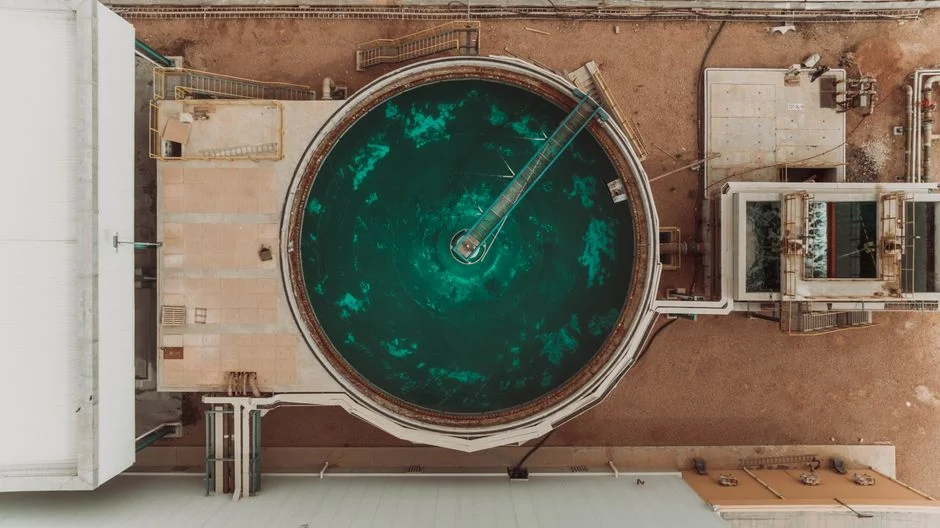
A clarifier wins when the stream is dominated by high-density inorganic settleables — metal hydroxides from pH-neutralization steps, gypsum or calcium carbonate precipitates, catalyst fines, and similar dense solids — and where FOG is a minor component. A mining case cited by Ecologix (2026) showed a clarifier reducing solids by 90% at lower cost than the DAF alternative would have delivered. The modern high-rate variant is the lamella-plate clarifier, where inclined plates raise the effective surface loading rate to 20–40 m³/m²·h and compress what would have been a 20-meter-diameter conventional basin into a 4-meter-square packaged unit. A representative product class is the high-efficiency lamella clarifier, which suits sites where the limiting permit parameter is TSS rather than oil and grease, and where OPEX discipline matters more than footprint. Two clarifier limitations to call out in the recommendation memo: poor FOG capture (typically well below 50%), and sensitivity to hydraulic surges unless an equalization tank upstream dampens peak-to-average ratios (Hahn, 2010). For more on retrofitting an existing clarifier rather than replacing it, the lamella clarifier retrofit guide walks through the engineering trade-offs.
The 2026 Default: DAF + Clarifier Hybrid for Complex Chemical Streams
For mixed chemical waste — high TDS plus FOG plus pH swings plus intermittent solvent traces — a single device rarely meets the full WQB-7 and 40 CFR Part envelope. The defensible 2026 default train is: equalization → coagulation/flocculation → DAF primary → clarifier or lamella polish → pH adjustment → discharge or RO reuse. The literature supports DAF as the primary separation step ahead of biological or polishing stages — the 2024 SSRN study on DAF plus a Modified Moving Bed Biofilm Reactor (MMBBR) for synthetic oily wastewater positioned DAF as the workhorse for oil and suspended-solids reduction before the biofilm stage (SSRN, 2024). Ecologix (2026) confirms that hybrid DAF plus clarifier trains are the standard answer for complex streams where neither device alone satisfies the permit envelope. The two practical exceptions: pure-FOG streams from a single-source washdown, and pure inorganic settleables from a neutralization reactor — in both cases a single device is more capital-efficient. The hybrid train is not free: the coagulation and flocculation step needs an automatic chemical dosing skid, and the upstream headworks needs a rotary bar screen to protect the DAF nozzles and lamella plates from rags and debris. As a point of reference for procurement, the same hybrid logic is now standard in adjacent sectors — see the petroleum and fabricated-metals comparisons in the DAF vs clarifier for petroleum wastewater and DAF vs clarifier for metals wastewater guides.
2026 Cost, Compliance, and Sizing Considerations for Billings
OPEX framing in 2026 should be written into the memo at the line-item level, not as a single number. DAF OPEX is dominated by saturator-compressor kilowatt-hours (a 5–10 kW compressor per 50 m³/h skid is typical), polymer and coagulant consumption, and float-handling — the float is wet, voluminous, and roughly 3–5% solids, which is a real downstream cost. Clarifier OPEX is dominated by sludge pumping and a smaller polymer dose, with energy mostly going to the scraper drive. On the regulatory side, a 2026 selection memo has to demonstrate compliance with three layers: Montana DEQ Circular WQB-7 numeric criteria and mixing-zone rules, the MPDES pretreatment limits in the site's discharge permit, and the applicable EPA Effluent Guidelines — 40 CFR Part 414 (organic chemicals), Part 415 (inorganic chemicals), Part 417 (soap and detergent), or Part 418 (fertilizer) depending on SIC code. Sizing has to follow the peak-to-average flow ratio: equalization tank volume sized to roughly 8–24 hours of average flow stabilizes both DAF and clarifier performance and protects the DAF saturator from hydraulic shock (Hahn, 2010). Permit-readiness tip: Ecologix (2026) recommends a bench- or pilot-scale wastewater analysis on the actual stream before committing CAPEX — this is the defensible practice and the line that holds up in an inspection.
Choosing in 30 Days: A 4-Step Decision Framework
The table below is the Monday-morning checklist. Run it in order; do not skip the pilot step.
| Step | Action | Decision Output |
|---|---|---|
| 1. Characterize the influent | Pull representative 24-hour composite samples; measure FOG, TSS, TDS, pH range, temperature, and peak vs average flow ratio | Quantitative influent profile against which to test the device |
| 2. Identify the limiting permit parameter | Map influent against WQB-7 and 40 CFR Part 414 / 415 / 417 / 418 limits; identify which parameter is closest to violation | The single constraint that drives device selection |
| 3. Match to device | FOG- or oil-limited → DAF primary; heavy-solids-limited → clarifier; mixed FOG + metals + TDS → hybrid DAF + clarifier train | Shortlist of one device or one train |
| 4. Pilot and size | Bench- or pilot-scale test on real wastewater; size the saturator, plate pack, or hybrid train to peak wet-weather flow with a 1.5× safety factor | Defensible CAPEX/OPEX basis and a memo that survives a DEQ review |
Frequently Asked Questions
For a Billings chemical plant, is a DAF or a clarifier the better primary clarifier in 2026?
It depends on the dominant contaminant. DAF removes 90–95% of emulsified oil and FOG (Hahn, 2010; Ecologix, 2026) and is the correct primary for surfactant- or solvent-bearing streams. A clarifier removes roughly 90% of heavy inorganic settleables at lower OPEX (Ecologix, 2026) and is the correct primary for metal-hydroxide or gypsum-laden streams. For mixed Billings waste, the 2026 default is a DAF primary with a clarifier or lamella polish.
What influent markers tell a process engineer to choose DAF over a clarifier?
FOG above ~200 mg/L, emulsified oils that resist gravity settling, surfactant-rich cleaning cycles, polymer residues from latex or coating operations, and trace solvents that co-float with the oil phase are the classic DAF markers. If the limiting permit parameter is oil and grease under 40 CFR Part 414 or 417, DAF is almost always the better answer.
What does a 2026 defensible selection memo need to include for Montana DEQ?
It needs to demonstrate compliance with Montana DEQ Circular WQB-7 numeric criteria and mixing-zone rules, the MPDES pretreatment limits in the discharge permit, and the applicable EPA Effluent Guidelines subcategory — typically 40 CFR Part 414 for organic chemicals, Part 415 for inorganic chemicals, Part 417 for soap and detergent, or Part 418 for fertilizer manufacturing. The standard practice is a bench- or pilot-scale wastewater analysis on the actual stream before committing CAPEX (Ecologix, 2026); a free wastewater analysis and pilot recommendation is the logical next step to scope the train and produce numbers the permit reviewer can audit.
Related Equipment
- Dissolved air flotation system — specifications, capacity range, and technical data
- high-efficiency lamella clarifier — specifications, capacity range, and technical data
- automatic chemical dosing skid — specifications, capacity range, and technical data