Why the 2026 Pretreatment Rule Set Changes the DAF vs Clarifier Question in Exeter
Industrial Organic Chemicals plants in Exeter, NH operating under NAICS 3251 are regulated by 40 CFR Part 433, which sets daily maximum limits of BOD 327 mg/L, TSS 60 mg/L, and O&G 38 mg/L for existing sources discharging to a POTW. These are not aspirational targets — they are the 2026 compliance floor enforced jointly by EPA Region 1 and the New Hampshire Department of Environmental Services under the Env-Ws 700 sewer-use series, because most Rockingham County sewer districts serve as the receiving POTW for Exeter's industrial corridor. The dual-jurisdiction reality is the first thing a plant engineer must internalize: a technology that meets the federal number but trips the local sewer-use ordinance (which often runs tighter on pH and sulfide) still triggers a notice of violation.
The 2026 update matters for a second reason. EPA's tightening of PFAS monitoring in NPDES permits and the renewed focus on emulsified O&G mean that a primary separator handling only free oil is no longer enough. If your 2024 audit showed marginal compliance, expect 2026 to demand a step-change in FOG and TSS reduction on the front end, before biological polishing. That pressure is why the choice between a 2026 pretreatment compliance guide for chemical plants path built around DAF versus one built around a lamella clarifier is no longer academic — it determines whether you pass your next self-monitoring report.
How DAF and Clarifiers Actually Work on Organic Chemicals Streams
A dissolved air flotation (DAF) system takes a pressurized recycle stream (typically 20–40% of the throughput) and saturates it with air at 4–6 bar in an air dissolution vessel. When the saturated recycle is released back into the main flow through a pressure-relief valve, the dissolved air comes out of solution as micro-bubbles in the 10–100 µm range. These bubbles attach to FOG droplets, oil-coated solids, and low-density monomers, lifting them to the surface where a mechanical skimmer removes the float layer (ClearStream, S4). The clarified underflow exits the bottom.
A lamella clarifier does the opposite: it relies on gravity sedimentation. Inclined plates at 55–60° shorten the effective settling path so that heavier particles — catalyst fines, polymeric debris, lime slurry carry-over — drop onto the plate surfaces and slide into a sludge hopper. Clarifiers develop a thickened sludge blanket rather than a float layer, and they need no air saturation, no recycle pump, and no bubble management (Ecologix, S3).
Why this matters on NAICS 3251 streams: organic chemicals waste frequently contains monomers, surfactants, and emulsified oils with specific gravity of 0.85–0.95 — very close to water. These particles do not settle on a Stokes-law timescale, which is why DAF outperforms gravity on FOG but underperforms on dense catalyst fines. Configuration also affects retrofit economics: circular DAF units are typically preferred for new builds under ~50 ft diameter and use a torque-tube drive, while rectangular DAF units ship fully shop-assembled and drop into existing concrete basins — the practical choice for most Exeter retrofits (ClearStream, S4). A dissolved air flotation system sized for 4–300 m³/h covers the throughput range typical of a single mid-sized resin or solvent line.
Side-by-Side: DAF vs Clarifier Performance on Exeter-Style Chemical Wastewater
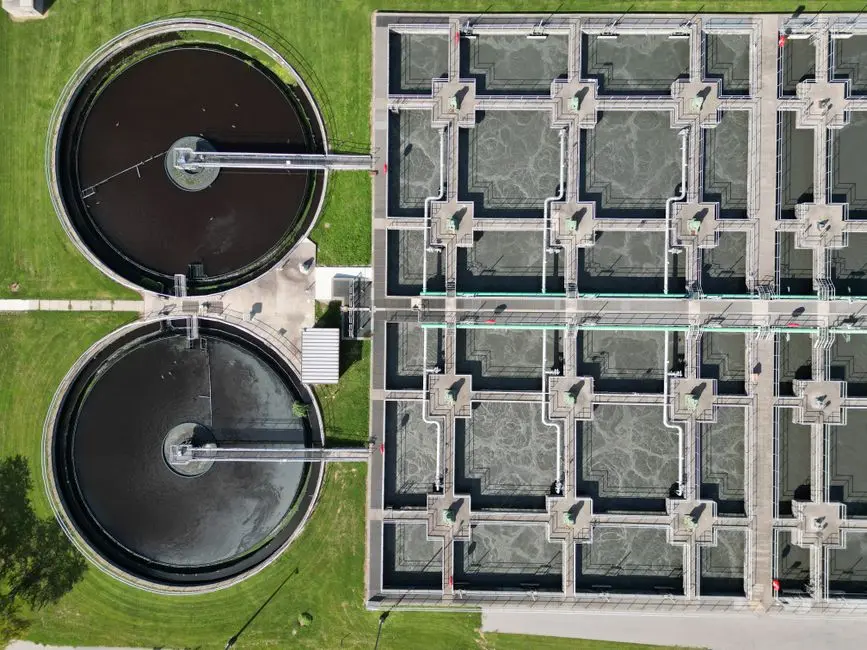
Before choosing, it helps to put the two technologies on the same page. The matrix below uses Ecologix's published case data (S3), ClearStream's DAF design context (S4), and 40 CFR 433 as the compliance benchmark.
| Parameter | Dissolved Air Flotation (DAF) | Lamella Clarifier |
|---|---|---|
| Mechanism | Micro-bubble flotation of low-density and emulsified particles | Gravity sedimentation on inclined plates |
| Best at removing | Free oils, emulsified FOG, oil-coated solids, low-SG monomers | Heavy inert solids, catalyst fines, polymeric debris, lime slurry |
| FOG / O&G removal | ~95% on emulsified oily streams (Ecologix case, S3) | ~70% on the same oily stream (Ecologix case, S3) |
| TSS reduction | 60–80% on oil-coated TSS; less effective on dense mineral TSS | ~90% on heavy-solids streams (Ecologix mining case, S3) |
| Typical hydraulic loading | 5–25 m³/m²·h (DAF design range) | 1–3 m³/m²·h equivalent for conventional clarifier; 20–40 m/h surface loading on a high-efficiency lamella clarifier (product spec) |
| Footprint | Compact, especially circular ≤50 ft | Larger basin unless lamella plates are used |
| CAPEX | Higher (air saturator, recycle pump, skimmer) | Lower (no air system) |
| OPEX | Higher (compressors, polymer, recycle pumping) | Lower (no air, less polymer) — Ecologix notes up to 30% chemical savings on lamella designs (S3) |
| Sensitivity to emulsified oil | Low — DAF's strength | High — emulsions barely settle |
| Sensitivity to heavy solids | High — dense solids can sink and re-suspend in the DAF tank | Low — clarifier's strength |
| 40 CFR 433 fit (TSS 60 / O&G 38 mg/L) | Comfortable margin on O&G; tightens with biological polish | Comfortable on TSS if influent is heavy solids; marginal on O&G |
The matrix shows why "DAF versus clarifier" is often the wrong framing for Exeter: the question is which stream characteristic is dominant, and whether a hybrid can capture both strengths.
Which Influent Profile Tips the Decision Toward DAF in 2026
DAF is the right primary unit when the influent carries compounds that physically cannot settle. The pattern-matches from NAICS 3251 process knowledge are clear: free oils and emulsified solvents from reactor wash-outs, resin and plasticizer carry-over from cleaning cycles, monomers with SG below 0.95, and surfactant-stabilized emulsions from intermediate synthesis. Each of these resists Stokes-law settling and will pass straight through a clarifier into the biological stage, where it can shock the biomass or push O&G over 38 mg/L.
Academic validation for sequencing DAF ahead of biological polishing on oily streams comes from the SSRN study on Combining Dissolved Air Flotation (DAF) and Modified Moving Bed Biofilm Reactors (MMBBR) for Synthetic Oily Wastewater Treatment (S1), which positions DAF as the primary oil-removal step and the MBBR as the polishing step. That sequencing — DAF first, biology second — is the same logic Exeter plants should apply in 2026.
Local process examples reinforce the case. Specialty resin manufacturing, paint and coatings intermediates, and pharmaceutical intermediate production around Rockingham County all generate streams that are DAF-friendly. DAF can also be installed ahead of an existing API separator to break emulsified FOG that an API unit alone cannot, which is one of the most common 2026 retrofit moves for older Exeter sites. Pairing DAF with an automatic chemical dosing system keeps coagulant and polymer feed stable across load swings — a real issue for batch resin operations.
When a Lamella Clarifier Is the Right Primary Unit in Exeter
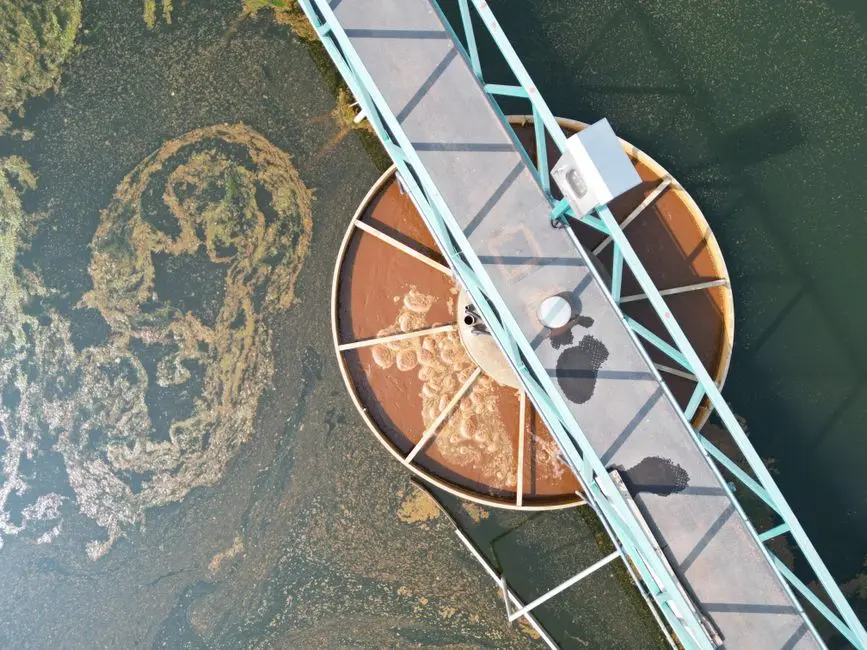
Clarifier-first is not the wrong answer — it is the right answer when the dominant load is heavy inert solids. Catalyst fines from hydrogenation reactors, polymeric debris from latex production, and lime slurry carry-over from neutralization all settle readily and reward a gravity-based unit with ~90% solids reduction at lower cost (Ecologix, S3). For these streams, a DAF would simply re-suspend the dense material in the float tank.
The high-efficiency lamella clarifier deserves a serious look for older Exeter sites with limited concrete bay space. Lamella designs pack the equivalent of a conventional clarifier's settling area into a fraction of the footprint by using inclined plates at 55–60°; product specifications cite surface loading rates of 20–40 m/h and chemical savings of up to 30% versus conventional clarifiers. Those numbers are vendor-supplied and should be validated against your jar test, but they set the right order of magnitude.
Two operational realities push Exeter operators toward clarifiers in specific cases. First, operator skill: a clarifier needs no air saturation, no recycle pump, no bubble management. For a small NAICS 3251 plant with thin EHS staffing, that is a real OPEX and reliability advantage — and the DAF and clarifier maintenance checklist shows the asymmetry clearly. Second, cold-weather robustness: New Hampshire winters push water viscosity up and change DAF bubble dynamics, while clarifier performance is comparatively insensitive. Both technologies still need freeze protection on exposed piping, but the DAF saturation vessel and recycle loop are the weak link in sub-freezing conditions.
The 2026 Hybrid Train Most Exeter Plants End Up Choosing
Most 2026 retrofits in Exeter will not be DAF or clarifier — they will be a hybrid train that captures the strengths of both. Ecologix explicitly notes that "hybrid systems can address complex wastewater streams, combining DAF's oil removal with clarifiers' sedimentation capabilities" (S3). The dominant 2026 configuration is: screening → DAF → equalization → biological (MBBR or activated sludge) → secondary clarifier → optional AOP polishing for chemical wastewater → ClO₂ disinfection for any reusable side-stream → plate-and-frame filter press for sludge dewatering.
| Unit | Function | Key Spec / Reference |
|---|---|---|
| Bar screen (GX series) | Remove rags, packaging, polymeric debris before primary separation | Rotary mechanical bar screen |
| DAF | Remove free and emulsified FOG, oil-coated TSS, low-SG monomers | DAF, 4–300 m³/h (product range) |
| Equalization basin | Buffer batch swings from resin / solvent campaigns | Typical HRT 8–24 h |
| Biological (MBBR / activated sludge) | Reduce soluble BOD below 327 mg/L; nitrification if required | SSRN DAF + MMBBR study (S1) |
| Lamella clarifier | Polish biological effluent; capture wasted sludge | High-efficiency sedimentation tank — 20–40 m/h surface loading (product spec) |
| ClO₂ generator | Disinfect any side-stream sent to reuse (cooling tower make-up, scrubber) | Chlorine dioxide generator |
| Plate-and-frame filter press | Dewater combined DAF float and clarifier sludge to >35% DS | Plate-frame filter press |
This train lets the DAF take the emulsified-oil load off the biology, lets the secondary lamella clarifier take the biological solids, and lets the filter press handle the combined sludge. It is the configuration that gets a NAICS 3251 plant to 60 mg/L TSS and 38 mg/L O&G with margin, which is what the 2026 EPA and NHDES posture actually demands.
Frequently Asked Questions
Is a DAF system or a clarifier better for hitting 40 CFR 433's 38 mg/L O&G limit?
DAF is the stronger primary unit for O&G because Ecologix case data shows DAF removes ~95% of oils and greases versus ~70% for a clarifier on the same emulsified stream (S3). For a NAICS 3251 plant chasing the 38 mg/L O&G ceiling under 40 CFR 433, DAF first is the safer sequencing choice.
When does a lamella clarifier make more sense than DAF for an Exeter chemical plant?
A lamella clarifier is the right primary unit when the dominant load is heavy inert solids — catalyst fines, polymeric debris, lime slurry carry-over — where gravity sedimentation achieves ~90% solids reduction at lower OPEX and no air-system maintenance. In NH winter conditions, clarifiers are also less sensitive to viscosity-driven bubble dynamics than DAF.
What flow range does the DAF cover, and is it enough for a typical Exeter retrofit?
The dissolved air flotation system covers 4–300 m³/h, which spans small specialty-intermediate lines up to mid-sized resin campaigns. Most single-process NAICS 3251 retrofits in Exeter fall inside that envelope; larger sites parallel units rather than oversizing one tank.
Do Exeter plants need both a DAF and a clarifier under 2026 EPA and NHDES expectations?
For most 2026 retrofits, yes — Ecologix confirms that hybrid DAF + clarifier trains address complex streams better than either unit alone (S3). The typical configuration is DAF upstream of a biological stage with a lamella clarifier downstream for solids polishing, which gets the plant to 60 mg/L TSS and 38 mg/L O&G with compliance margin under both 40 CFR 433 and the NHDES Env-Ws 700 sewer-use rules.