
Why Pharmaceutical Effluent in Morocco Demands a Dedicated Treatment Train
Morocco's industrial discharge framework — Loi 11-03 (2003) on water quality and Decree 2-14-499 (2014) fixing emission thresholds for liquid effluents — caps direct discharge at COD ≤ 500 mg/L, BOD₅ ≤ 100 mg/L, TSS ≤ 50 mg/L, pH 5.5–9.5, residual chlorine ≤ 1 mg/L for sensitive sectors, and total phosphorus ≤ 10 mg/L. A municipal ETP cannot meet these numbers on antibiotic- and solvent-laden API wastewater. Typical Moroccan pharmaceutical influent swings between COD 1,500–8,000 mg/L and BOD₅ 500–3,000 mg/L, with intermittent spikes of methanol, acetone, dichloromethane traces, and β-lactam/tetracycline residues from batch production at formulators clustered in the Casablanca (Aïn Sebaâ), Tanger, and Rabat industrial zones (academic biodegradability surveys note a COD/BOD₅ ratio often below 2, confirming a non-negligible refractory fraction). Temperature swings between 18 °C in winter and 38 °C in summer further destabilize conventional activated sludge. A four-stage train — equalization, primary clarification, MBR biological, and AOP/RO polishing — is the only configuration that clears Decree 2-14-499 while supporting water reuse under Morocco's 2026 water-stress agenda in the Souss-Massa and Tensift basins.
Influent Characterization: What the Designer Must Quantify First
Sizing a 2026 pharma ETP on textbook averages guarantees a non-compliant plant. The designer must run a structured characterization campaign before any equipment is selected. Build the influent envelope from total and soluble COD, BOD₅, TSS, VSS, pH, conductivity, total nitrogen, total phosphorus, sulfate, residual solvents (GC-MS), and a zone-of-inhibition assay for residual antibiotic activity. Sample on a 24-hour composite basis over at least 7 days, including one weekend, because Moroccan API and formulation facilities batch-discharge — CIP rinses, fermentation broth dregs, and tablet-coating wash water arrive in peaks that a 4-hour composite will smear. Run jar tests on the composite to fix coagulant and flocculant dose (typically PAC 100–250 mg/L plus anionic polyelectrolyte 1–5 mg/L) before locking the primary-stage footprint. Cross-check the COD/BOD₅ ratio: ratios below 2 confirm a refractory fraction that justifies budgeting an AOP or RO polishing step, not just biological treatment.
| Parameter | Method / Instrument | Sampling Frequency | Engineering Threshold of Concern |
|---|---|---|---|
| Total / Soluble COD | Dichromate, HACH DRB 200 or equivalent | 24-h composite, 7+ days | > 5,000 mg/L → toxic shock risk to biomass |
| BOD₅ | 5-day BOD, respirometric shortcut acceptable | 24-h composite, 3 days/week | COD/BOD₅ < 2 → refractory fraction present |
| TSS / VSS | Gravimetric, 103–105 °C / 550 °C | Daily grab | VSS/TSS > 0.7 → biological sludge yield will be high |
| pH, Conductivity | On-line probe in equalization basin | Continuous | pH outside 6.0–8.0 → neutralize before MBR |
| Residual solvents | GC-MS headspace on composite | Weekly | Methanol/acetone > 200 mg/L → strip in equalization |
| Antibiotic activity | Zone-of-inhibition (Bacillus subtilis ATCC 6633) | Weekly | Detectable inhibition → plan acclimatization + AOP |
| Total N / Total P | Persulfate digestion, spectrophotometric | Weekly | COD:N:P outside 100:5:1 → supplement nutrients |
Stage 1 — Equalization, pH Correction, and Primary Solids Removal
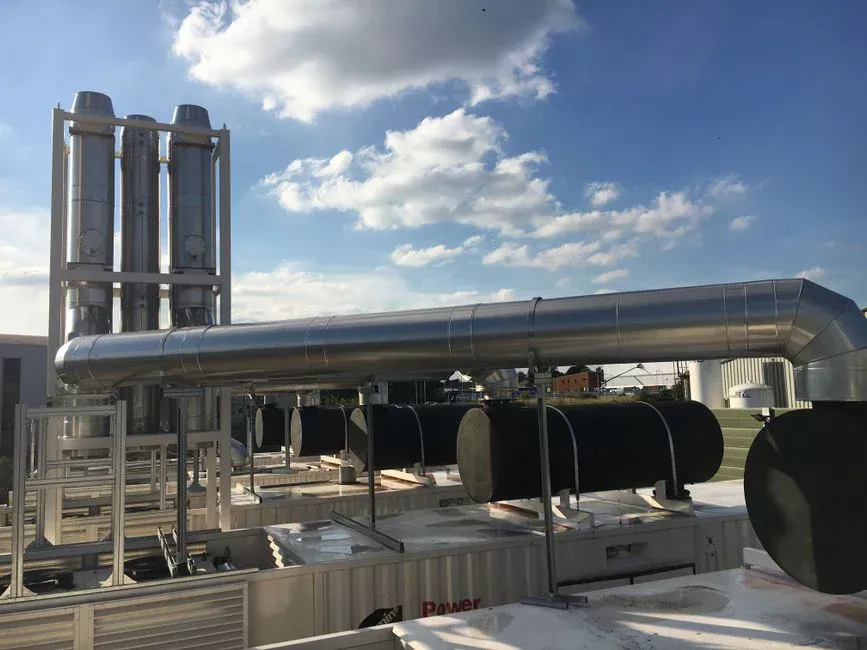
Stage 1 is where batch variability is killed. Pass raw effluent through a rotary mechanical bar screen (GX series) with 3–5 mm aperture at the headworks to protect downstream pumps from ragging, then route to an equalization basin sized at ≥ 8 hours HRT with mechanical mixers and diffused aeration to prevent anaerobic odor. Aeration also strips a fraction of volatile solvents (methanol, acetone) before they reach the membranes. pH correction to 6.5–7.5 is done inside the equalization basin via a PLC-controlled automatic chemical dosing skid dispensing NaOH or H₂SO₄ on a PID loop from the in-line pH probe. For primary solids and emulsified oil, choose between a dissolved air flotation unit and a high-efficiency lamella sedimentation tank. DAF wins when influent carries oils, solvents, or surfactants — micro-bubble flotation lifts emulsified fractions a lamella cannot settle. Lamella wins on footprint, simplicity, and lower energy when the influent is mostly settleable TSS.
| Criterion | DAF | Lamella Clarifier |
|---|---|---|
| Best influent profile | Oils, solvents, surfactants, colloids | Settleable TSS, low oil |
| Surface / hydraulic loading | 5–25 m³/m²·h (micro-bubble contact zone) | 20–40 m/h effective (lamella plate area) |
| Typical TSS removal | 70–90% | 60–80% |
| Footprint | Moderate | Compact (inclined plates) |
| Energy / chemical intensity | Higher (saturator + recycle pump + coagulant) | Lower |
| Sludge consistency | Float, 3–6% DS | Settled, 2–4% DS |
Stage 2 — Biological Treatment: MBR as the Workhorse for Pharma Effluent
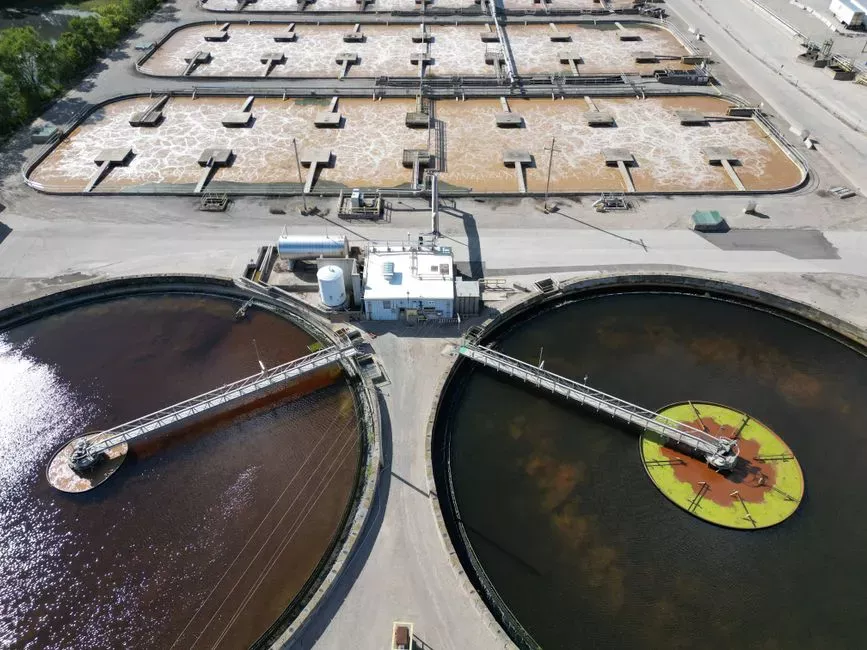
An integrated MBR system for pharmaceutical effluent outperforms conventional activated sludge on three metrics that matter for Decree 2-14-499 compliance: complete biomass retention on submerged PVDF flat-sheet MBR modules (0.1–0.4 μm pore), effluent TSS reliably under 5 mg/L, and a 60% smaller footprint than CAS at equivalent load. The flat-sheet geometry runs an integrated aeration scour — coarse-bubble diffusers beneath each cassette — that delivers 10–20× lower energy than external cross-flow tubular designs and tolerates the long sludge age (20–40 days) required to acclimate biomass to antibiotic residues. Published anaerobic pilots in Tanzania, India, and the Philippines (per the Sigma Journal review on pharmaceutical and medical-waste biodegradability) confirm that antibiotic-contaminated streams can be methanized with proper acclimatization, which supports a hybrid AnMBR or UASB+MBR train for high-COD API effluents where biogas recovery is attractive. Design the aerobic MBR at MLSS 8,000–12,000 mg/L, HRT 8–14 h, SRT 25–40 d, F/M 0.05–0.15 kg BOD/kg MLVSS·d, and DO 2–3 mg/L. Anticipate a slow acclimation phase (3–6 weeks) when biomass first contacts antibiotic-active feed.
| Parameter | Design Range | Operating Note |
|---|---|---|
| MLSS | 8,000–12,000 mg/L | Higher MLSS raises viscosity; watch for clogging |
| HRT (aerobic) | 8–14 h | Increase to 18 h if COD/BOD₅ < 2 |
| SRT | 25–40 d | Long SRT favors slow-growing nitrifiers and antibiotic-degrading consortia |
| F/M ratio | 0.05–0.15 kg BOD/kg MLVSS·d | Low F/M limits filamentous bulking |
| DO | 2–3 mg/L | Aeration scour uses 30–50% of plant OPEX |
| Membrane pore | 0.1–0.4 μm (PVDF flat-sheet) | Permeate TSS typically < 5 mg/L |
| Membrane flux | 15–25 L/m²·h | Run relaxation cycles every 8–10 min |
| PVDF replacement | Every 5–8 years | Clean-in-place every 6–12 months |
Stage 3 — Polishing and Water Reuse: AOP, Disinfection, and RO
MBR permeate clears most Decree 2-14-499 thresholds, but refractory APIs, residual antibiotic activity, and antibiotic-resistant gene (ARG) fragments still pass. Carbon-electrode advanced oxidation — covered in the CRC Press chapter on carbon electrodes for pharmaceutical wastewater treatment — generates hydroxyl radicals at the anode surface and is the most accessible polishing step for Moroccan plants because it operates at ambient temperature and pressure. The polished stream then moves to disinfection: a chlorine dioxide generator for final disinfection (50 g/h to 20,000 g/h) delivers biocidal action across EPA/EU/WHO frameworks without forming trihalomethanes at the same rate as chlorine, which is critical for any discharge routed to a sensitive receptor or to a cooling-tower reuse loop. For facilities targeting the highest reuse ratio under Morocco's 2026 water-stress plan, an industrial RO polishing train for water reuse at 70–95% recovery returns a near-demineralized stream to boilers, CIP, or cooling-tower make-up. Final compliance is verified with 24-hour composite sampling for COD, BOD, TSS, residual chlorine, conductivity, and ecotoxicity where the receiving environment includes agricultural or marine-coastal receptors in the Souss-Massa or Tensift basins.
Sludge Handling and Site-Wide Utilities
A well-designed water train produces 0.3–0.5 kg DS of waste activated sludge per kg COD removed — a 30–40% solids mass the design must budget for. Route waste sludge to a plate-and-frame filter press for pharma sludge dewatering with filtration area 1–500 m² and manual to PLC-automatic control. Condition with polyacrylamide at 4–8 kg/t DS to reach cake dry solids of 22–28%, then dispose under Moroccan hazardous-waste rules. Site-wide utilities deserve a full P&ID line: blowers sized for 1.2–1.5× the average MBR air demand, redundant chemical skids for coagulant/flocculant/pH adjustment, and a SCADA layer with trending on pH, DO, MLSS, and transmembrane pressure. Packaged MBR containerized systems (a configuration offered under the DF-series program) cut civil work and shrink the commissioning window, which is decisive for fast-track 2026 builds in the Casablanca industrial zone.
CAPEX/OPEX Framing and the 2026 Selection Matrix
CAPEX scales with flow band: small formulators < 50 m³/day, mid-tier plants 50–500 m³/day, large API producers > 500 m³/day. The cost-modeling methodology — civil works, electromechanical, membranes, instrumentation, commissioning — is laid out in the Wastewater Treatment Plant Cost in Mozambique 2026 reference, which uses the same Africa industrial-EPC template applicable to Moroccan builds; do not transplant the absolute numbers, only the structure. OPEX is dominated by aeration energy at 40–50% of total, followed by membrane replacement (PVDF flat-sheet every 5–8 years), chemical dosing, and sludge disposal. The 2026 design drivers — water recovery, circularity, utility optimization, and facility electrification — are aligned with the framing used in MECO's pharmaceutical-water webinar (July 2026), confirming that reuse-ready MBR + RO is now the default specification, not a premium option.
| If the influent is… | Primary choice | Biological choice | Polishing | Driver |
|---|---|---|---|---|
| High oil/solvent, variable pH | DAF + equalization | MBR (PVDF flat-sheet) | AOP + ClO₂ | Emulsion and batch variability |
| Mostly settleable TSS, low oil | Lamella clarifier | MBR | ClO₂ | Footprint, simplicity |
| Discharge to sensitive receptor or cooling-tower reuse | DAF or Lamella | MBR | RO at 70–80% recovery | Reuse economics + Loi 11-03 tightest limits |
| High-COD API with biogas potential | DAF + equalization | UASB + MBR (hybrid) | AOP + RO | Energy recovery from COD > 5,000 mg/L |
Frequently Asked Questions
What are the discharge limits for pharmaceutical effluent under Moroccan law?
Decree 2-14-499 caps direct discharge at COD ≤ 500 mg/L, BOD₅ ≤ 100 mg/L, TSS ≤ 50 mg/L, pH 5.5–9.5, residual chlorine ≤ 1 mg/L for sensitive sectors, and total phosphorus ≤ 10 mg/L. Surface discharge into a sensitive receptor (coastal or reused for irrigation) tightens these thresholds further.
Why is MBR preferred over conventional activated sludge for pharmaceutical wastewater?
An MBR with PVDF flat-sheet membranes retains all biomass on a 0.1–0.4 μm pore, sustains sludge ages of 25–40 days, and produces effluent TSS below 5 mg/L — enough to skip a secondary clarifier and feed directly to RO. Footprint is roughly 60% smaller than CAS at equivalent organic load.
How is antibiotic-resistant gene (ARG) reduction addressed in a pharmaceutical ETP?
Biological treatment alone is partial. Carbon-electrode advanced oxidation in the polishing step generates hydroxyl radicals that damage ARG fragments in the permeate, and final disinfection with chlorine dioxide (ClO₂) provides a residual barrier before reuse or discharge.
Can pharmaceutical sludge be disposed of locally in Morocco?
Dewatered cake at 22–28% DS from a plate-and-frame press is classified under Moroccan hazardous-waste rules when it carries antibiotic residues or solvent traces. Disposal must follow the tracking manifests issued by the competent authority; thermal destruction or secured landfill are the typical end routes.
Is water reuse worth the RO investment for a Moroccan pharma plant in 2026?
For plants above 100 m³/day facing Article 6 of Loi 11-03 reuse obligations or operating in the Souss-Massa and Tensift basins, RO at 70–95% recovery typically pays back inside 3–5 years through avoided potable-water and discharge fees, and it converts Loi 11-03 compliance from a cost into a utility-saving asset.