Why Kigali Has No Off-the-Shelf Semiconductor or Data-Hall Standard in 2026
Rwanda's 2026 effluent framework is industrial-generic, not semiconductor-specific. The binding reference is Ministerial Order No. 002/2023, with tightened 2024–2026 guidance issued under RDMA (Rwanda Development Management Authority) and RSB (Rwanda Standards Board); the 12-parameter REMA table is what a REMA inspector will measure a Kigali site against, because there is no fab- or data-hall-specific clause to point to (per Rwanda Ministerial Order on effluent standards, 2024 in-force parameters).
The parameters that drive most of the engineering work are: BOD ≤50 mg/L, COD ≤100 mg/L, TSS ≤50 mg/L, oil and grease ≤10 mg/L, pH 6–9, fecal coliform ≤100 CFU/100 mL, total nitrogen 20 mg/L, and total phosphorus 5 mg/L. Rwanda is also tightening toward EU BAT-AEL ranges by 2030, so a 2026 design needs 20–30% headroom under the current limits to avoid a near-term retrofit. Kigali itself has no centralized public sewer: only about 2% of households empty pit-latrine sludge, and hotels, hospitals, and large commercial buildings are mandatorily required to install private semicentralized sewerage systems (SCSSs) for treatment before discharge to the environment (per MDPI assessment of Kigali SCSS sustainability, 2018, based on EICV4). Any 2026 fab or hyperscale data-hall permit is therefore a private SCSS consent against the REMA table plus international benchmarks — WHO 2017 reuse guidelines and the EPA industrial framework — not a Kigali fab-specific limit. For the canonical KIP-scale numbers and the REMA-cited analytical methods, the 2026 Kigali industrial wastewater engineering guide is the companion reference.
| Parameter | REMA 2024–2026 limit | Analytical method | Engineering implication |
|---|---|---|---|
| BOD | ≤50 mg/L | APHA 5210 B | Forces a real biological stage (A/O or MBR), not a primary clarifier |
| COD | ≤100 mg/L | APHA 5220 B | Rules out simple aerobic lagoons for fab/dhall mixed streams |
| TSS | ≤50 mg/L | APHA 2540 D | Forces DAF or lamella pre-treatment ahead of MBR |
| Oil & grease | ≤10 mg/L | APHA 5520 B | Forces FOG removal (DAF or skimming) on IPA-bearing streams |
| pH | 6–9 | APHA 4500-H⁺ B | Forces neutralization on every batch stream before biology |
| Fecal coliform | ≤100 CFU/100 mL | APHA 9222 D | Forces dedicated disinfection — ClO₂ preferred over NaOCl in Kigali ambient |
| Total nitrogen | ≤20 mg/L | APHA 4500-N | Forces nitrification/denitrification cycle, not just carbon removal |
| Total phosphorus | ≤5 mg/L | APHA 4500-P | Forces chemical precipitation or enhanced biological P removal |
| Conductivity | Site-specific, RSB guidance | APHA 2510 B | Forces RO on cooling-tower blowdown before any reuse |
| Temperature | ≤35 °C at discharge | APHA 2550 B | Forces cooling retention before discharge to environment |
| Sulfate | Site-specific, typically ≤500 mg/L | APHA 4500-SO₄²⁻ E | Forces lime precipitation on SC1/SC2 rinses |
| Fluoride | Site-specific; international benchmark ≤15 mg/L | APHA 4500-F⁻ C | Forces Ca²⁺ precipitation step on acid rinses |
The Four Process Streams a Kigali Site Actually Generates
Stream segregation is the single most cost-determining decision on a 2026 Kigali site plan. Co-mingling any of the four streams below with sanitary or fire-test water is the fastest way to fail a REMA inspection, because organic load and trace metals behave very differently in biological treatment and the consent limit envelope collapses.
Stream 1 — Acid/alkali and SC1/SC2 rinses. Wafer-cleaning chemistry (NH₄OH/H₂O₂/H₂O "SC1", HCl/H₂O₂/H₂O "SC2") drives pH swings from 1 to 13, carries fluoride at 10–100 mg/L, sulfate up to 1,500 mg/L, and trace IPA residues. This is batch waste and must go to a dedicated, lined, vented equalization tank with NaOH or H₂SO₄ trim on a PLC-controlled chemical dosing skid (per the Gaborone semiconductor and data-hall 2026 engineering guide, which is the closest stream-by-stream analogue available for a SADC site).
Stream 2 — CMP slurry waste. TSS at 200–1,000 mg/L, silica or ceria nanoparticles, and a residual H₂O₂ oxidiser. The peroxide reacts violently with low-pH streams and has caused documented H₂ release at Asian fabs during batch transfers; it must never share an equalization tank with Stream 1. A DAF unit sized in the 4–300 m³/h range, with cationic polyacrylamide at 2–10 mg/L, is the standard pre-treatment (HydropureWater field data, 2026).
Stream 3 — Closed-loop fill-and-flush water from data-hall commissioning. A one-time 50–500 m³ surge, not continuous wastewater. It carries corrosion inhibitors, biocides, low TDS, and unusual microbes. Treat it through neutralization plus carbon adsorption, characterize before any discharge decision, and reuse on site wherever possible to avoid the SCSS consent path entirely (per E&E News reporting on the 2024–2025 Cheyenne fill-and-flush incident).
Stream 4 — Cooling-tower blowdown. Continuous 5–50 m³/day, TDS concentrated 3–6× over Kigali supply, silica 50–150 mg/L, scale-inhibitor and biocide residues. This is the prime RO reuse candidate and the stream that pays back the membrane CAPEX. Sanitary and fire-water-test discharges go to a separate, simpler train — typically a buried WSZ package plant — so they never enter the process consent.
| Stream | Source | Key parameters | Flow pattern | Pre-treatment |
|---|---|---|---|---|
| 1 — Acid/alkali & SC1/SC2 | Wafer cleaning | pH 1–13, F⁻ 10–100 mg/L, SO₄²⁻ up to 1,500 mg/L, IPA | Batch | Neutralization, lime precipitation, equalization 8–24 h |
| 2 — CMP slurry | Polishing | TSS 200–1,000 mg/L, SiO₂/CeO₂ nanoparticles, H₂O₂ residual | Batch | DAF with cationic polyacrylamide 2–10 mg/L |
| 3 — Fill-and-flush | Data-hall commissioning | One-time 50–500 m³, corrosion inhibitors, biocides | One-time surge | Neutralization, carbon adsorption, characterization |
| 4 — Cooling-tower blowdown | HVAC loop | TDS 3–6× supply, SiO₂ 50–150 mg/L, scale inhibitors | Continuous 5–50 m³/day | Scale-inhibitor break, ClO₂ shock, multi-media filter, RO |
| Sanitary/fire-test | Staff, fire system | BOD 200–400 mg/L, TSS 200 mg/L, no metals | Continuous diurnal | Buried WSZ package plant (off the process consent) |
Matching Stream Chemistry to the REMA Parameter Table
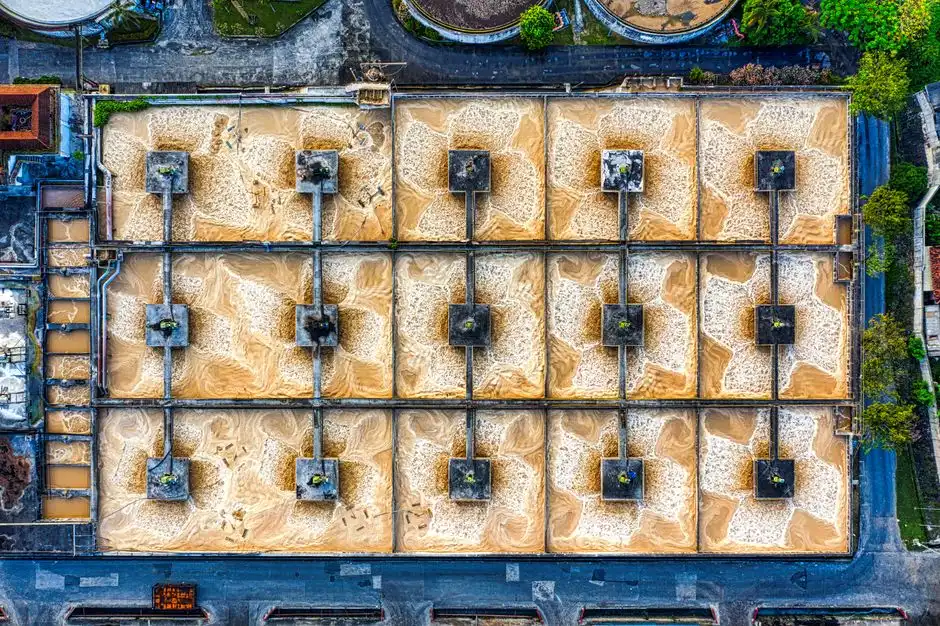
Each of the four streams breaks the REMA envelope on its own, which is exactly why segregation is non-negotiable. Stream 1 arrives at pH 1–13 with fluoride 10–100 mg/L and sulfate up to 1,500 mg/L — it would violate the pH 6–9 ceiling on the first dump, and the sulfate load alone rules out any biological stage without a lime-precipitation pre-step. Stream 2 arrives at TSS 200–1,000 mg/L against a 50 mg/L ceiling; a DAF step with cationic polyacrylamide at 2–10 mg/L lifts TSS to below 30 mg/L and clears residual FOG from polishing compounds (HydropureWater field data, 2026). Stream 4 arrives with TDS concentrated 3–6× over Kigali supply and silica at 50–150 mg/L — it needs a scale-inhibitor break and chlorine dioxide shock dosing to neutralize residual biocide before the biological stage can accept it without foaming or membrane fouling. The 2026 reference baseline matters: existing Kigali SCSSs achieve only about 45% average raw-to-effluent reduction across the surveyed plants (per MDPI assessment of Kigali SCSS sustainability, 2018). A purpose-built fab or data-hall train must outperform the installed base by a wide margin — segment the streams first, then design to the tightest parameter in each.
The 2026 Default Process Train: Segregation → DAF → MBR → RO
The defensible 2026 reference design for a Kigali back-end fab or hyperscale data hall is a five-stage train that can be lifted directly into a P&ID or tender. The first physical decision on a site plan is the layout of lined, vented holding tanks — one per stream, sized for 8–24 h residence to dampen the pH and flow swings that arrive whenever a fab dumps a batch. Co-mingling CMP slurry with acid/alkali waste is the classic failure mode: peroxide residual reacts violently with low-pH streams and releases H₂, and the residence time required to stabilize a 10 m³/h acid dump overwhelms any equalization volume that fits inside a 40-foot containerized skid. pH correction on Stream 1 uses NaOH or H₂SO₄ dosed through a PLC-controlled chemical dosing skid; Stream 2 is handled by a dissolved air flotation system sized 4–300 m³/h, with cationic polyacrylamide at 2–10 mg/L lifting TSS to below 30 mg/L (HydropureWater field data, 2026). A HydropureWater lamella clarifier running at 20–40 m/h surface loading rates, with 30% chemical savings versus conventional clarifiers, is a cheaper pre-biology guard when slurry volumes are low. Stream 4 needs a scale-inhibitor break and chlorine dioxide shock dosing to neutralize residual biocide before it reaches biology.
The core biological step is a submerged PVDF MBR membrane bioreactor operating at 6–10 h HRT, 8,000–12,000 mg/L MLSS, and 0.1–0.4 μm pore size. The submerged format tolerates the higher MLSS that IPA-induced foaming demands and produces a near-particle-free effluent — exactly what the downstream RO needs. The MBR permeate then passes through a multi-media filter to SDI ≤3; without that step, RO membranes foul within 4–6 weeks at Kigali feed-water quality. The industrial RO system runs at 70–90% recovery on cooling-tower blowdown (conservative 60–70% on the mixed stream), with permeate conductivity below 50 μS/cm, suitable for cooling-tower make-up and scrubber feed. Disinfection uses a chlorine dioxide generator (50–20,000 g/h) rather than sodium hypochlorite — hypochlorite loses 25–30% of its available chlorine in 25–30 °C Kigali ambient storage, while ClO₂ remains effective across the 6–9 pH range with no trihalomethane formation. Containerized delivery is the strongest cost lever at every scale, because it reduces site installation cost in a market where specialized construction labor is thin. For comparison with the closest regional analogue, the Gaborone semiconductor and data-hall 2026 engineering guide carries the same MBR+RO sizing envelope for SADC conditions.
| Stage | Equipment | Operating envelope | Footprint / note |
|---|---|---|---|
| Equalization | Lined, vented HDPE/PP tanks, 1 per stream | 8–24 h residence | Buffer batch swings; never co-mingle Stream 1 + Stream 2 |
| Pre-biology | Lamella clarifier or DAF | 20–40 m/h surface loading (lamella); 4–300 m³/h (DAF) | ~⅕ footprint of conventional clarifier; up to 30% chemical savings |
| Biological | Submerged PVDF MBR | 6–10 h HRT; 8,000–12,000 mg/L MLSS; 0.1–0.4 μm pore | 60% smaller than CAS; tolerates IPA foaming at higher MLSS than municipal designs |
| Polishing | Multi-media filter (sand + anthracite + garnet) | SDI ≤3 at outlet | Without this, RO fouls in 4–6 weeks at Kigali feed quality |
| Reuse | Industrial RO | 70–90% recovery on blowdown; 60–70% on mixed stream; permeate <50 μS/cm | Permeate suitable for cooling-tower make-up and scrubber feed |
| Disinfection | On-site ClO₂ generator | 50–20,000 g/h; 6–9 pH range; no THM formation | Replaces NaOCl which loses 25–30% available Cl₂ in Kigali ambient |
Three Consent Pathways and When to Pick Each

Three compliance pathways are realistic in 2026. The choice depends on site size, ESG commitments, and the speed of the REMA review process. Path A — Private SCSS discharge to environment under REMA permit. Lowest CAPEX, 6–10 week REMA review, REMA-anchored effluent limits; this is the mandatory route for large commercial buildings in Kigali because there is no centralized public sewer. Path B — On-site reuse for cooling-tower make-up, scrubbers, and irrigation. Cuts raw-water draw 60–80% and offsets 3–5 years of MBR+RO CAPEX through reduced water purchase; defensible against WHO 2017 reuse guidelines once RO permeate meets the 50 μS/cm envelope. Path C — Zero liquid discharge (ZLD) via brine concentrator and crystallizer. Justified only above ~500 m³/day combined flow or where the consent pathway is closed; CAPEX is 2–3× that of Path B (HydropureWater field data, 2026). The recommended 2026 default for a Kigali data hall with light process waste is Path A for sanitary plus Path B for cooling-tower blowdown. For a semiconductor back-end line, add Path C as a phased option once brine volumes are measured over the first 12 months of operation, rather than committing to ZLD on day one. Compared with the Dhaka semiconductor and data-hall compliance guide, the Kigali consent stack is shorter because the REMA table is industrial-generic rather than sector-specific, but the absence of a municipal outfall forces the private SCSS obligation on every project.
| Path | Consent mechanism | Typical CAPEX multiplier | Best fit | REMA review |
|---|---|---|---|---|
| A — Private SCSS to environment | REMA discharge permit against 12-parameter table | 1.0× (baseline) | Data hall sanitary; light process waste; mandatory for large commercial buildings in Kigali | 6–10 weeks |
| B — On-site reuse (cooling, scrubber, irrigation) | REMA permit + internal reuse specification | 1.3–1.6× (adds RO + reuse loop) | Cooling-tower blowdown; data halls with HVAC-dominant water draw; 60–80% raw-water offset | 6–10 weeks; reuse spec appended |
| C — ZLD (brine concentrator + crystallizer) | REMA permit with zero-liquid-discharge undertaking | 2.0–3.0× (adds thermal equipment) | Fab-scale flows above ~500 m³/day; closed consent pathway; ESG-driven sites | 8–14 weeks; phased in after 12-month brine baseline |
Kigali 2026 CAPEX, OPEX, and the 6-Step Procurement Path
Procurement needs a directional envelope, not a fabricated line item. The anchor is KIP package-plant economics: a 200 m³/day containerized MBR at US$260–US$360 per m³/day (roughly US$52,000–US$72,000 total) for industrial flows, with OPEX of US$0.22–US$0.32 per m³ (per the 2026 Kigali industrial wastewater engineering guide). Scale to fab/data-hall flows using the SADC bands: a 20 m³/h packaged data-hall train (segregation + DAF + MBR + RO) sits at US$450,000–US$900,000, with the spread driven by automation level and target reuse ratio; a 5 m³/h fab segregation + neutralization + DAF skid sits at US$180,000–US$400,000, with MBR and RO sized separately to the reuse target. OPEX drivers: chemical dosing at US$0.10–US$0.30 per m³, MBR+RO power at US$0.08–US$0.15 per m³, PVDF membrane replacement every 5–7 years (HydropureWater field data, 2026). Containerized systems save 30–40% on civil works versus in-ground construction in Kigali because lateritic KIP soils are expensive to excavate and slow to stabilize. Sanitary and staff waste is handled by a buried WSZ package sewage treatment plant so it never enters the process consent; sludge dewatering at the 50–500 kg DS/day scale typical of KIP tenants is best served by a plate and frame filter press with 1–500 m² filtration area, reaching 60–70% DS cake dryness for off-site composting or co-landfill disposal under REMA solid-waste rules. The 2026 logistics baseline is 35–45 days Chinese ex-works fabrication, 30 days sea freight to Dar es Salaam or Mombasa, and 14–21 days inland transit to Kigali by bonded truck — plan for 60–75 days total from purchase order to site delivery.
- Run a 7-day composite influent characterization per stream (pH, F⁻, TSS, TDS, COD, BOD, O&G, TN, TP) and align with the REMA 12-parameter table.
- Select consent pathway (A, B, or C) and lock the REMA permit timeline (6–10 weeks for A and B; 8–14 weeks for C).
- Issue an EPC tender with stream-by-stream equipment sizing, target reuse ratio, and the 2026 Kigali logistics baseline inside the INCOTERMS clause.
- Evaluate bids on Chinese ex-works price + CIF Mombasa or Dar es Salaam + inland bonded truck to KIP, with explicit reference to the 14–21 day inland leg.
- Pre-commission the containerized MBR and RO skids at the factory; FAT must include a 48-h clean-water performance run against the SDI ≤3 and permeate <50 μS/cm targets.
- Commission on site, train the operator, and run a 30-day performance test against the REMA parameters before the consent is signed over to the factory.
| Scale | Equipment scope | CAPEX band (US$, 2026) | OPEX band (US$/m³) | Lead time |
|---|---|---|---|---|
| 200 m³/day industrial baseline | Containerized MBR, no RO | $52,000–$72,000 ($260–$360 per m³/day) | 0.22–0.32 | 60–75 days PO to site |
| 5 m³/h fab segregation + neutralization + DAF | Front-end skid only; MBR/RO separate | $180,000–$400,000 | 0.18–0.28 (front-end) | 60–75 days PO to site |
| 20 m³/h packaged data-hall train (segregation + DAF + MBR + RO) | Full reuse-capable train | $450,000–$900,000 | 0.10–0.30 chemical + 0.08–0.15 power | 75–90 days PO to site |
| ZLD upgrade (Path C) | Brine concentrator + crystallizer | 2.0–3.0× of Path B | Thermal step dominates; site-specific | Phased after 12-month brine baseline |
| Sanitary/staff waste (off-consent) | Buried WSZ package plant, 1–80 m³/h | Sized to population equivalent | Low; A/O contact oxidation, fully automated | 30–45 days PO to site |
| Sludge dewatering (50–500 kg DS/day) | Plate and frame filter press, 1–500 m² | Site-specific | 60–70% DS cake, off-site disposal | 30–45 days PO to site |
Frequently Asked Questions
What are the binding Rwanda REMA effluent limits for a semiconductor or data-hall site in 2026?
BOD ≤50 mg/L, COD ≤100 mg/L, TSS ≤50 mg/L, O&G ≤10 mg/L, pH 6–9, fecal coliform ≤100 CFU/100 mL, TN 20 mg/L, TP 5 mg/L, per Ministerial Order No. 002/2023 in force from 2024; there is no semiconductor- or data-hall-specific clause, so designs must hit this industrial-generic table (per Rwanda Ministerial Order on effluent standards, 2024 in-force parameters).
What MBR sizing is defensible for a 5–20 m³/h Kigali data-hall or fab-segregation train?
A submerged PVDF MBR at 6–10 h HRT and 8,000–12,000 mg/L MLSS delivers sub-micron permeate at 60% smaller footprint than conventional activated sludge; flux typically 10–18 LMH at 0.1–0.4 μm pore size, with PVDF module life 5–7 years (HydropureWater field data, 2026).
What reuse recovery is realistic on cooling-tower blowdown in Kigali?
70–90% recovery through industrial RO, with permeate conductivity below 50 μS/cm suitable for cooling-tower make-up and scrubber feed; on the mixed fab stream, design conservatively to 60–70% recovery to protect membrane life (HydropureWater field data, 2026).
Which consent pathway should a 2026 Kigali data hall choose?
Path A (private SCSS to environment under REMA permit) for sanitary and light process waste, plus Path B (on-site reuse for cooling-tower blowdown) for the HVAC-dominant water stream; together they cut raw-water draw 60–80% and avoid the 2–3× CAPEX of a ZLD upgrade until brine volumes are measured over 12 months (HydropureWater field data, 2026).
How should the one-time data-hall fill-and-flush water be handled?
Treat it as a 50–500 m³ commissioning surge, not continuous wastewater; characterize for corrosion inhibitors, biocides, and unusual microbes, route through neutralization plus carbon adsorption, and reuse on site wherever possible to keep the volume off the REMA consent path entirely (per E&E News reporting on the 2024–2025 Cheyenne fill-and-flush incident).