Why Gaborone's 2026 Build-Out Changes the Wastewater Conversation
Digital Delta Data Centre, a double-storey facility with a dedicated white-space core, is rising inside the Botswana Innovation Hub Science and Technology Park in Gaborone in 2026, designed by Gabana Architects under the Ministry of Transport & Infrastructure (Ministry of Transport and Infrastructure - Botswana, 2026-04). The Ministry frames the building as a "key infrastructure asset supporting the country's telco ecosystem and digital economy," but it is not the only wastewater-generating tenant arriving. Composite 2026 planning scenarios for Gaborone also include a back-end semiconductor packaging or MEMS line co-sited at the Gaborone Industrial sites, which produces a fundamentally different effluent profile than a data hall.
The core engineering problem is that Botswana currently has no semiconductor-specific effluent regulation in 2026. There are no published Gaborone limits for fluoride, total dissolved silica, or per-oxide residuals from chemical-mechanical planarisation (CMP). Any 2026 design therefore has to be defensible against Water Utilities Corporation (WUC) Trade Effluent Consent terms, borrowed from general industrial categories, plus international benchmarks such as WHO guidelines for water reuse (2017) and the U.S. EPA industrial effluent framework where relevant.
Layered on top is Botswana's water-stress backdrop. Gaborone depends on Gaborone Dam and the North-South Water Carrier, both exposed to seasonal drawdown. That is why the 2026 design target is not just compliance but 70–90% on-site reuse, a figure that drops raw-water demand enough to shorten the payback on membrane capital expenditure to roughly three to five years in most packaged trains.
The Four Wastewater Streams You Will Actually Have to Treat
Stream segregation is the single most cost-determining decision in a Gaborone treatment train. The four streams below cover both a semiconductor back-end line and a hyperscale data hall, with a clean separation between batch chemistry wastes and continuous cooling wastes.
| Stream | Source | Typical flow (Gaborone 2026) | Key chemistry / parameters | Discharge mode |
|---|---|---|---|---|
| 1. Acid/alkali & SC1/SC2 rinses | Semiconductor wafer cleaning (NH₄OH/H₂O₂/H₂O "SC1", HCl/H₂O₂/H₂O "SC2") | 2–10 m³/h, intermittent | pH 1–13 swings, fluoride 10–100 mg/L, sulfate up to 1,500 mg/L, IPA residues | Batch, into dedicated equalisation |
| 2. CMP slurry wastewater | Semiconductor polishing steps | 1–5 m³/day, batch | TSS 200–1,000 mg/L, silica or ceria nanoparticles, residual H₂O₂ oxidiser | Batch, segregated holding |
| 3. Closed-loop fill-and-flush water | Data hall commissioning (one-time per hall) | 50–500 m³ per hall surge | Corrosion inhibitors, biocides, low TDS, possible unusual microbes | One-time, requires pre-discharge characterisation |
| 4. Cooling-tower blowdown | Both data hall and fab support cooling | 5–50 m³/day, continuous | TDS concentrated 3–6× over Gaborone supply, silica 50–150 mg/L, scale inhibitors, biocide residues | Continuous, candidate for RO reuse |
Sanitary wastewater and the occasional fire-water-test discharge are kept on a separate, much simpler train. Co-mingling them with the four process streams is the fastest way to lose a WUC consent, because organic load and trace metals behave very differently in biological treatment.
Segregation, Equalisation, and Pre-Treatment: Where Most 2026 Designs Win or Fail
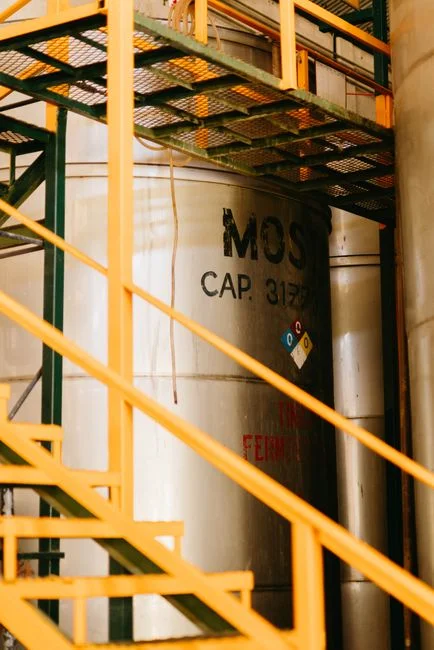
The first physical decision on a Gaborone site plan is the layout of lined, vented holding tanks. Every stream in the table above needs its own tank; never co-mingle CMP slurry with acid/alkali waste. The peroxide residual carried over from slurry polishing reacts violently with low-pH streams and releases H₂, which has caused documented explosions at Asian fabs during batch transfers.
Equalisation tanks are sized for 8–24 hours of residence to dampen the pH and flow swings that arrive whenever a fab dumps a batch. pH correction on Stream 1 is done with sodium hydroxide or sulfuric acid, both available through Gaborone chemical distributors, and dosed through PLC-controlled automatic chemical dosing skids. Stream 2 (CMP slurry) is the most demanding pre-treatment step: a DAF system sized in the 4–300 m³/h range, depending on fab throughput, lifts TSS to below 30 mg/L and captures the residual FOG from polishing compounds. Cationic polyacrylamide flocculant dosing of 2–10 mg/L is typical (HydropureWater field data, 2026). Stream 4 (cooling-tower blowdown) typically needs a scale-inhibitor break step and chlorine dioxide shock dosing to neutralise residual biocide before the stream enters the biological stage.
The classic 2026 design failure in this region is sending all four streams into a single neutralisation tank, then trying to tune the chemistry downstream. It almost never works, because the residence time required to stabilise a 10 m³/h acid dump overwhelms any equalisation volume that fits inside a typical 40-foot containerised skid.
Biological, Membrane, and Reuse Train: From MBR to RO
Once the streams are equalised and pre-treated, they are combined in a single biological-membrane stage. The parameters below are the realistic sizing envelope an engineer can lift into a PFD for a Gaborone 2026 plant (HydropureWater field data, 2026; cross-checked against typical MBR design references for industrial mixed wastewater).
| Unit operation | Design parameter | Typical range / value | Notes for Gaborone 2026 |
|---|---|---|---|
| Lamella clarifier (polish) | Surface loading | 20–40 m/h | Buffers high-TSS surges ahead of MBR; effective footprint ~⅕ of conventional clarifier |
| MBR (submerged PVDF, 0.1–0.4 μm) | HRT | 6–10 h | Combined equalised feed; accommodates batch swings from fab dumps |
| MBR | MLSS | 8,000–12,000 mg/L | Higher MLSS than municipal designs; controls foaming from IPA residues |
| MBR | Effluent quality | COD <50 mg/L, TSS <1 mg/L | Stable enough to feed RO without additional clarification |
| Multi-media filter (MMF) | Filtration grade | 5–10 μm effective | Protects RO from SDI spikes; automatic backwash keeps OPEX down |
| Industrial RO | Recovery | 70–90% | Higher recovery on cooling-tower blowdown (up to 90%); conservative on mixed stream |
| Industrial RO | Permeate conductivity | <50 μS/cm | Suitable for cooling-tower make-up and scrubber feed |
The core biological step is the MBR membrane bioreactor system operating at 6–10 h HRT and 8,000–12,000 mg/L MLSS. The submerged PVDF module format (0.1–0.4 μm pore size) is preferred over side-stream configurations because it tolerates the higher MLSS and produces a near-particle-free effluent, which is exactly what the downstream RO needs. A lamella clarifier ahead of the MBR provides a cheap insurance layer for the high-TSS surges that arrive whenever a CMP batch is dumped. The MBR permeate then passes through a multi-media filter for SDI stabilisation before the industrial RO system, which typically runs at 70–90% recovery with permeate conductivity below 50 μS/cm, more than clean enough for cooling-tower make-up and scrubber feed. The MBR module itself is often delivered as a pre-engineered MBR module skid, which reduces site installation time in Gaborone where specialised construction labour is thin.
Discharge, Reuse, or Zero Liquid Discharge: The 2026 Botswana Decision
Three compliance pathways are realistic in 2026. The choice depends on site size, ESG commitments, and the speed of the WUC consent process.
Path A — Discharge to WUC sewer under Trade Effluent Consent. Lowest CAPEX. Requires full characterisation, pre-treatment to consent limits, and ongoing self-monitoring through a local laboratory such as Wellfield Group Laboratory Services, which has handled hydrochemistry and industrial effluent work in Botswana since 1985.
Path B — On-site reuse for cooling-tower make-up, scrubbers, and irrigation. Cuts raw-water draw from Gaborone Dam by 60–80% and offsets 3–5 years of MBR plus RO CAPEX through reduced water purchase.
Path C — Zero liquid discharge (ZLD) via brine concentrator and crystalliser. Justified only at fab sites above 500 m³/day combined flow or where the consent pathway is closed. CAPEX is typically 2–3× that of Path B (HydropureWater field data, 2026).
The recommended 2026 default for a Gaborone data hall with light process waste is Path A for sanitary and Path B for cooling-tower blowdown. A semiconductor back-end line should add Path C as a phased option once actual brine volumes are measured over the first 12 months of operation, rather than committing to ZLD on day one.
CAPEX, OPEX, and a Realistic 2026 Sizing Example
Procurement will want a directional envelope, not a fabricated line item. The bands below are anchored in HydropureWater packaged skid pricing for export to SADC in 2026.
A packaged 20 m³/h data-hall train (segregation + DAF + MBR + RO) sits in the US$450,000–US$900,000 band, with the spread driven by automation level and target reuse ratio. A 5 m³/h semiconductor front-end segregation plus neutralisation plus DAF skid sits in the US$180,000–US$400,000 band, with MBR and RO sized separately to the reuse target. The most common OPEX drivers are chemical dosing at US$0.10–0.30 per cubic metre treated, power at US$0.08–US$0.15 per cubic metre for the MBR+RO combination, and membrane replacement every 5–7 years (HydropureWater field data, 2026). Sanitary and staff-waste flows are best handled by a compact package sewage treatment plant sized for 50–200 population equivalent, which keeps that stream off the process consent entirely. For context on how other semi-arid, data-hall-heavy regions have priced and specified similar trains, the data center wastewater treatment in Austin guide and the data center cooling blowdown treatment in Boston guide give comparable CAPEX envelopes for hyperscale flows, while the industrial wastewater treatment in Manama and industrial wastewater treatment in Kuala Lumpur pieces are useful SADC-and-tropical analogues. Containerised or skid-mounted designs reduce on-site installation cost in Gaborone, where specialised construction labour is thin.
Frequently Asked Questions
Does Botswana have specific discharge standards for semiconductor or data centre wastewater in 2026?
No. Botswana has no semiconductor- or data-centre-specific effluent standard published in 2026. Designs must be defensible against Water Utilities Corporation Trade Effluent Consent terms and international benchmarks such as WHO reuse guidelines, with parameter limits negotiated case by case (per WUC Trade Effluent Consent framework, 2026).
How should closed-loop fill-and-flush water from a data centre be handled in Gaborone?
Treat it as a one-time 50–500 m³ commissioning surge, never as continuous wastewater. Characterise for corrosion inhibitors, biocides, and unusual microbes before any discharge decision, route through neutralisation plus carbon adsorption, and reuse on site wherever possible to avoid the WUC consent path entirely (per E&E News reporting on the 2024-2025 Cheyenne fill-and-flush incident).
What is the typical flow rate and chemistry of cooling-tower blowdown in a Gaborone data hall?
Expect 5–50 m³/day of continuous blowdown with TDS concentrated 3–6× over the Gaborone supply, silica 50–150 mg/L, and trace scale-inhibitor and biocide residues. Recovery of 70–90% through RO is realistic and yields permeate below 50 μS/cm (HydropureWater field data, 2026).
Can RO reject brine be discharged to the Gaborone municipal sewer, or does it require ZLD?
At data-hall scale, brine volumes are small enough to be accepted under a negotiated WUC Trade Effluent Consent provided TDS and heavy-metal limits are met. At fab scale above 500 m³/day combined flow, ZLD via brine concentrator and crystalliser is the more defensible 2026 default (HydropureWater field data, 2026).
Which local laboratories can provide accredited wastewater analysis for compliance reporting in Botswana?
Wellfield Group Laboratory Services in Gaborone has handled hydrochemistry, microbiology, and industrial effluent analysis in Botswana since 1985 and is the most commonly used local option for WUC consent reporting (Wellfield Group, 2026).