What Houston Hotel & Resort Wastewater Actually Looks Like in 2026
Houston hotel wastewater is not domestic sewage in disguise — it is a blended industrial-municipal stream driven by kitchens, on-premises laundry, pool backwash, and guest-room blackwater, and the design numbers reflect that. A full-service Houston resort typically generates influent in the range of 200–700 mg/L COD, 100–350 mg/L BOD₅, 50–200 mg/L TSS, and 20–60 mg/L oil & grease (per WEF/ASPE design benchmarks for hospitality properties). Kitchens contribute most of the FOG and suspended solids; laundry contributes lint, high-pH surges, and surfactant-driven foaming; guest rooms contribute the bulk of the hydraulic load and nitrogen; pool backwash adds TDS and chlorine residual. Treating this stream as if it were a 200-mg/L BOD residential flow leads to undersized aeration tanks and chronic permit excursions.
The hydraulic design rule for Houston hotels in 2026 is straightforward: budget 0.30 m³/room-day for limited-service properties, 0.45 m³/room-day for full-service resorts with F&B, plus 0.10 m³/meal-day for kitchen flow (WEF MOP 8 / ASPE 63 design conventions). A 180-room resort with a 400-meal/day kitchen, for example, should be sized around 81 m³/day + 40 m³/day = ~120 m³/day average flow, with a peaking factor of 2.0–2.5 for biological sizing. That number drives every downstream equipment decision.
Houston's climate pushes the design further. The July average high of 35°C (95°F) keeps biological kinetics fast — nitrification rates roughly double between 15°C and 25°C — but the same temperature accelerates FOG emulsification and grease-shock loading on the aeration tank. A closed-tank MBR membrane bioreactor system buffers these swings better than an open clarifier-based activated sludge plant, which is one reason MBR has become the default for 100+ room Texas resorts.
Permit triggers are size-dependent. A Houston hotel discharging more than 5,000 gpd (≈19 m³/day) to a POTW must enroll in the receiving city's TCEQ-approved pretreatment program (Houston Water or the local MUD). Discharge to surface water or any irrigation-reuse path requires an individual TPDES permit — a 90–180 day review that should start before equipment selection is finalized.
| Source | COD (mg/L) | BOD₅ (mg/L) | TSS (mg/L) | O&G (mg/L) | Design notes |
|---|---|---|---|---|---|
| Guest rooms (blackwater) | 400–700 | 200–350 | 150–200 | 10–20 | Dominates hydraulic load; ammonia 20–40 mg/L |
| Kitchen flow (greasy) | 800–2,000 | 400–900 | 300–600 | 100–500 | Requires DAF pre-treatment; peaks at meal times |
| Laundry (lint + surfactants) | 300–700 | 150–300 | 100–250 | 5–15 | pH 9–11 spikes; high foam potential |
| Pool/spa backwash | <50 | <20 | 50–150 | <5 | High TDS, residual Cl; intermittent |
| Blended hotel influent (typical) | 200–700 | 100–350 | 50–200 | 20–60 | Diurnal peak-to-average ratio 2.0–2.5 |
The 2026 TCEQ and EPA Compliance Targets a Houston Hotel Must Hit
Every Houston hotel wastewater plant in 2026 is designed against the same rulebook: TCEQ 30 TAC §305.41 for secondary-treatment effluent, TCEQ Chapter 210 §210.1 for any reclaimed-water reuse, and EPA 40 CFR Part 503 for biosolids. The TCEQ secondary-treatment numbers — BOD₅ ≤ 20 mg/L (30-day average) / 30 mg/L (7-day average) and TSS ≤ 20 mg/L / 30 mg/L — are the floor that any well-designed package plant can meet. The harder numbers are downstream: ammonia ≤ 3 mg/L May–October / ≤ 5 mg/L November–April, and fecal coliform ≤ 200 CFU/100 mL as a 30-day geometric mean. The ammonia window is what forces Texas designers to size a true nitrification stage rather than rely on incidental nitrification in a clarifier.
The reuse trigger changes everything. TCEQ Chapter 210 §210.1 Type I reclaimed water requires TSS ≤ 5 mg/L and fecal coliform below detectable limits — numbers that an MBR delivers routinely and a buried package plant cannot reach without tertiary filtration. The moment a resort plans to irrigate a golf course, landscaped common areas, or any 5+ acres of turf with reclaimed water, the technology choice pivots from cost-optimized to quality-optimized. Disinfection choice also matters at resort scale: on-site ClO₂ disinfection or UV are preferred over chlorination because they avoid the THM formation that shows up in cooling-tower and pool-adjacent reuse loops.
On the solids side, EPA 40 CFR Part 503 governs biosolids handling for any plant generating more than 100 kg of dry solids per day — a threshold a 200+ room resort easily crosses. Sludge from a buried WSZ unit is typically hauled off-site as a liquid or pressed cake; the MBR train generates a thicker mixed-liquor waste that pairs naturally with a sludge dewatering filter press to reach the 60% moisture ceiling that makes disposal cost-effective.
| Parameter | TCEQ 30 TAC §305.41 (POTW/surface) | TCEQ Ch. 210 §210.1 Type I (reuse) | Implication for system choice |
|---|---|---|---|
| BOD₅ | ≤ 20 mg/L (30-d avg) | ≤ 5 mg/L (typical) | Both package-plant and MBR can meet POTW limit |
| TSS | ≤ 20 mg/L (30-d avg) | ≤ 5 mg/L | Reuse forces MBR or tertiary filtration |
| NH₃-N | ≤ 3 mg/L (May–Oct) / ≤ 5 mg/L (Nov–Apr) | ≤ 3 mg/L | Drives dedicated nitrification stage sizing |
| Fecal coliform | ≤ 200 CFU/100 mL (geo. mean) | Non-detect | UV or ClO₂ required for reuse |
| O&G (industrial waste) | ≤ 15 mg/L | ≤ 5 mg/L | DAF pre-treatment is standard upstream |
The Three System Trains That Work for Houston Hotels in 2026
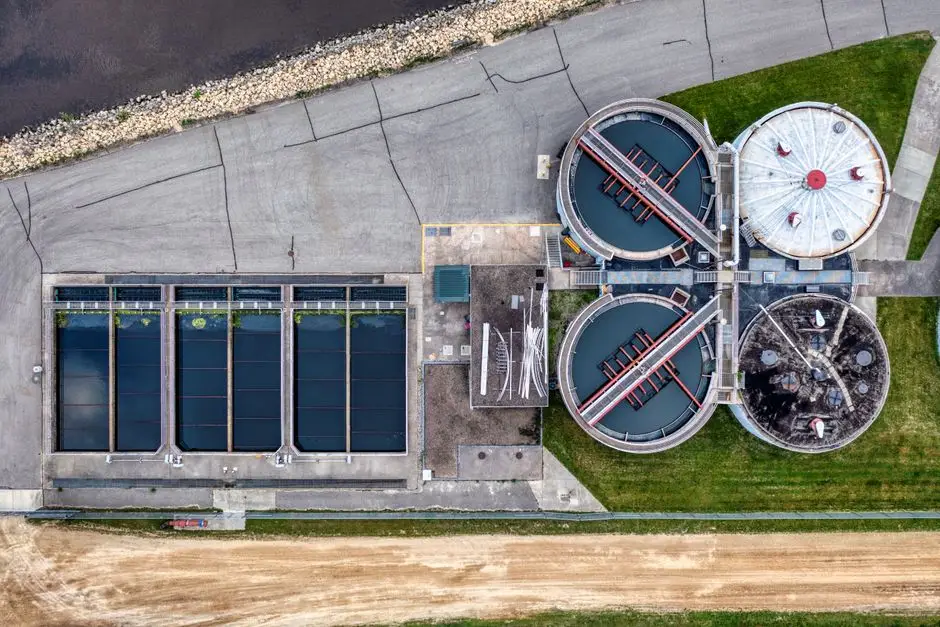
Houston hotels in 2026 choose between three packaged trains, and the choice is almost always a hybrid rather than a single unit. A DAF pre-treatment unit sits upstream of any biological stage in 80% of the designs I review — kitchens and laundry will punish a bare biological plant within months. A properly sized DAF removes 90–95% of FOG and 80–90% of TSS at hydraulic throughputs of 4–300 m³/h, and by stripping grease and suspended solids upstream it cuts aeration-tank organic loading by roughly 40% (HydropureWater field data, 2026). That single upstream decision is what keeps the downstream biology stable through Houston's July peak.
The MBR train — DAF + anoxic/aerobic basin + submerged PVDF ultrafiltration membrane at 0.1 μm pore size — is the right answer for any 100+ room resort, any property with a reuse goal, and any site where land is constrained. MBR effluent routinely measures TSS ≤ 5 mg/L and COD ≤ 30 mg/L, well inside both TCEQ §305 limits and Chapter 210 Type I reuse limits. The footprint is roughly 60% smaller than a comparable conventional activated sludge (CAS) plant because the membrane replaces the secondary clarifier and most of the tertiary filtration. Standard packaged MBR units cover 10–2,000 m³/day in a single skid, which covers the full Houston-hotel range. Membrane life is 7–10 years before replacement, and the closed-tank design shrugs off Houston's summer heat.
The buried WSZ A/O package plant is the right answer for ≤100-room limited-service hotels discharging to a POTW, where the owner needs a turnkey, no-operator system that disappears into the landscape. A buried WSZ A/O package plant delivers A/O biological contact oxidation in a fully buried tank with landscaping or parking above, capacity 1–80 m³/h, and effluent of ~20 mg/L BOD/TSS — enough for POTW discharge, not enough for irrigation reuse. The buried profile is what makes WSZ the default for tight urban Houston sites and for hotels where above-grade equipment would clash with the property image.
Conventional CAS (activated sludge + clarifier) is rarely the right answer for a Houston hotel in 2026: it is too large for the footprint, too sensitive to FOG shock, and cannot meet the 5 mg/L TSS ceiling that Chapter 210 reuse demands without a tertiary filter press on the back end. The two hybrids that actually get built are DAF + WSZ for kitchen-heavy limited-service hotels under 250 rooms, and DAF + MBR for any 100+ room resort or any project with a reuse business case.
Choosing the Right System: A 2026 Selection Matrix for Houston Hotels
The right system in 2026 is a function of two variables only: hotel size (driving hydraulic load) and discharge goal (POTW versus surface water versus irrigation reuse). Everything else — FOG load, laundry volume, climate — is handled by the standard DAF pre-treatment that sits upstream of every option. The matrix below maps the dominant Houston scenarios to a specific train, with a 2026 CAPEX order of magnitude an owner can take to a board (planning-grade numbers; site conditions move these 15–30%).
| Hotel size | Discharge to POTW | Discharge to surface water | Irrigation reuse (golf/landscape) |
|---|---|---|---|
| ≤ 80 rooms (limited-service) | WSZ package plant, 5–25 m³/h — CAPEX $40K–$120K installed | WSZ + DAF + UV/ClO₂, 5–25 m³/h — CAPEX $80K–$180K | Not economic at this size; haul off or POTW |
| 80–250 rooms (full-service) | DAF + WSZ, 25–60 m³/h — CAPEX $150K–$320K | DAF + MBR, 25–60 m³/day — CAPEX $280K–$520K | DAF + MBR + ClO₂, 25–60 m³/day — CAPEX $320K–$600K |
| 250+ rooms (resort) | DAF + MBR, 60–200 m³/day — CAPEX $350K–$700K | DAF + MBR, 60–200 m³/day — CAPEX $380K–$750K | DAF + MBR + ClO₂, 60–200 m³/day — CAPEX $420K–$850K |
Two decision rules collapse most of the matrix. First, if total design flow is below 20 m³/day, WSZ wins on cost and footprint — the membrane premium on MBR does not pay back at that scale. Second, if any irrigation reuse is on the table — even a future golf-course or landscape-irrigation phase — MBR wins on effluent quality regardless of hotel size, because no buried package plant will meet the 5 mg/L TSS ceiling of the MBR-vs-alternatives comparison without a tertiary stage that erases the WSZ cost advantage. For a side-by-side technical breakdown of MBR against CAS and SBR for this duty range, the MBR vs alternatives comparison gives the engineering detail. The same logic that picks MBR for hospitality in Houston is laid out for medical facilities in the Houston hospital wastewater treatment guide — pathogens, reuse triggers, and TCEQ permit timing are nearly identical.
2026 Cost Benchmarks and Permit Path for a Houston Hotel WWTS
2026 planning-grade CAPEX for a Houston hotel wastewater treatment system runs as follows: a WSZ package plant at $25K–$60K per 10 m³/day of capacity, an MBR system at $120K–$350K per 100 m³/day including the membrane modules and control panel, and a DAF pre-treatment unit at $18K–$80K depending on flow and air-to-solid ratio (HydropureWater 2026 catalog data). These are skid-and-tank-only numbers; site work, electrical, and startup typically add 30–50%. For a 180-room Houston resort targeting irrigation reuse, total installed CAPEX in 2026 lands in the $450K–$800K range; for a 60-room limited-service hotel on POTW discharge, the same line lands at $80K–$180K. Adjacent sectors cluster similarly — the industrial wastewater treatment guide shows parallel CAPEX bands for comparable packaged trains.
OPEX is dominated by three line items: MBR membrane replacement every 7–10 years ($40–$90 per m² of membrane area, depending on PVDF grade), UV lamp or ClO₂ precursor replacement, and sludge hauling at roughly $80–$150 per wet ton in the Houston market (per Texas Water 2025 biosolids pricing). Power for aeration is the second-largest OPEX bucket; the MBR train runs ~0.4–0.6 kWh/m³ treated, the WSZ ~0.3–0.5 kWh/m³. Sludge volume from MBR is typically 30–50% lower than from WSZ because of the higher MLSS and longer SRT, which partially offsets the membrane-replacement line item over a 20-year life.
The permit path splits cleanly on discharge destination. For POTW discharge, the hotel enrolls in the receiving utility's TCEQ-approved pretreatment program — Houston Water, a MUD, or a special utility district depending on the address — and submits a baseline monitoring report within 180 days. For surface water discharge or any reuse, the hotel files an individual TPDES permit application (Form 20049) with TCEQ Region 12 in Houston, which carries a 90–180 day technical review and a public-notice period. Implementation timelines: 10–14 weeks PO-to-commissioning for a WSZ package plant, 20–30 weeks for an MBR system, with the MBR critical path running through the membrane lead time and the TCEQ permit review in parallel.
Frequently Asked Questions
What TCEQ permit does a Houston hotel need for an on-site wastewater treatment system in 2026?
A Houston hotel discharging more than 5,000 gpd (≈19 m³/day) to a POTW enrolls in the receiving utility's TCEQ-approved pretreatment program; discharge to surface water or for irrigation reuse requires an individual TPDES permit under 30 TAC Chapter 305, with a 90–180 day TCEQ review (TCEQ Region 12, 2026).
What is the 2026 TCEQ ammonia limit for hotel wastewater in Houston?
TCEQ 30 TAC §305.41 sets NH₃-N at ≤ 3 mg/L from May through October and ≤ 5 mg/L from November through April, which forces a dedicated nitrification stage in any biological train sized for Houston's summer loads.
Can a buried package plant meet TCEQ Chapter 210 reclaimed-water standards for golf-course irrigation?
No — a buried WSZ A/O unit typically delivers ~20 mg/L TSS, while TCEQ Chapter 210 §210.1 Type I reclaimed water requires TSS ≤ 5 mg/L and non-detect fecal coliform, which pushes any reuse project to an MBR train with UV or ClO₂ disinfection.
What is the 2026 CAPEX range for a Houston hotel MBR wastewater system?
MBR system CAPEX in 2026 runs $120K–$350K per 100 m³/day of capacity including membranes; a 180-room resort on irrigation reuse lands at $450K–$800K total installed, versus $80K–$180K for a limited-service WSZ plant on POTW discharge (HydropureWater 2026 planning-grade data).
Is a DAF unit required for a Houston hotel wastewater plant?
DAF pre-treatment is effectively standard for any Houston hotel with a commercial kitchen or on-site laundry, removing 90–95% of FOG and 80–90% of TSS at 4–300 m³/h and cutting downstream aeration-tank load by ~40% (HydropureWater field data, 2026).