What Drives the Cost of Treating Electronics Assembly Wastewater
Electronics assembly wastewater treatment cost in 2026 spans $180,000–$3,200,000 in CAPEX and $0.40–$2.10 per m³ in OPEX, and five variables swing that range by 5–10× before any vendor touches a pipe. The first is the influent envelope: fluoride typically runs 10–500 mg/L from etchant streams, copper 5–200 mg/L from electroless plating rinse water, lead 0.5–20 mg/L from HASL and wave solder, tin 1–50 mg/L from solder flux wastewater, and COD 200–3,000 mg/L from developers and dry-film resist. pH swings from 1 to 12 between acid etchers and alkaline developers. Any vendor that does not ask for these numbers first is guessing.
Flow rate is the single biggest cost driver. A 5 m³/day pilot line, a 50 m³/day SMT + wave solder shop, and a 500 m³/day full-integration plant with PTH and electroless Cu/Ni/Au do not just differ by a factor of 10 — they differ by a factor of 15–20 in CAPEX per m³ of capacity because fixed engineering and automation costs amortize badly at small scale. Discharge target is the second lever: direct-to-sewer is the cheapest, surface-water discharge adds 25–35% to CAPEX, and 70–95% RO reuse adds another 30% on top of that — but it can flip the OPEX math entirely, which the heavy-metal wastewater treatment cost benchmark covers in detail. The regulatory regime matters too: US shops quote to 40 CFR Part 467 Printed Wiring Board limits, China shops to GB 39731-2020, and EU operations to IED 2010/75/EU BAT-AEL. Finally, brownfield retrofits — tying into an existing DAF or equalization tank — typically carry an 8–14% premium over greenfield builds, which is why two identical flows can quote 3× apart.
Standard Process Train for Electronics Assembly Effluent
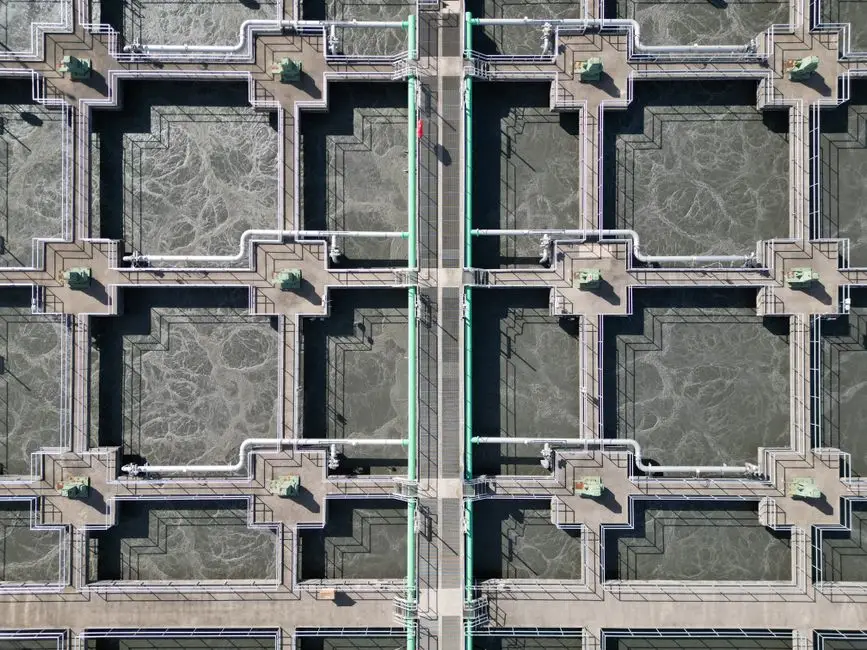
A correctly specified reference train for PCB wastewater treatment has six blocks, each of which should appear in any quote the reader evaluates. The first is equalization and pH adjustment: a 24–48 hour HRT tank with two submersible mixers and inline pH probes, because raw pH of 1–12 from segregated acid and alkaline streams must be neutralized to 7–9 before metals precipitation will work. The second block is heavy metals precipitation, where NaOH or lime raises pH to 8.5–9.5 and — for copper and lead that hydroxide alone cannot drop low enough — sulfide dosing with Na₂S or FeS takes soluble Cu to <0.1 mg/L and Pb to <0.05 mg/L. The third is fluoride removal: calcium chloride at 4–8× stoichiometric dose with 30–60 minutes contact time, which brings fluoride below the 10 mg/L required by GB 39731-2020.
Block four is coagulation, flocculation, and a lamella clarifier rated at 20–40 m/h surface loading, with sludge recirculation cutting polymer dose by 30%. Block five is an MBR polishing system using PVDF submerged membranes at 0.1–0.4 μm, which delivers effluent TSS <5 mg/L in roughly 60% of the footprint of a conventional activated-sludge train. Block six is optional but increasingly standard: an RO reuse system running at 95% recovery with permeate TDS <50 mg/L, suitable for final-rinse makeup, and concentrate returned upstream to the metals precipitation stage. Dosing across blocks 2–3 is handled by a PLC-controlled chemical dosing skid with redundant metering pumps.
| Block | Function | Key Parameter | Target Effluent |
|---|---|---|---|
| 1. Equalization + pH | Flow & pH dampening | 24–48 hr HRT, pH 7–9 | Stable feed to Block 2 |
| 2. Metals precipitation | Cu, Pb, Sn, Ni removal | pH 8.5–9.5, Na₂S polish | Cu <0.1, Pb <0.05 mg/L |
| 3. Fluoride precipitation | F⁻ removal | CaCl₂ 4–8× stoichiometric | F⁻ <10 mg/L |
| 4. Lamella clarifier | Solids separation | 20–40 m/h surface loading | TSS <30 mg/L |
| 5. MBR | Polishing + COD | 0.1–0.4 μm PVDF | TSS <5, COD <100 mg/L |
| 6. RO (optional) | Rinse-water reuse | 95% recovery | TDS <50 mg/L permeate |
2026 Cost Breakdown: CAPEX and OPEX by Plant Size

Three reference scenarios cover the bulk of RFQs a buyer at a PCB contract manufacturer will issue. A small facility running 5–15 m³/day on a single SMT line with no reuse typically lands at $180,000–$420,000 CAPEX and $1.50–$2.10/m³ OPEX, where NaOH, lime, and sludge hauling dominate the running cost. A mid-size facility at 30–80 m³/day with mixed SMT, wave solder, and selective solder plus 50% RO reuse lands at $750,000–$1.6M CAPEX and $0.85–$1.30/m³ OPEX. A large facility at 150–500 m³/day with full integration including PTH and electroless Cu/Ni/Au plating, with 70–95% RO reuse, lands at $2.1M–$3.2M CAPEX and $0.40–$0.70/m³ OPEX — the OPEX drop is almost entirely a function of the reuse offset, not better chemistry.
For a typical mid-size plant, OPEX breaks down as chemicals 35–45%, energy 20–25%, sludge handling 15–20%, labor 10–15%, and membrane replacement 5–10%. Greenfield builds should carry 12–18% contingency for civil works; brownfield retrofits usually price 8–14% above greenfield because of tie-in constraints and downtime windows. (HydropureWater field data, 2026.)
| Plant Size | Flow (m³/day) | Process Train | CAPEX (USD) | OPEX (USD/m³) |
|---|---|---|---|---|
| Small | 5–15 | Eq + pH + precipitation + lamella + MBR | $180,000–$420,000 | $1.50–$2.10 |
| Mid-size | 30–80 | + 50% RO reuse | $750,000–$1,600,000 | $0.85–$1.30 |
| Large | 150–500 | Full train + 70–95% RO | $2,100,000–$3,200,000 | $0.40–$0.70 |
How Discharge Standards Shape Equipment Selection
Discharge limits drive equipment selection more than flow does. In the US, 40 CFR Part 467 Printed Wiring Board subcategory sets daily maximums of Pb 0.42 mg/L, Cu 2.38 mg/L, Ni 0.43 mg/L, and Zn 1.48 mg/L — hydroxide precipitation plus a sand filter usually meets that envelope without sulfide polishing or RO. In China, GB 39731-2020 (effective January 2021, replacing the older 39728) tightens the targets: COD ≤500 mg/L, fluoride ≤10 mg/L, total Cu ≤0.5 mg/L, total Ni ≤0.5 mg/L, plus a new TN ≤30 mg/L cap that often forces an MBBR or denitrification filter where none was needed under the previous standard. The EU IED 2010/75/EU BAT-AEL runs tighter still: Cu 0.1–0.5 mg/L, Ni 0.1 mg/L, Pb 0.05–0.1 mg/L — that envelope typically requires sulfide polishing plus ion exchange or RO to hit consistently.
Reuse cases are a different category entirely. WHO and ANSI/AAMI ST108 do not directly govern industrial rinse-water reuse, so the spec is usually set by the end-customer (medical, aerospace, automotive) and runs tighter than any discharge rule. That is what forces RO inclusion even when direct discharge to a POTW would not.
| Parameter | US 40 CFR 467 (PWB) | China GB 39731-2020 | EU IED BAT-AEL |
|---|---|---|---|
| Copper | 2.38 mg/L daily max | 0.5 mg/L | 0.1–0.5 mg/L |
| Lead | 0.42 mg/L daily max | 0.5 mg/L | 0.05–0.1 mg/L |
| Nickel | 0.43 mg/L daily max | 0.5 mg/L | 0.1 mg/L |
| Fluoride | Site-specific | 10 mg/L | Site-specific |
| COD | Site-specific | 500 mg/L | Site-specific |
Where the Real Savings Are: RO Reuse Economics
RO reuse is the single largest cost lever in 2026, and it flips the conversation from "cost of compliance" to "cost of water." A 50 m³/day facility buying municipal water at $2.50/m³ spends roughly $45,000/year on rinse-water makeup. Running the RO at 70% recovery drops that to about $13,500/year — a $31,500/year gross saving before concentrate disposal. Payback on the RO skid plus reuse buffer tank typically lands between 18 and 36 months for any flow above 30 m³/day, provided the concentrate is routed back into metals precipitation rather than hauled off as liquid waste.
Two hidden OPEX items belong in the budget. CIP chemicals for RO run $0.03–$0.08/m³ of permeate. PVDF membrane replacement hits every 5–7 years at roughly $25/m² of membrane area, which is detailed further in the 2026 AOP maintenance cost benchmarks reference. Concentrate management is the bigger lever: liquid waste hauler fees run $80–$300/m³, so returning concentrate to Block 2 is not optional — it is the difference between a 24-month and a 60-month payback. The full TCO framing is laid out in the 2026 TCO breakdown for wastewater plants.
Vendor Selection Checklist Before You Issue the RFQ
The spread between a $1.2M and a $1.8M quote for the same flow usually comes down to six questions the buyer forgot to ask. First, require a 5-day composite sampling campaign with certified third-party lab analysis, not vendor quick-test strips — under-characterized influent is the root cause of roughly 80% of project failures (per HydropureWater field data, 2026). Second, demand guaranteed effluent numbers in writing on a monthly-average basis for 12 months post-startup, not just a "design basis" that reads well in a brochure. Third, confirm skid pre-assembly and a documented factory acceptance test; site-built systems routinely run 20–30% over schedule.
Fourth, ask for a 3-year OPEX model with chemical and energy unit costs the buyer can re-price against local tariffs. Fifth, verify automation: a PLC with remote telemetry (SCADA or 4G) is now standard for 24/7 electronics plants, and a manual-only system in 2026 is a red flag. Sixth, ask for a concentrate management plan — the vendor should specify how RO reject re-enters the front of the train, because the answer determines whether the project hits its 18–36 month reuse payback or misses it by years.
Frequently Asked Questions
How much does electronics assembly wastewater treatment cost in 2026?
CAPEX runs $180,000–$3,200,000 and OPEX $0.40–$2.10/m³ depending on flow and reuse target, anchored to 40 CFR Part 467, GB 39731-2020, and EU BAT-AEL envelopes. A 50 m³/day mid-size plant typically lands near $1.1M CAPEX and $1.05/m³ OPEX (HydropureWater field data, 2026).
What is the cheapest way to treat PCB rinse water for sewer discharge?
Equalization, hydroxide precipitation at pH 8.5–9.5, lamella clarification, and MBR polishing meet 40 CFR Part 467 daily maximums without RO, typically at $0.85–$1.30/m³ OPEX for mid-size flows. This is the standard train for printed wiring board effluent discharging to a POTW.
When does an electronics plant need RO on its wastewater?
RO becomes economic above 30 m³/day whenever rinse-water reuse offsets a municipal water cost above $1.50/m³. At 50 m³/day and $2.50/m³ water, the RO skid pays back in 18–36 months with 70% recovery (HydropureWater field data, 2026).
What does GB 39731-2020 require that older plants often miss?
The 2021 Chinese standard added a TN ≤30 mg/L cap and tightened total Cu to 0.5 mg/L, which forces denitrification and tighter metals polishing on retrofits. Many 2018-vintage plants quote against the older GB 39728 and fail the 2026 audit.
How long do MBR membranes last in electronics wastewater service?
PVDF submerged MBR membranes at 0.1–0.4 μm typically run 5–7 years before replacement at roughly $25/m² of membrane area. CIP chemical cost is $0.03–$0.08/m³ of permeate on a properly instrumented MBR polishing system (HydropureWater field data, 2026).