Why Algeria's 2026 Municipal Sewage Landscape Demands a New Engineering Playbook
Algeria's urban population will exceed 73% of the national total by 2026, adding roughly 1.3 million new urban residents per year that municipal sewage infrastructure must absorb (UN-DESA World Urbanization Prospects, 2024 revision). The Oran wastewater treatment plant at 270,100 m³/day — the country's largest single municipal asset discharging to the Mediterranean — was designed two decades ago for influent loads that no longer reflect current BOD₅, nitrogen, and pharmaceutical-micropollutant profiles. Plants in Algiers, Constantine, and Annaba are operating at 110–135% of nominal hydraulic capacity during wet-weather peaks, pushing overflows directly into the Mediterranean.
Coastal plants now face enforcement under the 1976 Convention for the Protection of the Mediterranean Sea Against Pollution (Algiers Convention, amended), which obliges parties to apply Best Available Techniques (BAT) and emission limit values consistent with EU practice. The 2024 COP outcomes tightened the nutrient and bathing-water annexes, and CNEE (Comité National d'Evaluation Environnementale) is now flagging non-compliant EIA submissions. Globally, the direction of travel mirrors China's GB 18918-2002 provincial tightening documented in 2025 upgrade case studies — tighter COD (<50 mg/L), total nitrogen (<15 mg/L), and total phosphorus (<0.5 mg/L) for sensitive receiving waters. Algeria is converging on the same EU-aligned envelope, not diverging from it. The engineering question for any 2026 tender is therefore binary: which process train, sized at what capacity, delivered under which financing vehicle, to meet Decree 06-141 today and the next regulatory tightening in 2027–2028.
Algerian Discharge Limits and Compliance Standards for 2026
MEDD Decree 06-141 and its associated JORA technical notice NT 106.002 set the municipal discharge envelope still enforced as of 2026, with draft amendments circulated in late 2025 that tighten nutrients for coastal discharges. The commonly cited 2006 limits remain the binding reference for any active permit unless a site-specific BAT decision applies. For any municipal sewage treatment plant in Algeria, design must demonstrate compliance against the parameters below.
| Parameter | MEDD Decree 06-141 / NT 106.002 (2006, in force 2026) | EU UWWTD 91/271/EEC (comparable) | Notes for 2026 design |
|---|---|---|---|
| BOD₅ | ≤ 25 mg/L | ≤ 25 mg/L | Aligned |
| COD | ≤ 90 mg/L | ≤ 125 mg/L | Algeria tighter by 28% |
| TSS | ≤ 35 mg/L | ≤ 35 mg/L | Aligned; MBR achieves ≤ 5 mg/L |
| N-total | ≤ 30 mg/L | ≤ 15 mg/L (sensitive areas) | 2025 draft: ≤ 15 mg/L for coastal plants |
| P-total | ≤ 5 mg/L | ≤ 2 mg/L (sensitive areas) | 2025 draft: ≤ 2 mg/L for Mediterranean discharges |
| Fecal coliforms | ≤ 2,000 CFU/100 mL (irrigation reuse, WHO 1989 baseline) | ≤ 200 CFU/100 mL (bathing water) | UV or ClO₂ required for reuse |
| pH | 6.5–8.5 | — | Standard envelope |
The Algiers Convention 2024 COP added explicit nutrient-reduction triggers for plants above 10,000 PE discharging within 5 km of a designated bathing or shellfish water. For an Oran-scale plant, this means the design envelope is effectively N ≤ 15 mg/L and P ≤ 2 mg/L — the same band the EU applies in sensitive areas under 91/271/EEC. Engineers should design tertiary polishing (denitrification filter or chemical P precipitation) with a 20% safety margin so the asset remains compliant under the 2027 amendment without retrofits.
Process Selection by Capacity Tier: From Rural 500 m³/day to Oran-Scale 270,000 m³/day
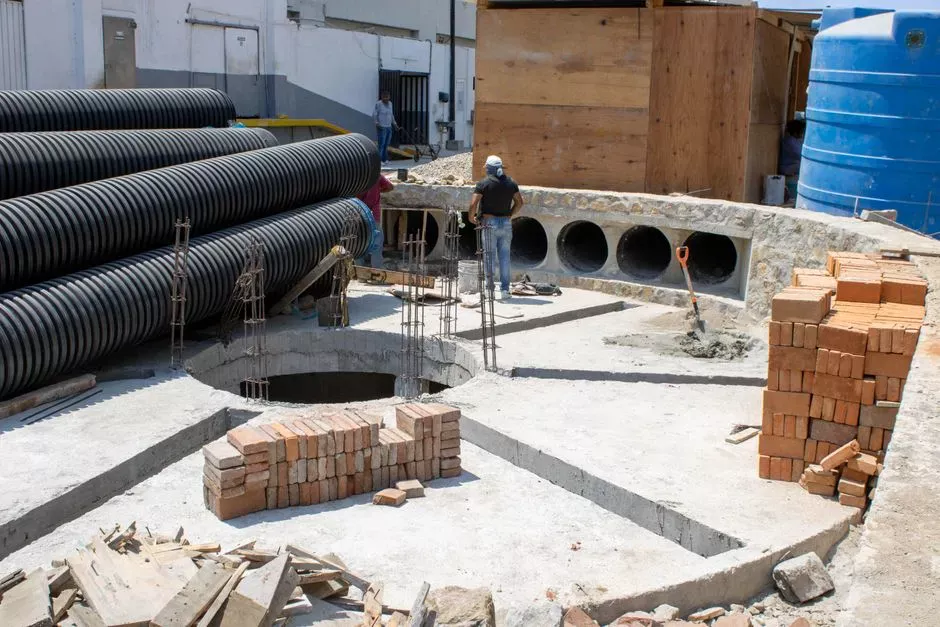
Process selection in Algeria is driven by three constraints that interact: population equivalent and hydraulic load, effluent quality target (especially the N ≤ 15 mg/L trajectory), and footprint available on a constrained coastal site. The framework below maps the three operating tiers to the process train that delivers the lowest 20-year net present cost under MEDD Decree 06-141.
| Tier | Capacity | Recommended process | Key operating parameters | Footprint benchmark |
|---|---|---|---|---|
| 1 — Small | < 2,000 m³/day | Packaged A/O or A²/O with integrated disinfection | HRT 8–10 h, MLSS 4,000–5,000 mg/L, SRT 12–18 d | 5–15 m² per 100 m³/day |
| 2 — Mid | 2,000–20,000 m³/day | SBR or A²/O + sand filter + ClO₂ or UV | SVI 80–150 mL/g, MLSS 3,500–4,500 mg/L, HRT 6–8 h | 8–12 m² per 100 m³/day |
| 3 — Large | > 20,000 m³/day (Oran class: 270,100 m³/day) | Conventional A²/O or MBR with denitrification + chemical or biological P removal, UV/ClO₂ polishing | SRT 15–20 d, F/M 0.08–0.15 kg BOD/kg MLSS·d, HRT 6–10 h | 10–18 m² per 100 m³/day (MBR: 40–60% of conventional) |
For peri-urban towns, military bases, hotel clusters, and new housing developments in the 200–2,000 m³/day band, a packaged underground A/O sewage plant for Tier 1 municipal sites delivers the lowest installed cost and can be commissioned inside 6–8 weeks from delivery. For Tier 2 district plants, sequencing batch reactors (SBR) tolerate the highly variable Algerian influent (peak-to-average ratio up to 2.5) without equalization tanks. For Tier 3 — anchored by the 270,100 m³/day Oran reference — an MBR membrane bioreactor for Tier 2–3 Mediterranean plants delivers sub-1 μm filtered effluent (TSS ≤ 5 mg/L, turbidity ≤ 1 NTU) that satisfies both irrigation reuse thresholds and emerging pharmaceutical-micropollutant concerns highlighted in recent nanoparticle and heavy-metal fate studies of municipal sludge. MBR also reduces footprint to 40–60% of a conventional clarifier-based layout — a decisive advantage on the constrained coastal plots around Oran, Algiers, and Annaba.
Decision rule: specify MBR when effluent must meet BOD < 10 mg/L for direct reuse, when the available site is below 60% of a conventional layout's footprint, or when the receiving water is a designated bathing or shellfish zone under the Algiers Convention. Otherwise, conventional A²/O with a sand-filter polish is the lower-CAPEX option at the Oran scale.
2026 CAPEX and OPEX Benchmarks for Algerian Municipal STPs
Budget figures for any 2026 Algerian municipal bid should be sanity-checked against the benchmarks below. They are derived from active 2024–2026 EPC tenders in the Maghreb, supplier quotation panels, and HydropureWater field data for skid-mounted pre-engineered units shipped into Algiers, Oran, and Béjaïa. The per-m³/day figure is the most defensible line item for an EPC bid manager or municipal procurement officer, because it absorbs currency, freight, and customs variability in a single number.
| Capacity tier | Delivery model | CAPEX (USD per m³/day) | OPEX (USD per m³ treated) | Energy benchmark (kWh/m³) |
|---|---|---|---|---|
| Tier 1 (≤ 2,000 m³/day) | Package / skid-mounted turnkey | 350–600 | 0.18–0.28 | 0.30–0.45 |
| Tier 2 (2,000–20,000 m³/day) | Hybrid (pre-engineered + civil) | 250–500 | 0.15–0.22 | 0.28–0.40 |
| Tier 3 (> 20,000 m³/day) | Civil EPC + packaged equipment | 180–450 | 0.12–0.18 | 0.25–0.35 |
OPEX is dominated by aeration energy at 45–55%, sludge handling at 15–20%, labor at 10–15%, and chemicals at 8–12%. In DZD terms, 1 USD ≈ 135 DZD at 2026 official rate, but most imported equipment is contracted in EUR or USD with a 5–15% customs duty and 19% TVA. Skid-mounted pre-engineered units compress on-site installation labor by 30–50% versus stick-built, which is the single most controllable line item for inland deployments where skilled contractor hours are scarce.
Financing vehicles actively deploying in 2026 include the World Bank Algeria Sustainable Water Supply & Sanitation Program (active envelope ~USD 500 m, blended with ONEE-style EPC procurement), the Agence Française de Développement (AFD) municipal water tranche, and the European Investment Bank's Mediterranean climate-adaptation loans. A Maghreb-region municipal STP cost benchmarks reference is useful for cross-validation. For inland or fast-track deployments under 12 months, the decentralized 2026 outlook for Maghreb towns outlines the packaged STP delivery model in more detail.
Headworks, Disinfection and Sludge — The Three Subsystems Most Often Under-Scoped
Three auxiliary systems disproportionately drive both compliance and 20-year operating cost, and they are the subsystems most frequently under-scoped in Algerian tender documents. Getting them right at design stage is cheaper than retrofitting in year 5.
Headworks. A GX series rotary bar screen for municipal headworks with 6–10 mm bar spacing is non-negotiable for any flow above 5,000 m³/day. Without it, rags and grit destroy downstream MBR membranes and clog aeration diffusers within 12–18 months. Fine screens below 3 mm should be added when the plant feeds an MBR.
Disinfection. Ammonia-rich Mediterranean sewage reacts with free chlorine to form trihalomethanes (THMs), which fail EU Drinking Water Directive 98/83/EC limits for any reuse scenario. A ClO₂ generator for Mediterranean municipal disinfection in the 50 g/h to 20,000 g/h output band avoids THM formation, holds a residual across a 5–10 km reuse distribution network, and operates at a lower dose than chlorine (0.5–1.0 mg/L ClO₂ vs. 2–5 mg/L Cl₂ for equivalent fecal coliform kill). UV is the alternative for plants near residential reuse zones, but at a 3–4× higher CAPEX per m³/day treated.
Sludge. A packaged municipal plant produces 0.7–1.2 kg dry solids per m³ treated. A plate and frame filter press for municipal sludge dewatering in the 1–500 m² filter area range reduces cake moisture to 65–75%, cutting transport volume by a factor of four and producing a cake that meets landfill acceptance criteria or can be co-composted with green waste. Auto chemical dosing for coagulant and polymer at 5–2,000 L/h, controlled by a PLC control architecture for municipal WWTPs, stabilizes effluent quality and cuts polymer consumption 15–25% versus manual dosing. A complete automatic chemical dosing skid is the lowest-cost upgrade with the shortest payback on an existing plant.
12-Month Execution Checklist: From Feasibility to Commissioning in Algeria
The 12-month plan below is the realistic delivery path for an EPC contractor or municipal engineer managing a 2026 Algerian tender, assuming no major land-acquisition delay. Each step carries a defined deliverable that the procurement officer can map to the CPS (Cahier des Prescriptions Spéciales).
- Months 0–2 — Feasibility and permitting. Influent characterization (minimum 7-day composite, BOD₅/COD/TSS/NH₄-N/P/alkalinity), MEDD permit scoping, EIA submission to CNEE. Deliverable: signed feasibility report with Decree 06-141 compliance matrix.
- Months 2–4 — Process selection and tender. Lock process train against the tier framework above, prepare the CPS document, run vendor pre-qualification (typically 3–6 bidders), issue the tender. Deliverable: shortlist of qualified bidders.
- Months 4–8 — Detailed engineering and procurement. Issue the EPC or split-contract award, complete detailed design, place equipment orders. Long-lead items (MBR membranes, ClO₂ generators, filter presses) should be on order by month 5. Deliverable: IFC drawings and approved equipment submittals.
- Months 8–11 — Installation and commissioning. Civil works, equipment installation, wet commissioning, performance test against Decree 06-141 limits. The 90-day reliability run begins at month 9. Deliverable: performance test certificate.
- Month 12 — Handover. Operator training, O&M manual handover, SCADA go-live, and a 12-month defects-liability period starts. Deliverable: take-over certificate and as-built documentation package.
For suppliers bidding into this timeline, the Baghdad municipal supplier selection guide is a useful parallel reference on what EPC evaluators look for in a pre-qualification dossier.
Frequently Asked Questions
What are the binding effluent limits for a municipal sewage treatment plant in Algeria in 2026?
MEDD Decree 06-141 / NT 106.002: BOD₅ ≤ 25 mg/L, COD ≤ 90 mg/L, TSS ≤ 35 mg/L, N-total ≤ 30 mg/L, P-total ≤ 5 mg/L. Draft 2025 amendments tighten N to ≤ 15 mg/L and P to ≤ 2 mg/L for coastal plants discharging under the Algiers Convention.
What CAPEX should a 5,000 m³/day municipal STP budget for in 2026?
USD 250–500 per m³/day for a hybrid pre-engineered + civil delivery, equating to USD 1.25–2.5 million total CAPEX, excluding land and grid connection. OPEX typically runs USD 0.15–0.22 per m³ treated.
Which process is best for a 270,000 m³/day coastal plant like Oran?
Conventional A²/O or MBR with biological denitrification and chemical phosphorus removal, polishing via UV or ClO₂, and a plate-and-frame filter press for the 190–325 tonnes/day of dry solids produced. MBR is preferred when site footprint is constrained or when direct reuse is required.
Can packaged equipment be used for an Oran-scale plant?
Packaged skid-mounted units dominate the headworks, disinfection, and sludge subsystems at the Oran scale. The biological reactors themselves are typically civil-built for cost reasons, but all auxiliary skids (bar screens, ClO₂ generators, chemical dosing, filter presses) are pre-engineered.
Which financing vehicles fund municipal sewage projects in Algeria in 2026?
The World Bank Algeria Sustainable Water Supply & Sanitation Program, AFD municipal water loans, and EIB Mediterranean climate-adaptation envelopes are the three active multilateral sources. Domestic funding flows through the ONEE-style EPC budget line and the Fonds National pour la Maîtrise de l'Énergie et l'Environnement.