What the Indonesian COD Discharge Limit Actually Is in 2026
The COD discharge limit in Indonesia is set by Permen LHK No. 5/2014 and strengthened by PP No. 22/2021. Industrial effluent discharged to surface water must generally stay below 250 mg/L COD, while palm oil mill effluent (POME) applied to land is capped at 5,000 mg/L. To meet these thresholds, raw POME influent at 15,000–25,000 mg/L requires an anaerobic + aerobic + polishing train that delivers ≥99% overall removal.
For most industrial facilities, the binding number is 250 mg/L COD at the discharge point to a river or stream, established under Annex II of Permen LHK No. 5/2014 (the live technical regulation for baku mutu air limbah, or effluent quality standard). PP No. 22/2021 — the national regulation on water resources management — sits one layer above and gives the Permen LHK limit its legal teeth: it is the umbrella law that makes non-compliance an administrative offence under Indonesian environmental law and ties violations to the PROPER rating system.
The 5,000 mg/L POME land-application cap is a different limit, set out in the same Permen LHK framework, and it governs a discharge route that the palm oil industry uses extensively: spreading treated effluent on plantation land as irrigation, rather than releasing it to a watercourse. A land-application permit is not a loophole — it is a land-use path with its own hydrogeology, soil loading, and monitoring requirements, and it only applies where the receiving soil can biologically process the residual COD. Most other industrial sectors (textile, food and beverage, pulp and paper, manufacturing) do not have a comparable land-application route and must hit 250 mg/L if they discharge to surface water.
The three practical compliance pathways are: (1) direct discharge to a river or stream under Annex II limits, (2) discharge to a public treatment works (IPAL komunal) under a separate negotiated ceiling, and (3) land application where the receiving medium allows it. Each pathway has a different monitoring cadence and a different binding parameter, and engineers should confirm the pathway in the facility's environmental permit (AMDAL/UKL-UPL) before sizing equipment. A polishing step built on an MBR membrane bioreactor for COD polishing is the most defensible way to lock in compliance across all three.
| Discharge Pathway | Governing Document | COD Ceiling (mg/L) | Typical Industrial User |
|---|---|---|---|
| River / surface water (general industrial) | Permen LHK 5/2014, Annex II | ≤ 250 | Textile, F&B, manufacturing, pulp & paper |
| Land application (POME) | Permen LHK 5/2014, POME provision | ≤ 5,000 | Palm oil mills with plantation permit |
| Public treatment works (IPAL komunal) | Local PDAM / estate operator agreement | Typically 300–500 | Estate tenants in Cikarang, Karawang, Batang |
| Sea / marine discharge | Permen LHK 5/2014, Annex III | Stricter, sector-dependent | Coastal hazardous-waste facilities |
How the Regulatory Stack Is Built: PP 22/2021, Permen LHK 5/2014, and Sector Decrees
Indonesian effluent compliance works on a three-tier hierarchy. PP No. 22/2021 is the government regulation (level 1, a Presidential-level rule) that governs water resource management and sets the legal framework for baku mutu air limbah — the national effluent quality standard. Permen LHK No. 5/2014 is the level-2 technical regulation issued by the Ministry of Environment and Forestry (KLHK) that spells out the actual numeric limits, sampling requirements, and analytical methods. Sector-specific Ministerial Decrees (level 3) layer on top of Permen LHK 5/2014 to set tighter or different limits for palm oil, textiles, food processing, and other priority industries.
For an industrial plant, the practical question is which Annex of Permen LHK 5/2014 applies. Annex I covers domestic wastewater (kitchen, greywater, sewage) and is rarely the binding document for a manufacturing facility. Annex II is the industrial-to-surface-water annex and contains the 250 mg/L COD ceiling most engineers will work against. Annex III governs industrial discharge to the sea and applies to coastal hazardous-waste treatment facilities and certain petrochemical operations. Confirming the correct annex is step one of any compliance review; getting it wrong invalidates every downstream design decision.
KLHK is the enforcing authority. The ministry runs the PROPER environmental rating program (Program Penilaian Peringkat Kinerja Perusahaan) and operates the SIMPEL online reporting portal, through which every covered facility must submit monthly self-monitoring data. PROPER ratings range from Gold (best) through Green, Blue, Red, to Black; a Black rating triggers administrative sanctions and, in repeat cases, operational suspension. KLHK also retains authority to revise the limits, and a 2024–2025 draft amendment to Permen LHK 5/2014 proposes tightening the COD ceiling to 100 mg/L for Class I upstream watersheds — a move that would directly affect facilities discharging to the headwaters of Java's and Sumatra's major rivers. Engineers specifying equipment today should plan for this tightening rather than sizing to the current 250 mg/L line; the MBR supplier selection guide for Indonesia covers the same forward-looking design principle in more detail.
COD Limits by Sector: Palm Oil, Textile, Food, Pulp & Paper
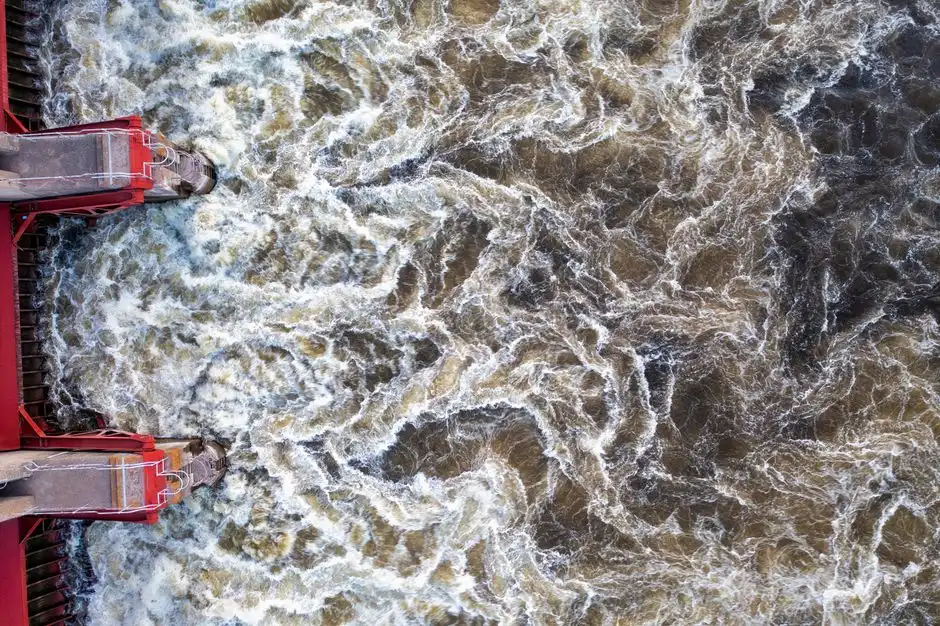
Permen LHK 5/2014 sets the floor; sector decrees raise the bar. Palm oil mills sit under a hybrid regime: the 5,000 mg/L land-application cap is unique to POME and is the most permissive number in the table, but mills that prefer river discharge must still hit 250 mg/L. Raw POME typically tests 15,000–25,000 mg/L COD at the inlet of the treatment plant (HydropureWater field data, 2026), so the engineering gap between influent and either ceiling is the central design problem for the sector.
Textile effluent is more variable than POME because the COD number depends on dye chemistry. Reactive dyes, which dominate Indonesia's dyehouse effluent stream, push influent COD to 2,000–5,000 mg/L, while disperse dyes run lower. The discharge limit is 150–250 mg/L depending on whether the receiving watercourse is a Class I or Class II water body under PP 82/2001 on water quality classification. Food and beverage plants generally face a 250 mg/L COD ceiling to surface water, but BOD₅ is often the binding parameter because sugar, starch, and dairy waste biodegrade efficiently; raw influent typically runs 800–4,000 mg/L COD. Pulp and paper mills discharge under a sector decree that sets a 350 mg/L COD ceiling to surface water for integrated mills, and raw black liquor COD can reach 8,000–15,000 mg/L. Hazardous-waste treatment facilities face the tightest limits, with the binding number set in Annex III of Permen LHK 5/2014 rather than in a sector decree.
| Sector | Raw Influent COD (mg/L) | River Discharge Limit (mg/L) | Land-Application Limit (mg/L) | Binding Parameter |
|---|---|---|---|---|
| Palm oil (POME) | 15,000–25,000 | 250 | 5,000 | Discharge pathway |
| Textile (reactive dye) | 2,000–5,000 | 150–250 | Not permitted | Receiving water class |
| Food & beverage | 800–4,000 | 250 | Site-specific | BOD₅ often tighter |
| Pulp & paper (integrated) | 8,000–15,000 | 350 | Not permitted | Color + COD |
| Hazardous-waste facility | Variable | Per Annex III | Not permitted | Annex III, sector-specific |
For the high-solids streams — POME and black liquor — a dissolved air flotation unit ahead of the biological stage removes a measurable fraction of suspended COD and protects downstream biology. For polishing, DF series PVDF flat-sheet MBR modules lock in the residual COD regardless of which sector limit applies.
Engineering the Removal: Treatment Trains That Hit 250 mg/L and Below
The treatment train is where the regulatory number becomes a mechanical specification. For POME, the defensible 2026 design is equalization → UASB or IC anaerobic reactor → aerobic lagoon or sequencing batch reactor → polishing MBR. The anaerobic stage alone delivers 70–85% COD removal on POME (HydropureWater field data, 2026), the aerobic stage removes another 80–90% of the residual, and the MBR polishing step drives the final number to ≤50 mg/L — well below the 250 mg/L surface-water ceiling and within striking distance of the draft 100 mg/L amendment. Overall removal is ≥99% from raw influent.
Textile trains start with equalization and pH correction, move through coagulation and a dissolved air flotation unit for suspended dye removal, then enter a biological stage (SBR or MBBR) for dissolved COD. A sand filter catches biological floc carryover, and an MBR or RO polish handles color and the last 50–100 mg/L of residual COD. Food and beverage plants run a slightly simpler train: screening → DAF for oil and grease → anaerobic (often UASB for high-strength dairy or starch streams) → MBR with 0.1 μm PVDF membranes. Pulp and paper trains use primary clarification for fibre recovery, conventional activated sludge for bulk COD, and tertiary sand filtration; MBR is increasingly specified where the mill wants to reuse process water at 50 mg/L COD.
The polishing step is where compliance either holds or breaks. The MBR membrane bioreactor for COD polishing is sized on a 0.1 μm nominal pore size and a per-module flux envelope of 32–135 m³/day, depending on the module area selected. Chemical conditioning is part of the same train: a PLC-controlled coagulant and pH dosing system stabilizes the biology and lets the MBR run at design flux without fouling. For the upstream settling step in F&B and pulp applications, a high-efficiency sedimentation tank ahead of the MBR reduces solids loading and extends membrane life.
| Sector | Train Configuration | Influent COD (mg/L) | Effluent COD (mg/L) | Overall Removal |
|---|---|---|---|---|
| Palm oil (POME) | Eq → UASB/IC → SBR → MBR | 15,000–25,000 | ≤ 50 | ≥ 99% |
| Textile | Eq → Coag/DAF → SBR/MBBR → Sand → MBR/RO | 2,000–5,000 | ≤ 100 | 95–98% |
| Food & beverage | Screen → DAF → Anaerobic → MBR (0.1 μm) | 800–4,000 | ≤ 50 | 95–99% |
| Pulp & paper | Primary clarifier → Activated sludge → Sand → MBR | 8,000–15,000 | ≤ 100 | 97–99% |
Sampling, Monitoring, and PROPER Rating: How the Limit Gets Enforced
The limit is enforced through a documented chain of custody, not through spot inspections alone. Permen LHK 5/2014 requires every covered facility to conduct monthly self-monitoring, with the results uploaded to the SIMPEL online portal operated by KLHK. Continuous online COD analyzers — either UV 254 correlation probes or dichromate-method instruments — are increasingly mandated for Class I facilities discharging to upstream watersheds, and the analyzer's data log is what defends the facility during an unannounced audit. Where online instrumentation is not yet installed, an accredited third-party lab must run the measurement at least once every three months, with chain-of-custody forms retained for five years.
PROPER rating is the other enforcement lever. KLHK publishes the rating annually based on the SIMPEL data and on-site verification, and a Black rating means administrative sanction under PP No. 22/2021, with the realistic worst case being temporary shutdown of the discharge point. A single missed monthly upload can move a facility from Blue to Red even when the actual effluent quality is in compliance; record discipline is therefore as important as treatment performance. The PLC-controlled coagulant and pH dosing system on the upstream side of the MBR supports this record discipline by logging dose rates against effluent trends, giving the compliance team a defensible audit trail.
2026 Outlook: Draft Amendments and the Push Toward 100 mg/L
The 2024–2025 draft amendment to Permen LHK 5/2014 proposes tightening the COD ceiling to 100 mg/L for facilities discharging to Class I upstream watersheds — the headwater catchments in Java and Sumatra that supply drinking-water intakes downstream. Industrial estates in Cikarang, Karawang, and Batang are first in line because they sit on Class I tributaries of the Citarum and Bengawan Solo systems. For these plants, MBR or RO polishing is no longer optional; it is the minimum equipment needed to meet the proposed number. Bilateral financing from JICA and the World Bank is also moving in the same direction, with new industrial estate loans conditioned on reuse-quality effluent at ≤50 mg/L COD, which is well within the operating envelope of an MBR polishing train sized today.
Frequently Asked Questions
What is the COD discharge limit for industrial effluent in Indonesia? The COD discharge limit is 250 mg/L for general industrial effluent discharged to surface water under Annex II of Permen LHK No. 5/2014, with PP No. 22/2021 providing the legal framework for enforcement. Sector decrees can impose tighter or different limits for palm oil, textile, and pulp and paper operations.
What is the COD limit for POME in Indonesia? The COD limit for palm oil mill effluent is 5,000 mg/L for land application and 250 mg/L for river discharge, both set under Permen LHK No. 5/2014. The 5,000 mg/L cap applies only to facilities with a valid land-application permit and a hydrogeologically suitable receiving site.
Which regulation governs industrial wastewater discharge in Indonesia? Industrial wastewater discharge in Indonesia is governed by the three-tier stack of PP No. 22/2021, Permen LHK No. 5/2014, and the relevant sector Ministerial Decree, with KLHK as the enforcing authority. The binding technical number for COD at the discharge point sits in the Annex of Permen LHK 5/2014 that matches the facility's discharge pathway.
What is the treatment train to hit 250 mg/L COD for POME? The treatment train to hit 250 mg/L COD for raw POME at 15,000–25,000 mg/L is equalization followed by UASB or IC anaerobic digestion, an aerobic SBR or lagoon, and an MBR polishing step. The combined train delivers ≥99% COD removal and typically produces effluent at ≤50 mg/L.
Is the Indonesian COD limit changing in 2026? The Indonesian COD limit is tightening in 2026 through a draft amendment to Permen LHK 5/2014 that proposes 100 mg/L for Class I upstream watersheds in Java and Sumatra. Industrial estates in Cikarang, Karawang, and Batang are first-affected, and MBR or RO polishing is being specified as standard equipment for new builds.