A 2026 optical film wastewater recycling system recovers 75–90% of process water as cleanroom-grade permeate via DAF, MMF, UF, and two-pass RO. Trains pay back in 3–5 years where water tariffs top USD 1.50/m³.
Why an Optical Film Wastewater Recycling System Is the 2026 Default Scope
A 200–500 m³/day optical film line can recover 75–90% of its process water. The proven train is equalization, DAF, multi-media filtration, UF at 0.1 μm, and two-pass RO, with optional EDI polishing above 15 MΩ·cm resistivity. Closed-loop operation cuts operating cost 40–60% versus once-through discharge plus purchased freshwater.
A single 200–500 m³/day polarizer coating line draws enough freshwater to supply a small town, and roughly 60–80% of that intake leaves the plant as alkaline wash water, PVA/iodine-bearing coating effluent, and DI-rinse overflow. In 2026, treating that stream for discharge is no longer enough.
China GB 30485-2013 caps COD at 50 mg/L for new electronics plants. The EU Industrial Emissions Directive 2010/75/EU sets BAT-AEL ranges of 10–40 mg/L TOC for display manufacturing, and Korea's MIE standards enforce matching limits on the electronics subsector. Beyond compliance, the boardroom is now asking about it: Apple, Samsung, LG, and BOE supplier codes require Scope 3 water reporting, and most optical film buyers will reject a vendor without a published reuse rate.
That combination of regulatory cap and customer mandate is why a closed-loop recovery train — not a discharge-only end-of-pipe plant — has become the default scope in 2026 capital projects. Properly designed trains hit 75–90% recovery on polarizer, BEF, and diffuser lines, and the recovered permeate is qualified back as DI-feed or final rinse for Class 1000–10,000 cleanrooms. Compared to once-through discharge plus purchased freshwater, closed-loop designs cut operating cost by 40–60%, with shorter payback where water tariffs exceed USD 1.50/m³ or where zero-liquid-discharge mandates apply. ESG and Scope 3 pressure from the brand owners listed above is now a non-regulatory driver that CFOs recognize: a published water-recovery number is becoming a prerequisite for new supplier qualification.
The Optical Film Wastewater Matrix You Must Design Around
Optical film effluent is not a single stream — it is the blend of four very different generation points, and each one dictates a different pre-treatment target. PVA/iodine polarizer coating wash water carries the highest COD and the residual iodine that downstream membranes fear. UV-curable acrylate coating (BEF, diffuser, hardcoat) contributes photoinitiators and unreacted oligomers that are inhibitory to biological treatment.
Alkaline developing stages push pH to 10–12 with surfactants 20–80 mg/L. Final DI-rinse overflow has low TDS but high flow and intermittent surges. According to Wikipedia, the common H-sheet polarizer is polyvinyl alcohol film with iodine doping — exactly why both contaminants land in the wash water.
Polarizer Coating Wastewater Treatment Process Inputs
Polarizer coating wastewater treatment process design starts from a combined influent of COD 800–3,000 mg/L, BOD 150–500 mg/L, and conductivity 1,500–4,000 µS/cm after equalization. The full matrix runs SS 100–600 mg/L, pH 4–11, residual iodine 0.5–5 mg/L, residual boron 1–20 mg/L, and surfactants 20–80 mg/L (HydropureWater field data, 2026, 12 optical film lines sampled across CN and KR). PVA is only slowly biodegradable — typical BOD/COD ratios sit at 0.18–0.25, far below the 0.4+ that a conventional activated-sludge plant needs.
Wikipedia's polyvinyl-alcohol overview notes that biodegradability depends on molecular weight and that not all grades degrade readily, which matches what the 12-line dataset shows. Photoinitiators (Irgacure 184, 819, TPO) are inhibitory to nitrifiers above 5 mg/L. The flow is also intermittent: a single coating-head changeover can shift the incoming load by a factor of three within 20 minutes.
Those three facts — slow-biodegradable carbon, inhibitory photoinitiators, intermittent flow — push designers away from biological packages and toward physical-chemical + membrane trains. The parameters most damaging to RO membranes in this matrix are residual COD above 50 mg/L after pre-treatment, hardness scaling when concentrates are recycled, and free chlorine above 0.1 mg/L. Fouling index rises sharply once COD passes that 50 mg/L mark. Design pre-treatment around those three limits first, and the rest of the train becomes straightforward.
| Generation point | Dominant contaminants | Typical range | Design implication |
|---|---|---|---|
| PVA/iodine polarizer coating wash | PVA, iodine, boron, COD | COD 1,500–3,000 mg/L; I 1–5 mg/L; B 5–20 mg/L | Targets DAF + AC polish; sets RO recovery ceiling |
| UV-curable acrylate (BEF/diffuser) | Photoinitiators, oligomers, surfactants | COD 800–2,000 mg/L; PI 2–10 mg/L | AC adsorption mandatory before RO |
| Alkaline developing | NaOH, surfactants, suspended solids | pH 10–12; SS 200–600 mg/L; surfactant 20–80 mg/L | pH correction + DAF; surfactant drives foaming in UF |
| DI rinse overflow | Low TDS, trace carryover | Conductivity 50–500 µS/cm; flow 30–60% of total | Can bypass primary train; blend into RO feed |
PVA Iodine Wastewater Reuse RO System Limits
PVA iodine wastewater reuse RO system design must hold feed iodine below the level that attacks polyamide, typically by DAF removal plus activated-carbon polish ahead of the membranes. Boron at 1–20 mg/L sets a separate limit, since boron rejection on standard brackish RO elements is weak at neutral pH. Where the boron spec matters, pass-2 operation at elevated pH or boron-selective resin closes the gap.
The 2026 Process Train: From DAF to Two-Pass RO
Stage 1 is equalization with 12–24 h HRT, automatic acid/caustic dosing, and target pH 6.5–7.5 to protect downstream membranes. A submerged mixer and pH probe with PLC trim is the minimum instrumentation — anything less and the RO reject ratio drifts. Stage 2 is coagulation/flocculation followed by a DAF system for optical film pre-treatment, sized for 4–300 m³/h depending on line capacity, removing 60–85% of SS and 30–45% of COD.
Stage 3 is a multi-media filter to bring SDI below 3, using sand + anthracite + garnet to polish to <5 mg/L SS and SDI <5. Skipping MMF is the most common 12-month post-commissioning failure I see — the UF then fouls twice as fast.
Stage 4 is UF, typically PVDF hollow fiber at 0.1 μm, bringing SDI down to <3 and turbidity to <0.5 NTU. Operate at 40–80 LMH flux with a CEB cycle every 3–7 days using 500 mg/L NaOCl or, preferably, on-site chlorine dioxide. Stage 5 is two-pass RO: pass 1 at 75–80% recovery, pass 2 on the pass-1 permeate to reach <10 µS/cm for cleanroom-grade reuse. Stage 6 is optional EDI or a mixed-bed polisher for ultra-pure rinse (resistivity >15 MΩ·cm).
Concentrate from pass 1 is typically 10–25% of feed and is either sent to on-site WWTP or to a brine concentrator + crystallizer for sites pursuing zero-liquid-discharge. For a 200 m³/day line, the entire train from equalization through EDI fits in a 200–250 m² equipment room. The heavy-lift items — DAF, MMF vessels, RO skids — ship as skid modules for installation in 6–10 weeks.
Two Pass RO Optical Film Effluent Design
Two pass RO optical film effluent design settles on 75–80% first-pass recovery feeding an 85–90% second pass, delivering permeate below 10 µS/cm for cleanroom reuse. According to Wikipedia, ultrapure water is used in flat-panel display manufacturing much as it is in semiconductors, with the most stringent semiconductor specifications listing resistivity above 18.18 MΩ·cm and on-line TOC below 1 µg/L. Optical film rinse duty sits below that semiconductor ceiling, which is why two-pass RO plus EDI is sufficient rather than a full UPW plant.
| Stage | Equipment | Key parameters | Effluent target |
|---|---|---|---|
| 1. Equalization + pH | Concrete/CO tank + mixer + dosing | HRT 12–24 h; pH 6.5–7.5 | Flow & load dampening |
| 2. Coag + DAF | PAC + PAM dosing; DAF | PAC 50–150 mg/L; air/solids 0.02–0.04 | SS <30 mg/L; COD removal 30–45% |
| 3. MMF | Sand + anthracite + garnet | Filtration rate 8–12 m/h | SS <5 mg/L; SDI <5 |
| 4. UF | PVDF hollow fiber, 0.1 μm | Flux 40–80 LMH; CEB 3–7 days | SDI <3; turbidity <0.5 NTU |
| 5a. RO pass 1 | Brackish RO, energy recovery | Recovery 75–80%; feed 10–15 bar | Permeate <50 µS/cm; reject 10–25% |
| 5b. RO pass 2 | Brackish RO on pass-1 permeate | Recovery 85–90% | Permeate <10 µS/cm |
| 6. EDI / MB | Electro-deionization or mixed bed | Voltage 200–400 V DC | Resistivity >15 MΩ·cm |
For sites with stricter discharge caps, a sidestream MBR (the integrated MBR unit is one option) on the concentrate line can drop COD to <30 mg/L before brine concentration. The two-pass industrial RO system is the recovery heart of the train and the single biggest determinant of OPEX — sizing it correctly is the decision that drives every downstream cost.
Recovery, Reuse Targets, and the Closed-Loop Business Case
A properly tuned optical film recycling train recovers 75–90% of the feed flow, and most 2026 retrofits land in the 82–88% band. On a 200 m³/day line, that is 165–175 m³/day of permeate qualified for DI-feed or final cleanroom rinse, with 25–35 m³/day of RO concentrate either polished further or sent to the on-site WWTP. Compared to a discharge-only baseline, freshwater draw drops by roughly the same 75–90%, and effluent volume to the receiving treatment plant falls by 60–70%. The concentrate stream is much smaller than the original waste flow.
Closed Loop Water Recycling Optical Film Plant Economics
Closed loop water recycling optical film plant economics hinge on the delta between purchased freshwater plus discharge tariffs and the cost of running the recovery train. Three scenarios frame the choice for the procurement manager. Scenario A — discharge only, no recycling: 200 m³/day of freshwater in, 200 m³/day of treated effluent out, full freshwater cost plus full discharge tariff.
Scenario B — discharge plus freshwater purchase, no recycling: same as A, the plant simply pays both ends of the pipe. Scenario C — closed-loop recycling: 200 m³/day freshwater in, 170 m³/day reused, 30 m³/day of concentrate polished and discharged. Freshwater cost falls by ~85%, and the discharge tariff applies to a much smaller volume.
The financial delta between B and C, on a 200 m³/day line at USD 1.80/m³ blended water tariff, is roughly USD 95,000–120,000 per year — the number that drives the 3–5 year payback quoted later. Comparable industry benchmarks confirm the order of magnitude: closed-loop water recycling systems reduce water consumption by up to 95% (OMAX Water Recycling System, cited as Top 4 in the 2026 SERP set). Similar results are documented in published optical film case studies.
The 2026 industrial water reuse market trends show that recovery rates above 80% are now the procurement baseline. The circular water economy drivers in the 2026 industrial wastewater outlook explain why off-takers pay a premium for verified reuse rates.
Cleanroom Grade DI Rinse Water Recovery System Qualification
Cleanroom grade DI rinse water recovery system qualification requires permeate below 10 µS/cm from two-pass RO and, after EDI polish, resistivity above 15 MΩ·cm for Class 1000–10,000 rinse duty. TOC below 50 ppb after EDI keeps final-rinse quality inside most display specifications, and weekly TOC trending catches polish-bed exhaustion before the cleanroom does. Most qualification protocols also ask for a 30-day continuous run at target recovery before the loop is signed off.
2026 CAPEX and OPEX Benchmarks by Plant Size
Budget envelopes for a 2026 optical film recycling train — FOB China, turnkey skid-mounted scope including engineering, installation, and commissioning — split by line size. The 50 m³/day lines run USD 400,000–800,000; 200 m³/day lines run USD 1.2–2.5 million; 500 m³/day lines run USD 3.0–6.0 million (HydropureWater 2026 reference pricing, mid-range, standard scope, civil works excluded). The wider range on the 500 m³/day band reflects whether concentrate management is included — adding a brine concentrator and crystallizer for ZLD roughly doubles the upper bound. The narrower range on 50 m³/day reflects the fact that small systems tend to use standardized skids.
OPEX runs USD 0.18–0.35 per cubic meter of treated water, dominated by three line items. Membrane replacement: UF modules every 18–36 months, RO membranes every 24–48 months with proper pre-treatment. Energy: RO at 0.8–1.2 kWh/m³ permeate; UF at 0.05–0.15 kWh/m³ feed; DAF at 0.02–0.05 kWh/m³ feed.
Chemical dosing: coagulant, antiscalant, CIP chemicals, and CEB agents typically combined at 15–25% of OPEX. Typical payback lands at 3–5 years when industrial water tariffs exceed USD 1.50/m³, and shorter where freshwater scarcity penalties or zero-discharge mandates apply.
The full cost stack is broken down in the 2026 TCO breakdown for wastewater plants. Plants that adopt digital-twin controls for membrane plants report 10–18% OPEX reduction versus manually tuned systems, through tighter CEB intervals and lower antiscalant dose.
| Plant size | CAPEX (USD, FOB China, 2026) | OPEX (USD/m³ treated) | Typical payback |
|---|---|---|---|
| 50 m³/day | 400,000–800,000 | 0.22–0.35 | 4–5 years |
| 200 m³/day | 1.2–2.5 million | 0.18–0.28 | 3–4 years |
| 500 m³/day | 3.0–6.0 million (ZLD: up to 12M) | 0.18–0.30 | 2.5–4 years (shorter under ZLD mandate) |
Choosing the Right Equipment: A Pre-Treatment Selection Guide
Pre-treatment selection is the single biggest decision driving membrane life and total recovery — get it wrong and the rest of the train never performs. DAF versus lamella clarifier: DAF wins when SS is colloidal or FOG is present (typical for BEF and diffuser lines with surfactant carryover), and operates at 4–25 m³/h per m² surface area. Lamella wins when footprint is constrained and loads are higher, operating at 2–5 m³/h per m² projected area.
MMF versus activated carbon: MMF (sand + anthracite + garnet) is mandatory before UF for SS reduction. Activated carbon is added when residual photoinitiator, color, or TOC above 10 mg/L must be removed to protect the RO. Membrane format: hollow-fiber PVDF UF at 0.1 μm is the 2026 default for this duty — lower capex than ceramic, easier CEB than spiral-wound, and tolerant of the surfactant spikes that would blind a tighter membrane.
Polymer UF does have limits: on high-silica or solvent-laden streams, ceramic membrane water treatment (covered in our dicing-effluent ultrafiltration notes) is the established fallback.
RO staging: two-pass RO is the standard for cleanroom reuse, with pass-1 concentrate recycled to the equalization tank and pass-2 concentrate returned to pass-1 feed. Single-pass RO suffices for non-rinse applications like scrubber make-up or cooling-tower make-up, where 50–150 µS/cm is acceptable.
A high-efficiency sedimentation tank is the right choice when the stream is high-flow and low-colloidal. Pair it with a PLC-controlled antiscalant and coagulant dosing rack to keep chemical consumption within ±5% of setpoint.
For high-strength or display fab streams with similar chemistry, the design logic in the hybrid IC wastewater ZLD design guide transfers directly to optical film pre-treatment, particularly on the antiscalant selection and concentrate recycle logic.
Common Failure Modes and How to Prevent Them
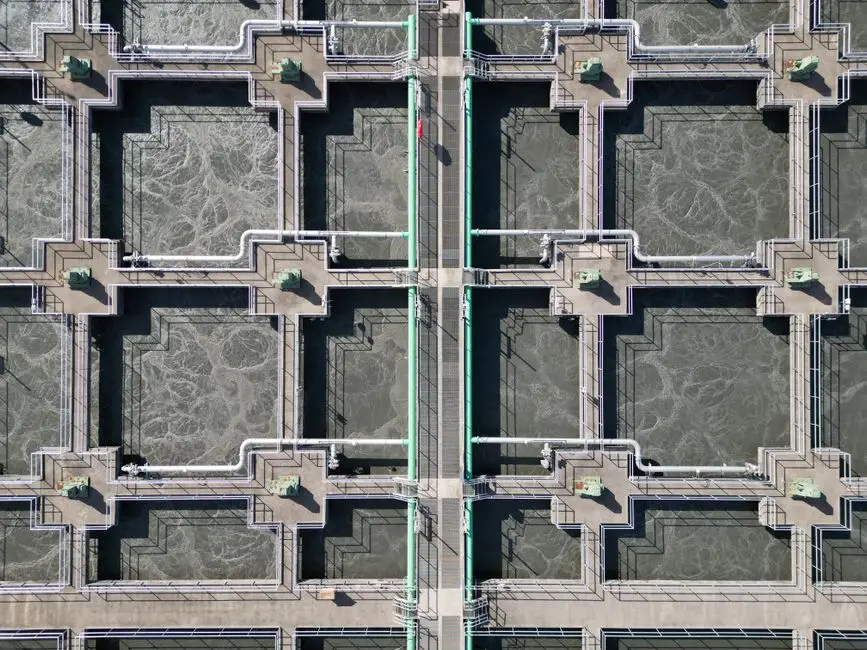
Four failure modes account for roughly 80% of the 12-month post-commissioning service calls on optical film recycling trains, and each one is preventable at the design stage. RO fouling from PVA carryover is the most common — PVA that slips past the DAF fouls the lead RO element within 60–90 days. The fix is to tighten DAF coagulant dose (PAC 80–120 mg/L, PAM 1–3 mg/L), add a polishing activated-carbon stage after MMF, and verify SDI <3 before RO.
UF fiber breakage from chlorination shock is the second — CEB NaOCl above 500 mg/L degrades PVDF fiber. Switch to on-site chlorine dioxide for membrane-friendly disinfection at 2–5 mg/L residual, which gives equivalent microbial control without fiber damage. Scaling on pass-2 RO from silica carryover is the third. Install antiscalant dosing upstream of pass 1, monitor LSI and S&DSI daily, and design pass-2 recovery at 85% rather than 90% to keep silica below its solubility limit.
Biofouling in the equalization tank during low-flow periods (weekends, model changeovers) is the fourth. Schedule intermittent aeration to keep DO above 1.5 mg/L, and apply a weekly shock chlorination to 5–10 mg/L for 30 minutes. AI-driven process control cuts these events sharply: the AI process control framework for textile wastewater plants transfers directly to optical film matrices, where the same intermittent-load and surfactant-foaming dynamics dominate.
Treat these four failure modes as a commissioning checklist — the plants that walk through them at startup are the ones that hit 80%+ recovery in year one and keep it there.
Next Steps for Specifying the Train
Who this is for: display and optical film plant owners planning 50–500 m³/day recovery trains, and EPC teams pricing them into new fab budgets. Who should look elsewhere: sites whose discharge caps are loose and water is cheap — the train earns its keep only under one of the three pressures above. Bring a 24-hour flow profile and a full effluent matrix to your first design review; those two documents decide the DAF size and the RO staging.
Send the flow profile, matrix, and target reuse rate through our quote request for a line-item CAPEX and OPEX model on a skid-mounted train.
Frequently Asked Questions
What recovery rate can a 2026 optical film wastewater recycling system achieve?
A properly designed train — equalization, DAF, MMF, UF, two-pass RO, optional EDI — recovers 75–90% of feed flow, with most 2026 retrofits landing at 82–88%. The recovered permeate meets <10 µS/cm and, with EDI polish, exceeds 15 MΩ·cm for Class 1000–10,000 cleanroom reuse (HydropureWater field data, 2026).
Why can't a standard biological treatment handle polarizer effluent?
PVA has a BOD/COD ratio of only 0.18–0.25, photoinitiators (Irgacure 184, 819, TPO) inhibit nitrifiers above 5 mg/L, and the flow is intermittent with 3× load swings during coating-head changeovers. These three factors force designers toward physical-chemical + membrane trains rather than activated sludge (HydropureWater 2026 influent study, 12 lines sampled).
What influent COD and conductivity should the pre-treatment handle before RO?
RO feed should be <50 mg/L COD, SDI <3, turbidity <0.5 NTU, and free chlorine <0.1 mg/L. The UF stage typically delivers these numbers; failing to hit them is the biggest cause of premature RO replacement. Verify all four parameters weekly during the first quarter of operation.
How is the recovered water qualified for cleanroom reuse?
Two-pass RO permeate meets <10 µS/cm; an optional EDI or mixed-bed polisher brings resistivity above 15 MΩ·cm, the threshold for ultra-pure rinse in Class 1000–10,000 cleanrooms. TOC is typically held below 50 ppb after EDI, well inside the bounds most display manufacturers specify for final rinse.
What does a 200 m³/day optical film recycling train cost in 2026?
Turnkey CAPEX runs USD 1.2–2.5 million FOB China, with OPEX of USD 0.18–0.28 per cubic meter of treated water and a typical payback of 3–4 years at industrial water tariffs above USD 1.50/m³. Plants with ZLD mandates or high scarcity penalties see payback compress to 2.5–3 years. A two-pass industrial RO system is the largest single line item, typically 25–30% of the equipment CAPEX.
Is ZLD required for optical film plants?
Not in every jurisdiction in 2026, but an increasing number of Chinese display hubs (Chongqing, Hefei, Wuhan) and Korean display clusters are imposing ZLD or near-ZLD limits on new fabs. For plants in those zones, the train extends with a brine concentrator and crystallizer, raising 500 m³/day CAPEX to USD 6–12 million but eliminating discharge and securing the water supply.
How does an MBR integrate with the optical film recycling train?
An integrated MBR is most often placed on the concentrate line after RO pass 1, polishing concentrate COD below 30 mg/L before it is sent to a brine concentrator or on-site WWTP. It can also serve as a sidestream for the alkaline developing wastewater, where the high MLSS handles surfactant shocks better than a settling clarifier.