Separate the Wastewater Streams Before Choosing Equipment
A data center in Salta should treat cooling blowdown and sanitary wastewater as separate streams, then confirm the receiving route in writing before selecting equipment. Cooling blowdown may require pH adjustment, suspended-solids filtration, dechlorination, heavy-metal removal or reverse osmosis depending on water chemistry, discharge limits and reuse goals. Sanitary sewage usually follows a biological treatment route. Because the supplied research does not establish Salta permits or sewer limits, the practical next step is a source-by-source register covering flow, temperature, chemistry, chemicals and discharge destination, followed by an RFQ based on representative analyses.
Do not combine streams merely because they eventually reach the same facility. Cooling blowdown, sanitary sewage, equipment-cleaning wastewater, water-treatment backwash and air-handling condensate have different pollutant profiles, flow patterns and reuse potential. The Tucumán source reports the same stream-segregation issue and states that the cooling-water chemical package and receiving utility requirements should determine the collection strategy (HydropureWater, Tucumán cooling-blowdown treatment article, undated).
For each stream, record minimum, average and peak flow, temperature range, source, discharge destination, reuse intent and whether entry into the sanitary sewer is permitted. For cooling blowdown, also obtain source-water analysis, expected cycles of concentration, operating blowdown flow, complete chemical inventory and representative source and blowdown samples. These inputs are prerequisites for calculating treatment duty; a nominal cooling-system flow is not a sufficient design basis.
The receiving route should be fixed before technology selection: sanitary sewer, direct environmental discharge or defined reuse. UGA Extension notes that cooling-system blowdown may contain treatment chemicals and can require wastewater treatment or permits before discharge (University of Georgia Cooperative Extension, 2026). That source concerns United States requirements, not Salta. Use it to define questions, then obtain current written criteria from the competent Salta authority and receiving utility.
| Stream register | Required characterization | Decision unlocked |
|---|---|---|
| Cooling-tower blowdown | Minimum, average and peak flow; temperature; cycles of concentration; source and blowdown analyses; chemical package; residual biocide; corrosion metals | Determine pretreatment, chemical control, discharge or reuse train |
| Sanitary sewage | Average and peak flow; fixture and process contributions; intended reuse; whether sewer entry is authorized | Define biological treatment and effluent endpoint |
| Equipment-cleaning wastewater | Cleaning agents; oil and grease; solids; batch volume; segregation method | Define neutralization, separation and batch treatment |
| Water-treatment backwash | Filter or membrane type; backwash frequency; chemical additives; concentrate volume | Determine recovery, segregation or disposal route |
| Air-handling condensate | Generation rate; possible contamination; collection point | Confirm whether direct reuse or sewer discharge is acceptable |
This data-center wastewater route and sizing framework provides a useful structure for developing the register, but its local requirements must not be transferred to Salta without written confirmation.
Identify the Pollutants That Control the Treatment Train
Cooling blowdown treatment should be selected from the limiting constituent in representative effluent, not from a preferred machine. The Tucumán source identifies total dissolved solids, chlorides, sulfates and phosphates as constituents of concern, noting that dissolved minerals can require advanced treatment such as reverse osmosis (HydropureWater, Tucumán cooling-blowdown treatment article, undated).
The decision follows the contaminant-to-function relationship. Suspended and colloidal solids require filtration where they threaten downstream equipment or the confirmed endpoint. Residual chlorine or another biocide requires dechlorination or reconsideration of the cooling-water chemical program. Copper, zinc and other corrosion products may require precipitation or ion exchange. Acidic or alkaline blowdown requires pH adjustment. Dissolved salts justify reverse osmosis when the receiving criteria or reuse quality cannot be met through the selected unit operations.
Reverse-osmosis pretreatment must also be defined by the water profile. The Tucumán article identifies multi-media filtration and activated carbon as pretreatment for RO reuse, while also requiring attention to concentrate management and membrane cleaning. A general U.S. source likewise lists reverse osmosis among cooling-blowdown treatment approaches (UGA Extension, 2026), but does not establish that it is required for a Salta installation.
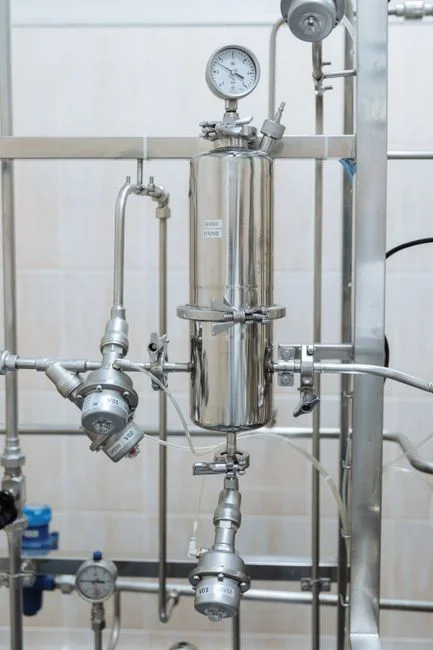
Available equipment specifications do not substitute for site data. The supplier-described ultrafiltration system for blowdown solids removal has a stated capacity of 2,000–40,000 L/h, uses 0.03-micron PVDF membranes and includes automatic backwash and air scour. It can therefore be evaluated for solids removal or RO pretreatment after confirming flow, feed characteristics, required filtrate quality and residual handling. The automatic chemical dosing system should be sized from measured flow, pH and chemical demand, not selected from an assumed blowdown rate.
| Verified concern | Required treatment function | Inputs needed from the buyer | Acceptance evidence |
|---|---|---|---|
| TDS, chlorides, sulfates or phosphates | Advanced treatment when required, potentially RO | Full source and blowdown analyses; endpoint; recovery expectation | Permeate and concentrate analyses at agreed operating conditions |
| TSS and colloidal solids | Clarification or filtration | TSS profile; particle characteristics; solid loading | Filtrate TSS and turbidity; backwash and residue records |
| Residual chlorine or biocide | Dechlorination or chemical-program change | Chemical inventory; residual measurements; reaction demand | Residual-biocide result at designated sample point |
| Copper, zinc or other metals | Precipitation or ion exchange | Representative metals analysis; corrosion-source review | Effluent metals results; sludge or spent-media disposition |
| Acidic or alkaline effluent | pH neutralization | pH distribution; flow; acid or caustic demand; chemical compatibility | Continuous pH response and off-specification trip test |
Size the System from Verified Flow and Water Chemistry
Cooling-blowdown equipment should be sized from the site’s operating flow and concentrate chemistry, not from a generic data-center ratio. The Buenos Aires engineering article uses the relationship blowdown = makeup ÷ (cycles of concentration − 1). Its example uses 1,200 m³/day of makeup at 4–6 cycles of concentration and reports 240–300 m³/day of blowdown (HydropureWater, Buenos Aires data-center wastewater article, 2026). Those values are illustrative Buenos Aires inputs, not Salta design values.
Confirm the actual makeup and blowdown under the intended cooling configuration and operating regime. Check the calculation against measured flows, evaporation losses, drift, chemical additions and blowdown control. Chemical dosing capacity should follow measured flow, pH and reagent demand because those variables determine the injection rate, storage duration and control response.
Sanitary treatment starts with confirmed average and peak flows, wastewater characteristics and the reuse endpoint. The supplier-described packaged WSZ range is 1–80 m³/h, while the supplier-described MBR system for sanitary wastewater covers 10–2,000 m³/day (HydropureWater, Buenos Aires data-center wastewater article, 2026). Neither range determines selection for Salta. Footprint, effluent quality, reuse requirements, operations and residuals must be compared against verified site inputs.
The layout also needs physical provisions often missed during equipment pricing: containment, segregated drainage, chemical storage, maintenance access, sample points, automated pH and flow monitoring, and storage for filter backwash, spent media or treatment sludge. Residuals must have a documented destination; collection equipment alone does not establish disposal acceptance.
Use this sequence for preliminary sizing:
- Issue a source-by-source flow and water-analysis register.
- Select the sanitary, blowdown and residual treatment objectives from the confirmed route.
- Calculate duty from minimum, average and peak conditions.
- Size each treatment function and its auxiliary systems.
- Reconcile equipment capacity, storage, footprint and utility demand with the P&ID.
Choose Between Discharge, Reuse and Closed-Loop Cooling
The preferred endpoint determines whether treatment is needed for compliance, reuse or cooling-system performance. UGA Extension reports that closed-loop systems can reduce water consumption by up to 70% compared with traditional open evaporative cooling, but they require greater system complexity (University of Georgia Cooperative Extension, 2026). That is a comparative cooling-system finding, not a Salta project estimate.
A discharge proposal should state the confirmed receiving route and demonstrate compliance with every applicable pollutant, temperature, flow and monitoring condition. A reuse proposal must define the receiving process: cooling makeup, irrigation, construction dust control or another specified use. Collection of blowdown alone does not make reuse technically or legally acceptable (HydropureWater, Tucumán cooling-blowdown treatment article, undated).
The supplier-described industrial softener range is 1–45 T/h with paired brine tanks up to 2,000 L, while the supplier-described reverse-osmosis product is identified as an industrial purification system (HydropureWater, product information supplied for this article, 2026). These specifications permit preliminary market comparison, but final selection still depends on measured hardness, scaling constituents, required recovery, pretreatment and brine disposal.
For a cooling reuse train, compare at least clarification or filtration, softening, RO and return to the cooling system. The Buenos Aires article cites industrial RO recovery of 75–95% for this application (HydropureWater, Buenos Aires data-center wastewater article, 2026). Confirm recovery against the full constituent profile and account for concentrate disposal rather than accepting recovery as an unconditional guarantee.
RO pretreatment may include multi-media filtration and activated carbon to reduce membrane fouling and control cleaning demand. At the same time, the industrial-water softener system and reverse-osmosis water-purification system should be evaluated against the reuse endpoint, required water quality, space, utilities and residual-management requirements.
| Option | Primary objective | Decision criteria | Key procurement guarantee |
|---|---|---|---|
| Sanitary-sewer discharge | Comply with confirmed connection and pretreatment conditions | Written acceptance; flow, pollutant, temperature and monitoring limits | Certified startup performance at agreed peak flow |
| Direct environmental discharge | Meet confirmed effluent and receiving-water criteria | Authorised route, discharge point, monitoring schedule and reporting | Compliance with each stated parameter under representative loading |
| Cooling reuse | Return treated water to a defined cooling process | Makeup quality, recovery, pretreatment, concentrate and storage | Flow, recovery and endpoint quality under defined source-water conditions |
| Closed-loop cooling | Reduce evaporative water consumption | Cooling redesign, utility demand, complexity and operating controls | Water balance and cooling performance across the agreed operating envelope |
The high-purity cooling-water systems reference can inform the engineering comparison, but local reuse acceptance remains a Salta confirmation item.
Build an RFQ That Converts Requirements into Guarantees
The RFQ should convert the verified route, analyses and reuse endpoint into testable supplier obligations. Give every bidder the same design flow, source-water report, representative blowdown analyses, cycles of concentration, chemical inventory, confirmed destination, reuse specification, footprint, utility requirements and monitoring schedule.
Require itemized pricing for treatment equipment, chemical storage, membranes or filter media, residual collection and disposal, monitoring instruments, laboratory analysis, utilities, commissioning, operator training and maintenance. Separate one-time capital cost from consumables, reagent use, membrane or media replacement, residue handling and scheduled service so proposals can be evaluated over the operating period.
Turn the limiting parameter into a measurable acceptance criterion. A dechlorination test should identify the residual-biocide input and required output; a solids-removal test should state the flow and solids loading; an RO test should define recovery and constituent endpoints. Also require guaranteed treatment flow, chemical consumption under specified loading, control logic, interlocks, bypass philosophy, off-specification response and maintenance intervals. These measures convert the cooling-blowdown discharge and reuse comparison into enforceable vendor commitments.
Include the following procurement package:
- Source-by-source flow register and representative laboratory analyses.
- Cooling-water chemical inventory and residual-biocide information.
- Written receiving-route criteria and identified regulator or utility.
- Defined reuse endpoint and applicable quality specification.
- Equipment P&ID, controls narrative, footprint and utility load.
- Containment, sampling, drainage and residual-management plan.
- Commissioning protocol, acceptance criteria, warranty and performance guarantees.
No verified Salta permit limits, sewer conditions, direct-discharge requirements or monitoring schedule appear in the supplied research. Obtain written confirmation from the competent authority and receiving utility before ordering. The Tucumán article identifies the same unresolved evidence gap for its jurisdiction and explicitly treats U.S. discharge frameworks as non-transferable (HydropureWater, Tucumán cooling-blowdown treatment article, undated).
Frequently Asked Questions
Why should cooling blowdown and sanitary sewage be treated separately?
They have different chemistry, flow patterns and discharge requirements. Cooling blowdown can contain concentrated minerals, treatment chemicals, suspended solids and biocide residues, while sanitary sewage requires biological treatment and has different reuse criteria. Combining them can increase treatment duty and weaken monitoring.
Which measured inputs are needed before equipment can be sized?
Request minimum, average and peak flows; source-water and representative blowdown analyses; cycles of concentration; temperature; chemical inventory; residual biocide; pH; solids; metals; dissolved minerals; footprint; and the confirmed receiving or reuse endpoint. Without these inputs, treatment capacity and chemical consumption cannot be defended.
How should a discharge proposal be compared with an RO reuse proposal?
Compare them against the same verified water analyses and operating flow. Require total capital and operating inputs, guaranteed flow, effluent or reuse quality, recovery, pretreatment, concentrate and residual handling, utilities, and maintenance. The reuse option should also define storage, distribution and backflow controls.
What should suppliers guarantee, and what must be verified in writing in Salta?
Require guarantees for treatment flow, the limiting contaminant, chemical consumption under specified loading, controls, bypass response and maintenance intervals, supported by startup tests. Before ordering, obtain written confirmation of the discharge route, applicable limits, connection conditions, monitoring requirements and reuse acceptance from the competent Salta authority and receiving utility.