
Separate sanitary wastewater from cooling process water
San Miguel de Tucumán’s data center wastewater design begins with two distinct systems: domestic sanitary sewage and industrial process wastewater. RSP Engineers identifies cooling-tower blowdown as the principal process-wastewater source in large data centers and distinguishes it from domestic flow, which is typically smaller but has different discharge characteristics and regulatory treatment (RSP Engineers, undated). The project team should also investigate water-treatment backwash, equipment-cleaning wastewater and air-handling condensate before assigning each stream to a collection system, treatment train and permitting route.
Create a source-by-source register with at least these fields:
- Flow: continuous, intermittent and peak generation, including blowdown tied to cooling-system makeup and evaporation.
- Condition: temperature, suspended solids, dissolved salts, pH, chlorine and metals that may require control.
- Chemicals: biocide, corrosion inhibitor, antiscalant, acid or caustic, cleaning products and any material used in water-treatment backwash regeneration.
- Evidence: sampling point, sampling method, operating condition represented and laboratory used.
- Destination: sanitary sewer, approved direct-discharge route, treatment system or on-site reuse.
Do not combine sanitary and process wastewater merely because both are wastewater. The stream segregation and control strategy should reflect the cooling system, the treatment chemical package, the receiving utility’s requirements and written local approval. Similar project-development issues are addressed in the data center wastewater treatment guide and the Muntinlupa data center wastewater treatment guide; however, neither establishes requirements for San Miguel de Tucumán.
Characterize blowdown before choosing treatment
Cooling-blowdown chemistry determines the limiting contaminant and the necessary pretreatment modules, as evaporation leaves minerals and treatment chemicals behind. RSP Engineers identifies elevated total dissolved solids, chlorides, sulfates and phosphates as common constituents of concern; it states that dissolved minerals can be difficult to remove and may require advanced treatment such as reverse osmosis (RSP Engineers, undated). The project should not size equipment from the cooling system’s nominal blowdown flow alone.
Obtain the source-water analysis, expected cycles of concentration, operating blowdown flow, temperature range, cooling-water chemical package and representative source and blowdown samples. Confirm whether copper and zinc arise from corrosion and identify the biocide chemistry. The chemical package is a prerequisite to permit preparation because it directly determines which water-quality parameters need control (RSP Engineers, undated).
| Input or condition | Why it controls design | Information required |
|---|---|---|
| pH | Acidity or alkalinity may require dosing before discharge. | Representative measurements, chemical products and receiving criteria. |
| TDS, chlorides, sulfates and phosphates | Concentrated dissolved constituents may require advanced treatment. | Source-water chemistry, cycles of concentration and blowdown analysis. |
| Suspended solids | Solids can foul downstream treatment or exceed local limits. | TSS results and evidence of cooling-system or carryover sources. |
| Residual chlorine or other biocide | Persistent disinfectant may require dechlorination or chemical change. | Complete biocide package, residual measurements and discharge criteria. |
| Copper and zinc | Corrosion products may require dedicated removal. | Representative metals analysis and confirmation of corrosion sources. |
| Temperature | Hot blowdown can affect a receiving treatment system. | Seasonal temperature range and locally applicable limits. |
RSP Engineers discusses a commonly cited pH range of 6.0–9.0 and gives 150°F only as an example maximum temperature limit (RSP Engineers, undated). Neither value is an Argentine or Tucumán requirement. Use them only to frame questions, not as design criteria. Further process context appears in the cooling blowdown treatment guide.
Select the discharge route and reuse strategy
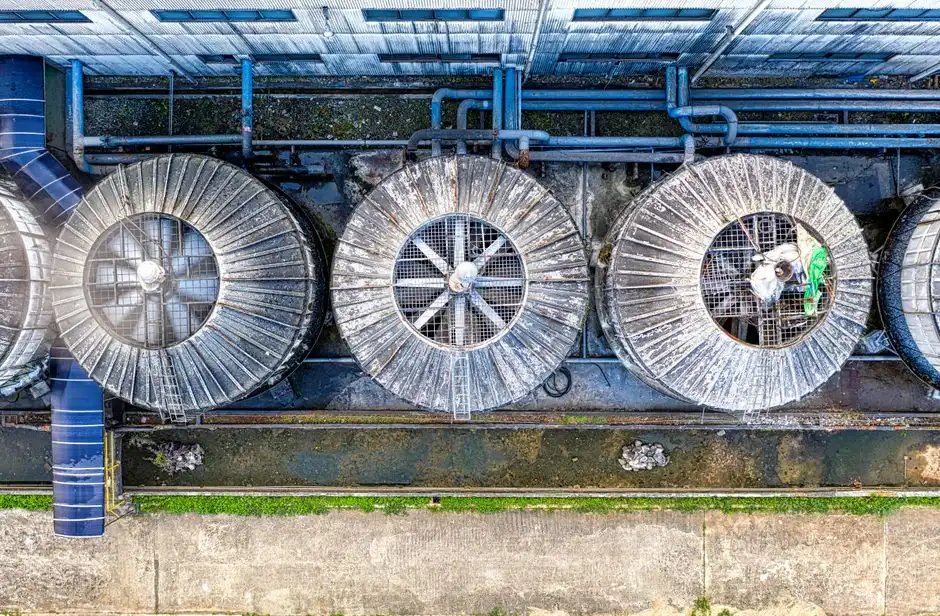
The discharge route must be selected from written local acceptance criteria before treatment equipment is ordered. RSP Engineers describes sanitary-sewer discharge under an industrial-user or pretreatment authorization and direct surface-water discharge under an NPDES-style permit as two principal frameworks (RSP Engineers, undated). These are United States frameworks; Argentine equivalents and the competent authority for a San Miguel de Tucumán site were not identified in the supplied research.
| Route | Use it when | Required confirmation before design |
|---|---|---|
| Sanitary sewer with industrial-user or pretreatment authorization | The local utility accepts process wastewater after the specified pretreatment. | Written acceptance; pollutant, flow, temperature and monitoring limits; connection conditions; residual ownership and monitoring obligations. |
| Approved direct environmental discharge | The competent authority permits the proposed receiving water and treatment performance. | Authorised route, discharge point, effluent criteria, monitoring schedule, reporting process and any environmental assessment. |
| On-site reuse | Treated water has a defined end use and its quality satisfies the receiving process or applicable rules. | Water-quality endpoint, distribution system, storage, backflow and contamination controls, and authority acceptance where required. |
RSP Engineers identifies irrigation, construction dust control and cooling reuse as possible uses for treated blowdown (RSP Engineers, undated). It also states that process wastewater must not pass through a stormwater system; that statement concerns the cited U.S. framework and does not establish a Tucumán legal conclusion. It should be treated as a design prohibition unless the local authority provides specific written approval. Further reuse considerations are set out in the wastewater reuse treatment options.
For San Miguel de Tucumán, request written confirmation from the relevant local and national authorities. The supplied evidence contains no verified local discharge limit, permit route, connection condition or monitoring condition. Sewer connection, direct discharge, reuse and equipment procurement remain unresolved until that evidence is obtained.
Build the pretreatment train around the limiting contaminant
The treatment train should be built around the worst verified discharge parameter, not around a preferred technology. RSP Engineers identifies pH neutralization for acidic or alkaline blowdown, filtration for suspended solids, chemical precipitation or ion exchange for heavy metals, and dechlorination where residual biocide is present (RSP Engineers, undated). Reverse osmosis is an advanced option where the discharge criteria or reuse objective justify it; University of Georgia Extension likewise identifies reverse osmosis among treatment approaches for cooling-system blowdown (UGA Extension, 2026).
| Objective | Potential module | Design condition | Scope still required |
|---|---|---|---|
| Control acidity or alkalinity | pH neutralization system with acid or caustic dosing | Representative pH, flow and chemical consumption. | Dosing rate, tank volume, control sequence, containment and local chemical-approval checks. |
| Remove suspended solids | Filtration or an ultrafiltration pretreatment system | Solid loading, particle characteristics and required solids endpoint. | Filtrate quality, cleaning method, waste-residue storage and replacement strategy. |
| Remove copper, zinc or other metals | Chemical precipitation or ion exchange | Representative metals concentrations and permit limit. | Sludge or spent-media handling, residual disposal and compatibility with the selected chemistry. |
| Reduce residual chlorine | Dechlorination | Residual chlorine, reaction requirements and downstream disinfectant needs. | Dosing control, contact arrangement and verified off-specification response. |
| Reduce dissolved salts or meet a reuse endpoint | Reverse osmosis, potentially after pretreatment | TDS and constituent profile plus the required reuse quality. | Permeate recovery, pretreatment, concentrate management, membrane replacement and energy demand. |
Footprint can control the project plan. RSP Engineers states that a simple pH-neutralization system may occupy a few hundred square feet, while filtration combined with chemical precipitation may require several thousand square feet for equipment, tanks and chemical storage (RSP Engineers, undated). Reserve space for containment, drainage, chemical storage, maintenance access, sample points, automated pH and flow monitoring, and filter or sludge residues. An automatic chemical dosing system should be specified around measured flow, pH and chemical demand, not selected before those inputs are available.
Chemical compatibility also requires verification. Permit requirements for a treatment chemical do not by themselves establish compatibility with cooling equipment, membranes, liners or stored chemicals.
Define monitoring, commissioning and reuse acceptance

Acceptance criteria translate the selected discharge or reuse route into measurable operating and commissioning requirements. RSP Engineers states that industrial discharge permits can require regular sampling, certified-laboratory analysis, compliance reporting and automated pH and flow monitoring (RSP Engineers, undated). For Tucumán, the permit holder and laboratory should be identified from the written authorization rather than assumed from general guidance.
- Establish the compliance baseline: obtain the applicable pH, flow, temperature, suspended-solids, residual-chlorine, TDS and metals limits, plus any limits for treatment chemicals.
- Confirm analytical methods: specify sampling points, sample preservation, laboratory accreditation and whether each parameter requires continuous monitoring, routine sampling or event sampling.
- Write startup tests: demonstrate flow, pH control, residual-chlorine removal or conversion, solids removal and any required metals or TDS performance under representative operating conditions.
- Test failure responses: verify high-level alarms, chemical-dosing interlocks, automatic bypass or shutdown conditions, containment response and the operator’s notification process.
- Maintain readiness: include spare filter elements or membranes, chemical reserve, calibration requirements and access for laboratory and maintenance personnel.
For reuse, define the endpoint before selecting final filtration, reverse osmosis or disinfection. An irrigation, dust-control or cooling application has different quality and distribution requirements. Collection of blowdown alone does not establish that reuse is technically or legally acceptable. The broader Muntinlupa data center wastewater treatment guide provides a useful comparison framework, but its local requirements do not transfer to San Miguel de Tucumán.
The equipment procurement package should include the design flow, water analyses, source-water report, cycles of concentration, chemical inventory, applicable permit, plot-space constraints, utility requirements, monitoring schedule, commissioning tests, control narrative, bypass philosophy, residue-management plan and performance guarantees. This turns the discharge decision into a verifiable equipment scope.
Frequently Asked Questions
What treatment does a data center in San Miguel de Tucumán need for cooling blowdown?
It needs an industrial wastewater pretreatment train selected from the blowdown chemistry and confirmed discharge route. Modules may include pH neutralization, filtration, dechlorination, heavy-metal removal and reverse osmosis, but no verified Tucumán limit or site-specific chemical analysis was supplied, so the final train cannot be specified yet.
How much will the wastewater and cooling blowdown treatment cost?
The supplied research contains no quotation or project price. Request itemized capital and operating proposals covering treatment equipment, chemical storage, membranes or filter media, residuals disposal, monitoring, laboratory analysis, utilities and maintenance. Give each supplier the same flow, analysis, duty, footprint and acceptance criteria so that the proposals are comparable.
Which discharge route should be selected before sizing equipment?
Seek written confirmation of the sanitary-sewer, direct-discharge and reuse routes from the competent authorities. The sewer route cannot be treated as approved merely because it is a common industrial route in other jurisdictions, and stormwater routing must not be assumed acceptable.
How should the project select and verify a treatment supplier?
Require suppliers to demonstrate performance against the written permit or reuse endpoint, provide guaranteed flow and chemical consumption data, confirm control and bypass logic, identify maintenance and replacement requirements, and include startup tests for the limiting contaminant. Also require a site-specific scope for tanks, dosing, containment, sampling, monitoring and treatment residues before selecting the supplier.
What information is needed to size the pretreatment system?
Provide source-water quality, representative blowdown analyses, cycles of concentration, minimum, average and peak flow, temperature range, complete chemical package, sampling points and the confirmed discharge or reuse criteria. These inputs determine the treatment duty; without them, equipment capacity and consumption estimates are not defensible.
When can the project proceed from selection to procurement?
Proceed when the discharge route, applicable limits, representative wastewater data and intended reuse endpoint are documented, and the project team has converted them into a treatment objective, equipment list, monitoring plan and commissioning acceptance criteria. Earlier procurement risks selecting a technology that cannot meet the confirmed duty or site constraints.