
Separate blowdown from sanitary sewage
The closest supplied Port Harcourt reference separates cooling-tower blowdown from domestic sewage because the streams have different compositions, flow characteristics and treatment requirements; its figures are preliminary analogues, not Calabar design loads. The reference associates 170–340 m³/day of blowdown with a 5–10 MW campus and 15–40 m³/day of sewage with a 200–500-person shift, although the excerpt also states 80–250 m³/day for cooling blowdown on a comparable load.
That internal variation is a warning: the Port Harcourt values should not be transferred to Calabar without reconciliation. A single combined treatment train would expose biological MBR media to cooling-water chemicals, elevated temperature and variable salinity. The appropriate arrangement is a physico-chemical blowdown train and a separate sanitary-sewage bioreactor, as discussed in the data-center blowdown treatment-train comparison.
| Design input | Cooling-tower blowdown | Sanitary sewage | Calabar information required |
|---|---|---|---|
| Preliminary analogue | 170–340 m³/day for the referenced 5–10 MW Port Harcourt campus | 15–40 m³/day for the referenced 200–500-person shift | Measured Calabar flow and confirmed campus configuration |
| Dominant characteristics | Concentrated salts and cooling chemicals, including corrosion inhibitor, scale inhibitor, biocide and dispersant | Biological organic load from staff facilities | Representative chemical and wastewater analyses |
| Preliminary treatment concept | Screening, equalization, pH control, DAF, filtration and then discharge or RO reuse | Separate biological treatment | Route and performance confirmed through project design |
| Key sizing basis | Evaporation, cycles of concentration, chemicals and discharge route | Peak flow, BOD₅, TSS and operating hours | At least one full cooling-season dataset |
Before selecting equipment, the facility team should provide the cooling configuration, measured evaporation rate, cycles of concentration, chemical program, wastewater flow, occupancy and effluent samples. The data-center wastewater reuse-versus-discharge analysis provides a further route comparison, but it does not establish Calabar permits, intake chemistry or design flows.
Build the Calabar design basis before choosing equipment
The supplied research does not provide Calabar-specific intake TDS, source-water temperature, storm conditions, campus load or wastewater flows, so no treatment skid can yet be sized defensibly. The project should obtain at least one full cooling-season dataset, including operating periods, representative wastewater samples and a traceable water balance before equipment selection.
Issue a chemical-analysis request covering source water and blowdown. The required parameters are TDS, pH, conductivity, hardness, silica, iron, suspended solids, orthophosphate, zinc, residual oxidizing biocide, temperature and flow. Include every cooling chemical, its dose range and application frequency because the Port Harcourt source, dated 2026, explains that corrosion inhibitor, scale inhibitor, biocide and dispersant accumulate as evaporation concentrates the circulating water.
The Port Harcourt reference uses 0.7–1.0 m³/hr of evaporation per MW of IT load and a 4.0 cycles-of-concentration example for brackish tropical feed. These figures are hypotheses for Calabar, not design criteria: replace them with measured evaporation, a validated climatic model and the actual cooling-water operating strategy. The equation stated in that source is:
Blowdown flow = evaporation loss ÷ (cycles of concentration − 1).
Equipment RFQs should also establish whether stormwater can enter the cooling or equalization system. The Port Harcourt article describes rainfall-driven equalization inflows, but it does not establish equivalent conditions at the Calabar site. A rotary mechanical screen for upstream debris protection can be evaluated after the inlet arrangement and peak flow are established.
| Fillable design-basis field | Entry or source | Procurement consequence |
|---|---|---|
| Cooling-system configuration | Open or closed loop; number and type of towers; operating schedule | Defines stream separation, equalization and standby requirements |
| IT load and campus development | Present and planned load | Sets hydraulic design basis; Port Harcourt values remain comparators only |
| Evaporation and blowdown | Measured seasonal evaporation, blowdown flow and CoC | Calculates pretreatment and storage duty |
| Water and effluent chemistry | Source-water and blowdown analyses | Sets DAF, filtration, RO and disinfection criteria |
| Cooling chemical program | Products, dose ranges, residual targets and control methods | Identifies dechlorination and membrane-protection needs |
| Sanitary-sewage basis | Occupancy, peak flow, BOD₅, TSS and operating hours | Determines bioreactor capacity and equalization |
| Discharge or reuse route | Receiving sewer or water body, consent route and tenant WUE requirement | Selects discharge disinfection, RO reuse or a third route for evaluation |
| Site utilities | Power, drain, compressed air, chemicals and sludge-removal route | Defines installation and operating-cost boundaries |
Chemical dosing should remain a controlled design item rather than a fixed bid assumption. An automatic dosing system can be included after jar testing establishes the required coagulant, flocculant, pH-adjustment and antiscalant duties.
Choose discharge treatment or RO water reuse
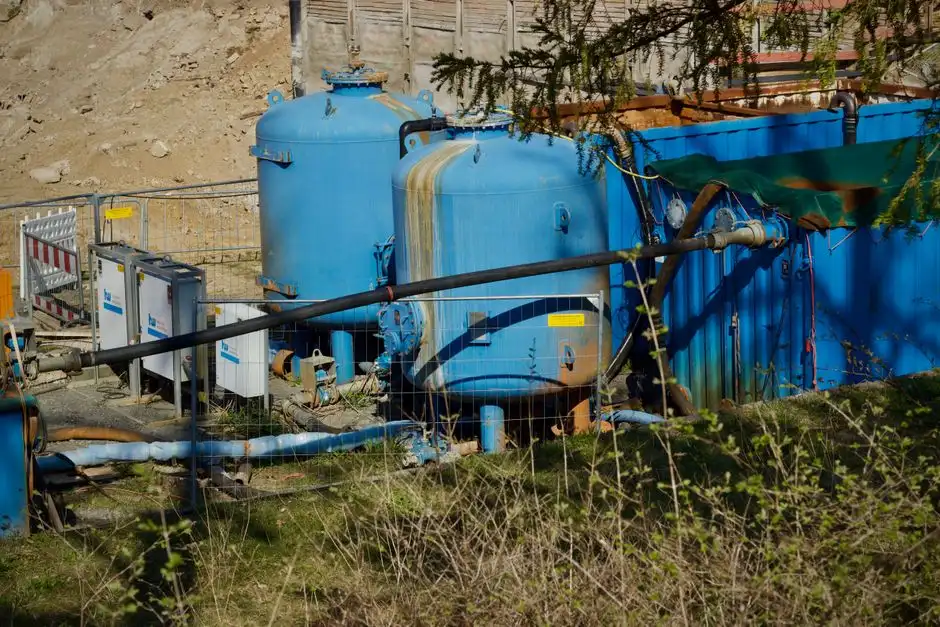
The Port Harcourt reference presents two branches after multimedia filtration: side-stream RO for cooling make-up reuse or chlorine-dioxide treatment for a sewer or surface-water discharge route. This branch point should follow confirmation of Calabar’s receiving authority, consent conditions and tenant water-use targets, not precede them.
For the RO branch, the Port Harcourt source, dated 2026, identifies 65–75% recovery and reuse-feed goals of SDI₁₅ below 3, turbidity below 0.5 NTU, free chlorine below 0.1 mg/L, iron below 0.05 mg/L and hardness below 50 mg/L as CaCO₃. These are preliminary feed specifications. An RO system for cooling make-up recovery should be sized only after actual source-water chemistry, recovery requirements, membrane condition and concentrate disposal have been established.
For discharge, the same source cites an FMEnv envelope of pH 6–9, TSS no more than 30 mg/L, BOD₅ no more than 50 mg/L, COD no more than 150 mg/L, total residual chlorine no more than 0.1 mg/L, total phosphorus no more than 2 mg/L, zinc no more than 1 mg/L and lead no more than 0.5 mg/L. These values are a preliminary compliance screen because the reference applies them in Port Harcourt; it does not prove that the same envelope or consent conditions apply in Calabar.
A third route deserves technical review: Saltworks, in the supplied commercial research, describes modular evaporator-crystallizers with automation, self-cleaning and true liquid discharge. That option should be evaluated against energy demand, concentrate or residual disposal, utility reliability, local service capability and permit requirements. “True liquid discharge” does not establish lawful discharge or automatic suitability.
| Decision | Use when | Required verification | Main treatment boundary |
|---|---|---|---|
| Discharge after physico-chemical treatment | The confirmed Calabar route accepts the resulting effluent and no tenant requirement forces higher recovery | Authority approval, sewer or surface-water consent, local limits, biocide residual and receiving-water conditions | Screening, equalization, pH control, DAF, filtration and disinfection |
| RO cooling make-up reuse | The project has verified water-recovery or tenant WUE objectives and a feasible concentrate route | Feed chemistry, RO recovery, permeate quality, scaling, membrane cleaning and concentrate disposition | Discharge pretreatment plus side-stream RO and controlled blending |
| Evaporator-crystallizer route | Near-liquid-discharge conditions dominate and energy, residues and local support are acceptable | Full mass and energy balance, residue destination, permit route and service support | Pretreated blowdown plus modular evaporation and crystallization |
If the confirmed discharge route uses chlorine dioxide, the chlorine-dioxide generation and contact system should be evaluated for feed conditions, safety, storage and effective contact performance rather than selected from nominal flow alone.
Select and size the treatment train
The Port Harcourt process framework routes blowdown through mechanical screening, equalization and neutralization, DAF, multimedia filtration, then either RO reuse or chlorine-dioxide disinfection. This sequence establishes unit-operation logic, but Calabar jar tests and pilot work must determine chemical doses, solids capture and pretreatment performance before equipment dimensions are fixed.
For the DAF stage, the Port Harcourt source uses pH 7.0–7.5, PAC 30–80 mg/L, flocculant 0.5–2 mg/L and 10–15 minutes of hydraulic retention. Treat these as starting conditions for testing, not guaranteed Calabar operating values. A DAF system for cooling-blowdown pretreatment should be checked against measured peak flow, temperature, chemical program, variable inflow and the resulting solids loading.
Sanitary sewage should use a separate MBR treatment train for the sanitary-sewage stream. The Port Harcourt reference selects a packaged MBR for the referenced 15–40 m³/day sewage flow and a 200–500-person shift, but the Calabar unit must be sized from verified peak flow and organic loading. The supplementary explanation of how MBR treatment works supports the process choice; it does not supply Calabar sizing data.
| RFQ package | Required duty and design evidence | Acceptance information |
|---|---|---|
| Blowdown screening and equalization | Peak flow, inlet arrangement, storage volume and pH-adjustment range | Screen performance, level-control response and documented detention calculation |
| DAF and chemical dosing | Representative water chemistry, trial-derived doses and solids balance | Guaranteed removal, sludge production, automatic control and sampling points |
| Filtration | Filtrate quality required by the selected discharge or RO branch | Turbidity, SDI and pressure-drop criteria under agreed operating cycles |
| RO or disinfection branch | Recovery objective or confirmed discharge chemistry; concentrate or contact-system basis | Guaranteed permeate quality or disinfection performance and agreed test protocol |
| Sanitary MBR | Measured peak flow, BOD₅, TSS, operating schedule and sludge route | Guaranteed hydraulic and effluent performance, membrane cleaning and standby provisions |
| Sludge handling | Measured solids concentration and dewatering trial | Cake consistency, batch cycle, filtrate return and disposal documentation |
Specify automatic controls, standby strategy, site utilities, maintainability, operator training and performance testing in the RFQ rather than purchasing on nominal flow alone. The source identifies DAF sludge at 0.5–1.5% dry solids and dewatering to 25–35% cake; verify both through Calabar pilot testing. If a filter press is selected, the plate-and-frame sludge dewatering system should be matched to measured cake behavior and the approved haulier’s acceptance criteria.
Verify compliance and procurement acceptance
The FMEnv values in the supplied Port Harcourt article are a preliminary screening envelope, not confirmed Calabar permit conditions. That article identifies the Federal Ministry of Environment, NESREA and state-level consents for its Port Harcourt location; it does not establish the competent authority, consent route or applicable limits for the Calabar site.
The permit specialist should identify the Cross River State authority, receiving sewer or surface-water conditions, EIA status, sludge-disposal route and required monitoring. Confirmation should also cover any tenant WUE requirement and whether the discharge point is controlled by the data-center owner, landlord or municipal utility.
Final acceptance should depend on representative influent testing, a site-specific mass balance, hydraulic testing, guaranteed effluent values and an agreed sampling protocol. The direct-versus-indirect discharge assessment illustrates why the receiving route must be defined, but it does not replace Calabar-specific approval evidence.
- Obtain the Calabar site data and complete the design-basis checklist.
- Confirm the receiving route and applicable consent with the relevant authority.
- Run jar tests and the necessary pilot work.
- Compare discharge, RO reuse and true-liquid-discharge routes against confirmed requirements.
- Issue an RFQ with guaranteed performance, test methods, sampling points and remedy provisions.
- Make final equipment acceptance conditional on site-specific testing and compliance evidence.
Frequently Asked Questions
Is DAF necessary for cooling-blowdown treatment in Calabar?
DAF is a credible pretreatment option when Calabar blowdown contains precipitated metals, orthophosphate or other solids that would impair downstream filtration or RO. It is not established as mandatory by the supplied research. Decide after representative testing identifies the solids fraction, chemical dosing demand and whether clarification removes contaminants that would otherwise foul the next unit.
How should the MBR and RO equipment be sized?
Size the MBR from verified Calabar peak sewage flow, BOD₅, TSS, operating hours and sludge-production duty; the Port Harcourt value of 15–40 m³/day applies only to its referenced 200–500-person shift. Size RO from measured feed chemistry, required cooling make-up quality, recovery and concentrate disposal. Neither the 15–40 m³/day sewage figure nor the source’s 65–75% RO recovery range is a Calabar guarantee.
What data should a supplier receive before quoting?
Require source-water and blowdown analyses, cooling configuration, evaporation and blowdown data, cycles of concentration, chemical inventory, wastewater flows and loads, proposed discharge or reuse route, site utilities, and confirmation of receiving-authority conditions. Ask bidders to state assumptions, exclusions, guarantees and test methods so that quotations can be compared on the same design basis.
How should cost and supplier-selection risk be managed before ordering?
No supplied source provides Calabar-specific equipment prices, permits or intake chemistry, so request an itemized quotation covering equipment, installation, chemicals, sludge handling, energy, controls, commissioning, training, guarantees and exclusions. For supplier selection, require evidence from representative Calabar testing, identifiable local service capability and a clear acceptance protocol. Do not compare skid prices alone, because an unverified chemical assumption or concentrate route can change the whole treatment solution.
Related Equipment
- DAF system for cooling-blowdown pretreatment — specifications, capacity range, and technical data