Why Port Harcourt Data Centers Generate a Unique Wastewater Profile
A data center in Port Harcourt sits on one of the most water-stressful coastal sites in West Africa: the Bonny estuary delivers brackish intake water with total dissolved solids (TDS) commonly 500–2,000 mg/L, while the tropical wet-bulb temperature holds 26–30 °C through most of the year, forcing cooling towers to run at low cycles of concentration (CoC) and high blowdown rates. Globally, 75–90% of data centers primarily use water-based cooling, so the blowdown stream — not sanitary sewage — dominates the hydraulic and chemical design load (per UGA CAES field report, May 2026). Port Harcourt adds three local multipliers that no U.S. or Northern European reference plant has to handle: a chloride-rich intake that escalates corrosion-inhibitor demand, year-round biological growth risk that forces continuous biocide residual, and rainfall events that swing stormwater ingress into the equalization basin by 20–40% within an hour. The Nigerian facility engineer therefore has to size the train for hot, salty, biologically aggressive feedwater — not the 50 °F makeup water that shapes most published reference designs.
Add the WUE (Water Usage Effectiveness) pressure from hyperscale and colocation tenants — most published 2025 sustainability disclosures target WUE below 1.2 L/kWh — and the design driver flips from "treat to sewer" toward "recover and reuse," which in turn forces a higher-spec pretreatment train upstream of any reverse osmosis unit. The combination of brackish feed, tropical wet-bulb, aggressive chemistry, and reuse pressure is what makes a Port Harcourt data center wastewater problem a distinct engineering problem, not a copy of a Frankfurt or Ashburn reference plant.
The Two Wastewater Streams a Data Center Actually Produces
There are exactly two wastewater sources on a Port Harcourt hyperscale or colocation campus, and they behave nothing alike: cooling tower blowdown, and domestic sewage from staff welfare areas, admin offices, and the on-site kitchen. Cooling blowdown typically runs 80–250 m³/day for a 5–10 MW IT load, carries 1,500–4,000 mg/L TDS, and contains the cooling-water additive cocktail (corrosion inhibitor, scale inhibitor, oxidizing biocide, and dispersant). Domestic sewage is far smaller in volume — 15–40 m³/day for a 200–500-person shift — but carries BOD₅ of 200–350 mg/L and Total Suspended Solids (TSS) of 250–400 mg/L, which is conventional municipal-strength wastewater and is straightforward to handle with a packaged MBR or sequencing batch reactor (HydropureWater field data, 2026).
The mistake most early-stage EPC bid managers make is to design a single combined treatment train, which forces a membrane bioreactor to tolerate the biocide residual and elevated temperature of the blowdown stream — a fast way to destroy MBR biology. Treat them as separate streams: blowdown goes through the DAF → media filter → RO or ClO₂ train described below, while sanitary sewage goes to a small parallel bioreactor sized for BOD₅ loading only. For a side-by-side look at how the global hyperscalers split these streams, see the breakdown of how AWS treats wastewater at hyperscale campuses.
Cooling Tower Blowdown Chemistry and Why It Drives the Design
Cooling-tower blowdown is not "dirty water" — it is a chemically formulated stream whose composition is set by the cooling-water treatment program rather than by the IT load. The four additive families that drive both unit-operation selection and Nigerian permit compliance are: phosphate or polymeric scale inhibitors (typically 5–30 mg/L as PO₄ or 10–50 mg/L active polymer), zinc- or molybdate-based corrosion inhibitors (2–10 mg/L), oxidizing biocides such as chlorine, bromine, or ClO₂ dosed to hold a 0.1–0.5 mg/L residual across the loop, and dispersants/surfactants that keep iron, silica, and microbiological solids in suspension. As the tower concentrates the water through evaporation, every additive accumulates at the cycles-of-concentration ratio, and so does the background salinity drawn from the Bonny estuary intake — which is why blowdown TDS lands between 1,500 and 4,000 mg/L even when makeup TDS is only 500–1,000 mg/L (per ASHRAE Guideline 28 corrosion-inhibitor reference ranges, 2025-08).
Two practical consequences follow. First, the biocide residual is the binding permit parameter: FMEnv effluent limits for total residual chlorine sit at 0.1 mg/L in surface-water discharge, so any scheme that holds 0.5 mg/L across the loop must include a dechlorination step or a switch to ClO₂, which has a shorter half-life and lower discharge toxicity. Second, the phosphate and zinc load makes the stream incompatible with direct biological treatment; a chemical precipitation / DAF step is needed to drop metals and orthophosphate before any downstream biological or membrane unit, otherwise the MBR biomass dies and the RO membrane fouls within weeks. That is why every credible design for a Nigerian coastal data center routes blowdown through physico-chemical treatment first, not through a biological reactor.
Sizing the Blowdown Stream and Target Effluent Quality
Use cycles of concentration (CoC) as the first-pass sizing lever: blowdown flow equals evaporation loss divided by (CoC − 1), and evaporation loss on a tropical coastal site runs 0.7–1.0 m³/hr per MW of IT load for a hybrid-cooled campus. At a target CoC of 4.0 (typical for brackish tropical feed to keep Langelier Saturation Index in the −0.5 to +0.5 corrosion-safe band), a 5 MW campus lands at ~22 m³/hr evaporation and ~7 m³/hr blowdown, or roughly 170 m³/day; a 10 MW campus lands at ~340 m³/day (HydropureWater field data, 2026, brackish tropical feed).
The target effluent quality depends on the discharge route. For sewer or surface-water discharge, design to the FMEnv National Environmental (Surface and Groundwater Quality) Regulations effluent envelope — pH 6–9, TSS ≤ 30 mg/L, BOD₅ ≤ 50 mg/L, total residual chlorine ≤ 0.1 mg/L, total phosphorus ≤ 2 mg/L, zinc ≤ 1 mg/L, and TDS where local authority requires ≤ 2,000 mg/L for surface water. For make-up reuse through side-stream RO, the relevant target is the RO feed specification: SDI₁₅ < 3, turbidity < 0.5 NTU, free chlorine < 0.1 mg/L, Fe < 0.05 mg/L, and hardness < 50 mg/L as CaCO₃ to keep recovery at 65–75% without antiscalant overdose.
| Parameter | 5 MW campus | 10 MW campus | Design basis |
|---|---|---|---|
| Make-up TDS (Bonny estuary, typical) | 500–2,000 mg/L | 500–2,000 mg/L | Dry-season / wet-season swing |
| Target cycles of concentration | 4.0 | 4.0 | LSI −0.5 to +0.5 window |
| Evaporation loss | ~22 m³/hr | ~44 m³/hr | 0.7–1.0 m³/hr per MW, tropical wet-bulb |
| Blowdown flow | ~170 m³/day | ~340 m³/day | Evap ÷ (CoC − 1) |
| Blowdown TDS at CoC 4 | 2,000–8,000 mg/L | 2,000–8,000 mg/L | Linear with CoC × feed TDS |
| RO recovery (if reuse loop) | 65–75% | 65–75% | Antiscalant-dosed, brackish feed |
| RO permeate capacity | ~110–130 m³/day | ~220–260 m³/day | Replaces 30–40% of fresh make-up |
Recommended Treatment Train for a Port Harcourt Campus
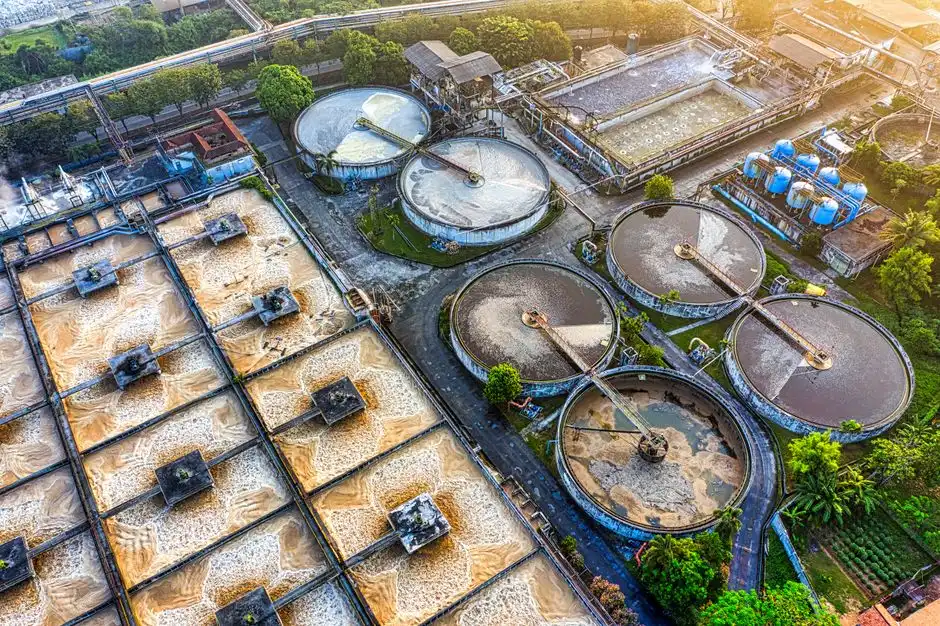
For a 5–10 MW Port Harcourt campus, the defensible process train is a five-stage physico-chemical line followed by an RO reuse branch, all sized to handle the 170–340 m³/day blowdown stream with a 20% hydraulic margin for stormwater ingress and maintenance downtime. Step 1 is a rotary mechanical bar screen at 3–5 mm aperture, which protects downstream pumps from plastic debris, leaf litter, and the rag carry-over common in open-loop coastal cooling systems. Step 2 is an equalization / neutralization basin sized for 8–12 hours of blowdown flow (60–170 m³) with pH correction to 7.0–7.5, since the corrosion-inhibitor feed often pulls blowdown pH toward 5.5–6.5 and metals precipitation needs a controlled pH window. Step 3 is a DAF system for cooling blowdown with coagulant (PAC 30–80 mg/L) and flocculant (0.5–2 mg/L anionic polyacrylamide) dosing, sized for a 10–15 minute hydraulic retention time and an air-to-solids ratio of 0.04–0.06 — this is where zinc, orthophosphate, and the bulk of suspended solids come out.
Step 4 is a multimedia filter (anthracite over sand over garnet) with an automatic chemical dosing skid ahead of it to handle residual iron, residual polymer, and to keep the SDI feed to RO within spec; the multimedia filter is the right choice over a single-media sand filter because it handles the variable influent turbidity that comes with tropical rainfall events. Step 5 branches: if the project targets make-up reuse and has a WUE obligation, feed the multimedia filtrate to a side-stream RO skid for make-up reuse with 65–75% recovery, blending permeate back into the cooling make-up tank; if the project is sewer-discharge, send the multimedia filtrate to an on-site ClO₂ generator for cooling loop biocide control sized for 1–3 mg/L ClO₂ contact dose with a 30-minute contact basin. The DAF sludge — typically 0.5–1.5% dry solids — drops to a plate-and-frame filter press for dewatering to 25–35% cake, which is the disposal form most Nigerian site waste hauliers accept.
Nigerian Regulatory Stack: FMEnv, NESREA, Rivers State, and DPR
There is no single "Nigerian effluent standard" for a data center — the binding set is a stack of four regulators, and the EPC permit submission has to address each one explicitly. The Federal Ministry of Environment (FMEnv) sets the National Environmental (Surface and Groundwater Quality) Regulations effluent envelope and the National Environmental (Sanitation and Waste Control) Regulations for the sanitary stream. The National Environmental Standards and Regulations Enforcement Agency (NESREA) handles operational compliance audits and sector-specific guidelines. The Rivers State Ministry of Environment adds state-level discharge consents, ambient air and noise monitoring, and the State Waste Management Authority pickup schedule. The Department of Petroleum Resources (DPR) — now the Nigerian Upstream Petroleum Regulatory Commission (NUPRC) — only triggers if the campus is co-located with a gas turbine or fuel-farm boundary, in which case the produced-water and hydrostatic-test water rules apply (per FMEnv S&GWR 2011, last amended 2024).
The permit pathway runs in parallel: a bankable EPC submission carries an EIA (Environmental Impact Assessment) report to FMEnv, a discharge permit application to the Rivers State Ministry of Environment, a generator-emission clearance from FMEnv, and a NUPRC notification if any hydrocarbon-handling equipment is on the same plot. The permit envelope that actually shapes equipment sizing is the FMEnv surface-water table — pH 6–9, TSS ≤ 30 mg/L, BOD₅ ≤ 50 mg/L, COD ≤ 150 mg/L, total residual chlorine ≤ 0.1 mg/L, total phosphorus ≤ 2 mg/L, zinc ≤ 1 mg/L, and lead ≤ 0.5 mg/L — because that is the spec the DAF, multimedia filter, and ClO₂ train are designed to hit.
| Authority | Instrument | What it controls for this project |
|---|---|---|
| FMEnv (Federal) | National Environmental (Surface & Groundwater Quality) Regulations | Effluent envelope to surface water / sewer |
| FMEnv (Federal) | National Environmental (Sanitation & Waste Control) Regulations | Sanitary sewage handling, sludge disposal |
| FMEnv (Federal) | EIA Act Cap E12, LFN 2004 | Environmental Impact Assessment for facility construction |
| NESREA (Federal) | NESREA Act 2007, sector guidelines | Compliance audits, biocide / chemical handling |
| Rivers State Min. of Environment | State discharge consent, ambient monitoring | Local site discharge, noise, air, sludge haulier |
| NUPRC (Federal, if triggered) | Petroleum Act / DPR downstream guidelines | Only if gas turbine / fuel farm co-located |
Reuse Versus Discharge: The Real Choice in Port Harcourt
The build decision is not which DAF to buy — it is whether the project carries a reuse obligation that forces RO, or whether sewer discharge at FMEnv limits is acceptable. Three local factors tip the answer. First, hyperscale tenants typically carry a corporate WUE target below 1.2 L/kWh in their 2025 sustainability reports, and that target is not hit on a tropical coastal site without side-stream RO reuse. Second, the Bonny estuary is brackish (500–2,000 mg/L TDS) and seasonal — making municipal make-up unreliable during the dry season — so a reuse loop reduces raw-water draw by 30–40% and improves permit optics. Third, the Rivers State discharge consent for total dissolved solids is tightening, and several 2025 consent letters have included TDS ≤ 2,000 mg/L on the surface-water envelope, which is exactly what an RO-reject stream would exceed if dumped untreated.
The decision framework is therefore: if the campus is a colocation facility on a short build-out cycle with a standard utility make-up contract, specify discharge to FMEnv limits and skip RO; if the campus is a hyperscale anchor tenancy on a 30-hectare greenfield with a published WUE KPI, specify the full RO reuse branch and accept the 3–5% additional CapEx plus the antiscalant and CIP chemical opex. For a detailed look at the reuse-versus-discharge logic in practice, see the engineering review of Digital Realty's data center wastewater process.
| Decision driver | Discharge to FMEnv limits | Side-stream RO + reuse |
|---|---|---|
| Tenant profile | Colocation, multi-tenant | Hyperscale anchor, single-tenant |
| WUE target | < 2.0 L/kWh acceptable | < 1.2 L/kWh required |
| Raw-water draw | 100% of make-up from utility | 60–70% of make-up, 30–40% RO permeate |
| CapEx vs. discharge baseline | 1.0× | 1.3–1.5× |
| Opex addition | Baseline chemical cost | + antiscalant, CIP chemicals, membrane replacement |
| Permit complexity | FMEnv + Rivers State | FMEnv + Rivers State + reuse-loop monitoring |
Equipment Short-List and Sizing for a 5–10 MW Port Harcourt Campus
For a 5–10 MW campus sized to the blowdown flows above, the short-list below covers the eight unit operations an EPC bid form needs to price. The mechanical bar screen is sized on peak instantaneous flow (~25 m³/hr) with a 3 mm aperture, the equalization basin is sized for 8–12 hours of blowdown at 170–340 m³/day, and the lamella clarifier is the right equalized-wastewater workhorse for the second clarification step when the DAF needs a standby or when the stream is too dilute for efficient air flotation. The automatic chemical dosing skid carries four dosing heads (PAC, polyacrylamide, NaOH for pH correction, and antiscalant for the RO feed) on a single frame with a shared controller.
For the sanitary stream, a packaged MBR is the lowest-risk choice because it hits BOD₅ ≤ 30 mg/L and TSS ≤ 10 mg/L in a single skid with a small footprint — appropriate for a 200–500-person shift producing 15–40 m³/day. The ClO₂ generator finishes the train for either discharge or reuse polishing, and a small plate-and-frame filter press handles the DAF sludge to a 25–35% dry cake for offsite haulage. Every item maps to a vendor RFQ line; every line carries a hydraulic and a load basis a procurement engineer can defend in a bid clarification meeting.
| Unit operation | 5 MW sizing | 10 MW sizing | Design duty |
|---|---|---|---|
| Rotary mechanical bar screen | 25 m³/hr peak | 50 m³/hr peak | 3 mm aperture, downstream pump protection |
| Equalization / neutralization basin | ~80 m³ | ~170 m³ | 8–12 hr HRT, pH correction to 7.0–7.5 |
| DAF system for cooling blowdown | 10 m³/hr | 18 m³/hr | Coagulant + flocculant, 10–15 min HRT |
| Lamella clarifier for equalized wastewater | 10 m³/hr | 18 m³/hr | Standby / low-load clarification step |
| Multimedia filter (anthracite / sand / garnet) | 10 m³/hr | 18 m³/hr | SDI₁₅ < 5, turbidity < 1 NTU to RO feed |
| Automatic chemical dosing skid | 4 dosing heads | 4 dosing heads | PAC, polyacrylamide, NaOH, antiscalant |
| Side-stream RO skid for make-up reuse | 130 m³/day permeate | 260 m³/day permeate | 65–75% recovery, brackish feed |
| On-site ClO₂ generator for cooling loop biocide control | 200 g/hr ClO₂ | 400 g/hr ClO₂ | 1–3 mg/L contact dose, 30 min contact basin |
| Packaged MBR for sanitary stream | 2 m³/hr (40 m³/day) | 2 m³/hr (40 m³/day) | BOD₅ ≤ 30 mg/L, TSS ≤ 10 mg/L |
| Rotary mechanical bar screen | Included above | Included above | First-stage screening |
| Plate-and-frame filter press | 2 m³/hr, 25–35% cake | 3 m³/hr, 25–35% cake | DAF sludge dewatering for offsite haulage |
Frequently Asked Questions
What wastewater and cooling blowdown treatment does a data center in Port Harcourt, Nigeria need?
Physico-chemical treatment sized for 170–340 m³/day of blowdown at a 5–10 MW IT load: rotary screening, equalization, DAF clarification, multimedia filtration, and either side-stream RO at 65–75% recovery for make-up reuse or ClO₂ disinfection for sewer discharge — designed to FMEnv surface-water limits (TSS ≤ 30 mg/L, BOD₅ ≤ 50 mg/L, total residual chlorine ≤ 0.1 mg/L, zinc ≤ 1 mg/L). The sanitary sewage stream is handled separately by a packaged MBR sized for 15–40 m³/day.
How many cycles of concentration should a Port Harcourt cooling tower run?
Target 3.5–4.5 cycles for a brackish Bonny-estuary feed at TDS 500–2,000 mg/L, which keeps the Langelier Saturation Index in the −0.5 to +0.5 corrosion-safe band while holding blowdown flow at 6–9 m³/hr per MW of IT load. Pushing past 5.0 cycles escalates zinc and phosphate discharge past the FMEnv 1 mg/L zinc envelope and forces RO pretreatment to handle higher SDI.
Can cooling tower blowdown be discharged to the Rivers State sewer without RO?
Yes, if the DAF + multimedia filter + ClO₂ train holds TSS ≤ 30 mg/L, total residual chlorine ≤ 0.1 mg/L, zinc ≤ 1 mg/L, and the local consent envelope's TDS limit — typically ≤ 2,000 mg/L for surface-water discharge, which is achievable at 3.5–4.5 cycles on brackish feed. If hyperscale tenant WUE targets below 1.2 L/kWh apply, side-stream RO becomes mandatory.
What is the dominant chemical risk in Nigerian data center blowdown?
Biocide residual and zinc — the corrosion-inhibitor package and the oxidizing biocide both accumulate at the cycles-of-concentration ratio, and the FMEnv envelope is tight on both: total residual chlorine ≤ 0.1 mg/L and zinc ≤ 1 mg/L. A DAF with coagulant dosing at pH 7.0–7.5 plus a switch from chlorine to ClO₂ is the standard mitigation.