What an Effluent Treatment Plant in Argentina Must Achieve
An effluent treatment plant in Argentina should be selected around the industrial wastewater’s flow, pollutant load, discharge destination and reuse objective—not a generic package size. For factories, a common train is screening or equalization, DAF for oil, FOG and suspended solids, biological treatment for biodegradable organics, followed by filtration, disinfection or advanced treatment where required. The applicable permit may depend on the authority and jurisdiction, including ACUMAR or other national, provincial and municipal requirements. Published MBR systems span 10–2,000 m³/day, while DAF systems span 4–300 m³/h; these are equipment ranges, not guaranteed project performance.
An industrial ETP is the selected process train used to remove or reduce regulated pollutants before discharge to a sewer, surface water or another authorized destination. It is not simply a vessel or package unit. Pretreatment, biological treatment, solids separation, filtration, disinfection and advanced polishing should be assigned separate functions, with each stage linked to a measured contaminant or operating objective.
For example, an industrial DAF system can address floatable material before biological treatment, while an integrated MBR wastewater treatment system combines biological treatment and membrane separation. Neither replaces the need to define the receiving requirement.
ACUMAR, Decreto 999/92, Decreto 2009/09 and applicable ADA requirements should be included in a project-specific jurisdictional review. The supplied Argentina guide identifies them as relevant considerations, not universal limits for every industrial site. The final objective may be compliant discharge, water reuse or process-water recovery; each requires a different combination of polishing and monitoring.
Build the Project Basis from Wastewater and Permit Data
The design basis must come from measured flow and pollutant loads, because nominal factory output does not establish hydraulic or contaminant capacity. Begin with production and discharge schedules, stormwater separation, operating days, wash-water flows and future expansion assumptions.
Require wastewater characterization for pH, oil and grease, suspended solids, COD, BOD and nutrients, adding parameters required by the relevant authority and industry. Collect flow and load monitoring data rather than sizing only from production figures. Hydraulic loading describes water volume; pollutant loading determines whether coagulation, biological treatment or membrane capacity is adequate.
Before selecting equipment, map the discharge point, sewer or receiving-water route, reuse destination, sampling obligations and commissioning criteria. Identify compounds that may inhibit biological processes, foul membranes or restrict reuse. Screening may also require a rotary mechanical bar screen where the waste stream contains coarse material that could damage downstream equipment.
| Input | Evidence required | Decision supported |
|---|---|---|
| Flow regime | Average and peak flow, discharge schedule, wash-water and stormwater inputs | Equalization, hydraulic treatment capacity and buffer volume |
| Wastewater quality | Representative samples for pH, oil and grease, suspended solids, COD, BOD and nutrients | DAF, biological, membrane and polishing requirements |
| Contaminant risks | Toxicity, biodegradability, membrane-fouling tendency and reuse-specific contaminants | Process inhibition controls, pretreatment and final water quality |
| Regulatory route | Discharge point, receiving authority, applicable instrument, sampling and reporting duties | Permit basis and compliance matrix |
| End use | Discharge, reuse or process recovery quality target | Disinfection, advanced treatment and monitoring scope |
Do not ask bidders to solve an undefined project. A defensible budget requires the same wastewater and permit basis that will govern final acceptance.
Choose a Treatment Train for the Actual Wastewater
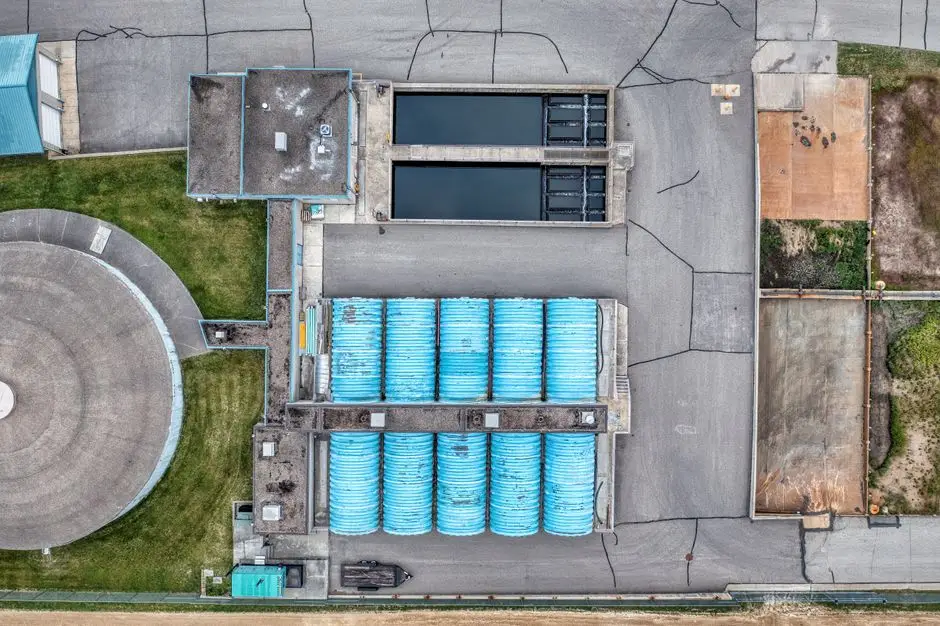
The correct treatment train follows the contaminants: headworks and equalization, flotation or clarification, biological treatment, solids separation, filtration, disinfection and—where justified—advanced polishing. A process selection should be driven by the operating objective rather than by a single package type.
- Protect and equalize: remove coarse material, buffer flow variation and control contaminants that could upset downstream processes.
- Remove floatables: use DAF for oil, FOG, suspended solids and colloidal matter where those fractions are significant.
- Remove biodegradable organics: apply biological treatment, with MBR as an option where integrated treatment and fine solids separation are required.
- Control solids and pathogens: add filtration and disinfection where the permit, reuse destination or process specification requires them.
- Polish for reuse: evaluate additional barriers for the intended application rather than assuming primary treatment produces reusable water.
HydropureWater’s published industrial DAF system range is 4–300 m³/h across 13 standard models. The configuration uses micro-bubble flotation and automatic skimming for suspended solids, FOG, oil and grease, and colloidal matter. This is a catalog range, not proof that a given model will meet the project’s load or effluent objective.
The published integrated MBR wastewater treatment system range is 10–2,000 m³/day, using submerged PVDF membranes and filtration below 1 μm. Treat this as a screening configuration for integrated biological treatment and membrane solids separation, not as a universal effluent guarantee.
Where solids control and membrane pretreatment are required, a hollow-fiber ultrafiltration system can be considered. HydropureWater’s published UF range is 2,000–40,000 L/h, with 0.03 μm PVDF membranes, inlet turbidity up to 300 ppm, automatic backwash and air scour.
| Technology | Primary role | Published catalog reference | Buyer’s verification |
|---|---|---|---|
| DAF | Floatable solids, oil, FOG and colloidal matter | 4–300 m³/h; 13 standard models | Oil and FOG load, flotation performance and sludge handling |
| Integrated MBR | Biological treatment with fine membrane separation | 10–2,000 m³/day; submerged PVDF; filtration below 1 μm | Organic load, membrane flux, fouling control and target water quality |
| Ultrafiltration | Fine solids separation and membrane pretreatment | 2,000–40,000 L/h; 0.03 μm PVDF; turbidity up to 300 ppm; automatic backwash and air scour | Feed characteristics, flux, cleaning demand and downstream compatibility |
Advanced treatment is a separate design case. University of Twente research identifies nanofiltration as a potential technique for polishing wastewater treatment plant effluent for agricultural or direct or indirect potable reuse. Wageningen University and Research’s doctoral thesis, awarded on September 23, 2022, documents research on constructed wetlands for micropollutant removal from treatment-plant effluent. These findings justify evaluating polishing; they do not prove suitability for a specific factory without wastewater testing.
Add chemical dosing, lamella clarification and sludge dewatering only when they solve a defined objective. Residual sludge requires a destination, and any chemical system must match the actual treatment chemistry.
Size the Plant from Verified Inputs
Plant capacity is a calculated project outcome, not a catalogue selection. Set design flow from verified average flow, peak discharge, storm and wash-water inputs, equalization storage and operational contingency. Then check hydraulic capacity and contaminant loading independently: equipment with sufficient flow capacity can still be undersized for its pollutant load.
Use the published DAF range of 4–300 m³/h and MBR range of 10–2,000 m³/day to screen quotations, not to establish final size. A bidder should demonstrate how the selected configuration handles the project’s flow profile, organic load, oil and FOG, nutrients, membrane feed quality and discharge or reuse criteria. A high-efficiency sedimentation tank may be considered where clarification is included in the process basis.
| Sizing check | Evidence to request | Reason for rejection or redesign |
|---|---|---|
| Design flow | Average and peak flow with production, discharge, wash-water and storm assumptions | Capacity based only on nominal production |
| Pollutant load | COD, BOD, suspended solids, oil and FOG, nutrients and operating variability | Flow capacity accepted without load verification |
| Duty and redundancy | Duty cycle, standby philosophy, equalization and maintenance strategy | No defined response to peak discharge or equipment outage |
| Physical integration | Footprint, civil works, utilities, controls and sludge route | Equipment does not fit the site or residual-stream plan |
| Expansion | Future production and treatment assumptions | No route to increase capacity without major reconstruction |
Every proposal should state the duty cycle, redundancy philosophy, footprint, utilities, control philosophy, sludge estimate, maintenance access and future-expansion assumptions. Also request chemical consumption, membrane cleaning or replacement logic, expected operating labour and instrument requirements.
Treat reuse as a higher-specification case. The same discharge objective may require additional filtration, membranes, disinfection and monitoring for water reuse or process recovery. The treatment objective must therefore be fixed before final equipment sizing and price comparison.
Verify Compliance, Commissioning and Operational Readiness
Compliance becomes executable when every permit condition is converted into a measurable obligation. Create a matrix containing each pollutant, limit, averaging period, sampling point, monitoring method, responsible party and reporting requirement. Do not treat equipment specifications as substitutes for permit conditions.
Separate project deliverables into factory acceptance, site acceptance, performance testing, operator training, initial spares, remote monitoring and O&M documentation. Performance should be demonstrated with representative industrial wastewater, not only clean-water tests or generic removal claims.
A 2014 Journal of Toxicology study of hospital wastewater and the sewage treatment plant serving around 10 million inhabitants in Buenos Aires included toxicity and genotoxicity assessment alongside routine chemical parameters. Although its scope was institutional wastewater rather than factory ETP design, it demonstrates why a site-specific review may need more than conventional bulk-quality monitoring when hazardous characteristics are credible.
| Stage | Acceptance evidence | Operational deliverable |
|---|---|---|
| Factory acceptance | Equipment inspection, construction records, controls review and agreed tests | Approved manufacturing and inspection dossier |
| Site acceptance | Installed performance, utilities, interlocks, alarms and safety systems | Completed site acceptance record |
| Performance testing | Representative wastewater, protocol, measurements and agreed acceptance criteria | Performance test report |
| Operator handover | Training records, operating manual, maintenance plan and spares | Trained operating team |
| Compliance handover | Sampling procedure, monitoring plan and reporting responsibility | Operational compliance matrix |
Where wastewater variability makes scale-up uncertain, require representative characterization and pilot or bench testing. Validate the selected process against actual wastewater before accepting a performance guarantee. For disinfection requirements, compare an chlorine dioxide generator and an UV sterilizer for water treatment against the required application, residuals, by-products, monitoring and operating conditions.
Qualify Argentine ETP Suppliers Before Awarding the Contract
Supplier qualification should test engineering responsibility and project execution, not the size of a published product range. RevenueBase identified 52 effluent treatment plant company matches associated with Argentina as of November 2026, but those matches are market-mapping entries rather than a quality ranking.
Ask each bidder to state which process stages it designs, manufactures, sources and installs, and identify the party responsible for every interface. This exposes gaps between equipment supply, civil construction, controls integration, commissioning and long-term operation.
| Due-diligence area | Evidence requested | Commercial risk if omitted |
|---|---|---|
| Local capability | Comparable references, engineering credentials, local commissioning and emergency-response resources | Overseas supplier leaves site interfaces unowned |
| Scope allocation | Matrix covering equipment, civil work, installation, commissioning, training and guarantees | Duplicated or missing responsibilities |
| Process fit | Design flow, loads, calculations, utilities and treatment objectives | Capacity is selected from catalogue limits without verification |
| Operations support | Controls integration, spare parts, consumables, remote monitoring and O&M support | Operational cost and downtime remain undefined |
| Compliance support | Permit inputs, monitoring deliverables, sampling support and responsibility matrix | Treatment package does not satisfy permit evidence needs |
Compare local project references, commissioning resources, controls integration, emergency response, spare-parts availability and long-term O&M support. Require the bidder to identify treatment plant parts, valves and media by specification, service life, compatibility and supply responsibility.
Verify proposed capacity against the project flow and loads. A large published range does not demonstrate an appropriate industrial wastewater process design, and catalogue performance does not replace site-specific acceptance criteria.
Frequently Asked Questions
How much does an industrial effluent treatment plant in Argentina cost?
The supplied research does not provide a defensible universal price for an industrial ETP in Argentina. A comparable quotation requires verified average and peak flow, wastewater loads, discharge or reuse targets, site constraints and a defined scope covering equipment, civil works, utilities, controls, commissioning, training and O&M. Request an itemized offer and separate initial capital cost from recurring chemical, sludge, energy, membrane and maintenance costs.
Should an Argentine factory choose DAF, MBR or a package sewage treatment plant?
Choose by process role. DAF is suited to separating oil, FOG, floatable solids and colloidal matter; an integrated MBR combines biological treatment with fine membrane separation; and an underground integrated sewage treatment system provides packaged anoxic or aerobic treatment, sedimentation and disinfection. Ask each bidder to map the proposed unit to the characterized pollutants and required effluent quality rather than comparing package names.
What size ETP does a factory in Argentina need?
Size from peak flow, average load, operating profile and permit criteria. The published DAF range of 4–300 m³/h and MBR range of 10–2,000 m³/day are screening references only. Require project-specific hydraulic calculations, contaminant-loading checks, duty-cycle analysis and a demonstrated treatment train.
Which permits and discharge limits apply to an ETP in Argentina?
Requirements depend on jurisdiction, industrial activity, receiving authority and discharge point. The supplied Argentina guide identifies ACUMAR, Decreto 999/92, Decreto 2009/09 and ADA as relevant compliance considerations, not universal site limits. Obtain a written jurisdictional review and translate the applicable conditions into a parameter-by-parameter compliance matrix before awarding equipment.
What should a supplier include in an ETP quotation?
Require the process basis, design flow and loads, equipment scope, civil and utility requirements, controls, commissioning, performance criteria, training, O&M, consumables and warranty terms. For reuse, add the required polishing, disinfection, monitoring and acceptance protocol so the quotation covers the intended end use rather than only the discharge train.