Start With the Cooling and Wastewater Water Balance
A Jamnagar data center needs treatment systems designed around its cooling architecture and each incoming water stream, not one universal wastewater plant. Coastal seawater is a credible cooling source, but desalination creates intake and brine-discharge obligations. Sewage, washdown, floor drainage, and cooling-tower blowdown require separate routes. Closed-loop liquid cooling can reduce evaporation losses, while blowdown reuse must control scaling, corrosion, microbiology, and concentration cycles. Capacity and compliance depend on verified flows, chemistry, cooling design, discharge conditions, and site-survey data.
Begin by deciding whether the facility will use evaporative cooling, sealed liquid cooling, or a hybrid arrangement. Schneider Electric reported on July 30, 2026, that conventional evaporative cooling can lose up to 85% of its water to the atmosphere, while a sealed, non-evaporative coolant loop virtually eliminates evaporation loss. That choice changes the water balance before any treatment vendor is selected.
Map each source and its destination separately. Cooling make-up, cooling-tower blowdown, coolant loss or discharge, sewage, equipment washdown, floor drainage, fire-water interactions, and process drains should not be combined without water-quality and reuse data. Use the data center cooling tower water treatment guide to structure the cooling-water inventory, but verify all assumptions against the Jamnagar site.
| Stream to segregate | Record before selecting equipment | Likely decision boundary |
|---|---|---|
| Cooling make-up | Design, average and peak flow; source chemistry; temperature | Seawater, freshwater or reclaimed-water supply route |
| Cooling-tower blowdown | Flow, cycles of concentration, conductivity, hardness, alkalinity, silica, calcium, sulfate, iron, manganese, microbiology and corrosion indicators | Blending, pretreatment, RO, reuse or discharge |
| Direct-to-chip coolant loss or discharge | Fluid type, concentration, contamination risk and disposal route | Recovery, segregation or controlled disposal |
| Sewage and process drains | BOD, COD, suspended solids, nutrients, microbiology and flow duration | Biological treatment, solids separation and disinfection or polishing |
| Washdown and floor drainage | Oil and grease, solids, detergents, temperature and episodic flow | Equalization and physical pretreatment before biological treatment or discharge |
| Fire-water interactions | Generation event, retained volume and contamination pathway | Isolation, emergency containment and inspection |
The supplied research does not provide Jamnagar site flows, wastewater concentrations, cooling cycles of concentration, or applicable discharge limits. Those are essential engineering inputs, not details to be supplied by a generic equipment catalogue.
Choose the Jamnagar Cooling Water Source
Seawater reduces dependence on freshwater but does not remove the need for environmental control. The Hindu BusinessLine reported that Jio plans a 168 MW Jamnagar data centre cooled with desalinated seawater, while Greyhound Research noted that the approach requires energy, intake systems, and answers for brine and discharge that demand local ecological governance, measurement, reporting, and audit.
Schneider Electric also reported Reliance Jio’s use of desalinated seawater for cooling on July 30, 2026. This establishes a credible coastal precedent, not a universal answer for every Jamnagar project. The site still needs evaluation of intake conditions, marine constraints, pretreatment requirements, corrosion materials, desalination performance, concentrate disposal and the receiving environment.
| Cooling-water source | Main treatment and infrastructure burden | Decision question for Jamnagar |
|---|---|---|
| Seawater | Intake, screening and pretreatment where required, desalination, corrosion control and brine management | Are marine intake and discharge conditions technically and legally supportable? |
| Freshwater | Source reliability, water cost, pretreatment for cooling chemistry and wastewater disposal | Does the source remain dependable through seasonal stress? |
| Reclaimed water | Robust source-water treatment, distribution connection, chemistry control and life-cycle assessment | Can reuse quality and supply reliability satisfy both cooling and make-up requirements? |
| Closed-loop coolant | Heat rejection through chillers, air-cooled systems or other thermal equipment; minimal water loss but greater heat-rejection complexity | Can the mechanical system meet the required heat load in local ambient conditions? |
Schneider Electric reported on July 30, 2026, that direct-to-chip liquid cooling reduces cooling energy use by up to 60% compared with mechanical air cooling. It also cited current rack examples of about 142 kW for NVIDIA GB300 NVL72 and up to 246 kW for Vera Rubin. Those figures support early architecture planning, but they do not establish the correct architecture for every project. CDUs, chillers and heat rejection must still be planned as one system for Jamnagar’s climate.
Compare the options against freshwater reliability, treatment burden, energy, corrosion exposure, discharge exposure and expansion flexibility. The Bhavnagar data center treatment comparison can support the wider decision method, but local survey data and approvals must determine the Jamnagar route.
Match Each Wastewater Stream to Its Treatment Route
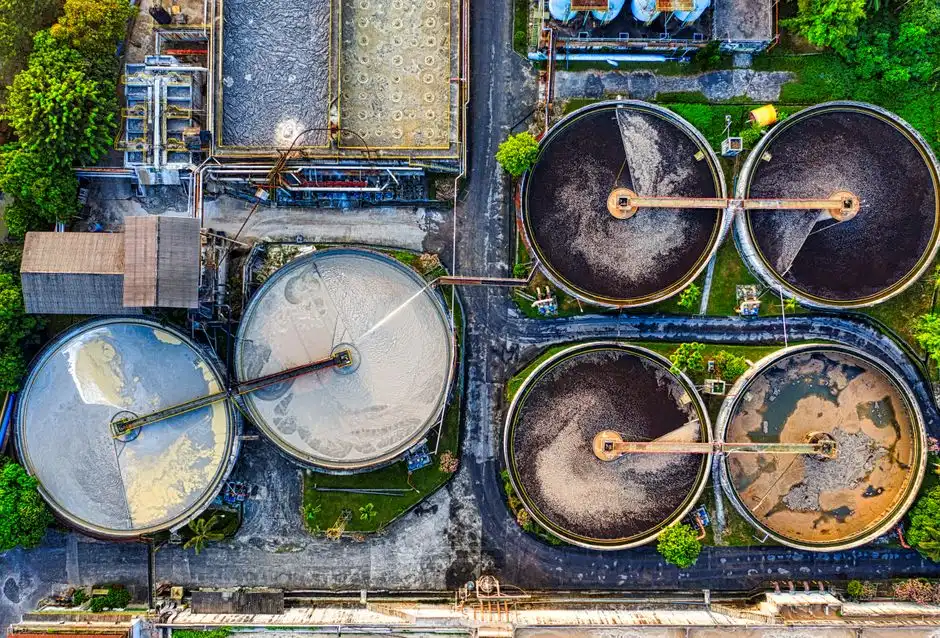
Sewage, washdown and cooling blowdown require different treatment routes because their contaminants and reuse constraints differ. Combining them may simplify piping while transferring biological load, oil, scaling salts or dissolved solids into equipment that was not designed for them.
For sewage-dominated flows, use biological treatment and solids separation before disinfection or reuse polishing. Request BOD, COD, suspended solids, nutrients, microbiology and flow-duration data. A packaged biological system or MBR should be selected only after comparing effluent variability, automation, footprint, reuse targets and operator requirements. For washdown and oily floor drainage, start with screening, equalization and oil and grease removal; determine whether biological treatment or further polishing is needed from the collected data.
Cooling-tower blowdown requires a different assessment. Analyze conductivity, TDS, hardness, alkalinity, silica, calcium, sulfate, iron, manganese, biological growth, corrosion indicators and cycles of concentration. If reuse is possible, UF pretreatment for blowdown reuse can remove suspended material, colloids and microorganisms, while RO supplies salt-removal capability. UF is not a desalination process.
| Wastewater route | Primary process | Required design information | Before final discharge |
|---|---|---|---|
| Sewage-dominated | Biological treatment, solids separation, disinfection and reuse polishing where required | BOD, COD, suspended solids, nutrients, microbiology and flow duration | Project-specific permit and receiving-water analysis |
| Washdown and oily drainage | Screening, equalization, oil and grease removal, then biological treatment or discharge as justified | Oil and grease, solids, detergents, temperature and episodic flow | Receiving-water and reuse assessment |
| Cooling-tower blowdown | Chemistry control, filtration and, where justified, UF plus RO | Scaling constituents, conductivity, microbiology, corrosion indicators and cycles of concentration | Permit, concentrate route and receiving-water analysis |
| Reuse polishing | UF for particulates and microorganisms; RO for dissolved salts | Feed-water envelope and required permeate quality | Quality monitoring linked to the reuse destination |
Open Engineering Inc’s 2026 preprint uses depth filtration, granular activated carbon and chlorination as one primary treatment train and separately evaluates UF plus RO. That comparison illustrates why treatment should follow feed chemistry and reuse targets rather than automatically include every process. The MBR versus conventional activated-sludge analysis provides additional biological-process context, but it does not establish a Jamnagar discharge standard.
The final route requires a project-specific permit and receiving-water analysis. The supplied research does not establish a numerical Jamnagar effluent limit, so no compliance guarantee can be made at this stage.
Treat Cooling Blowdown for High-Recovery Reuse
Evaporation removes water from cooling towers while leaving dissolved and sparingly soluble salts behind, so recovery must control scaling, corrosion and microbial growth without allowing unsafe cycles of concentration. IDE reported in 2026 that conventional brackish-water RO typically reaches 75–80% recovery before scaling risk, chemical consumption and operational instability become limiting factors.
| Option | Process concept | Trade-off to evaluate |
|---|---|---|
| Conventional pretreatment plus RO | Filtration and chemistry control followed by a conventional RO train | Simpler familiar process, but recovery remains constrained by feed chemistry and membrane scaling |
| Higher-recovery managed-solids train | RO removes permeate while selected scaling salts are precipitated and removed as managed solids before further concentration | Higher recovery potential with additional process control, solids handling and chemical-management requirements |
| Lower-recovery reuse train | A smaller RO recovery duty with a larger residual stream | Potentially simpler operation, but requires a permitted destination for the remaining discharge |
IDE cites one industrial application involving blowdown from 20 hybrid cooling towers, RO brine and manufacturing wastewater. The system reportedly operated at around 95% recovery and reduced permeate silica to about 1 mg/L. Treat this as an application result, not a guaranteed performance value for a Jamnagar facility.
Compare life-cycle effects as well as water savings. Open Engineering Inc’s 2026 preprint found that its wastewater scenario had about twice the freshwater scenario’s global warming potential; treatment energy accounted for roughly 80% of the difference. Before recovery benefits were counted, UF plus RO energy rose to more than five times the freshwater case. The same study reported an indirect water penalty of approximately 0.93 L/m³, less than 0.1% of the direct displacement benefit under its assumptions. These results provide evaluation context, not a universal Jamnagar offset.
Specify membrane cleaning, chemical compatibility, corrosion materials, energy availability, redundancy, operator capability and the handling of RO concentrate or precipitated solids. An industrial RO water treatment system and UF pretreatment for blowdown reuse should be evaluated against the verified design envelope, not selected from nominal recovery alone.
Build a Procurement-Ready Equipment and Sizing Framework
Set the treatment objective before asking for a price: compliant discharge, internal cooling make-up, process reuse or a combination. Each objective changes the required water quality, monitoring, redundancy and reject-water route. Use the water-balance and treatment tables above to define which streams belong in each package.
| Equipment | Information the buyer must request | Selection check |
|---|---|---|
| Industrial RO | Feed-water envelope, target permeate quality, design recovery, concentrate destination, antiscalant strategy, cleaning philosophy, controls scope and redundancy | Is the duty supported across the verified feed chemistry, not only the average sample? |
| UF | Feed turbidity, flow, solids loading, temperature, backwash frequency and required filtrate quality | Can the pretreatment remove the actual solids and biological load without excessive cleaning? |
| Packaged biological treatment or MBR | Influent quality, flow-duration profile, effluent target, footprint, automation, sludge route and operator requirements | Does the system handle variability and meet the required reuse or discharge quality? |
| RO and UF treatment train | Recovery assumptions, water-chemistry limits, consumables, reject-stream route, commissioning tests and performance guarantees | Does the supplier state the complete duty, standby arrangement and operating envelope? |
HydropureWater’s industrial RO systems are described as offering recovery rates up to 95%, subject to site-specific chemistry and design. Its UF systems use 0.03-micron PVDF membranes, accept feed turbidity up to 300 ppm and provide automatic backwash and air scour. These are product parameters to check against the site analysis, not evidence that the blowdown will be suitable.
Where biological treatment is required, compare the integrated water purification option and integrated MBR wastewater treatment option by footprint, automation, effluent variability, reuse targets and operating responsibility. Require the selected supplier to state its design basis, duty, standby arrangement, recovery assumptions, chemistry limits, consumables, reject-stream route, commissioning tests and performance guarantees. Without flow-duration data and source-water analyses, a defensible plant capacity cannot be set.
Plan Commissioning, Monitoring, and Regulatory Evidence
Commissioning should test the water balance and the treatment process as one system. Begin with source-water sampling, then verify equipment acceptance, membrane integrity where applicable, controls simulation, alarm response and the accounting of every inlet, outlet, reject stream and reuse destination.
Create an operating dashboard covering source and treated flow, blowdown, permeate, concentrate, freshwater withdrawal, cycles of concentration, conductivity, silica, hardness, pH, turbidity, microbiology where relevant, energy and chemical consumption. Track absolute withdrawals and water intensity together. Otherwise, a higher-energy reuse train can appear favourable simply because it reduces volume without exposing the associated energy and chemical burden.
Open Engineering Inc’s 2026 preprint reported an indirect water penalty of approximately 0.93 L/m³ for its reuse train, less than 0.1% of the direct displacement benefit under the study’s assumptions. Use that finding as methodological context only; local energy, chemical and upstream impacts may differ.
Establish periodic sampling and an auditable chain from intake through treatment, reuse, discharge and sludge or brine handling. Automated chemical control and the available treatment components should be specified around that chain, as described in the automatic chemical dosing system and treatment valves and media reference. Do not claim regulatory compliance until the applicable Jamnagar approvals and discharge conditions are obtained.
Frequently Asked Questions
What wastewater and cooling blowdown treatment does a Jamnagar data center need?
It needs separately engineered routes for sewage, washdown and floor drainage, cooling make-up, and any cooling-tower blowdown. The actual package depends on the cooling architecture, verified source flows, chemistry, intended reuse and permit conditions. A seawater source may support cooling but does not solve sewage treatment or brine management.
How should the buyer size the treatment system?
Use the water-balance and equipment tables above, then request measured average and peak flows, flow-duration profiles, complete chemistry, temperature, cooling cycles of concentration and the required treated-water quality. Do not accept a plant size based only on cooling-system capacity or an average water sample.
How do desalination and blowdown reuse differ?
Desalination converts an alternative raw water source into cooling-grade water and creates a residual brine stream. Blowdown reuse treats an existing cooling-water discharge to recover water for reuse. The former begins with an intake; the latter begins with concentrated tower water and must manage scaling, corrosion and microbial risks.
What should be included in a supplier’s pricing and technical offer?
Request a priced scope that states the design flow, water-chemistry envelope, target water quality, recovery assumption, pretreatment, reject-stream route, redundancy, controls, consumables, maintenance, commissioning tests and performance guarantees. Without these inputs, ask for budgetary exclusions and explicit exclusions rather than a fixed equipment price.
Which supplier and compliance risks require the most scrutiny?
Select a supplier only after verifying its Jamnagar-relevant experience, local support, operator requirements, chemical compatibility, energy basis and evidence from comparable feedwater. Separately obtain the applicable intake, discharge and reuse approvals; neither a technology claim nor a cooling-water source establishes permission to discharge brine or treated effluent.