What System Does a Wellington Factory Actually Need?
A Wellington factory generally needs a dissolved air flotation system when its wastewater contains suspended solids, oil and grease, or colloidal material that must be removed before biological treatment, reuse or discharge; otherwise, a complete industrial effluent treatment plant may be required. DAF is one process within an industrial treatment train, not an interchangeable term for an ETP. The correct choice depends on representative wastewater tests, peak and average flow, solids and FOG loading, pH, temperature, toxicity, reuse requirements, sludge handling and the applicable discharge consent.
Make three separate decisions: whether pretreatment is required, which main separation process fits the wastewater, and whether tertiary or reuse treatment is needed. Doosan’s Integrated solutions for a better life publication states that industrial wastewater generally requires a combination of physical, chemical and biological treatment processes because contaminants and toxicity vary by industry (Doosan Heavy Industries & Construction, 2024-08). A DAF unit removes floatable and suspended material; it does not independently resolve every dissolved contaminant, biological treatment or disinfection requirement.
| Selection question | Indicative process | Decision basis |
|---|---|---|
| Does the wastewater contain gross solids or material requiring equalisation? | Screening, gross-solids removal and equalisation | Production cycles, peak flow and observed wastewater characteristics |
| Must suspended solids, colloidal material or FOG be separated? | DAF or clarification, with chemical conditioning where required | Representative analysis and the required downstream water quality |
| Do biodegradable dissolved organics remain? | Biological treatment with separation | Influent organics, toxicity, temperature and treatment objective |
| Does the final objective require fine solids separation, disinfection or reuse-specific treatment? | Tertiary filtration, membrane treatment and disinfection as applicable | Consent conditions or the receiving process water specification |
If the proposed scope is only an industrial DAF system, confirm that solids separation is the whole duty. If the factory also has dissolved organic, toxicity, reuse or final discharge requirements, ask for the complete treatment train.
Start with the Factory's Wastewater Profile
Representative sampling determines whether a Wellington factory needs DAF, clarification, biological treatment or a combined ETP; one clean production-period grab sample is not a sufficient design basis. Sampling should cover normal production, peak production, start-up, shutdown and cleaning cycles so suppliers can identify intermittent solids, FOG, chemical dosing or pH shocks.
Assemble the following inputs before requesting equipment quotations:
- Average and peak flow, including the duration and frequency of peak periods.
- Suspended solids, fats oils and grease, and their variation through the operating cycle.
- pH, temperature, dissolved contaminants and indicators of toxicity or inhibitory substances.
- The required effluent quality and intended destination: sewer entry, direct environmental discharge, cooling, boiler use, food-process reuse or another application.
- Available footprint, utilities, access, operating hours and the available sludge route.
Peak hydraulic and solids loads can control equipment sizing even when the daily production volume appears manageable. A unit selected only from average flow may not cope with a short solids surge or accumulated FOG during a cleaning cycle.
| Information to request | Why it affects selection |
|---|---|
| Flow and production chronology | Establishes hydraulic design conditions and equalisation requirements |
| SS and FOG concentrations and loads | Distinguishes solids-separation duties and indicates DAF or clarification suitability |
| pH, temperature and toxicity | Defines chemical-conditioning needs and biological treatment constraints |
| Dissolved contaminant analysis | Shows whether physical separation alone can meet the objective |
| Discharge or reuse specification | Determines required downstream treatment and polishing |
| Sludge volume and disposal constraints | Confirms whether DAF sludge can be thickened, dewatered and received |
Hydroflux’s HyDAF engineering tool uses influent flow rate, solids load, temperature and operating pressure to size the dissolved-air system (Hydroflux Epco New Zealand, HyDAF Dissolved Air Flotation). Ask every supplier to explain its equivalent sizing assumptions. Also identify whether front-end solids removal is needed; Hydroflux shows screening and sludge management alongside DAF within a treatment plant, while an automatic mechanical bar screen may be considered where gross solids require removal before fine separation.
Compare DAF, Clarification, Biological Treatment and Membrane Options
DAF is the strongest candidate when the principal duty is separating suspended solids, FOG or colloidal material, but it is not a substitute for biological treatment where dissolved biodegradable organics remain. FILTEC describes DAF as dissolving air under pressure, releasing microscopic bubbles in the flotation tank and skimming the attached solids from the surface (FILTEC, Dissolved Air Flotation Systems (DAF) | Solids Separation). Clarification is the gravity-driven alternative; biological treatment addresses biodegradable dissolved load; MBR combines biological treatment with fine membrane separation.
| Option | Best-supported role | Key limitation or condition |
|---|---|---|
| DAF | Suspended-solids, colloidal-material and FOG separation; pretreatment, tertiary clarification or sludge thickening where appropriate | Does not by itself remove every dissolved contaminant or provide biological treatment or disinfection |
| Clarification | Gravity-driven solids separation | Requires suitable settling characteristics; lamella units add flocculation and inclined plates to a compact structure |
| Biological treatment | Treatment of dissolved biodegradable organics after suitable pretreatment | Performance depends on influent characteristics, temperature, toxicity, nutrients and operating control |
| MBR | Combined biological treatment and fine membrane separation | Requires membrane pretreatment, fouling control, permeate handling and a complete supporting plant |
Hydroflux identifies primary clarification before biological treatment, tertiary clarification and sludge thickening as distinct DAF applications (Hydroflux Epco New Zealand, HyDAF Dissolved Air Flotation). That distinction matters: one flotation duty cannot be substituted for another without recalculating the process conditions.
Hydroflux’s tank configurations respond to the expected solids behaviour. The HD range suits streams where minimal settled solids are expected and can be drained. HD-V has steep sloping sides and a screw conveyor for streams with a high probability of sedimentation. HD-S uses multiple hoppers for large systems requiring regular automated solids withdrawal.
For gravity separation, HydropureWater’s high-efficiency sedimentation tank combines sludge recirculation, flocculation and inclined-plate separation in one compact structure. Where dissolved biodegradable material remains, the WSZ biological treatment package combines anoxic and aerobic biological contact oxidation, sedimentation and disinfection for non-residential applications. Where biological treatment and fine membrane separation are both required, the MBR wastewater treatment system covers 10–2,000 m³/day and provides filtration below 1 μm.
Map the Treatment Process from Inlet to Effluent
A complete industrial effluent treatment plant is a sequence of duties, not a single tank selected by flow. The normal pathway is:
- Influent characterisation and equalisation: smooth flow and load variation and provide a stable treatment feed.
- Screening or gross-solids removal: protect downstream equipment from rags, packaging and other settleable material.
- pH or chemical conditioning: prepare the wastewater for coagulation, flocculation and separation.
- DAF or clarification: remove suspended solids, FOG or chemically conditioned floc.
- Biological treatment where required: reduce dissolved biodegradable contaminants.
- Filtration or tertiary treatment: capture residual or fine solids and meet the selected reuse or discharge objective.
- Disinfection where required: provide microbiological control for the specified route.
- Reuse or discharge: transfer treated water through the agreed route.
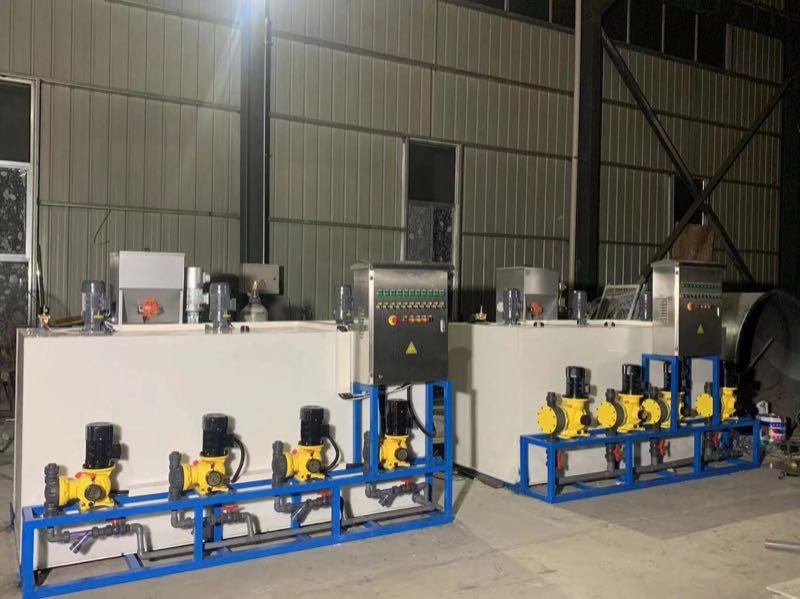
Hydroflux states that HyDAF is one process component in a complete plant, supported by ancillary operations for influent conditioning, sludge handling, further treatment or recycling (Hydroflux Epco New Zealand, HyDAF Dissolved Air Flotation). An automatic chemical dosing system can support pH adjustment and controlled coagulant or flocculant addition, but it does not replace wastewater characterisation: the chemical and dose must follow the identified treatment duty and process design.
Build the solids route into the scope at the same time as the liquid treatment. Hydroflux includes sludge thickening among its DAF applications, while Doosan identifies dewatering as part of sludge treatment and notes that sludge management can also support energy recovery (Doosan Heavy Industries & Construction, 2024-08). Where separated sludge needs dewatering before storage, transfer or disposal, evaluate a plate-and-frame filter press at that decision point. For reuse routes with a specified microbiological requirement, include an UV sterilizer only after confirming the required duty and receiving-water specifications.
Choose the Right DAF Configuration and Capacity
HydropureWater’s DAF systems cover 4–300 m³/h across 13 standard models, but that equipment range is not a substitute for wastewater-based sizing. The supplier must confirm the selected capacity against the project’s flow, solids load and operating conditions; a flow-compatible tank can still be undersized if it lacks sufficient flotation and solids-handling capacity.
| Decision point | Required supplier response |
|---|---|
| Standalone DAF or DAF-led ETP? | State which pretreatment, sludge handling and downstream treatment stages are included |
| Hydraulic capacity | Identify the model and demonstrate that the design flow and peak flow are accommodated |
| Solids and FOG duty | State the sizing loads and expected sludge yield |
| Tank configuration | Justify HD, HD-V or HD-S against the expected settled-solids behaviour and withdrawal frequency |
| Dissolved-air system | Show how flow, solids load, temperature and operating pressure were considered |
| Controls and maintenance | Specify air-saturation monitoring, skimmer access, pump checks and chemical-dosing controls |
Use Hydroflux’s configurations as a screening framework: HD where minimal settled solids are expected, HD-V where sedimentation is likely and automatic removal by screw conveyor is warranted, and HD-S for large systems requiring regular automated withdrawal through multiple hoppers (Hydroflux Epco New Zealand, HyDAF Dissolved Air Flotation).
FILTEC identifies air-saturation monitoring, skimmer inspection, pump checks and correct chemical dosing as routine operating checks for DAF systems (FILTEC, Dissolved Air Flotation Systems (DAF) | Solids Separation). These should appear in the controls, operating manual and maintenance scope. Before approving the package, decide whether the site needs a standalone DAF, a DAF-led ETP or DAF as one stage in a biological or reuse treatment plant. The 2026 DAF selection and decision framework provides a further basis for comparing configurations and supplier scope.
Build a Supplier-Ready Procurement Brief
A comparable quotation requires the same wastewater basis, design assumptions and boundary of supply from every supplier. Ask each supplier to state the design flow, hydraulic and solids-loading assumptions, treated-water objective, sludge yield, utilities demand, footprint, controls and commissioning scope.
| Brief item | Information the factory must provide | Information the supplier must return |
|---|---|---|
| Wastewater basis | Representative analyses, production cycles, flow chronology and operating parameters | Design basis and any exclusions or assumptions |
| Treatment objective | Sewer, direct-discharge or reuse route and applicable specifications | Proposed treatment train and expected process role of each stage |
| Equipment sizing | Average and peak flow, solids load, temperature and operating pressure | Model inputs, selected model and capacity justification |
| Sludge route | Removal frequency, storage constraints and disposal destination | Expected sludge yield, thickening or dewatering method and handling scope |
| Site and services | Footprint, access, power, water, drainage and operating requirements | Utility demand, footprint, controls and delivery boundary |
| Local delivery | Installation dates, access requirements and site-management responsibilities | Engineering, fabrication, installation, commissioning and after-sales responsibilities |
Require an explanation of how the system was sized and modelled. Hydroflux states that every HyDAF application is scientifically modelled and that its dissolved-air engineering tool considers influent flow, solids load, temperature and operating pressure (Hydroflux Epco New Zealand, HyDAF Dissolved Air Flotation). Ask the supplier to identify any assumptions that could change the selected capacity or performance.
For a Wellington project, ask for named local engineering, installation, commissioning and after-sales support. Hydroflux reports qualified engineering and project personnel through offices throughout New Zealand and Australia, including commissioning engineers and service technicians (Hydroflux Epco New Zealand, HyDAF Dissolved Air Flotation).
Ask for the price of the proposed treatment train, not only an isolated DAF. The quotation should identify pretreatment, chemical dosing, sludge handling, controls and downstream treatment where required. The supplier should review the factory’s consent and intended discharge or reuse route, but the final permit obligations remain tied to the site’s applicable authority. Use the 2026 DAF selection and decision framework to check that technical assumptions, exclusions and commercial boundaries are stated rather than left ambiguous.
Frequently Asked Questions
How do I know whether my factory needs DAF or a complete ETP?
Choose DAF as the main physical-separation stage when the dominant duty is removing suspended solids, colloidal material or FOG and the downstream objective can be met with that separation. Choose a complete ETP when the wastewater also contains dissolved biodegradable organics, inhibitory contaminants, or requirements for biological treatment, filtration, disinfection or reuse-specific polishing. Doosan’s 2024-08 water treatment publication supports the general need to combine physical, chemical and biological processes for industrial wastewater.
How much will an industrial ETP or DAF system cost?
Request a quotation based on the complete treatment train and the factory’s actual wastewater profile. The research does not provide a defensible unit price for the Wellington application, so a generic price would be misleading. Require separate pricing for equipment, civil works, chemical dosing, pretreatment, sludge handling, downstream treatment, controls, utilities, installation, commissioning and exclusions. This lets the buyer compare quotations on the same scope rather than comparing DAF hardware prices against complete-ETP prices.
What should I check when selecting a DAF supplier?
Check the supplier’s sizing method and local delivery capability. Ask it to demonstrate how influent flow, solids load, temperature and operating pressure informed the dissolved-air design, as Hydroflux’s engineering tool does, and ask for the proposed tank configuration and solids-withdrawal method. For Wellington execution, request named responsibility for engineering, commissioning, service and spare parts. The 2026 DAF selection and decision framework can be used to compare the evidence behind each supplier’s proposal.
Can DAF provide the wastewater quality required for factory reuse?
DAF can support reuse as a pretreatment step by removing suspended solids, FOG and organic solids before filtration, biological treatment or other polishing. FILTEC identifies DAF and filtration as processes that can improve process-water reuse, but the reuse specification determines the complete train. Confirm the receiving application’s quality, fouling and microbiological requirements before selecting the final treatment stages. The emergency DAF FOG interception case study can help distinguish an interception duty from a full reuse treatment scheme.