Which Treatment Fits a Santa Anna Mining Project?
For mining and metals wastewater near Santa Anna, MBR is usually the stronger option when flow is below roughly 2,000 m³/day, available footprint is under about 500 m², and the plant must reuse water. Its membrane replaces the secondary clarifier and sand filter, reducing footprint by about 60%, while maintaining higher MLSS and more stable solids separation. Conventional activated sludge is generally less capital-intensive for large dilute flows, low electricity tariffs and sites with long-lived aeration basins. Neither process removes metals by itself: both require upstream precipitation and effective pretreatment, and the final design must be checked against the current permit and 40 CFR Part 440.
These thresholds are screening criteria, not a Santa Anna design rule. HydropureWater’s 2026 comparison identifies MBR as the stronger fit below roughly 2,000 m³/day, below about 500 m² of available footprint, or where reuse or zero-liquid-discharge (ZLD) is a project driver. CAS becomes more practical above roughly 5,000 m³/day, below about $0.07/kWh, or where an existing aeration basin has more than 20 years of useful life and no reuse driver exists.
The procurement decision should therefore resolve three questions before comparing equipment bids: what effluent quality must be demonstrated, what hydraulic and site constraints apply, and what value will be placed on recovered water. The MBR cost per m³ and selection guide provides additional screening context, but Santa Anna-area water pricing, electricity tariffs, discharge authorization and current permit terms remain items the buyer must obtain and verify.
Why Mining Water Changes Biological Treatment
Mining influent can violate the settling assumptions built into a municipal-style activated-sludge design, particularly when organic loading is low and dissolved salts are high. HydropureWater’s 2026 field data reports mining influents with BOD/COD ratios below 0.3, hardness in the thousands of mg/L as CaCO₃, sulfate above 1,000 mg/L and TDS above 5,000 mg/L.
CAS retains biological solids through gravity settling in the secondary clarifier. Bulking, shock loading, low settleability or a metal pulse can therefore carry biomass out of the system. HydropureWater’s 2026 field data reports a 30–60% loss of CAS removal efficiency for a 24–72-hour period following a metal pulse. The mechanism matters: floc that carries associated metals into the effluent is also the mechanism used to remove those metals during normal operation.
MBR decouples biomass retention from settleability. The submerged PVDF membrane physically retains solids, so effluent quality does not depend solely on the settling velocity of biological floc. The supplied HydropureWater 2026 comparison associates that configuration with more stable effluent during disturbances. This is a resilience argument, not a substitute for toxicity control, equalization or chemical treatment.
Neither MBR nor biological treatment alone removes soluble arsenic, lead, zinc, copper, nickel or cadmium. Upstream heavy-metal precipitation remains necessary, with pH control and solids removal arranged so the biological stage receives a stable feed. An PLC-controlled chemical dosing system can automate pH adjustment, coagulant addition and membrane-cleaning chemicals, but the reagent and set points must come from jar tests and the selected process design.
MBR and Activated Sludge Process Comparison
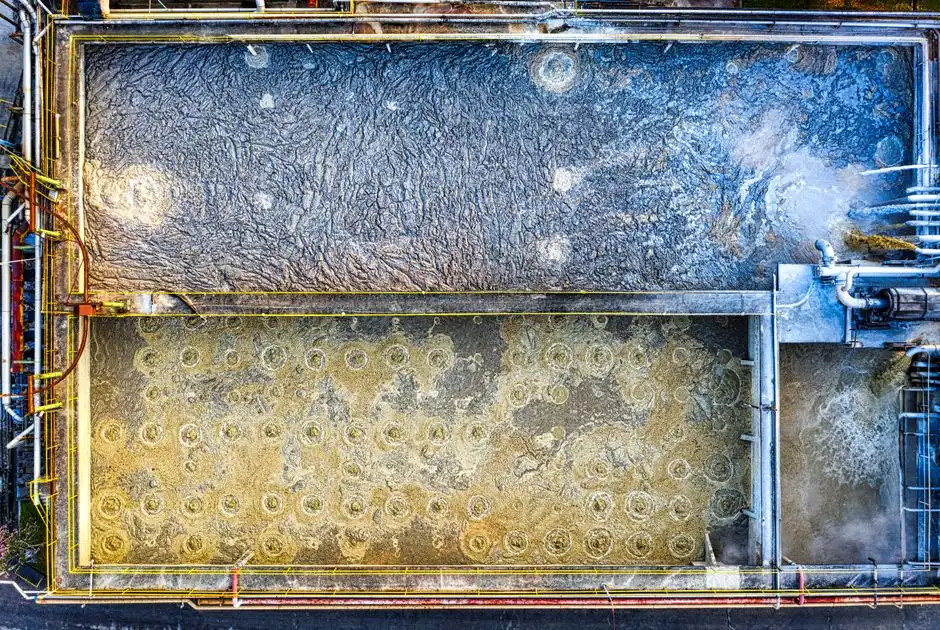
MBR replaces the settling and filtration functions that make CAS more land- and equipment-intensive, while introducing membrane maintenance obligations that a gravity clarifier does not have. CAS uses an aeration basin, a secondary clarifier, return activated sludge and waste sludge withdrawal. MBR combines biological treatment with submerged PVDF membrane separation; the membrane replaces the secondary clarifier and sand filter.
| Parameter | MBR | Conventional activated sludge |
|---|---|---|
| Solids separation | Submerged PVDF membrane | Gravity clarification |
| MLSS | 8,000–12,000 mg/L; the supplied Eolia comparison also reports up to 15,000 mg/L | 2,000–4,000 mg/L |
| Reported EPA MBR Fact Sheet turbidity | 0.01–1.31 NTU | Not applicable |
| Reported EPA MBR Fact Sheet ammonia-N | 0.10–0.72 mg/L | Not applicable |
| Concrete and civil scope | Approximately 60% less because sedimentation and filtration are eliminated | Baseline conventional train |
| Main operating burden | Air scour, routine CIP, membrane replacement and tighter pretreatment controls | Clarifier sludge handling, return sludge and settling performance |
The MLSS and performance figures above come from HydropureWater’s 2026 comparison, which attributes the MBR turbidity and ammonia-N values to the EPA Membrane Bioreactor Fact Sheet for the Calls Creek and Cauley Creek facilities. They are reported performance values, not guarantees for a Santa Anna site. The comparison should be validated against the project’s actual feed and acceptance criteria.
Submerged PVDF is the dominant module format in the supplied research. Module geometry determines headworks requirements: hollow-fiber systems generally require 1–2 mm screening, while flat-plate systems generally require 2–3 mm. A supplier may specify a different value, so the final screen cutoff belongs in the selected manufacturer’s guarantee rather than in a generic specification. The DF-series 0.1-micron PVDF MBR module is one flat-sheet reference, while an integrated submerged-PVDF MBR system should be evaluated as a complete biological, membrane and control package rather than as a vessel alone.
The trade is direct: MBR gains solids separation and footprint, but requires air scour, chemical cleaning, replacement reserves and tighter pretreatment. CAS remains mechanically simpler, provided that clarifier performance remains reliable under the actual mining influent.
Santa Anna Compliance Is More Than a Technology Choice
40 CFR Part 440, Ore Mining and Dressing, is the federal framework containing daily-maximum and monthly-average effluent limits for arsenic, lead, zinc, copper, nickel and cadmium, according to the supplied 2026 comparison. It is not the complete California compliance basis for a Santa Anna project.
Both MBR and CAS require upstream precipitation to control metals. An MBR’s stronger TSS and turbidity separation does not remove dissolved metals from solution and therefore does not eliminate the precipitation step. The required dose, pH and residual-solids handling must be established from the actual water chemistry rather than inferred from the process comparison.
The supplied research notes that state conditions may add parameters such as selenium and sulfate. No Santa Anna-specific limit was supplied, so none should be inferred. Before freezing equipment specifications, the buyer should obtain the current NPDES permit, applicable state limits, discharge location, reuse authorization and receiving-water constraints. That review must distinguish federal limits from permit-specific conditions and local pretreatment or sewer requirements.
Use a mining wastewater sewer-limit compliance guide as a prompt for that permit review, not as a substitute for the current Santa Anna permit. Monitoring records should cover influent pH, TDS, sulfate, hardness, target metals, TSS, turbidity, ammonia and flow variability. A composite average can conceal short metal or pH pulses that determine whether biological solids are inhibited or lost.
Compliance should also be framed as a discharge or reuse obligation, not merely an equipment-performance claim. The final acceptance protocol should map each monitored parameter to the applicable permit or reuse criterion, including the averaging period and sampling method.
Pretreatment Determines Whether MBR or CAS Works
The minimum defensible treatment sequence begins with equalization and flow damping, followed by fine screening, pH adjustment or metal precipitation, biological treatment, solids separation and optional UV or RO polishing where true reuse requires it.
| Process step | Design purpose | Procurement requirement |
|---|---|---|
| Equalization | Damp flow, pH and metal pulses | State average and peak flow plus required detention in hours |
| Fine screening | Remove abrasive fibres and debris | Hollow-fiber modules generally require 1–2 mm; flat-plate modules generally require 2–3 mm, subject to the manufacturer specification |
| pH adjustment or precipitation | Convert soluble metals to separable solids | Establish reagent, pH and solids-removal performance by jar test |
| Biological treatment | Remove soluble organic load and support nitrification where required | Specify the feed matrix, SRT basis and upset-response protocol |
| Solids separation | MBR membrane or CAS secondary clarifier | Define flux, turbidity, TSS and sludge-handling acceptance criteria |
| Optional UV or RO | Prepare water for true reuse | Define the intended reuse endpoint rather than specifying polishing by default |
The supplied research reports a mining design practice of pH 6.5–7.5 ahead of the MBR for hydroxide precipitation, compared with a reported pH 8.5–9.5 CAS approach. These are design practices presented in the source material, not universal regulatory limits. A process engineer must confirm them against precipitation testing because metal species, competing ions and residual solids can change the required endpoint.
Abrasive fines, oil and floatables can foul screens and membranes. Where the feed warrants it, suitable DAF or clarification should precede equalization to protect downstream equipment. The GX-series rotary mechanical bar screen and dissolved air flotation equipment should be selected against measured debris and floatables loads, not included merely because the stream is labeled mining wastewater.
Automatic dosing should cover pH adjusters, coagulants and CIP chemicals. The controls need interlocks for high pH, excessive chemical demand and abnormal flow, while operators retain the responsibility for confirming residual chemistry. For MBR sludge, the supplied research recommends a plate-and-frame filter press to reach 25–35% dry solids for disposal or backfill. Those figures are a referenced research recommendation, not a site guarantee.
Capital Cost, Operating Cost and Water Reuse Economics
For the supplied 1,000 m³/day reference case, MBR CAPEX is approximately 20–40% higher and OPEX approximately 15–30% higher per m³ than equivalent-flow CAS, according to HydropureWater’s 2026 field data. The premium buys membrane separation and a smaller civil footprint; it does not remove the need for precipitation, sludge handling or permit compliance.
| Cost or value driver | Effect on MBR selection | Evidence status |
|---|---|---|
| Equipment and civil scope | Membrane cassettes, fine screens, permeate pumps and PLC upgrades raise CAPEX | 20–40% CAPEX premium for the 1,000 m³/day reference case |
| Operating requirements | Air-scour energy, sodium-hypochlorite and citric-acid cleaning and replacement raise OPEX | 15–30% OPEX premium per m³ for the reference case |
| Make-up water | Water above about $2/m³ strengthens the reuse case | Reported payback of the CAPEX premium in 4–6 years when reuse value is high or brine disposal is costly |
| Electricity | Below about $0.07/kWh strengthens CAS; the Eolia comparison cites above about $0.09/kWh in a high-water-cost reuse scenario | HydropureWater 2026 comparison |
| Membrane life | 5–8 years under rigorous pretreatment and disciplined CIP | Include replacement in the 20-year evaluation |
The economic switch is usually reuse value, not membrane unit price alone. The supplied research reports that when make-up water costs more than about $2/m³ or brine disposal is expensive, MBR-permeate reuse can recover the CAPEX premium in 4–6 years. Those figures require validation using Santa Anna-area tariffs, actual reuse yield, disposal charges, labor, chemical consumption and the measured flow profile.
The model should separate fixed and variable costs. Fixed items include membranes, screens, permeate pumps, controls and CIP equipment. Variable items include air scour, cleaning chemicals, replacement membrane allocation, sludge disposal and the value of water not reused. The MBR cost per m³ and selection guide provides the referenced comparison, but no Santa Anna quotation should be inferred from it.
Run a sensitivity case around water price, electricity tariff, reuse percentage, membrane replacement date and disposal cost. If the ranking changes within plausible local inputs, the project should retain CAS or a hybrid option until pilot and vendor data narrow the uncertainty.
Score the Alternatives Before Ordering Equipment
The screening framework compares MBR, CAS and a hybrid clarifier-plus-MBR polishing option against the same site constraints rather than scoring each technology on its preferred criteria. The first three questions are whether footprint is under about 500 m², flow is below roughly 2,000 m³/day, and a reuse or ZLD driver exists. Two or three affirmative answers favor MBR; zero or one favors CAS or a hybrid clarifier-plus-MBR train applied only to the reuse stream, according to HydropureWater’s 2026 framework.
| Criterion | MBR | CAS | Clarifier-plus-MBR hybrid |
|---|---|---|---|
| Footprint under about 500 m² | Strong fit | Requires available clarifier area | Moderate; depends on retained equipment |
| Flow below roughly 2,000 m³/day | Strong screening fit | Often economical at larger dilute flows | Can limit polishing scope |
| Reuse or ZLD driver | Strong fit | Weak fit without polishing | Strong fit for the reuse stream only |
| Existing aeration basin with more than 20 years of useful life | May be bypassed by new equipment | Economic override when there is no reuse driver | Can retain clarification for general discharge |
| Permit and pretreatment risk | Must be a mandatory input | Must be a mandatory input | Must be a mandatory input |
The CAS override is important: an existing aeration basin with more than 20 years of useful life and no reuse driver can make conventional activated sludge the economical choice. The hybrid option is distinct from a full MBR: it retains existing clarification and installs membrane polishing only for water requiring reuse. It should be evaluated against the integrated submerged-PVDF MBR system on the same mass balance and lifecycle-cost basis.
Permit risk, pretreatment complexity, membrane-maintenance capability, confirmed local water and power prices, and actual reuse yield are mandatory inputs rather than optional score bonuses. A bidder that cannot substantiate them should not receive a technology-selection advantage.
Pilot, Tender and Commissioning Checklist
A 60–90-day pilot with an MBR cassette against the actual feed is the recommended way to test flux, fouling and metals-removal behavior before purchasing the full train, according to the supplied HydropureWater 2026 comparison. The pilot should run through representative operating variations rather than only a steady laboratory feed.
The tender data package should require a seven-day composite influent characterization, equalization volume in hours of average flow, the selected manufacturer’s screen cutoff in millimeters, membrane warranty in years and the 10-year replacement cost in dollars per m² of membrane area. Vendors should also submit flux and normalized-permeability curves, chemical-cleaning assumptions and control narratives.
The supplied DF-series pilot reference uses 0.1-micron PVDF flat-sheet elements, integrated aeration and individually replaceable elements. Its module configurations range from 80–225 m² and the cited production range is 32–135 m³/day. These are equipment-reference values from HydropureWater’s 2026 comparison; they do not establish Santa Anna performance without feed-specific verification.
Commissioning acceptance tests should cover flux, normalized permeability, turbidity, TSS, ammonia-N, target metals, membrane cleaning frequency, recovery after CIP and automatic-control interlocks. The MBR process flow diagram and P&ID guide can support the tender drawings, but the accepted process flow must reflect Santa Anna’s permit, reuse endpoint and actual equalization requirements.
Require a site-specific mass balance covering precipitation solids, biological sludge, MBR sludge, filtrate return and final disposal. The final bid review should also confirm that each proposed guarantee is tied to a defined feed, sampling method and operating condition.
Frequently Asked Questions
Is MBR or conventional activated sludge cheaper for a mining wastewater project?
MBR has the higher preliminary cost in the supplied 1,000 m³/day reference case: approximately 20–40% more CAPEX and 15–30% more OPEX per m³ than equivalent-flow CAS, based on HydropureWater’s 2026 field data. CAS is generally more economical where there is no reuse driver, electricity is below about $0.07/kWh, or a long-lived aeration basin already exists. The buyer should request a site-specific 20-year cash-flow comparison using confirmed Santa Anna-area tariffs, disposal costs, labor, chemicals, replacement membranes and actual reuse yield.
How should flow and footprint be used to size the selected process?
Use flow below roughly 2,000 m³/day, footprint below about 500 m² and the presence of a reuse or ZLD driver as screening criteria from HydropureWater’s 2026 framework. Two or three affirmative answers favor MBR; zero or one favors CAS or a hybrid clarifier-plus-MBR polishing train. Final sizing still requires peak and average flow, equalization requirements, the selected module format, pretreatment constraints and the intended reuse endpoint.
What should a supplier provide before equipment is selected?
Require the selected module format, manufacturer-specific screening cutoff in millimeters, flux and permeability guarantees, membrane warranty in years, replacement cost in dollars per m², CIP assumptions, control narratives and acceptance-test methods. Also request a complete mass balance and a priced pretreatment train. A generic performance statement or bare equipment price is insufficient for comparison.
Does MBR eliminate the need for precipitation and permit review?
No. Both MBR and CAS require upstream precipitation for soluble metals, and neither substitutes for review of the current NPDES permit, applicable California requirements or site-specific discharge and reuse conditions. The supplied 2026 comparison identifies 40 CFR Part 440 as the federal framework for arsenic, lead, zinc, copper, nickel and cadmium, but no Santa Ana-specific state or local limit should be inferred from that reference.
What should a 60–90-day pilot prove?
The pilot should test the actual feed under representative flow and chemistry variations, then document flux, normalized permeability, turbidity, TSS, ammonia-N, target metals, cleaning frequency, CIP recovery and control interlocks. It should also verify that precipitation and screening prevent membrane fouling or metal toxicity from invalidating the comparison. The MBR cost per m³ and selection guide supports the screening logic, but pilot results must control the final bid.