What wastewater does a Qom data center need to treat?
A data center in Qom generally needs two treatment paths: one for cooling-tower blowdown and another for domestic, humidification and process wastewater. CTBD typically contains 1,200–6,000 mg/L TDS and 10–50 mg/L suspended solids, so it needs solids removal below 10–15 microns before RO or NF, followed by reuse or brine management. At 4 cycles of concentration, roughly 25–30% of makeup water leaves as blowdown. The practical 2026 design is reuse-first RO, with partial ZLD considered where discharge is restricted; actual source-water analysis and Qom discharge permits must determine final capacity and recovery.
Cooling-tower blowdown is the primary process-wastewater stream. It can be hot and contains concentrated dissolved solids, scaling minerals, suspended solids, biocides, corrosion inhibitors and scale-control residues. Genesis Water Technologies (2025) reports CTBD at 4–8 times makeup-water concentration, or 1,200–6,000 mg/L TDS, with suspended solids of 10–50 mg/L. Heat and chemical composition therefore require a dedicated train rather than dilution into a biological system.
Domestic and process wastewater should remain a separate collection system. Canteen and restroom wastewater, dormitory sewage, humidification bleed-off, laboratory wastewater and generator wash water are primarily BOD, COD and pathogen loads. Equipment can be sized only after these flows are separated; an MBR train for data-center domestic wastewater belongs on that biological path, not the CTBD desalination train.
Also screen for ammonia-bearing wet-scrubber blowdown from standby generators. HydropureWater’s 2026 Isfahan guide reports NH₃-N at 50–500 mg/L where scrubbers are present and calls for separate nitrification or air stripping before this flow joins the biological train. RO and softener backwash, cleaning wastewater and air-handling condensate must also appear in the site water balance and segregation drawings.
| Stream | Dominant characteristics | Routing decision |
|---|---|---|
| Cooling-tower blowdown | Heat, TDS, scaling minerals, suspended solids and treatment chemicals | Filtration, membrane pretreatment, reuse or brine management |
| Domestic and process | BOD, COD and pathogens; potentially variable flow | Screening, biological treatment and disinfection |
| Generator scrubber blowdown | Possible ammonia load | Separate nitrification or air stripping |
| Backwash, cleaning and condensate | Chemistry and temperature vary by source | Classify by concentration and reuse suitability before diversion |
The mechanical headworks should protect downstream biological and membrane equipment from solids entering the collection system. A rotary mechanical bar screen is one equipment option to evaluate where debris control is required, but hydraulic selection must follow the peak flow and screen aperture.
Establish the Qom source-water and permit basis before sizing equipment
Qom membrane and zero-liquid-discharge sizing cannot be finalized from an IT load or a generic regional water profile. The binding inputs are actual intake chemistry, freshwater-withdrawal entitlement, discharge location and the permitted effluent envelope applicable to that outfall.
Request intake analysis for calcium, magnesium, silica, alkalinity, chloride and sulfate, together with TDS, suspended solids and temperature. These parameters control softening, antiscalant demand, concentrate chemistry and membrane recovery. The operator’s environmental consultant should confirm the intake source, permitted freshwater withdrawal and outfall with the Iran Department of Environment. The Iran wastewater engineering guide provides useful permit context, but it does not replace Qom-specific approval.
As a cross-check only, HydropureWater’s 2026 Isfahan regional benchmark gives BOD₅ ≤50 mg/L, COD ≤200 mg/L, TSS ≤50 mg/L, free chlorine below 1 mg/L and total chromium ≤0.5 mg/L, verified through 24-hour composite sampling. Those values were presented for an Isfahan regional analogue; they are not a confirmed Qom permit and should not be used as the final acceptance criteria.
Confirm whether discharge is to sewer, a controlled outfall or another approved route, and obtain written limits for flow, TDS, temperature, treatment-chemical residuals and monitoring. If concentrated RO concentrate cannot be accepted, the brine volume must be included in the site water balance before equipment capacity is fixed. This permit-led sequence also prevents reuse claims that cannot be supported by the receiving cooling tower, humidification system or domestic reuse specification.
Calculate the cooling blowdown and domestic wastewater design load
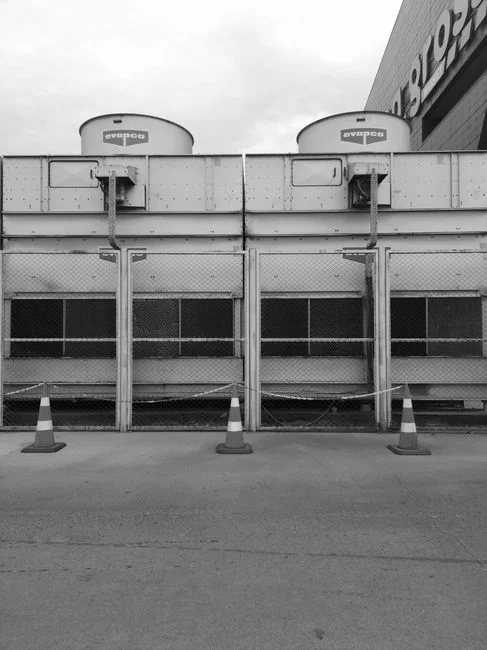
Cooling-tower blowdown load must start from measured makeup flow and operating cycles of concentration, with evaporation and blowdown verified from the site water meter. Genesis Water Technologies (2025) reports that at 4 cycles, approximately 25–30% of makeup water becomes blowdown; for a site using 10 million gallons per month, this corresponds to 2.5–3 million gallons per month. That relationship supplies a check, not a substitute for Qom metering.
The IDE Tech 2026 figure, as cited by HydropureWater’s 2026 Isfahan guide, gives total water demand of up to 2 million litres per day for a 100 MW facility. Treat this as a regional water-demand envelope, not a Qom design flow or a direct CTBD production rate.
Size the domestic and process train separately using peak and average sanitary, humidification, washdown and scrubber flows. Add proposed RO permeate demand to the cooling-tower makeup balance, then apply the selected recovery, operating-hours assumption and redundancy policy to membrane and pumping capacity.
| Sizing input | Required site record | Design use |
|---|---|---|
| Makeup-water flow | Measured monthly and peak demand | Establishes the CTBD water-balance baseline |
| Cycles of concentration | Operating range and control set points | Sets CTBD volume and dissolved-solids loading |
| Evaporation and blowdown | Metered or mass-balance data | Reconciles consumption against makeup |
| Domestic and process flow | Peak and average by source | Sizes screening, biological treatment and disinfection |
| Recovery and operating hours | Selected treatment and redundancy assumptions | Determines membrane, pump and thermal capacity |
Build a chemistry-aware treatment train for Qom
CTBD should follow a chemistry-aware sequence: collection and cooling, side-stream filtration, solids polish below 10–15 microns, membrane treatment, reuse assessment and brine management. The feed envelope is 1,200–6,000 mg/L TDS at 4–8 times makeup concentration, with 10–50 mg/L suspended solids. Biocide, scale-inhibitor, corrosion-inhibitor and legacy chromate or phosphate chemistry must be recorded because each affects fouling, pretreatment and discharge acceptance.
Genesis Water Technologies (2025) gives side-stream filtration at 1–5% of circulation flow, 10–25 micron removal and $50,000–$200,000 capital cost. This stage should not be confused with final CTBD solids removal; the membrane feed still needs polishing below 10–15 microns. Where finer solids removal and biological protection are required, evaluate UF pretreatment for cooling-tower blowdown before RO or NF.
For RO, Genesis Water Technologies (2025) gives 150–400 psi operating pressure, 50–85% recovery and permeate at 10–50 mg/L TDS. Antiscalant dosing, pH control and membrane-fouling monitoring are integral to the design. IDE Tech (2026), as cited by HydropureWater, notes that conventional brackish-water RO is usually constrained near 75–80% recovery by scaling. A reverse-osmosis blowdown-recovery skid should therefore be selected against Qom chemistry rather than a generic recovery target.
UF operates at 10–30 psi and 90–95% recovery, with cleaning generally required every 1–3 months depending on feed quality. NF operates at 75–150 psi and 70–85% recovery, with permeate at approximately 30–50% of feed TDS; it is the alternative where partial hardness and sulfate removal is sufficient. An automatic antiscalant and biocide dosing system should be scoped with the membranes rather than treated as an accessory.
Route domestic and process wastewater through screening, biological treatment and disinfection. Use a separate MBR treatment train for data-center domestic wastewater when reuse quality or footprint requirements justify it. Scrubber blowdown enters this biological train only after the required ammonia-removal step.
Add MVC when membrane concentrate cannot be discharged. Genesis Water Technologies (2025) reports 95–98% recovery of concentrate-stream water, distillate below 10 mg/L TDS and energy use of 15–25 kWh per 1,000 US gallons. The source also identifies partial ZLD as an RO-plus-MVC configuration that reduces discharge volume by 80–90%.
| Stage | Supported performance | Main engineering issue |
|---|---|---|
| Side-stream filtration | 1–5% of circulation flow; 10–25 micron removal | Corrosion products, biofilm fragments and particulates |
| UF pretreatment | 10–30 psi; 90–95% recovery | Cleaning interval depends on feed quality |
| RO | 150–400 psi; 50–85% recovery; permeate 10–50 mg/L TDS | Scaling, antiscalant control and concentrate volume |
| NF | 75–150 psi; 70–85% recovery; permeate 30–50% of feed TDS | Partial rather than complete demineralization |
| MVC | 95–98% concentrate-stream recovery; distillate below 10 mg/L TDS | Energy use and final brine handling |
Choose reuse, compliant discharge, partial ZLD or full ZLD
Cooling-tower makeup reuse is normally the first strategy because it reduces both freshwater intake and discharge. Genesis Water Technologies (2025) reports typical reuse recovery of 60–85%. Reuse quality must remain compatible with the cooling-tower chemical program, and the permeate destination must be included in the utility balance. The wider data-center cooling blowdown treatment guide provides a useful comparison of reuse and disposal routes.
Choose compliant discharge only after the Qom permit, receiving outfall capacity and treatment-chemical limits are documented. This route may require TDS reduction, biocide management, neutralization or other controls; it should not be justified by a generic guideline. The industrial RO cost and sizing guide is relevant to evaluating this option.
Partial ZLD combines membrane concentration with MVC and, according to Genesis Water Technologies (2025), reduces discharge volume by 80–90%. Full ZLD adds crystallization and achieves 95–99% overall water recovery, with solid waste below 1% of original blowdown volume. Full ZLD becomes defensible only where discharge is unavailable or the permit and whole-life case justify the additional thermal and solids-handling scope.
For initial screening, the same 2025 source reports $250,000–$500,000 installed CAPEX and $1.50–$3.00 per 1,000 gallons OPEX for 50,000 GPD RO; $1–3 million for 10,000–30,000 GPD MVC; and $3–8 million CAPEX plus $5–15 per 1,000 gallons OPEX for full ZLD. These are US benchmarks. They exclude Iranian import duties, port handling, inland transport and supplier commissioning.
| Route | Decision condition | Indicative benchmark |
|---|---|---|
| Reuse | Permitted reuse destination and compatible cooling-water chemistry are confirmed | 60–85% recovery (Genesis Water Technologies, 2025) |
| Discharge compliance | Qom outfall and written effluent envelope accept the treated stream | Cost depends on required treatment; US benchmarks do not include Iran logistics |
| Partial ZLD | Residual brine has an approved injection, hauling or special-permit route | 80–90% discharge-volume reduction (Genesis Water Technologies, 2025) |
| Full ZLD | Liquid discharge is unavailable and crystallization and solid disposal are viable | 95–99% overall recovery; $3–8 million CAPEX (Genesis Water Technologies, 2025) |
For blowdown reuse, check the need for softening before the membrane train. For membrane procurement and replacement planning, specify compatible RO and UF membrane elements rather than accepting generic element warranties.
Plan Qom procurement, commissioning and operating risk
A Qom equipment quotation is incomplete unless it identifies delivery responsibility, commissioning responsibility and operating exclusions. Require written confirmation of FOB terms, containerization, the applicable Iranian port and port handling, inland transport to Qom, workshop pre-commissioning and supplier commissioning. These items must also appear in the payment milestones and acceptance procedure.
Request an Iran-specific commercial uplift covering import duties, port handling, inland transport and commissioning because the cited US equipment benchmarks exclude them. Obtain a supplier-written lead time; the supplied research publishes no Iran-bound lead-time figure, so no numerical schedule should be assumed.
Price at least 12 months of RO and UF membrane elements, automatic antiscalant and biocide dosing, critical spares, initial chemicals and operator training. Define replacement triggers, membrane storage requirements and responsibility for preserving membranes during prolonged site delays. Confirm local availability or source of treatment valves, filter media and critical spares.
| Procurement package | Required written item | Acceptance evidence |
|---|---|---|
| Commercial | FOB basis, Iranian port, inland haulage, duties and commissioning scope | Landed Qom price and exclusions |
| Schedule | Supplier-written manufacturing and delivery lead time | Milestones and delay responsibility |
| Consumables | At least 12 months of membranes, dosing equipment, chemicals and critical spares | Quantity, compatibility and storage plan |
| Performance | Feed chemistry, conductivity, SDI, differential pressure, flux, permeate and concentrate limits | Site acceptance test protocol |
| Operations | Training, manuals, troubleshooting and handover | Operator competency record |
Performance acceptance should monitor feed chemistry, conductivity, SDI, differential pressure, membrane flux, permeate quality, RO concentrate and biological-process stability. The supplier’s standard guarantees are not enough if the Qom permit or the selected recovery target is stricter. Include those project-specific limits in the guarantee test.
Frequently Asked Questions
How much should a Qom data center budget for cooling blowdown treatment?
No defensible Qom lump-sum price can be given without measured flows, Qom chemistry, the reuse or discharge decision and an Iran-specific commercial quotation. For screening only, Genesis Water Technologies (2025) gives $250,000–$500,000 installed CAPEX and $1.50–$3.00 per 1,000 gallons OPEX for a 50,000 GPD RO system; these US figures exclude Iranian duties, port handling, inland transport and supplier commissioning. Request the same breakdown from suppliers, then add locally confirmed logistics and civil, electrical and biological works.
Should the Qom project use RO, NF, partial ZLD or full ZLD?
Use RO when permeate must meet cooling-tower reuse or desalination requirements; consider NF only if partial hardness and sulfate removal is sufficient. Select partial ZLD when the permit constrains discharge but an approved brine route remains. Full ZLD requires confirmed evaporation, crystallization and solid-disposal arrangements. The deciding evidence is the Qom outfall permit, intake analysis and brine-disposal route—not the technology name alone.
What should a wastewater-treatment supplier include in a Qom bid?
Require a process guarantee, feed and permeate design bases, equipment datasheets, P&ID, battery limits, FOB and delivery terms, Iran-specific logistics, customs responsibility, commissioning, training and performance-test criteria. Also require a membrane and critical-spares schedule with at least 12 months of replacement elements included. The bid should identify what it excludes, especially civil works, chemicals during commissioning, electrical upgrades and brine disposal.
How is domestic wastewater separated from cooling-tower blowdown?
Use separate collection, piping and treatment systems. CTBD should enter the filtration and membrane train; canteen, restroom and dormitory wastewater should enter screening, biological treatment and disinfection. Ammonia-bearing generator scrubber blowdown needs a separate nitrification or air-stripping step before biological treatment. Softener or RO backwash, cleaning wastewater and condensate should also be classified and routed according to concentration and reuse suitability.
What site data is needed before the treatment train is finalized?
Obtain measured makeup, evaporation, blowdown, domestic and process flows; the operating range for cycles of concentration; and intake analysis covering calcium, magnesium, silica, alkalinity, chloride, sulfate, TDS, suspended solids and temperature. Also secure the Qom intake, withdrawal and discharge permissions; the approved outfall limits; the intended reuse destinations; brine-disposal options; operating hours; redundancy requirements; and local electrical, logistics and commissioning conditions.