Which System Fits the Wastewater, Not the Product Label
For Chicago food and beverage factories in 2026, choose dissolved air flotation (DAF) when FOG, product-loss organics, phosphorus, or fine solids limit performance; choose a clarifier when the flow is predominantly heavy, settleable solids and lower operating energy is the priority. DAF uses compressed air and micro-bubbles to attach to suspended material and float it for skimming, while a clarifier uses gravity to settle solids as bottom sludge. Neither choice should be based on the plant being labeled “food and beverage”; wastewater behavior, operating peaks, residuals handling, and discharge objectives determine the answer.
HydropureWater’s beverage-wastewater design guidance gives the practical rule: select DAF when FOG, product-loss organics, or phosphorus controls performance, and select sedimentation when energy cost dominates and the load is mostly settleable (HydropureWater, 2026). The food and beverage wastewater DAF system should include both surface-float removal and bottom-sludge withdrawal, because chemicals or non-floating particulates can produce sinking sludge.
A high-efficiency lamella clarifier remains credible when the wastewater is dominated by readily settleable material and compressed-air demand is a significant operating cost. DAF and clarification are not mutually exclusive: a hybrid route can capture floatable oils and FOG in DAF while a clarifier captures heavier solids.
| Decision condition | Initial equipment direction | Evidence still required |
|---|---|---|
| FOG, floatable organics, or phosphorus dominates | DAF with chemical conditioning and solids withdrawal | Site wastewater analysis, pilot results, and float and bottom-sludge handling details |
| Mostly heavy, settleable solids | Clarifier | Settling behavior, loading basis, sludge density, and available footprint |
| Both floatable and heavy solids | Hybrid DAF and clarification | Mass balance, residuals route, operating sequence, and downstream biological treatment impact |
Why Chicago Food and Beverage Wastewater Is Different
Batch CIP cleanings are the principal hydraulic surge that can exceed a continuously sized treatment unit’s design condition. HydropureWater identifies batch CIP surges and product-loss streams as defining features of beverage wastewater (HydropureWater, 2026). A system selected from average production flow alone can therefore be hydraulically inadequate even when its nominal treatment mechanism is suitable.
Product loss also changes how solids behave. Spilled syrup, rejected batches, and fruit pulp can alter the density profile of the wastewater, making some particles less likely to float. That makes bottom-sludge withdrawal more important than a surface skimmer alone. The wastewater may also carry FOG from food processing and organic loads from bottle-wash detergent carry-over, syrup, and rejected product.
These streams can produce fragile floc when surfactants interfere with particle aggregation. A coagulant program should therefore be established from wastewater testing, with polymer aid evaluated where floc breaks up or skimming is incomplete. HydropureWater’s 2026 design guidance notes that sugar or surfactant carry-over can put beverage streams in this fragile-floc case.
DAF has established industrial use in Chicago: EllisLudell reports that its first-generation DAF was manufactured and installed in Chicago in 1973 (EllisLudell, undated commercial source). That operating history supports regional familiarity with the technology, but it does not substitute for testing the current plant’s wastewater.
Current regional supplier activity also continues. Clearwater Industries highlighted SigmaDAF USA DAF, MBR, and filter-press systems at WEFTEC 2025 in Chicago, held September 29 to October 1, 2025 (Clearwater Industries, 2025). This shows continued equipment and service presence around Chicago; it is market context, not evidence that any named system will meet a specific plant’s permit conditions.
Before equipment selection, use current food and beverage wastewater sewer-limit guidance to identify the applicable discharge, reuse, and pretreatment requirements. A treatment train that is effective in a jar test may still fail because equalization, residuals handling, or monitoring does not fit the operating schedule.
Compare DAF and Clarifiers Against the Actual Treatment Targets
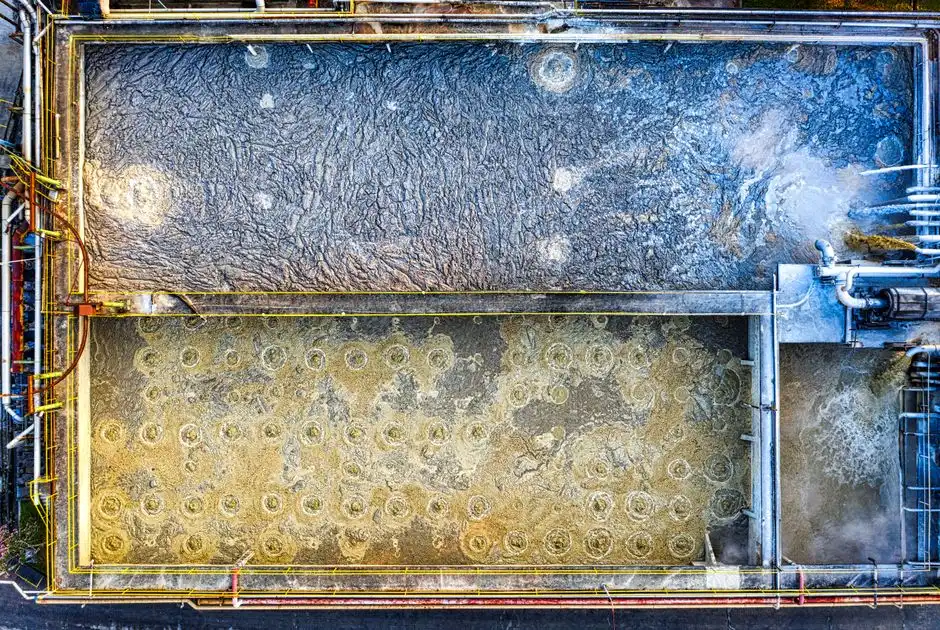
HydropureWater identifies suspended solids, organic matter, hydrocarbons, phosphorus, and nitrogen as DAF removal targets, but the supplied 2026 research does not provide universal food-and-beverage performance numbers for those five parameters (HydropureWater, 2026). A quotation should therefore be judged against the plant’s own influent and required effluent values, not a generic percentage.
DAF generally consumes more energy than sedimentation because it requires compressed air. That comparison concerns air-compression demand; it does not establish that a clarifier will meet a stricter FOG or organics target at lower total cost. Chemicals, sludge handling, equipment space, maintenance, and downstream treatment must be included in the comparison.
One commercial food-processing example reported 95% oil-and-grease removal with DAF against 70% for a clarifier on the same stream (Ecologix Systems, undated commercial source). Treat that as a single application comparison, not a design guarantee. Separately, EllisLudell states that FOG and TSS removal above 95% are common and that some installations report 99% reduction (EllisLudell, undated commercial source). Those are vendor-reported claims, and the specific installation, wastewater, loading, and measurement basis are not supplied.
DAF is generally more suitable for floatable oils, FOG, and fine solids; a clarifier is more suitable for heavy, readily settleable solids. Ecologix reports 90% solids reduction through clarification in a mining application (Ecologix Systems, undated commercial source), but that is outside food and beverage and cannot establish performance for a beverage plant.
HydropureWater’s lamella clarifier catalog lists surface loading rates of 20–40 m/h and chemical consumption reduced by up to 30% (HydropureWater, 2026). These are catalog figures, not project guarantees. Require the selected design to be matched to the wastewater, available area, sludge withdrawal, and chemical program.
| Criterion | DAF | Clarifier | Procurement question |
|---|---|---|---|
| FOG and floatable material | Primary removal mechanism | Less suited to readily floatable material | What measured FOG and oil removal is guaranteed on the plant’s wastewater? |
| Suspended solids | Captures floating fine solids when floc and bubble attachment work | Captures heavier settleable solids | Which solids fraction controls the permit or downstream biological load? |
| Energy | Includes compressed-air generation and recycle pumping | No air-compression step | What total energy demand does each supplier calculate for the duty? |
| Chemical complexity | Coagulant and possible polymer aid require controlled dosing | May use coagulant or flocculant depending on settling performance | What dose and turndown are established by testing? |
| Residuals | Skimmable float plus possible sinking sludge | Bottom sludge | Where does each residual go, and what solids concentration reaches dewatering? |
| Footprint and retrofit | Depends on saturation, flocculation, and flotation sections | Depends on tank area, settling depth, and sludge collection | Can the verified loading rate fit the available footprint? |
Build a Pretreatment Process That Survives CIP and Product-Loss Events
A beverage pretreatment train should be designed as a sequence, not as an isolated clarification tank. HydropureWater’s 2026 process sequence is screening and flow equalization, coagulant dosing, floc formation, saturated recycle water, micro-bubble attachment, and skimming of the float blanket (HydropureWater, 2026).
- Screen the incoming wastewater before it reaches pumps, flocculation equipment, or solids-handling machinery.
- Equalize both hydraulic flow and contaminant loading, with enough response for batch CIP cleaning.
- Condition the wastewater with the coagulant and polymer program established through testing.
- Separate floatable material and collect any sinking sludge through an independent withdrawal path.
- Transfer residuals to a compatible thickening and dewatering route.
- Confirm that the clarified stream supports the intended discharge, reuse, or downstream biological treatment.
Document hourly average flow and peak hourly flow during CIP cleaning. HydropureWater also requires influent TSS, FOG, BOD/COD, pH, and temperature before sizing (HydropureWater, 2026). These inputs must be tied to operating records, not estimated from production throughput.
Automatic chemical dosing is the practical control method for multi-shift beverage plants because manual make-down is less suitable to thin maintenance staffing. The automatic chemical dosing system should be selected from the tested chemical program rather than from supplier literature alone.
Residuals handling must be designed in parallel with clarification. A plate-and-frame filter press or sludge thickener may be needed when float or settled solids do not meet the dewatering equipment’s feed-solids acceptance. Specify the float and bottom-sludge streams separately; a unit that performs well on surface float can still leave a solids-handling problem.
The downstream biological stage should be evaluated as part of the same train. Clarification can reduce incoming solids and organics, but a procurement decision based only on clarification performance risks underestimating the load delivered to food processing wastewater biological treatment.
Validate Chemistry and Equipment Performance Before Signing
The minimum jar-test matrix specified by HydropureWater is three coagulants selected from alum, poly aluminum chloride, poly aluminum sulfate, ferric chloride, bentonite, and organic polymers, crossed with at least one polymer at three dose levels each (HydropureWater, 2026). Run the matrix on wastewater representative of production losses and CIP-spiked conditions rather than only on a diluted clean-water sample.
The documented chemical comparison is specific: monomeric aluminum was more efficient than polymeric or colloidal aluminum for TSS and soluble COD removal, while polymeric and colloidal forms were more effective for soluble silica removal (HydropureWater, 2026, citing WWD Magazine). Monomeric aluminum is therefore a documented starting point for sugar-and-organic beverage streams, where silica is rarely the limiting parameter, but the final chemical and dose must be confirmed by jar testing.
Jar testing should establish chemical demand and basic settling or flotation behavior. A wastewater pilot test should then establish whether the proposed equipment handles the actual flow, solids loading, fragile floc, surfactants, and sinking material. For a DAF supplier, require an air-to-solids performance curve at the design solids loading, not a single test point. For a clarifier supplier, request representative solids characterization, confirmation of the loading basis, available footprint, sludge withdrawal arrangement, and downstream solids handling.
Do not let a removal percentage substitute for a mass balance. Ask where the removed solids go, what residual solids concentration reaches the press or thickener, and whether the proposed skimmer or sludge collection mechanism handles the tested material.
| Validation step | Required evidence | Decision affected |
|---|---|---|
| Wastewater characterization | Flow, TSS, FOG, BOD/COD, pH, temperature, and representative production and CIP events | Whether the unit is technically applicable |
| Jar testing | Specified coagulant-polymer matrix and three dose levels per polymer | Chemical program and expected solids behavior |
| Pilot testing | Actual CIP-spiked wastewater and proposed equipment configuration | Performance, controls, and residuals handling |
| Supplier submittal | Written design values, performance curves, guarantees, and training scope | Commercial comparison and acceptance |
Make the Chicago Vendor RFQ Comparable and Permit-Ready
A comparable RFQ must make each supplier state its design basis in writing. HydropureWater identifies hydraulic loading rate, air-to-solids ratio, recycle rate as a percentage of forward flow, flocculation retention time, and effluent targets for TSS, FOG, BOD, phosphorus, and nitrogen as key written inputs (HydropureWater, 2026).
The supplied research does not publish beverage-specific numeric values for hydraulic loading, air-to-solids ratio, recycle percentage, or flocculation retention. Shortlisted vendors must therefore supply and substantiate their own values rather than inherit generic catalog assumptions. These are quotations or design commitments, not evidence supplied by this article.
Request the skimmer mechanism, float-thickening beach geometry, sludge-handling interface, PLC and automation scope, and references from named food and beverage plants. Generic industrial references do not establish experience with syrup carry-over, surfactants, fruit pulp, or CIP peaks. Require site performance testing, startup assistance, and operator training in the quotation because continuous beverage production limits the practical time available for commissioning corrections.
Obtain current discharge or reuse requirements from the applicable Chicago sewer authority and write them into the final equipment specification. The supplied research provides no universal numeric Chicago discharge limit, so a universal limit should not be assumed.
As a catalog screening check, HydropureWater lists a DAF capacity envelope of 4–300 m³/h across 13 standard models (HydropureWater, 2026). Compare the plant’s hourly average and CIP peak flow with that envelope; outside it, require custom engineering. A clarification supplier’s capacity is not stated in the supplied research and must be derived from its verified design basis.
| RFQ item | Minimum supplier response |
|---|---|
| Design basis | Hourly average flow, peak hourly CIP flow, and supplied wastewater and effluent values |
| DAF performance | Hydraulic and air loading, recycle percentage, flocculation retention, and air-to-solids performance curve |
| Clarifier performance | Verified loading basis, settling area, solids characterization, and sludge withdrawal design |
| Residuals | Float and bottom-sludge routes, expected solids concentration, and dewatering interface |
| Compliance and delivery | Current permit basis, commissioning tests, startup support, operator training, and written schedule |
Make the Final Selection Using a Plant-Specific Decision Framework
The binding constraint should decide the comparison: FOG and floatable organics point toward DAF, while predominantly heavy, settleable solids and lower air-related energy demand point toward a clarifier. Next, test flow variability, especially CIP peak flow and product-loss events. Inadequate equalization can invalidate an otherwise suitable equipment selection.
Then test chemical demand, floatability, sludge density, floor space, automation requirements, and downstream dewatering. Use pilot results and written performance curves to select between finalists; do not use a generic food-processing percentage as the basis for a purchase order.
For a complex stream, evaluate three routes on the same basis: DAF with solids handling, clarification with solids handling, and a hybrid route. For the downstream biological evaluation, compare how each clarified stream affects soft drink wastewater biological treatment rather than treating pretreatment as the end of the decision.
| Decision sequence | If the answer is yes | If the answer is no |
|---|---|---|
| Do FOG or floatable organics control the target? | Advance DAF or a hybrid route | Continue with the clarifier evaluation |
| Can equalization handle the documented CIP peak? | Size against peak flow and loading | Revise equalization before equipment selection |
| Did pilot testing confirm the claimed performance? | Compare guarantees and total operating requirements | Revise chemistry or equipment configuration |
| Do residuals fit the downstream solids-handling route? | Include the complete route in the award | Add thickening or dewatering capacity |
Frequently Asked Questions
Is a clarifier cheaper to operate than DAF for a food and beverage plant?
Generally, yes: clarification avoids the compressed-air generation associated with DAF. The total cost still includes chemical use, sludge handling, space, maintenance, and the cost of meeting the plant’s actual limits. Ask each supplier for an energy and consumables comparison against the same operating basis rather than comparing tank prices alone.
How should DAF be sized for a beverage plant with CIP cleaning?
Use the documented hourly average flow and peak hourly flow during CIP cleaning, then evaluate influent loading and the supplier’s verified design criteria. Average production flow is not a sufficient sizing basis. Require the supplier to state its hydraulic loading, air-to-solids ratio, recycle rate, and flocculation retention and substantiate them through testing.
What should a Chicago wastewater supplier provide before selection?
Request named food and beverage references, written design values, performance curves, equipment submittals, site acceptance testing provisions, startup assistance, operator training, and enforceable performance guarantees. Check that the proposed reference wastewater and operating conditions resemble the plant’s production, product-loss, and CIP streams.
Does the DAF-versus-clarifier choice affect sewer compliance?
Yes. Both technologies must be selected around current discharge or reuse requirements because the treatment route changes the solids, FOG, and organic load delivered to the sewer authority or downstream biological process. Obtain the current requirements from the applicable Chicago sewer authority; the supplied research does not establish a universal numeric Chicago limit.