How Sebring Chemical Factories Should Make the Choice
Sebring chemical factories should choose dissolved air flotation (DAF) when the target pollutants are oils, FOG, fine solids, colloids, or material that can be conditioned into floatable floc; they should favor conventional or lamella clarification for readily settleable solids. The decision must not rely on average flow or total suspended solids (TSS) alone. Compare both options using source-specific chemistry, particle behavior, peak and batch flows, chemical demand, target effluent quality, and the available sludge-dewatering route. A mixed chemical stream may justify DAF and clarification in sequence, but only after testing demonstrates that each stage performs a distinct function.
A DAF unit may be sold as a “flotation clarifier,” but that label does not make it equivalent to a gravity-settling clarifier. Procurement documents should explicitly state whether the proposed unit separates by microbubble flotation and skimming or by gravity sedimentation. The same wastewater, hydraulic profile, conditioning assumptions, and acceptance criteria must be used to screen both technologies.
Build a separate sampling and flow record for production wastewater, washdown, contact waters, and stormwater. Include TSS, oils and greases, pH, total and dissolved metals, particle-size behavior, temperature, and source variability. Document production peaks, batch-discharge profiles, stormwater contribution, and equalization requirements because they affect hydraulic loading, chemical demand, and equipment duty.
| Plant condition | Initial process screen | Decision evidence required |
|---|---|---|
| Oils, FOG, fine solids, colloids, or flocculable material | Favor DAF, subject to conditioning and flotation testing | Oils-and-greases analysis, particle behavior, pH range, chemical demand, and pilot results |
| Heavy crystalline, granular, or otherwise readily settleable solids | Favor conventional or lamella clarification | Settleability, particle-size distribution, solids density, loading basis, and sludge collection data |
| Mixed floatable and settleable fractions | Consider staged treatment only if each stage has a defined role | Fraction-by-fraction removal tests and a complete treatment-train mass balance |
| Batch or stormwater-driven peaks | Review equalization before selecting separator size | Source-by-source hydrograph, batch profile, stormwater fraction, and equalization operating plan |
For a structured site-screening approach, the chemical wastewater DAF versus clarifier guide provides a useful comparison framework, while the transportation-equipment wastewater separator comparison illustrates the need to test the actual stream rather than infer performance from an industry label.
DAF and Clarifiers Separate Different Material
DAF and gravity clarification remove different physical fractions of chemical wastewater because their separation forces and target particles differ. DAF is aligned with floatable or chemically flocculable material; conventional and lamella clarification are aligned with solids that settle under gravity.
In dissolved air flotation, air is dissolved under pressure and released as microbubbles. The bubbles attach to suspended or conditioned particles, which rise to the surface and are removed by a skimmer. Heavier material can settle into a bottom collection zone and be withdrawn separately. Clearwater Industries specified 30–50 micron microbubbles for its DAF systems in its April 27, 2026 publication. That equipment detail does not establish floatability by itself: the [operating principle of microbubble DAF separation depends on effective conditioning and suitable particle characteristics.
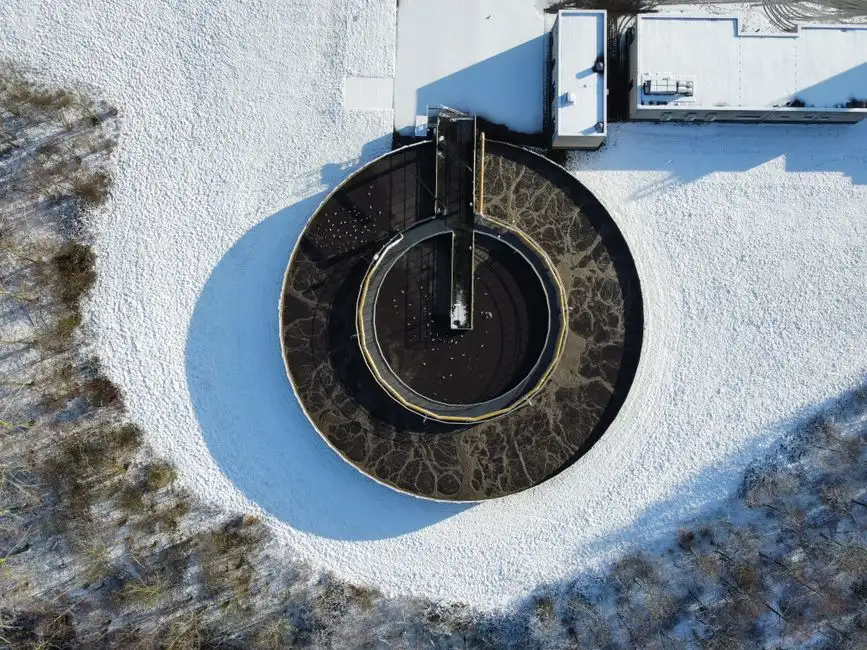
Conventional clarification uses gravity sedimentation. Settleable solids move into a bottom collection zone and are removed as sludge. A lamella plate clarifier adds inclined plates that improve separation within a more compact structure. A high-efficiency lamella clarifier is therefore most relevant when the principal contaminant is a heavy, settleable fraction and the proposed configuration includes compatible flocculation, sludge collection, and solids handling.
Chemical wastewater can change behavior with pH, temperature, concentration, and stream chemistry. Total concentration alone does not establish whether particles will float or settle. A colloid may require conditioning before either mechanism becomes dependable; an oil emulsion may behave differently from free oil; and metal-bearing material may be dissolved, attached to light particles, or associated with heavy precipitates.
For metals, distinguish the dissolved fraction from metals attached to settleable or flocculable solids. Reliable capture depends on conditioning the metal-bearing material and then separating the resulting floc. A bid should therefore identify the analytical method, sample location, chemical treatment, and separation step by which the metals are expected to be removed.
Match the Separator to the Chemical Wastewater Profile
The strongest process match follows the physical behavior and variability of the dominant contaminant fraction, not the product category proposed by a vendor. Each wastewater source must be assessed separately because a dilute washdown stream can require different treatment from concentrated production wastewater.
| Wastewater profile | Why DAF is commonly considered | Why clarification is commonly considered | Required confirmation |
|---|---|---|---|
| Dominant oils or FOG | Floatation directly targets material that can attach to bubbles and be skimmed | Not usually the first process screen unless the oil-bearing solids settle and the treatment objective differs | Free-oil and emulsion observations, oils-and-greases analysis, temperature, and conditioning test |
| Fine, colloidal, or flocculable solids | DAF can capture particles after coagulation and flocculation enlarge them and improve bubble contact | May be effective only if flocculated particles settle at the required rate | Particle-size distribution, settleability, flotation test, and chemical-dose response |
| Heavy crystalline or granular solids | Can float after conditioning, but this may add chemical demand where gravity separation is sufficient | Matches the settling behavior of dense solids | Settleability, solids density, loading basis, and sludge-collection assessment |
| Mixed floatable and heavy solids | DAF can remove the floatable fraction before clarification captures residual heavy solids | A clarifier can handle settleable material after flotation removes oils and light solids | Sequential removal tests and a clear mass balance for each stage |
| Variable batch discharges | Can perform when hydraulic, solids, and chemical-loading conditions remain within the proven design envelope | Can perform when settling remains adequate during transient loadings | Batch hydrograph, equalization data, worst-case load, and upset-response plan |
For oils, FOG, and flocculable solids, the central engineering question is whether the selected conditioning creates particles with enough size and surface condition for reliable bubble contact. Clearwater states that chemical conditioning increases particle size and improves contact with microbubbles, so the coagulation and flocculation system is part of the separator—not a minor accessory.
For heavy settleable solids, gravity separation is the more direct mechanism. Inclined plates in a lamella unit can reduce the footprint needed for separation, but they do not remove the need to establish settleability, hydraulic distribution, and sludge collection.
ChemREADY identifies Sebring within the service area served from its Twinsburg office. Its treatment scope includes flow-equalization basins, DAF, biological processes, clarification, and dewatering, with testing for parameters including pH, alkalinity, TSS, COD/BOD, FOG, and metals. That is evidence of full-chain capability, not proof that one separator will fit every chemical stream.
Performance examples must retain their source conditions. Ecologix Systems reports 95% oil-and-grease removal with DAF in a food-processing example, compared with 70% efficiency for a clarifier on the same stream, and 90% solids reduction with a clarifier in a mining example. These are supplier examples with different source conditions, not Sebring performance guarantees.
Size for Peak Flow, Chemistry, and Real Separation Duty
Equipment sizing requires a representative characterization program rather than one averaged sample. Average flow may conceal the batch discharges, washdown events, and stormwater inflows that determine the real separation duty.
Request source-by-source flow records, peak-flow data, batch-discharge profiles, stormwater contribution, and equalization data. The analytical program should include TSS, particle-size distribution, settleability, oils and greases, temperature, emulsion observations, total and dissolved metals, pH range, and alkalinity where relevant. Samples should be tied to production conditions and the sampling point relevant to each proposed unit.
Hydraulic loading and solids loading must both be matched. A model selected from average flow alone leaves the separation mechanism, chemical demand, skimmer or sludge capacity, and downstream solids route unresolved. A satisfactory bid should connect the measured flow and solids profile to the proposed tank, separation area, recycle arrangement, solids-handling system, and material selection.
| Design input | Evidence the buyer should require | Equipment decision affected |
|---|---|---|
| Flow and hydraulic profile | Source-by-source flow records, production peaks, batch profiles, stormwater contribution, and equalization behavior | Tank sizing, hydraulic residence, distribution, recycle, and controls |
| Solids and contaminant behavior | TSS, particle-size distribution, settleability, oils and greases, total and dissolved metals, and emulsion observations | Flotation or gravity mechanism, separation area, conditioning, and skimmer or sludge withdrawal |
| Chemistry and materials exposure | pH range, temperature, alkalinity, and the actual wastewater matrix | Chemical dosing, mixing energy, materials, corrosion protection, and utility requirements |
| Downstream solids duty | Expected sludge volume, moisture condition, storage time, dewatering route, and disposal method | Solids collection, pump or auger arrangement, dewatering capacity, and storage |
HydropureWater’s DAF catalog lists 13 standard models spanning 4–300 m³/h. This is a manufacturer catalog range, not a site-sizing guarantee. Clearwater’s April 27, 2026 publication describes the FPAC as intended for small-to-medium flow with high solids loads, the FPBC for low-to-medium solids loads, and the FPHF for high flow with low-to-large solids loads. These are configuration distinctions. The factory’s measured flow, solids, particle behavior, and conditioning results must still determine the model.
For procurement, an industrial DAF system for chemical wastewater should be requested against a defined design basis. A clarifier bid should provide equivalent information for settling area, hydraulic distribution, sludge collection, recirculation where proposed, and chemicals. Neither proposal should stop at a model name and nominal flow.
Compare Chemical Dosing, Controls, and Sludge Handling
The separator cannot be evaluated independently from its conditioning and solids-disposal systems. A low-priced tank with incomplete chemical, controls, or dewatering scope may not meet the same performance obligation as a fully specified treatment train.
Include pH adjustment, coagulant and flocculant dosing, mixing energy, and chemical storage in the performance review. Flotation conditioning must create particles that contact bubbles effectively; clarification dosing has a different objective and should not be assumed interchangeable. Both proposals should identify the chemical, dose-control range, mixing arrangement, storage duty, and operator intervention.
Controls should cover chemical feed, pH, flow, level, skimmer or sludge withdrawal, alarms, and data logging. Clearwater’s COMPACT DAF description states that its PLC allows operators to adjust chemical dosing pumps, skimmer speed, and sludge discharge. A bid should specify the same functions, relevant interlocks, sensor locations, and alarm response rather than merely listing an automatic control panel.
The sludge routes are different. DAF float is skimmed from the surface, while a lamella clarifier can use sludge recirculation. Each route still needs a compatible collection method, storage arrangement, dewatering process, and disposal plan. HydropureWater’s plate and frame filter press range of 1–500 m² filtration area illustrates why dewatering capacity belongs in the equipment boundary. A filter press should be selected against the expected solids quantity and moisture condition, not added as a generic line item.
| Bid component | DAF-specific question | Clarifier-specific question | Common acceptance evidence |
|---|---|---|---|
| Conditioning | Will pH control, coagulation, and flocculation create floatable floc with reliable bubble contact? | Will conditioning create particles that settle at the required rate? | Jar or pilot test linked to the proposed dose range and wastewater matrix |
| Controls | How are dosing, recycle, skimmer speed, and sludge discharge controlled? | How are dosing, flow distribution, level, and sludge withdrawal controlled? | I/O list, interlocks, alarms, sensor locations, and data-logging scope |
| Solids handling | Where does float go, and can the downstream dewatering route accept it? | Where does bottom sludge go, and how is recirculation managed? | Mass and moisture basis, storage time, dewatering duty, and disposal route |
| Cost | Which costs are specific to air supply, recycle, skimming, and conditioning? | Which costs are specific to settling area, sludge collection, recirculation, and civil works? | Common commercial scope and stated operating assumptions |
Do not assume DAF is always more expensive to operate. Ecologix states that clarifiers generally have lower operating costs, while DAF may be more cost-effective for specific oily contaminants. The defensible comparison is total cost under the same wastewater, chemical assumptions, labor basis, utilities, sludge route, and performance target.
Verify Sebring Compliance Before Buying Equipment
Separator selection and permit compliance are separate workstreams, and equipment selection cannot substitute for verifying the requirements applicable to the specific Sebring site.
Obtain the current discharge permit or authorization, sewer-use or pretreatment requirements, sampling plan, discharge criteria, and any applicable local or regional conditions. The supplied research does not establish a universal numeric discharge limit for Sebring chemical factories, so a generic national limit should not be inserted as if it were the site’s enforceable requirement.
The characterization program should align with the analytes and operating conditions addressed by the permit. A treatment train proposed only for TSS removal, for example, may not address every constituent and operating condition that the site is required to manage. The factory should establish which parameters apply to each discharge point and which are pretreatment or operational requirements before finalizing equipment scope.
Ask each supplier to identify the wastewater, chemical doses, flow, temperature, test method, sampling point, and acceptance criterion behind every performance commitment. Vendor case studies are supporting evidence only. A case performed on a different chemical stream or under different hydraulic conditions cannot establish guaranteed performance at the Sebring plant.
The [Smexico plant wastewater acquisition requirements guide and the Wuxi AppTec wastewater requirements guide provide useful examples of how wastewater obligations should be checked separately from technology selection. Their locations and regulatory details are not Sebring requirements, so the factory must obtain the controlling local documents directly.
Where a performance guarantee is proposed, tie it to the site’s own wastewater characterization, the selected sampling point, defined analytical methods, operating conditions, and the applicable acceptance criteria. Permit language should be reviewed by the responsible environmental and engineering personnel rather than inferred from a supplier’s equipment statement.
Use a Repeatable Vendor Evaluation Checklist
A repeatable evaluation requires every supplier to answer the same technical and commercial questions against one measured wastewater basis. Comparing tank prices before normalizing the treatment scope creates false savings.
- Define the basis: provide each bidder the source-specific characterization, hydraulic profile, target effluent requirements, chemical assumptions, and sludge route.
- State the mechanism: require written identification of flotation and skimming, gravity settling, inclined-plate separation, or a staged combination.
- Size the duty: require design flow, peak-flow treatment, solids-loading basis, separation area, equalization assumptions, and chemical-loading limits.
- Complete the train: price pretreatment, pH control, coagulation and flocculation, mixing, controls, utilities, sludge collection, storage, dewatering, installation, and service.
- Test the claim: require comparable wastewater, defined doses, flow, temperature, test method, sampling point, and acceptance criterion.
| Required proposal item | Question the evaluator must answer | Reason to reject an incomplete response |
|---|---|---|
| Design basis and separation mechanism | Which measured stream, peak condition, contaminant fraction, and physical mechanism does the equipment address? | The proposal cannot be compared with another technology on a common basis |
| Conditioning and controls | What chemicals, mixing, sensors, interlocks, alarms, and operator actions are included? | Performance and operating cost remain undefined |
| Solids and dewatering | Where does float or sludge go, and which equipment handles the resulting duty? | Primary separation may create a downstream bottleneck |
| Materials and installation | Why do the proposed materials and civil or utility interfaces fit the wastewater and site conditions? | Durability and installed cost may be understated |
| Proof and service scope | What comparable evidence, site test plan, references, spares, and service support are offered? | The buyer cannot judge delivery risk or support expectations |
Reject generic removal percentages that omit influent conditions, chemical dosing, test method, sampling location, and acceptance criteria. Clearwater states that its standard DAF material is 304 stainless steel, with 316 stainless steel, polypropylene, and other materials available on request, in its April 27, 2026 publication. Material selection should be justified against the factory’s actual chemistry and temperature, not accepted from a standard list without rationale.
Ask why the competing technology was screened or rejected. A valid comparison should use the same wastewater, conditioning assumptions, hydraulic profile, and performance criteria. A bid that evaluates only DAF, or only a clarifier, is incomplete until the supplier explains the exclusion.
Compare total cost of ownership rather than purchase price alone. The same commercial schedule should cover separator, pretreatment, pH control, chemical dosing, controls, utilities, labor, maintenance, sludge handling, dewatering, disposal, installation, and service. The [sourcing-partners guide for wastewater equipment components can help procurement organize component and supplier questions, while the chemical wastewater DAF versus clarifier guide offers a useful structure for keeping the same design basis across bids.
Frequently Asked Questions
Which process is better for chemical wastewater: DAF or a clarifier?
Choose DAF for oils, FOG, fine solids, colloids, and material that can be conditioned into floatable floc. Choose conventional or lamella clarification for heavy solids that settle readily. For mixed streams, consider both in sequence only when testing shows that DAF removes a defined floatable fraction and clarification captures a different residual fraction.
How should a factory compare DAF and clarifier supplier prices?
Require one design basis and one complete-scope quotation. The price comparison should include pretreatment, pH control, chemical dosing, mixing, controls, utilities, sludge collection and storage, dewatering, installation, maintenance, and service. Without those inputs, the lowest equipment price does not establish the lowest total cost of ownership.
What information is needed to size a DAF or lamella clarifier?
Request source-specific characterization, peak and batch flows, stormwater contribution, equalization data, pH and temperature ranges, particle behavior, settleability, oils and greases, total and dissolved metals, and a stated solids-loading basis. Average flow alone is not enough to select the separator, its separation area, or its solids-handling duty.
What should a factory require as proof of performance?
Request evidence from comparable chemical wastewater and require the proposal to identify chemical doses, flow, temperature, test method, sampling point, and acceptance criterion. Supplier case studies can support the selection, but they should not become binding guarantees unless the site-specific conditions and test method are established.
Does choosing the right separator establish Sebring permit compliance?
No. The proposed treatment train must support the current permit and local pretreatment conditions, but the factory must obtain and verify those requirements directly. The relevant wastewater characterization, analytes, sampling plan, and operating conditions should align with the controlling site-specific documents; the supplied research does not establish a universal numeric discharge limit for Sebring chemical factories.