Which unit should a Bowie factory choose?
For Bowie mining and metals factories in 2026, choose a clarifier for dense, rapidly settling mineral fines and a DAF for oil, grease, emulsions, colloids or buoyant floc; many combined streams need both. A lamella clarifier is the more compact primary option for dense solids, while DAF uses 30–50 µm micro-bubbles to float conditioned floc. DAF performs poorly with heavy silt and clay loads, so raw tailings should not be assigned to it without testing. The final choice should follow jar tests and pilot data, with the RFQ covering seasonal flow, TSS, particle size, pH, dissolved metals, sludge solids, winterization, controls and downstream filtration.
Start with the contaminant fraction, not the equipment catalog. A mining or metals stream can combine dense tailings fines, colloidal clay, oil from equipment maintenance, residual flotation reagents, and dissolved copper, lead, zinc or iron. Gravity clarification addresses the settleable mineral fraction. Flotation addresses conditioned particles that can be made buoyant. Neither mechanism alone resolves every fraction.
A lamella clarifier increases effective settling area within a smaller tank, but it still separates particles by gravity and withdraws settled sludge from the bottom. DAF attaches 30–50 µm bubbles to floc and removes the resulting blanket with a skimmer, as described by Clearwater Industries in the HydropureWater 2026 application note. Fluence, also cited in that note, states that DAF is not well suited to high concentrations of heavy, non-floating particles such as silt and clay.
Use the broader DAF versus clarifier comparison for mining wastewater to document the mechanism selection, but make the final Bowie decision only after the stream has been characterized across operating and seasonal conditions.
A four-step selection method for Bowie mining wastewater
A Bowie equipment decision becomes defensible when the buyer follows the same four steps for every candidate mechanism and records the inputs used to reach the conclusion.
- Characterize the stream. Measure flow, TSS, particle-size distribution, pH, temperature, dissolved copper, lead, zinc and iron, oils and grease, flotation-reagent carryover, and seasonal variability.
- Classify the fractions. Separate dense settleable fines from fine or colloidal solids, buoyant precipitates, emulsified oil and dissolved species. Treat the dominant fraction as the primary design duty, but retain the others as polishing requirements.
- Establish conditioning by jar test. Identify pH adjustment, coagulant and flocculant conditions. Clearwater Industries, cited in the HydropureWater 2026 application note, describes a 15–45 second DAF flocculation contact-time range and says the applicable value is established empirically through jar testing; it is not a universal plant requirement.
- Validate the train. Use pilot data and the plant’s current Bowie discharge, reuse or pretreatment obligations to set equipment performance guarantees before accepting a final design.
The same HydropureWater 2026 application note warns that inconsistent influent data across seasonal flow changes can produce undersized equipment and non-compliance. That makes a consistent sampling and testing protocol part of the equipment-selection process, not an afterthought.
| Step | Required evidence | Decision released |
|---|---|---|
| Characterization | Seasonal flow, TSS, particle-size distribution, pH, temperature, metals, oils and reagent carryover | Dominant contaminant fraction and design envelope |
| Classification | Settleable, colloidal, buoyant and dissolved fractions | Clarifier, DAF or combined train |
| Jar testing | pH, coagulant and flocculant response | Conditioning approach and preliminary chemical consumption |
| Pilot validation | Comparable mixed-solids performance and solids handling | Guaranteed design values, controls and downstream requirements |
If chemical feed is part of the selected train, request an automatic chemical dosing system for the trial and final installation, with its control signals and operating envelope aligned with the pilot results.
DAF and clarifier performance compared
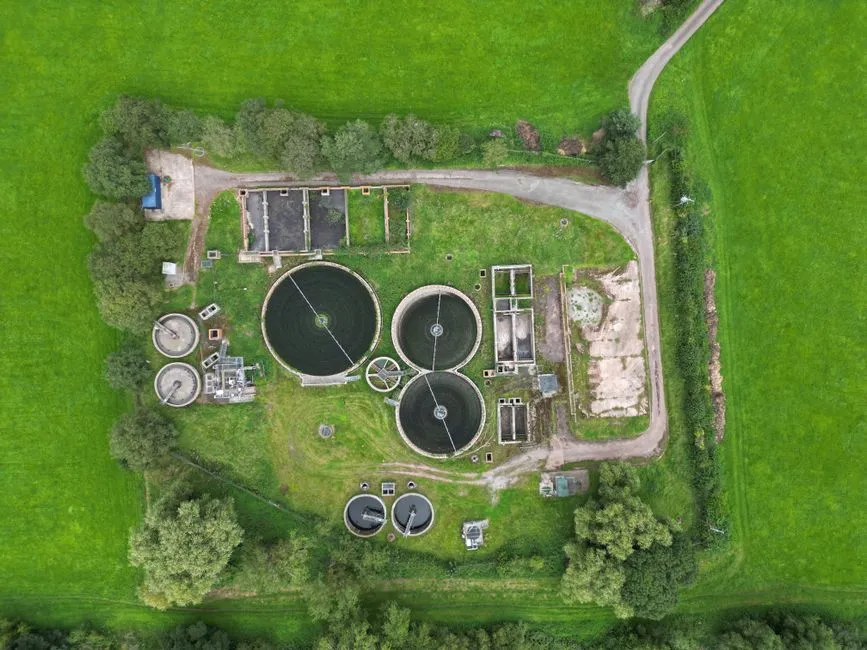
Clarification and flotation remove different physical fractions, so their performance must be compared against the contaminants present in the Bowie stream rather than as generic removal percentages.
Clarification is the established primary mechanism for dense mineral fines and metallurgical sludge. Lamella plates increase effective settling area and reduce the footprint required for gravity separation; they do not change that mechanism. DAF uses micro-bubble flotation to collect oil droplets, conditioned fine precipitates, biological floc and loose polymer-conditioned floc above the water surface, where a skimmer removes the floated blanket.
| Issue | Clarifier or lamella unit | DAF unit |
|---|---|---|
| Primary mechanism | Gravity separation with bottom sludge withdrawal; lamella plates increase effective settling area | 30–50 µm micro-bubbles attach to floc, which is skimmed from the surface |
| Best-matched fraction | Dense mineral fines, tailings and metallurgical sludge that settle under the selected hydraulic conditions | Oil droplets, fine precipitates, biological floc and conditioned low-density solids |
| Important limitation | Emulsions, surfactants, colloidal fines and dissolved metals may pass into overflow | High silt and clay loads are poorly suited to flotation; recycle, air generation and sludge withdrawal remain critical |
| Conditioning | Performance depends on particle settleability, surface-overflow rate and sludge withdrawal | pH, coagulant and flocculant dose must be established by testing |
| Solids outlet | Bottom underflow | Surface float removed by skimmer |
Neither unit separates dissolved metal ions merely through gravity or flotation. If metals are present in solution, chemical precipitation or another treatment step must convert or remove that dissolved fraction before physical separation. The clarifier and DAF then separate the resulting precipitate.
Catalog values provide a screening basis, not a Bowie guarantee. The supplier information summarized in the HydropureWater 2026 application note lists 4–300 m³/h across 13 DAF models and a 20–40 m/h surface-loading band for the referenced lamella design. These are supplier starting points; the final hydraulic duty must reflect the selected stream and pilot evidence. For preliminary vendor discussions, compare an industrial DAF system for mining wastewater with a high-efficiency lamella clarifier, but do not let catalog capacity substitute for site-specific design.
When the correct answer is clarifier followed by DAF
A combined clarifier-to-DAF train is the more defensible arrangement when a Bowie stream contains both dense mineral solids and a remaining buoyant or colloidal load.
Bulk clarification should come first. It removes dense mineral solids, reduces the solids burden presented to flotation, and produces underflow that can be routed to sludge dewatering. DAF then captures conditioned oil, residual colloids and buoyant precipitates that escape the clarifier overflow. This sequence assigns each unit the fraction it can physically address; it does not ask either mechanism to perform an incompatible job.
The process train should be reviewed as equalization and characterization; pH adjustment or chemical precipitation where required; coagulation and flocculation; lamella clarification; DAF polishing; solids dewatering; and final filtration or discharge/reuse treatment. The exact order of chemical precipitation and clarification must follow the chemistry demonstrated during bench and pilot work.
A clarifier-only arrangement can be appropriate where the solids are dense and readily settle, oil and emulsified-oil carryover are insignificant, and no DAF-type polishing is required. A DAF-first arrangement can be appropriate for emulsified oils, cutting fluids, light floc and colloidal solids where settleable tailings are not dominant. Those are stream-specific conclusions, not defaults.
DAF effluent may still require filtration or membrane treatment before reuse or discharge. Include that boundary in the original RFQ rather than discovering it after the main unit is purchased. The ultrafiltration system for downstream solids separation is one possible polishing approach, subject to project-specific validation.
Sizing, construction and Bowie operating constraints
The equipment should be sized from the demonstrated duty and the construction envelope required for Bowie service, rather than from a generic surface-loading or rise-rate assumption.
| Design area | Information to obtain | Evidence status |
|---|---|---|
| DAF hydraulics | Peak flow, hydraulic loading, recycle rate, air-to-solids ratio, flotation contact time and conditioned-solids flotation behavior | No universal Bowie rise rate is established in the supplied research |
| Lamella clarification | Selected surface-overflow rate, plate angle, effective settling area, sludge-hopper capacity, underflow solids target and withdrawal design | Use 20–40 m/h only as the referenced supplier catalog band |
| Fine silica service | Whether the lower 10–15 m/h band is needed | Recommended by the supplied regional material for fine silica |
| Winter operation | Protection of recycle line, saturation vessel, exposed piping and tanks; freeze protection for an unheated clarifier hopper | Must be defined by project and vendor |
| Acidic or abrasive service | Corrosion-resistant construction, including evaluation of 316L stainless steel or specialized coatings | Construction options identified by the supplied research |
| Post-DAF polishing | UF suitability, feed turbidity, flow and recovery requirements | Supplier states up to 300 ppm turbidity and 2,000–40,000 L/h capacity for its UF system; project validation required |
For DAF, require the bidder to state its sizing basis and operating limits. The supplied research does not establish a universal rise rate for Bowie mining streams. For lamella clarification, require the selected surface-overflow rate and sludge design rather than accepting the supplier’s broad 20–40 m/h band without checking particle settleability. The regional material recommends 10–15 m/h for fine silica.
Cold weather changes procurement scope, not just equipment selection. Require a winterization plan covering the DAF recycle line, saturation vessel and exposed piping or tanks, together with freeze protection for an unheated clarifier sludge hopper. Do not accept a specific cold-temperature bubble-performance reduction without a traceable supporting study; instead, require temperature-corrected performance and a winter-startup guarantee.
Acidic and abrasive streams also need documented corrosion allowances. The supplied research identifies 316L stainless steel and specialized coatings as options to evaluate. Require material certificates and clearly state which wetted components, fasteners, coatings and replacement parts each cover.
The referenced UF system is described as removing colloids and suspended solids without chemicals, accepting up to 300 ppm turbidity and operating from 2,000 to 40,000 L/h. Those are equipment-specific supplier values, not proof that the system will meet Bowie reuse requirements.
What should the Bowie RFQ and vendor guarantee include?
A comparable Bowie RFQ must define the influent, treatment boundary, performance envelope and sludge route so bidders quote the same work rather than alternative scopes under the same headline price.
| RFQ item | Required bidder response | Acceptable evidence |
|---|---|---|
| Stream characterization | TSS, particle-size distribution, pH, temperature, dissolved metals, oils and grease, seasonal flow, reagent carryover and proposed chemical doses | Representative sampling plan and bench or pilot report |
| Treatment boundary | Pretreatment, precipitation, flocculation, clarification, flotation, solids removal, final polishing, controls, utilities, installation and commissioning | Process flow diagram, battery limits and exclusions |
| Performance guarantee | Guaranteed TSS, relevant metals, oil and grease results at defined influent conditions | Operating envelope and explicit exclusions outside it |
| Qualification | Experience with comparable metal-bearing streams | Pilot evidence, reference installations and post-commissioning support |
| Controls and materials | Dosing integration, material certificates, documentation and warranty scope | Control narratives, drawings and applicable certification scope |
| Operations | Training, spares, winterization and sludge-dewatering interfaces | Defined deliverables and commercial exclusions |
Ask each bidder to state whether ISO 9001 certification applies to the manufacturer and its scope. Certification is useful supplier-quality evidence, but it is not proof that the proposed equipment will meet the plant’s permit. Similarly, 40 CFR Part 437 is a regulatory research starting point, not the governing site-specific determination. Require the plant’s current permit, applicable subcategory and current Bowie and Maryland requirements to govern the final compliance design. Additional context is available in mining wastewater sewer-limit compliance guidance.
For DAF bids, require chemical dose, recycle, air generation, temperature and sludge-withdrawal conditions to be included in the guarantee. For clarifier bids, require the selected surface-overflow rate, plate geometry, hopper capacity and underflow target to be stated. If an automatic chemical dosing system is included, specify its interface, alarms, maintenance requirements and guarantee responsibility.
Do not let a vendor substitute generic reference performance for this stream. Comparable pilot data, a defined seasonal operating envelope, training, control narratives, spares, winterization and downstream sludge interfaces should appear in every offer.
Compare lifecycle cost without hiding the sludge line
Industrial-grade DAF capital expenditure is reported at $150,000 to more than $1.5 million, depending on flow and materials of construction, in the HydropureWater 2026 application note. This is a broad research range, not a Bowie quotation or a value that can be entered directly into a plant budget.
The same source describes a 20–30% premium over base-model municipal DAF units for heavy-duty mining sludge handling. Procurement should treat that as a quotation question: ask the bidder to identify the premium, its basis, and the equipment or civil works included.
| Lifecycle component | Information to request | Evaluation basis |
|---|---|---|
| Installed treatment | DAF or clarifier, foundations, chemical skid, controls and utilities | One integrated scope with exclusions stated |
| Sludge solids | 4–8% DS for DAF float and 2–5% DS for lamella underflow | Regional field-data starting points, not guaranteed results |
| Solids dewatering | Plate-and-frame press area, operating mode and cake-handling requirements | Supplier range of 1–500 m²; final sizing from pilot solids characteristics |
| Operating costs | Energy, chemicals, sludge hauling, labor, maintenance and disposal | Same evaluation period for all alternatives |
| Winterization | Insulation, heat trace, enclosed equipment and startup provisions | Scope-specific installed and operating cost |
The supplied regional sludge starting points are 4–8% dry solids for DAF float and 2–5% dry solids for lamella underflow. They are field-data references, not promised project results. The referenced plate-and-frame filter press covers 1–500 m² filtration areas and manual, hydraulic or automatic PLC operation. Have the sludge vendor size it from pilot solids characteristics rather than assuming that the upstream unit’s catalog output fixes press capacity. A plate-and-frame filter press for mining sludge dewatering should therefore be quoted as part of the integrated treatment scope.
Compare alternatives over the same evaluation period, including energy, chemical consumption, sludge hauling, labor, maintenance and disposal. A lower vessel price can be offset by more reagent consumption, a less favorable solids-solids ratio, additional polishing, winter utilities or a larger dewatering line. Exact Bowie pricing, lead time, guarantees and regulatory applicability require site-specific data and a written quotation.
Frequently Asked Questions
How much does DAF or clarifier equipment cost for a Bowie mining plant?
Exact Bowie pricing requires a written quotation based on flow, TSS, particle-size distribution, contaminants, materials, sludge handling, controls, winterization and installation. The broad research range for industrial-grade DAF capital expenditure is $150,000 to more than $1.5 million, and the reported 20–30% mining-solution premium over base-model municipal DAF units must be vendor-quoted. Ask for an integrated price covering the selected unit, chemical conditioning, sludge dewatering, controls and winterization rather than comparing vessel prices alone.
Which supplier qualification is most important when choosing between DAF and a clarifier?
Require evidence from a comparable metal-bearing stream, followed by pilot data and a performance guarantee tied to the defined Bowie influent and effluent conditions. Confirm that the bidder defines the treatment boundary, operating envelope and downstream polishing requirement. Also request post-commissioning support, automated dosing integration, material certificates, operator training and warranty scope. ISO 9001 may be relevant to manufacturer quality systems, but it does not establish that the proposed equipment will meet the permit.
Can a Bowie plant use a clarifier alone for a mixed mining wastewater stream?
Only if the stream does not require separate treatment of emulsified oil, buoyant floc or residual colloidal material. A clarifier alone can be appropriate for dense, readily settling solids with insignificant oil carryover. If characterization shows a material buoyant or colloidal fraction, specify DAF polishing or another validated treatment step. Whether filtration or membranes are also required depends on the plant’s current discharge or reuse objectives.
Does 40 CFR Part 437 prove that a DAF or clarifier will meet Bowie discharge requirements?
No. Treat 40 CFR Part 437 as a regulatory research starting point, then verify the plant’s current permit, applicable subcategory and current Bowie and Maryland requirements. Neither DAF nor a clarifier is selected by regulation name alone. Compliance depends on the characterized stream, selected chemistry, treatment train, operating envelope, monitoring and site-specific performance demonstration.