Build the compliance basis before selecting treatment equipment
The controlling document is the current POTW pretreatment permit, not the equipment datasheet. Start with the industrial user permit, current local sewer-use limits, discharge authorization, monitoring duties, and any applicable categorical pretreatment standards. The supplied 2026 mining and metals guide identifies 40 CFR 435 as part of the decision framework, but the applicable category, exemption, or lack of categorical coverage must be confirmed for the plant. Do not treat any technology as a permit guarantee. EPA 542-R-14-00 states that selecting a treatment technology may or may not produce compliance with applicable federal, state, tribal, or local requirements.
Request the POTW’s current limit schedule, prohibited-discharge list, monitoring parameters, sampling frequency, reporting requirements, and surcharge criteria. No numerical Mount Vernon sewer limits were available in the supplied research, so this article does not infer pH, TSS, oil and grease, metal, flow, or surcharge limits. Establish which conditions come from federal categorical requirements, which come from local pretreatment limits, and which are site-specific permit conditions. The regional mining-plant pretreatment compliance workflow provides a parallel structure for developing that hierarchy, while the mining plant sewer-limit compliance strategy shows why a local permit review must precede design.
Build a source-by-source inventory before sizing equipment. Include heavy mineral slurry, tailings-thickener overflow, acid mine drainage, metal-finishing rinse water, oily vehicle and equipment wash water, metalworking fluids, and intermittent batch discharges. EPA 542-R-14-00, March 2014, defines mining-influenced water as water whose chemical composition has been affected by mining or mineral processing, including acid rock drainage, neutral and alkaline waters, mineral-processing waters, and residual waters. That definition is useful for screening, but it does not establish whether a particular stream is subject to a particular categorical standard.
Characterize each wastewater stream before blending it
Blending incompatible feeds hides the design load and can convert a simple solids-removal problem into a chemical-treatment problem. Separate the plant wastewater into four engineering profiles: heavy mineral slurry and tailings-thickener overflow; AMD and metal-rich rinse water; oily wash water and metalworking fluids; and mining-vehicle or heavy-equipment wash water. Characterize each source during representative production and batch-discharge periods before testing the proposed blended composite. The 2026 guide supports sizing from a 24-hour averaged profile based on actual discharge duration rather than the largest pump’s nameplate, but batch releases must still be checked for peak hydraulic and control requirements.
| Wastewater profile | Characterization to obtain | Primary engineering concern |
|---|---|---|
| Heavy mineral slurry and thickener overflow | Particle-size distribution, solids concentration, settleability, density, and oil content | Coarse, rapidly settling solids are candidates for gravity or lamella separation; characterize the fine fraction before assigning the entire flow to either unit. |
| AMD and metal-rich rinse water | pH, dissolved metals, metals expected to precipitate, alkalinity, and precipitation behavior | Dissolved metals must be converted to a removable solid phase before physical separation. |
| Oily wash water and metalworking fluids | Free versus emulsified oil, FOG, TSS, grit, droplet condition, and cutting-fluid or drawing-compound additives | Near-neutral-buoyancy oil requires a flotation mechanism rather than settling alone. |
| Mining-vehicle or heavy-equipment wash water | Oil, entrained grit, detergents or other additives, TSS, flow variability, and batch duration | The stream may contain both floatable contaminants and heavy solids requiring separate removal mechanisms. |
For heavy mineral slurry, record whether coarse particles settle rapidly and whether the fines fraction remains significant. Rapidly settling, oil-free material generally supports gravity or lamella clarification. For AMD, EPA 542-R-14-00, March 2014, states that active and passive mining-water treatment generally aims to raise pH, lower dissolved-metal concentrations, and lower sulfate. The exact chemistry program must come from testing the plant’s actual water. For oily streams, distinguish free oil from stabilized emulsions because their separation behavior differs.
Use a PLC-controlled chemical dosing skid only after jar testing has established reagent selection and dose range. Sampling should cover ordinary operation, maximum batch discharge, upset conditions, and each proposed blend. Do not assume that a source sampled once represents a variable wash-water or thickener-overflow discharge.
Match DAF and clarifiers to the pollutants each can remove
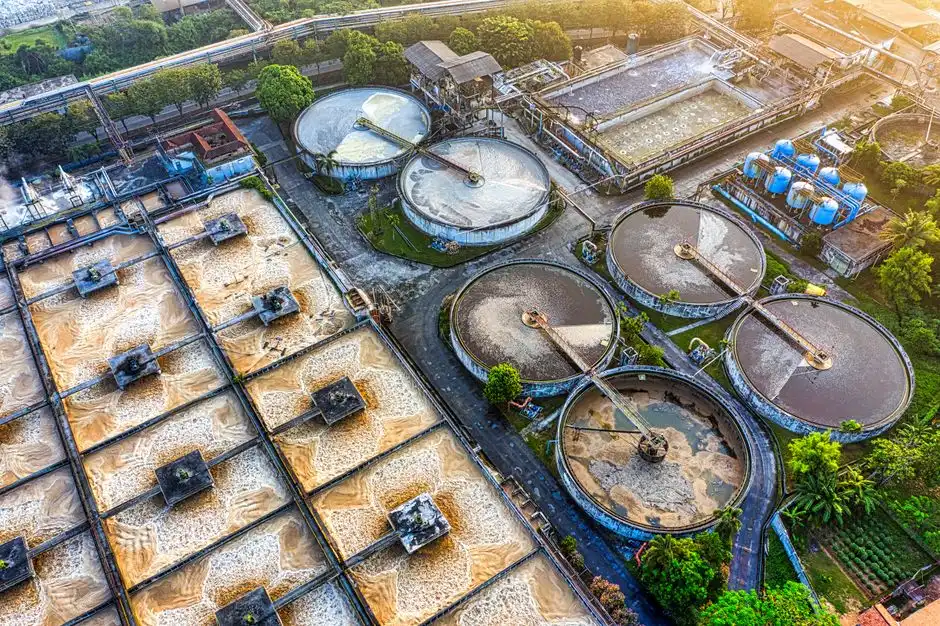
DAF and lamella clarification are not interchangeable because their separation mechanisms differ. In a DAF unit, a pressurized recycle side stream releases air through nozzles, creating microbubbles that attach to oil, fine solids, and precipitates so the resulting float can be skimmed. Rodrigues and Rubio in the International Journal of Mineral Processing, Volume 82, Issue 1, February 2007, report bubble sizes of 30–100 μm and describe flotation of fine and ultrafine mineral particles. A packaged DAF system for mining wastewater is therefore a candidate when emulsified oil, fine particles, or newly formed metal precipitates control the treatment objective.
Lamella clarification uses inclined plates to shorten the settling distance. The HydropureWater product specification for its lamella clarifier states a 20–40 m/h surface loading rate and up to 30% lower flocculant consumption than a conventional basin. Those are vendor specifications, not guaranteed Mount Vernon performance. The same 2026 guide reports approximately 95% oil removal for DAF versus approximately 70% for the clarifier on one high-oil industrial stream, with visible sheen and FOG slip on stabilized emulsions (Ecologix, 2026, as reproduced by HydropureWater). As the counter-case, it reports approximately 90% solids reduction for the clarifier configuration on a heavy-sediment mining stream at lower cost (Ecologix, 2026, as reproduced by HydropureWater).
| Decision factor | DAF | Lamella clarification |
|---|---|---|
| Separation mechanism | Microbubble flotation of attached oil, fines, and precipitates | Inclined-plate settling of particles with adequate settling behavior |
| Best-supported feed case | Emulsified oil, FOG, fine solids, and AMD precipitates | Heavy, inert, oil-free solids and residual floc |
| Reported comparison evidence | Approximately 95% oil removal on a high-oil industrial stream (Ecologix, 2026, as reproduced by HydropureWater) | Approximately 70% oil removal on that stream and approximately 90% solids reduction on a heavy-sediment mining stream (Ecologix, 2026, as reproduced by HydropureWater) |
| Principal limitation | Requires correct chemistry, recycle, and flotation control | Inclined plates shorten settling distance but do not change buoyancy, so near-neutral oil droplets may not be captured |
| Typical role in a mixed train | Primary removal of floatable oil, fines, and precipitates | Final polishing of heavier residual floc before permitted discharge |
For a heavy, oil-free feed, a lamella clarifier for residual floc polishing may be sufficient and less chemically complex. For a feed containing emulsified oil, sub-50 μm metal fines, or AMD precipitates, DAF is the stronger primary mechanism. Mixed feeds often justify DAF followed by lamella polishing because the units remove different particle populations. The detailed DAF versus clarifier comparison provides the source discussion behind this selection rule.
Create a treatment train that can be verified at each step
The treatment train should be organized as a measurable sequence: characterize and equalize the feed, condition the selected contaminants, separate the primary solids or float, polish the residual solids, monitor the final discharge, and route the resulting sludge to dewatering. For AMD, place pH adjustment before solids separation so target metals precipitate into a solid phase that can be removed. Each reagent needs its own calibrated setpoint and controlled feed; otherwise a change in alkalinity, metal loading, or flow can push the treatment chemistry outside its validated range.
Use jar testing to select the coagulant, flocculant, pH target, and dose sequence on actual plant wastewater before fixing the production recipe. The supplied 2026 guide identifies skipped jar testing as the most common cause of DAF underperformance and a failure mode a control authority may examine during a 40 CFR 435 review. Jar tests also provide the chemical program required to price operating costs and reproduce treatment performance in automatic controls.
| Process location | Required function | Verification question |
|---|---|---|
| Before treatment | Source segregation, equalization, flow measurement, and representative feed characterization | Does the measured flow and contaminant load match the selected design basis? |
| Chemical conditioning | pH adjustment and coagulant/flocculant dosing selected by jar testing | Are setpoints tied to measured flow, pH, and validated dose response? |
| Primary treatment | DAF flotation for oil, fines, and precipitates, or clarification for suitable solids | Does the selected mechanism match the contaminant and required removal objective? |
| Polishing | Lamella capture of residual floc where required | Has residual TSS and other permit parameters been checked after polishing? |
| Final discharge | Permit-specific monitoring and flow confirmation | Do analytical results satisfy every applicable permit requirement at the authorized point? |
For a mixed train, DAF can remove emulsified oil, fine solids, and AMD precipitates, while downstream lamella clarification polishes residual floc. Install equalization and flow monitoring upstream of treatment. Use the 24-hour averaged flow profile for process sizing while preserving capacity and controls for actual batch releases. Define monitoring points after equalization, after primary treatment, after polishing, and at final discharge. Confirm pH, TSS, oil and grease, metals, flow, and any other parameters against the current permit rather than treating this list as a universal discharge standard.
Manage sludge and operating costs as part of compliance
A compliant water-quality result is not complete if the residual sludge cannot be dewatered, transported, or disposed of under the plant’s operating plan. The supplied 2026 guide states that DAF sludge typically comes off at 3–6% dry solids—too thin for direct landfill disposal and too thick to haul as a simple liquid. Where stackable cake is required, evaluate a plate and frame filter press for DAF sludge and include the resulting cake-handling and disposal basis in the project scope.
Price operating expenditure using the polymer dose established by jar testing, not a generic chart. The 2026 guide identifies polymer as the largest variable operating cost on a DAF system. Chemical consumption should also be tied to measured alkalinity, flow, and contaminant loading. Clarification may reduce chemical demand for a heavy-solids feed, while a combined DAF-and-lamella train adds saturation, recycle, compressed-air, and dewatering requirements that must be evaluated together.
Compare total installed scope rather than vessel price. The supplied guide identifies the saturated vessel, recycle pump, skimmer drive, PLC, integrated chemical-dosing skid, controls, and downstream dewatering as components that affect operability. It also cites EPA 625/1-75-003a, Process Design Manual for Suspended Solids Removal, January 1975, as the historic engineering baseline for sedimentation, tube settlers, wedge-wire clarifiers, and flotation. That document is background, not a current permit. EPA 542-R-14-00, March 2014, remains useful technical background for AMD and metals treatment, but it predates 2026 and does not replace site-specific engineering, current permits, or control-authority review.
Turn the design into a defensible procurement package
Each quotation should state the design flow basis, feed assumptions, treatment objectives, duty cycle, materials of construction, control philosophy, and performance-test method. The receiving engineer needs to know whether the offered system was designed for the buyer’s actual wastewater or for a generic mining application. Mining-industry evidence should be relevant to the proposed feed. The supplied 2026 guide cites Rodrigues and Rubio, International Journal of Mineral Processing, Volume 82, Issue 1, February 2007, as an operating reference for microbubble flotation in mining-vehicle wash water and AMD applications.
Request line-item pricing for the saturated vessel, recycle pump, skimmer drive, PLC, and integrated chemical-dosing skid in 304SS, plus an alternate 316SS quotation when chloride-bearing wash water or bright-dip rinse water is present. Require a chemical-program scope tied to a jar-test protocol on the buyer’s actual stream. For controls, request evidence of pre-wired, factory-tested dosing components, saturation equipment, PLC logic, alarms, and the data outputs needed to support permit reporting.
HydropureWater’s catalog DAF range is 4–300 m³/h across 13 standard models, according to the supplied 2026 guide. Treat that as a vendor catalog fact, not evidence that a particular model is appropriate for every Mount Vernon flow. The design must be checked against the actual 24-hour average, discharge duration, peak condition, feed chemistry, and duty cycle.
Define an acceptance test before award. The parties should agree on feed data, analytical methods, sampling points, operating conditions, and pass criteria. Those criteria should trace to the applicable permit and verified treatment objectives, not only to a generic equipment-efficiency curve. Factory testing, site commissioning, operator training, spare parts, control narratives, and performance-test protocols should be identified separately so omissions do not become field-integration risk.
Frequently Asked Questions
Should a Mount Vernon mining plant choose DAF or a clarifier?
Choose DAF when emulsified oil, FOG, fine solids, or AMD precipitates are the controlling contaminants. Choose lamella clarification when the feed is dominated by heavy, inert, oil-free solids or when the role is polishing residual floc. For mixed feeds, the defensible sequence is usually DAF primary treatment followed by lamella polishing. The choice must still be confirmed through source characterization and jar testing.
What should determine the size of a DAF or clarifier system?
Use the measured 24-hour averaged flow profile based on actual discharge duration, then check peak hydraulic conditions and batch controls. Feed chemistry, solids or oil loading, duty cycle, and jar-test-derived reagent requirements must also be included. The largest intermittent pump’s nameplate is not, by itself, a defensible sizing basis. A wastewater skid should be sized against documented flow and contaminant data.
How much does a mining wastewater treatment system cost?
Do not request or evaluate a price without first obtaining the design flow, feed analyses, treatment objectives, chemical program, controls scope, materials, site installation conditions, and sludge-disposal route. The supplied research contains no supported Mount Vernon system price. Ask vendors for capital-cost line items and operating-cost estimates using the buyer’s jar-test-established polymer dose; polymer is identified as the largest variable operating cost on a DAF system in the 2026 guide.
What evidence should a wastewater equipment supplier provide?
Require relevant mining references, stated design assumptions, feed and effluent objectives, control narratives, materials information, factory-test records, and a mutually defined site acceptance protocol. Request a chemical-program scope tied to jar testing on the buyer’s actual stream. Ask for mining-industry operating references appropriate to AMD or vehicle wash water, such as Rodrigues and Rubio, International Journal of Mineral Processing, Volume 82, Issue 1, February 2007.
Can one treatment unit prove compliance before sewer discharge?
No. Equipment performance does not establish permit compliance, as EPA 542-R-14-00, March 2014, expressly cautions that a selected technology may or may not result in compliance with applicable requirements. Demonstrate compliance through the complete chain: current permit conditions, representative source characterization, jar-test-validated chemistry, treatment and polishing performance, monitoring at defined points, and final discharge sampling using the required analytical methods.