Identify the compliance rules that apply before selecting equipment
Mining and metals plants near Loxley meet sewer pretreatment limits by defining the applicable regulatory requirements, characterizing each wastewater stream, and selecting treatment steps against verified discharge targets. The equipment sequence may include equalization, pH correction, coagulation, clarification, filtration, and reverse-osmosis polishing, but the final train must reflect current permits and representative influent data. Federal mining effluent guidelines, direct-discharge permits, and sewer-authority requirements answer different questions and should not be treated as interchangeable.
EPA’s 40 CFR Part 436 covers wastewater from mine drainage, mineral processing operations, and stormwater runoff, and applicable requirements are incorporated into NPDES permits (US EPA, source excerpt dated 2026-02). A quarry must first establish its mineral category. Dimension Stone, Subpart A, is listed as reserved, so the operator should not assume that this subpart supplies numeric effluent limits (US EPA, source excerpt dated 2026-02). The US effluent guidelines and NPDES permit limits guide provides a useful starting point, but not a substitute for a site-specific regulatory determination.
An NPDES permit addresses a direct discharge to waters of the United States. A POTW discharge is governed by the sewer authority’s industrial pretreatment program and written discharge limits. If the plant discharges to a POTW, confirm whether it needs a pretreatment permit or permit-equivalent authorization and whether local limits are more restrictive than the applicable federal requirements.
| Requirement layer | What it establishes | Evidence required before specification |
|---|---|---|
| 40 CFR Part 436 | Federal baseline for covered mining drainage, processing wastewater, and stormwater runoff | Mineral category, applicable subpart, and permit incorporation language |
| NPDES permit | Requirements for a direct discharge | Permit number, outfall, parameters, averaging periods, monitoring, and discharge authorization |
| POTW pretreatment requirements | Limits and monitoring governing indirect sewer discharge | Current written local limits for pH, metals, TSS, and other applicable pollutants |
| Example only: Michigan MIG490000 | Direct-discharge terms for a specific Michigan permit | Not a Loxley limit: pH 6.5–9.0 S.U.; TSS 30 mg/L monthly and 45 mg/L daily under one listed condition set (Michigan Department of Environment, Great Lakes, and Energy, permit excerpt) |
The legal record should identify the applicable subpart, permit number, discharge point, averaging period, monitoring frequency, sample type, and whether the route is direct or through a POTW. Do not convert the Michigan example into a Loxley requirement. Also check permit and local-limit currency before issuing an equipment specification.
Characterize each mining wastewater stream separately
Mining sites near Loxley need separate characterization for acid mine drainage, process water, tailings-pond effluent, mine dewatering discharge, and stormwater because these streams do not share a reliable default chemistry. The sampling program should establish which pollutants control equipment sizing and which streams can be segregated, equalized, or reused without disrupting treatment.
Acid mine drainage is generated when sulfide minerals in waste rock and tailings oxidize; the resulting sulfuric acid can mobilize iron, manganese, copper, zinc, arsenic, and cadmium (AMPAC USA, 2025-09). These pollutants require attention to acidity and dissolved metals, not merely visible solids. Dewatering discharge may be comparatively clean or metal-bearing depending on geology, while tailings-pond effluent can contain fine solids, processing chemicals, and leached metals (AMPAC USA, 2025-09).
Process water requires its own profile. Flotation, heap-leaching, cyanide-gold extraction, and chlorination circuits can generate materially different concentrations of reagents and dissolved ore constituents, potentially including cyanide, ammonia, or chloramines (AMPAC USA, 2025-09). A quarry wastewater profile cannot be substituted for those results.
| Stream | Characterization focus | Design use |
|---|---|---|
| Acid mine drainage | Acidity, pH, dissolved metals, flow variability | Chemical demand, precipitation, solids separation, and polishing |
| Process water | Residual reagents, dissolved ore constituents, suspended solids | Stream-specific treatment and discharge eligibility |
| Tailings-pond effluent | Fine solids, metals, and process chemicals | Solids handling, clarification, and filtration |
| Dewatering discharge | Geology-dependent metals, pH, and flow | Equalization and treatment route |
| Stormwater | Contacted materials, solids, metals, and discharge frequency | Segregation, containment, and permit coverage |
Sample across representative operating and storm conditions. Report peak and average flow, pH, metals, TSS, TDS, and relevant process chemicals. For mine water reuse, request a recovery percentage; the research reports a 40–60% reduction in freshwater intake where RO-enabled internal reuse is feasible (AMPAC USA, 2025-09). That is an outcome to evaluate, not a guaranteed Loxley result. The mining wastewater decanter-centrifuge guide provides additional context for solids-handling decisions, but influent characterization must still precede equipment selection.
Build a treatment train that matches the discharge risk
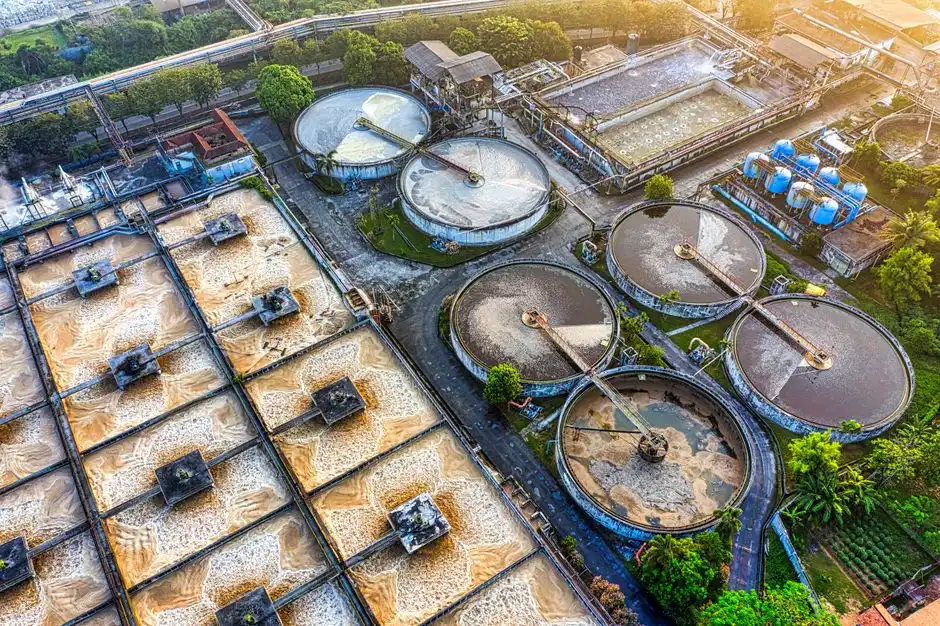
A defensible mining treatment train starts with equalization and controlled chemistry because pH correction must precede precipitation of dissolved metals as hydroxides, followed by clarification and membrane protection. Each unit has a feed assumption, a controlled output, and a downstream consequence if it underperforms.
Equalization buffers peak flow and flow variation before chemical dosing. A PLC-controlled chemical dosing system can tie lime, coagulant, flocculant, and pH-adjuster injection to the plant controls. Coagulation then converts dissolved and fine material into flocs that can be separated. The literature sequence places pH correction before metals precipitation, coagulation, solids separation, filtration, and membrane polishing where needed (Genesis Water Technologies; PMC review, 2024-02).
| Process condition | Preferred treatment step | Selection basis |
|---|---|---|
| Variable flow and chemical demand | Equalization and automatic dosing | Peak flow, operating variation, pH control, chemical inventory |
| Buoyant floc, oils, or floating fines | DAF | Floc buoyancy and contaminant floatability |
| Metal-hydroxide sludge and footprint constraints | Lamella clarification | Sludge volume, plate arrangement, underflow handling |
| Colloids and suspended solids ahead of RO | Multimedia filtration or UF | Target membrane-feed condition, especially SDI |
| Dissolved metals or salts above the sewer limit | RO polishing | Permit limit, feed conductivity, recovery target, concentrate route |
| Metal-bearing precipitation sludge | Plate-and-frame filter press | Sludge volume, cake target, cycle time, filtrate handling |
Choose DAF when floc is buoyant or oils and fines are present; choose a lamella clarifier when sludge volume and footprint drive the design. The supplier’s DAF versus clarifier selection for mining wastewater explains the mechanical distinction in more detail. The hydronic boundary is equally important: clarification removes the bulk of precipitated solids, but it does not establish that membrane feed is acceptable.
Protect downstream membranes with multimedia filtration or UF. HydropureWater’s multimedia filters are specified for SDI suitable for downstream RO protection, while its UF system for RO pretreatment uses 0.03-micron PVDF membranes, accepts turbidity up to 300 ppm, and includes automatic backwash and air scour. Use an industrial RO polishing system when dissolved metals or salts remain above the limit. The research reports more than 99% rejection of dissolved metals and salts, with 50–70% recovery for AMD feed and 70–85% when RO is the first stage of a zero-liquid-discharge train (AMPAC USA, 2025-09).
Handle metal-bearing sludge separately. A mining sludge filter press can dewater precipitation sludge; HydropureWater offers filtration areas from 1 m² to 500 m² and manual, hydraulic, or automatic PLC-controlled configurations. Integrate flow, pH, conductivity, chemical dosing, membrane status, and POTW monitoring through a shared PLC/HMI, and retain the self-monitoring records required for the applicable authorization.
Select equipment by wastewater condition and operating constraint
Equipment selection should compare documented capacity and feed limits with the facility’s own flow, chemistry, footprint, sludge, and reuse conditions. Catalog maximums are screening criteria—not guarantees that a stated flow will produce compliant water at every permitted loading.
| Equipment | Published scope | Buyer check |
|---|---|---|
| Industrial DAF system | 4–300 m³/h across 13 standard models | Selected model must cover peak flow and relevant floc-loading conditions |
| Lamella clarifier | Surface loading rates of 20–40 m/h and up to 30% lower chemical consumption | Confirm basis of the chemical-consumption claim and test against site chemistry |
| Integrated JY system | 10–200 m³/h | Check whether the packaged scope matches the required treatment train |
| UF system | 2,000–40,000 L/h; feed turbidity up to 300 ppm | Compare actual peak flow, turbidity, membrane condition, and recovery with catalog limits |
The written basis of design should state peak and average flow in m³/h, representative influent chemistry, required effluent values, available footprint, sludge-handling constraints, and the desired recovery percentage. It should also distinguish continuous discharge from stormwater control because those operating profiles may require different equipment decisions.
Ask each supplier to show how chemical dosing, clarification, filtration, RO, sludge dewatering, and controls function as one system. A proposed discharge result should be linked to a defined feed condition, not presented as a nameplate guarantee. The DAF and lamella comparison for mining and metals wastewater can help structure that technical review.
The supplied research does not publish complete Loxley-area system prices or Loxley flow bands. Obtain a site-specific quotation against the signed basis of design rather than relying on generic price or capacity claims. At minimum, request chemical consumption, power demand, footprint, sludge-generation estimate, membrane replacement assumptions, controls scope, installation requirements, commissioning acceptance tests, and validation of the proposed recovery rate.
Turn the basis of design into a compliance and procurement package
A vendor-ready package converts permit conditions and analytical data into enforceable design inputs. Include current permit copies, the applicable 40 CFR subpart determination, a signed basis of design, representative laboratory results, peak and average flow, current local sewer limits, and the desired recovery percentage. If stream segregation is part of the concept, identify each stream and its proposed destination in the package.
Require a control narrative that identifies pH setpoints, chemical-dosing logic, clarification criteria, filter backwash or UF-cleaning triggers, RO recovery and conductivity limits, and alarm handling. Define monitoring and sampling responsibilities before commissioning so equipment performance can be tied to the facility’s self-monitoring and POTW reporting obligations.
Require a recovery curve and measured performance data rather than accepting a nameplate rejection or recovery claim as proof of site performance. Supplier references should demonstrate comparable chemistry, treatment objectives, controls, and operating conditions. The wastewater requirements review for a plant acquisition illustrates why permit scope and operating data belong in the transaction or procurement record rather than being reconstructed after award.
Before signing, reconcile the final equipment list with every permit condition and analytical result. Any gap between a monitored parameter and an available instrument should become a documented process-control or sampling requirement, not an unsupported compliance assumption.
Frequently Asked Questions
What limits apply to a mining plant near Loxley?
The applicable limits depend on the mineral category,
Frequently Asked Questions
What sewer discharge limits apply to a mining plant near Loxley?
Mining facilities near Loxley must comply with the local municipal sewer use ordinance, which typically enforces strict limits on heavy metals and total suspended solids (TSS). Common discharge standards include a maximum TSS concentration of 250 mg/L, oil and grease limits of 100 mg/L, and pH levels maintained strictly between 5.5 and 9.5 standard units.
Specific heavy metal thresholds often align with EPA-derived pretreatment standards, requiring lead levels below 0.69 mg/L and total copper concentrations not exceeding 2.07 mg/L. Facilities must verify these values against the specific industrial discharge permit issued by the local wastewater authority for the 2026 fiscal year.
How much does mining wastewater pretreatment cost near Loxley?
Capital expenditure for a mid-sized mining pretreatment system in the Loxley region typically ranges from $250,000 to $850,000, depending on the required flow rate and contaminant profile. Smaller, skid-mounted systems may start at $150,000, whereas high-capacity automated plants requiring advanced filtration can exceed $1.2 million.
Operational costs, including chemical flocculants, energy consumption, and sludge disposal fees, generally average between $2.50 and $6.50 per 1,000 gallons treated. These costs fluctuate based on the specific mineralogy of the ore and the resulting complexity of the wastewater chemistry.
Should a mining wastewater system use DAF or a lamella clarifier?
The choice between Dissolved Air Flotation (DAF) and a lamella clarifier depends on the density and particle size of the suspended solids. DAF is superior for removing light, low-density solids, oils, and greases that tend to float, typically achieving up to 90% removal efficiency for emulsified oils.
In contrast, a lamella clarifier is more effective for heavy, inorganic mineral tailings and metal precipitates that exhibit high settling velocities. If the mining wastewater contains a mix of heavy metals and high-density solids, a lamella clarifier is generally the more robust and cost-effective solution due to its smaller footprint and lower energy requirements compared to pressurized DAF systems.
What data should I give a wastewater treatment supplier for an accurate quote?
To receive an accurate proposal, provide a comprehensive water quality analysis report detailing the concentration of all regulated contaminants, including heavy metals, sulfates, and total dissolved solids (TDS). You must also specify the peak flow rate in gallons per minute (GPM) and the average daily volume of wastewater generated.
Additionally, include details regarding the current discharge point specifications, existing power availability at the site, and the desired level of system automation. Providing a copy of your current municipal discharge permit or a list of required effluent quality targets is essential for sizing the pretreatment equipment correctly.
Can treated mining water be reused on site instead of discharged to the sewer?
Yes, treated mining water can often be recycled for dust suppression, ore processing, or equipment cooling, which significantly reduces the volume of wastewater requiring discharge. Implementing a closed-loop system frequently requires secondary treatment stages, such as reverse osmosis or ion exchange, to reduce salinity and prevent the buildup of recirculating contaminants.
By reusing water, mining plants can lower their municipal water procurement costs and reduce the risk of non-compliance with sewer discharge limits. However, operators must ensure that the quality of the recycled water remains within thresholds that prevent scaling or corrosion of industrial processing machinery.