
Why Giza Effluents Need a Purpose-Built ETP
Cairo and Giza governorates host a documented textile and mixed-industrial base, and bacterial isolates for reactive azo dye decolorization were collected from sewage and textile effluents in both governorates (S2, AMB Express, 2018). The same field research records reactive azo dye effluents running at pH ≈ 9, with dye loads up to 500 mg/L and roughly 10–15% of process dye lost to the wastewater stream — values the ETP must be sized to handle (S2). The same study isolated Pseudomonas aeruginosa CR-25 from a common effluent treatment plant in the region, confirming that biological routes are field-relevant and not only laboratory artefacts (S2).
A municipal plant copied into this profile will fail on color and dye residuals, because reactive azo dyes are highly recalcitrant to conventional biological methods due to strong electron-withdrawing groups (S2). The S2 study also found that biological treatment alone does not always provide satisfactory results for industrial wastewater, which is why an advanced oxidation process (AOP) is normally layered after the biological stage for the recalcitrant fraction (S2). In practical terms, a Giza ETP cannot be a copy of a municipal design — biological pH tolerance and color/dye load dominate the process train selection, and the equalization tank must buffer the alkaline peaks before biology sees them.
The Giza ETP Process Train: Unit Operations in Sequence
A modern Giza ETP is sequenced as headworks → equalization/neutralization → biological → solid–liquid separation → polishing → sludge handling. Each stage carries a specific duty tied to the documented Cairo/Giza textile profile.
Headworks: a rotary mechanical bar screen protects downstream biological and membrane stages from rags, plastics, and fibrous debris common in mixed industrial streams. Equalization and neutralization: an equalization tank buffers pH ≈ 9 textile peaks, and an automatic chemical dosing system is the documented control point for pH correction ahead of biological stages.
Biological stage: pH-tolerant Pseudomonas isolates documented in Cairo/Giza textile effluents (S2), or a two-stage anaerobic UASB train with tapioca co-substrate for reactive dyebath effluent (S2, citing Chinwetkitvanich et al. 2000), handle degradable COD and color. Solid–liquid separation: a dissolved air flotation system for high-FOG, dye-bearing, or suspended-solids streams; a high-efficiency sedimentation tank for sludge-recirculation flocculation duty; and an MBR membrane bioreactor system with the MBR membrane module for near-reuse quality.
Polishing: advanced oxidation (Fenton, O3, UV/TiO2) for recalcitrant azo dye color — the S2 study concludes that "the combination of both biological and AOP allow eliminating of degradable pollutants of wastewater in a cost-effective and time-saving manner" (S2, citing Oller et al. 2011). Nanofiltration polishing of WWTP effluent is documented as a route to EU WFD reuse quality for agricultural or (in)direct potable use (S1, University of Twente, Schrader 2015). Constructed wetlands are documented as a downstream micropollutant polish (S5, Wageningen 2022). Sludge handling: a plate and frame filter press dewaters the biological and chemical sludge produced across the train.
| Stage | Unit operation | Documented duty |
|---|---|---|
| Headworks | Rotary mechanical bar screen | Remove rags, plastics, fibrous debris from mixed industrial flow |
| Equalization | Equalization tank + chemical dosing | Buffer pH ≈ 9 textile peaks; dose correction ahead of biology |
| Biological | pH-tolerant Pseudomonas or two-stage UASB | Decolorize reactive azo dyes; reduce degradable COD (S2) |
| Solid–liquid separation | DAF, sedimentation tank, MBR | Remove FOG, TSS, and biomass; deliver near-reuse quality on MBR |
| Polishing | AOP, nanofiltration, constructed wetlands | Destroy recalcitrant color; reach EU WFD reuse quality (S1, S5) |
| Sludge | Plate and frame filter press | Dewater combined biological/chemical sludge to cake |
Sizing the ETP: Flow, Load, and Footprint Logic
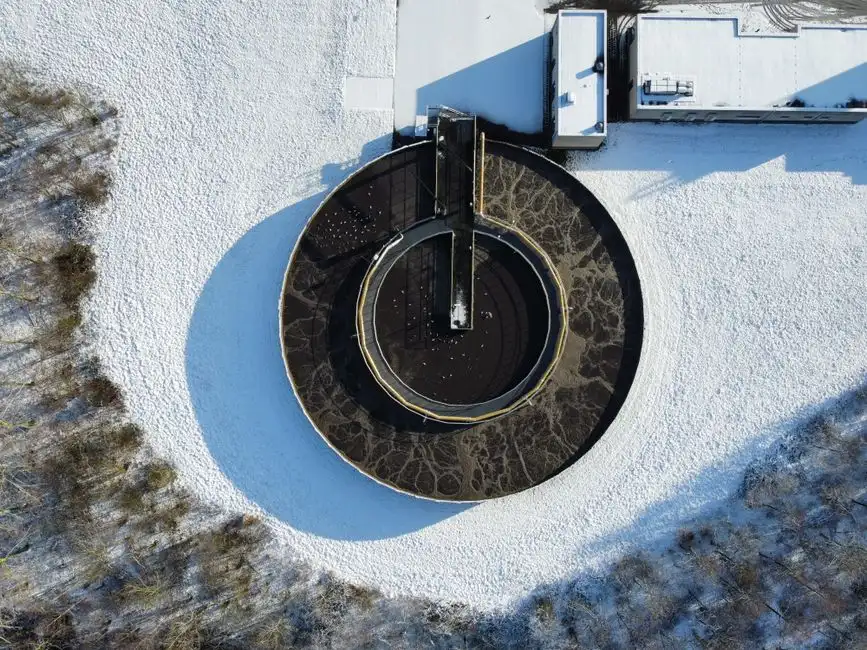
Three inputs define ETP capacity in this region: average and peak hourly flow, influent COD/BOD, and pollutant-specific load (e.g., dye mg/L) — the textile benchmark from S2 is dye up to 500 mg/L at pH ≈ 9 (S2). Hydraulic retention time (HRT) for the biological stage must accommodate the high-pH, high-dye influent; pH-tolerant isolates and a two-stage UASB system with tapioca as a co-substrate are documented routes for reactive dye baths (S2).
Membrane bioreactors deliver near-reuse quality with a smaller footprint than conventional activated sludge — the package / underground STP class shows that 1–80 m³/h units can run fully automated with no operator, which sets a useful benchmark for low-staff Giza sites (see the package / underground integrated sewage treatment reference class). Membrane polishing flux and recovery must be specified from influent SDI; ultrafiltration pretreatment is the documented route to protect downstream RO/nanofiltration membranes, and an RO system can follow if the reuse target demands it. For a deeper engineering read on the MBR stage itself, see the MBR working principle 2026 guide, and for the broader ZLD envelope around this train, see the ZLD plant 2026 buyer's guide. For an organic-stream comparator train, see organic wastewater treatment 2026.
| Design input | Documented value or source | Engineering action |
|---|---|---|
| Reactive azo dye load | Up to 500 mg/L at pH ≈ 9 (S2) | Size biological HRT for high-pH; reserve AOP capacity for recalcitrant fraction |
| Process dye loss | 10–15% of applied dye to effluent (S2) | Set influent dye design load from production recipe, not just measured inlet |
| Membrane protection | UF pretreatment documented (S1) | Specify UF on SDI basis before NF/RO |
| Package STP capacity | 1–80 m³/h, fully automated, no operator | Use as a low-staff benchmark for site planning |
Pollutant-Specific Removal Logic for Giza Effluents
Reactive azo dyes: biological decolorization by pH-tolerant Pseudomonas is documented at the Cairo/Giza scale, with the post-biological step needing advanced oxidation (Fenton, O3, UV/TiO2) for the recalcitrant fraction (S2). The S2 paper concludes that "biological and post photocatalytic treatments for textile wastewater containing azo dyes represent a promising alternative to conventional single process treatment … with the advantages of being cheap and non-toxic" (S2).
COD and color: combined biological + photocatalytic treatment is documented as cheaper and less toxic than AOP alone (S2). Heavy metals and chemical additives (soda ash, caustic soda, acetic acid) in textile baths require precipitation + DAF + ion exchange as the conventional train, with polishing as needed. Fats, oils, and grease: DAF is the documented high-efficiency route. Micropollutants and pharmaceuticals: constructed wetlands are documented as a polishing technology for WWTP effluent micropollutants (S5, Wageningen, Lei 2022, awarded 23 Sept 2022). Pathogens: a chlorine dioxide generator provides chemical-free or low-byproduct microbial control, and a UV sterilizer is effective against chlorine-resistant Cryptosporidium and Giardia.
Compliance and Reuse Targets for 2026
Discharge compliance: the documented reference benchmark for industrial wastewater in the region is the EU Urban Waste Water Directive 91/271/EEC; any local Egyptian discharge rule should be cross-checked against it (S2). Reuse benchmark: nanofiltration polishing of WWTP effluent to EU Water Framework Directive quality is documented as suitable for agricultural or (in)direct potable reuse (S1, University of Twente, Schrader PhD). Disinfection benchmark: chlorine dioxide generation should be checked against EPA, EU Drinking Water Directive 98/83/EC, and WHO Guidelines for Drinking-water Quality where reuse is in scope.
Sludge handling: dewatered cake disposal must meet local Egyptian hazardous / non-hazardous classification; the filter press spec is the boundary the engineer controls. Audit trail: automatic chemical dosing and PLC control provide the dosing accuracy and records environmental inspectors expect. For a regional comparator on compliance framing in a neighbouring jurisdiction, see Effluent Treatment Plant in Hail 2026.
Choosing an ETP Supplier in the Egyptian Market
The Egyptian supplier cluster is recorded in the RevenueBase Egypt ETP construction snapshot dated 16 September 2026, which lists 69 ETP construction companies in Egypt, with Cairo leading at 24 company records, followed by Alexandria and Nasr City (S3, RevenueBase). The same snapshot records at least one Giza-headquartered ETP vendor (AquaTreat, 11–50 employees) and a Cairo-headquartered multinational EPC, VA Tech WABAG Egypt (201–500 employees), with a recorded business description spanning "over ninety years … in the field of total water management" (S3).
The industrial-chemical tier is represented by TAQA Water (TAQA Arabia's newly launched subsidiary) and M.S.S. Multi Service Solutions (10th of Ramadan, 11–50 employees), the latter explicitly described as "a leading service provider in industrial water treatment and process chemical solutions" (S3). Mid-tier specialists in the recorded snapshot include IWTE (6 October), Entag Engineering Tasks Group (El Obour), Environmental Services and Water Treatment Company ESWTCO (Cairo), EDF (Cairo, 51–200 employees), and IWS Fluence Dubai Middle East (Sheraton El Matar) (S3).
Run this decision framework against any short-list: (1) in-house biological + membrane capability covering DAF/MBR/AOP/nanofiltration; (2) reference list in Giza/Cairo textile or food, not only municipal work; (3) after-sales coverage within Egypt; (4) documented compliance documentation for EU WFD or the local Egyptian equivalent; (5) a written process guarantee backed by pilot data. Engineering caveat from S3: a recorded business description is not a service-quality guarantee — the snapshot is a company directory ordered by tracked contacts, not a service-quality rating, and the supplier's process guarantees and pilot data must be reviewed before award (S3).
| Tier | Recorded example (S3) | HQ | Recorded employee band |
|---|---|---|---|
| Multinational EPC | VA Tech WABAG Egypt | Cairo | 201–500 |
| Industrial-chemical | TAQA Water; M.S.S. Multi Service Solutions | Cairo; 10th of Ramadan | Not recorded; 11–50 |
| Mid-tier specialist | IWTE; Entag; ESWTCO; EDF; IWS Fluence | 6 October; El Obour; Cairo; Cairo; Sheraton El Matar | 11–50; 11–50; 11–50; 51–200; 11–50 |
| Giza-headquartered | AquaTreat | Giza | 11–50 |
Frequently Asked Questions
What budget should a Giza textile plant set for a turnkey ETP in 2026?
The supplied research (S1, S2, S3) does not publish turnkey ETP prices for Egypt, so a fixed figure cannot be cited. The cost-defining inputs you must request from each short-listed vendor are: average and peak hourly flow, influent COD/BOD and dye load (the documented benchmark is up to 500 mg/L reactive dye at pH ≈ 9, S2), the chosen biological–membrane train (UASB vs MBR vs SBR), the polishing envelope (AOP and/or nanofiltration), and the level of PLC automation. A 60% footprint reduction over conventional activated sludge is a useful MBR boundary to ask vendors to validate against your site plan. Use those inputs as the line items in a normalised tender comparison rather than relying on headline turnkey numbers.
How do I short-list ETP suppliers in Egypt without relying on a directory ranking?
The recorded Egyptian ETP cluster is 69 companies as of 16 September 2026, with Cairo leading at 24 records (S3, RevenueBase). A short-list should be built against five checks rather than a directory position: in-house biological + membrane capability, a reference list in Giza/Cairo textile or food, after-sales coverage within Egypt, the ability to integrate DAF, MBR, AOP, and nanofiltration in one train, and documented compliance evidence for the EU WFD or the local Egyptian equivalent. S3 explicitly notes that its list is ordered by tracked contacts, not by service quality, and that a recorded business description is not a service-quality guarantee — so each short-list member's pilot data and process guarantees must be reviewed before award.
Can a biological stage alone meet reuse or strict discharge limits for reactive azo dyes?
No. S2 (AMB Express, 2018) records that biological treatment alone does not always provide satisfactory results for industrial wastewater, because reactive azo dyes are highly recalcitrant to conventional biological methods due to strong electron-withdrawing groups. S2 concludes that the combination of biological treatment with an advanced oxidation step (Fenton, O3, UV/TiO2) is a cost-effective and time-saving route for textile wastewater, and the S1 University of Twente PhD (Schrader) documents nanofiltration polishing of WWTP effluent to EU WFD quality as the route to agricultural or (in)direct potable reuse.
What reuse or polishing options are documented for a Giza ETP beyond biology and membranes?
Two documented options sit on top of the biological + membrane train. First, constructed wetlands are documented as a polishing technology for WWTP effluent micropollutants in the Wageningen PhD thesis awarded 23 September 2022 (S5, Lei). Second, nanofiltration is documented as a polishing step to reach EU WFD reuse quality suitable for agricultural or (in)direct potable use (S1, Schrader PhD, University of Twente). For a Giza plant, the choice between the two is driven by the reuse destination — wetlands for an agricultural polish where land is available and discharge volumes are modest, nanofiltration where the reuse target is industrial process water or (in)direct potable.