
Why a Conakry Data Center Treats Blowdown Differently
Cooling-tower blowdown in any open-loop evaporative system concentrates dissolved solids, suspended matter, residual biocides, corrosion inhibitors and trace heavy metals in the recirculating water before it is purged (UGA Extension TP-121, Saha, June 2026; EPA, 2026). What changes in Conakry is not the chemistry itself but the load arriving at the tower: Atlantic chloride and sulfate enter with humid coastal air as well as with the municipal supply, and the makeup water already carries the salinity profile of a near-shore tropical grid. Generic Water Usage Effectiveness (WUE) guidance in the 0.47-0.65 gal (1.8-2.5 L) per kWh band (Genesis Water Technologies) was developed around US facilities and treats the intake number as the whole story; in Conakry the gap between water consumed by evaporation and water withdrawn from a stressed municipal system is the entire business case.
Two local realities sharpen the problem. First, Guinea's grid instability forces prolonged diesel generator operation, and the genset jacket-cooling loop and any adiabatic side streams can be cross-fed with treated blowdown, multiplying the reuse case well beyond the IT cooling loop. Second, Conakry's position on the Atlantic pushes chloride deposition into the tower pack and drift eliminators, so the safe 4-6 cycles of concentration (CoC) window identified by Genesis Water Technologies narrows further as the chloride-sulfate baseline rises. A Conakry treatment train must therefore be designed for the upper end of that band with side-stream polishing enabled before 6 CoC, not for a textbook 4-6 CoC envelope with inland assumptions.
Blowdown Streams, Volumes and What They Contain
The blowdown ratio is calculated as 1 divided by (CoC minus 1): at 4 CoC the blowdown is 25% of makeup, and at 6 CoC it is 20% (Genesis Water Technologies). This non-linear relationship dictates the design, as each additional cycle returns less water than the previous one and pushes the loop into a scaling-and-corrosion regime that chemical dosing cannot manage.
Flow bands frame the sizing problem. A medium-sized data center can use up to 300,000 gal/day for cooling and a hyperscale facility up to 5 million gal/day, per UGA Extension TP-121 (Saha, June 2026). Conakry's near-term projects cluster at the low end of that range, in the 2-20 MW envelope, but the local per-kW cooling demand is higher than temperate-region references because the wet-bulb temperature stays elevated year-round. Blowdown composition targets total suspended solids, total dissolved solids, residual oxidising biocide, phosphonates, silica, and the trace heavy metals released from corrosion of tower pack and chiller metallurgies, per UGA Extension TP-121 (Saha, June 2026).
Field audits typically find actual blowdown running 15-30% above the theoretical calculation because of leaks, emergency dumps and once-through cooling bypasses (Genesis Water Technologies). A Conakry site audit should size for the upper end of that band before design finalisation; under-sizing the polishing stage prevents a project from achieving a working reuse line.
Conakry Treatment Train: Pretreatment, CoC Optimization, Side-Stream, Reuse
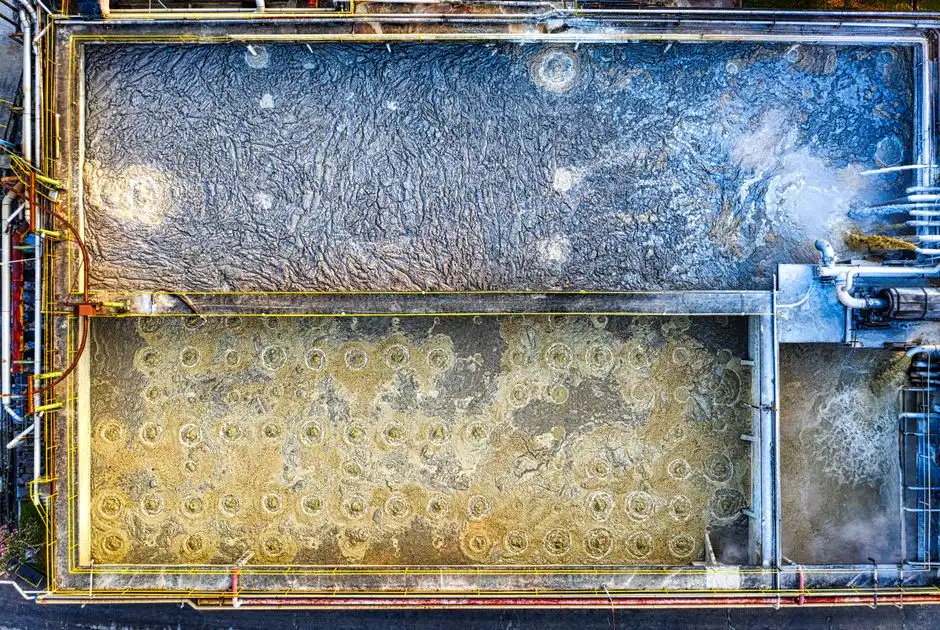
A defensible Conakry train follows five stages and is built from modular, containerised equipment so it can be commissioned inside Guinea's import-logistics window.
- Stage 1 — Makeup pretreatment. A multi-media filter drops turbidity ahead of the tower, and an automatic chemical dosing skid maintains a chlorine or chlorine dioxide residual plus antiscalant feed that can ride out the salinity spikes typical of Guinean municipal supply.
- Stage 2 — CoC optimisation. Switch the microbiological control programme to a simpler non-oxidising approach (tablet-based or biodispersant). This lets the tower run closer to 6 CoC without the dissolved-solids penalty of an aggressive phosphonate rotation, per Genesis Water Technologies.
- Stage 3 — Side-stream softening or reverse osmosis. A slipstream of blowdown is polished through an industrial water softener or, where makeup TDS justifies the energy, through an RO unit feeding back into the main loop. Full-flow RO is economic only at hyperscale; side-stream RO is the right scale answer for 2-20 MW Conakry sites, per Genesis Water Technologies.
- Stage 4 — Blowdown polishing. A dissolved air flotation unit or a lamella clarifier strips suspended solids ahead of cartridge filtration, and a UV sterilizer disinfects the polished stream for non-potable reuse in toilets, irrigation, adiabatic pads, or genset jacket cooling.
- Stage 5 — Discharge. If reuse demand is exhausted, residual blowdown is neutralised for pH and routed to municipal sewer or, where permitted, to ocean outfall. The Conakry receiving environment and the national permitting framework must be confirmed during engineering; this is the input a buyer must request from the local environmental authority.
| Stage | Equipment | Function | Conakry-specific note |
|---|---|---|---|
| 1 — Makeup pretreatment | Multi-media filter, automatic chemical dosing skid | Turbidity reduction, residual biocide, antiscalant | Must ride out salinity spikes in municipal supply |
| 2 — CoC optimisation | Non-oxidising biocide / biodispersant feed | Microbiological and scale control without dissolved-solids penalty | Enables approach to 6 CoC without phosphonate rotation |
| 3 — Side-stream | Industrial water softener or RO unit | Polishes slipstream of blowdown for return to main loop | Right scale for 2-20 MW; full-flow RO is hyperscale-only |
| 4 — Polishing | DAF or lamella clarifier, cartridge filter, UV sterilizer | Suspended solids, residual microbiology | Required ahead of any non-potable reuse endpoint |
| 5 — Discharge | pH neutralisation, sewer or ocean outfall routing | Final residuals | Permitting pathway to be confirmed with Guinean authority |
Design Parameters for a Conakry Cooling Loop
The parameter envelope below represents the technical requirements an engineer should hand to a vendor on a like-for-like basis. Cycles of concentration should be held at 4-6 in baseline operation, and side-stream treatment must be enabled before 6 CoC is approached (Genesis Water Technologies). Chloride needs to be capped at the level the chiller and tower metallurgy is rated for; confirm this with the equipment supplier, because a coastal Conakry site should not assume inland ratings. Blowdown turbidity should be held in a single-digit NTU band so that clarity does not force premature blowdown (Genesis Water Technologies, Stage 2 guidance on self-cleaning filtration). Microbiological control should be specified as non-oxidising to avoid persistent halogenated by-products that complicate downstream reuse and discharge sampling (Genesis Water Technologies).
| Parameter | Design target | Source / basis |
|---|---|---|
| Cycles of concentration | 4-6 baseline; side-stream on before 6 | Genesis Water Technologies |
| Blowdown ratio at 4 CoC | 25% of makeup | Genesis Water Technologies (1/(CoC-1)) |
| Blowdown ratio at 6 CoC | 20% of makeup | Genesis Water Technologies |
| Blowdown turbidity | Single-digit NTU band | Genesis Water Technologies, Stage 2 |
| Microbiological control | Non-oxidising (tablet or biodispersant) | Genesis Water Technologies |
| Chloride cap | Per chiller/tower metallurgy rating | Confirm with equipment supplier |
| Actual vs theoretical blowdown | 15-30% above theoretical | Genesis Water Technologies (field audit allowance) |
Reuse Options, Genset Cooling and Closing the Loop
A 10 MW facility at 4 CoC can recover approximately 3.75 million gallons of blowdown per month for reuse, per Genesis Water Technologies. This volume displaces a meaningful share of makeup in a 2-20 MW Conakry facility if the reuse envelope prioritizes high-value end uses: cooling-tower makeup (the best fit-for-purpose match), followed by genset jacket cooling, and finally toilet flushing and landscape irrigation, per the hierarchy in Genesis Water Technologies.
Conakry's humid climate dictates that adiabatic and free-cooling side streams should be specified for treated blowdown rather than potable water. The operating cost per litre of cooling delivered is lower, and the chemistry of the polished blowdown is already matched to the cooling loop. Where roof catchment or municipal reuse water is available, a Conakry site can blend external non-potable into the makeup line, provided the chemistry and microbiology of the blend undergo separate verification before entering the tower.
Budget Range, Payback and Procurement Risks in Guinea
Genesis Water Technologies cites a $200,000 capital cost and a 6.7-year simple payback for a 15 MW US facility recovering 60% of blowdown, improving to 3-5 years once avoided sewer, pretreatment and compliance costs are counted. A Conakry project should expect longer payback at smaller scale and shorter payback where the avoided cost of imported potable water is high; the buyer must request the local unit water cost from the utility and the avoided sewer charge from the municipality before finalizing any payback projection.
At 2-10 MW, the per-gallon capex of a hyperscale RO-and-ion-exchange train runs 3-4× higher than at hyperscale, per Genesis Water Technologies, which is why modular physical-plus-targeted-chemical trains are the economic fit. Containerised, skid-mounted and pre-wired equipment cuts site installation time and reduces the exposure of the construction schedule to Guinea's import logistics. Service and consumable supply (resin, RO and UF membrane spares, and the valves and media that wear out) represent a significant operating risk, and spares plus a local stocking plan should be priced into the bid evaluation.
Pre-Procurement Checklist for a Conakry Data Center
- Confirm Conakry ambient conditions (wet-bulb temperature, chloride deposition rate) and the contractually guaranteed blowdown water analysis from the cooling-tower supplier.
- Pin down the local discharge or sewer-discharge limits, the permitting authority, and any specific restrictions on chloride, sulfate or temperature before sizing the polishing stage.
- Decide which reuse end uses are contractually required (genset cooling, toilet flushing, irrigation) and match the treatment train to the highest-value endpoint.
- Ask vendors for a Conakry-specific reference list, a containerisation option, and a spare-parts plan.
Frequently Asked Questions
What cycles of concentration should a Conakry data center target?
Hold CoC at 4-6 in baseline operation, per Genesis Water Technologies, and have side-stream softening or reverse osmosis enabled before 6 CoC is approached. Conakry's Atlantic chloride exposure tightens the safe operating window, so the buyer should request a metallurgy-rated chloride cap from the chiller supplier rather than assuming an inland rating.
What percentage of blowdown can a 2-20 MW Conakry site realistically reuse?
Genesis Water Technologies' two-stage physical-plus-targeted-chemical train reduces makeup water demand by 15-25%. A buyer should request a site-specific water balance from the vendor using the actual Conakry makeup analysis and the contractually guaranteed blowdown water analysis; the 15-25% range is the envelope to plan around.
What equipment cost band should a procurement committee expect?
Genesis Water Technologies cites $200,000 in capex for a 15 MW US facility with a 6.7-year simple payback, improving to 3-5 years once avoided costs are counted. For a 2-10 MW Conakry project, the per-gallon capex runs 3-4× higher than at hyperscale (Genesis Water Technologies), so the buyer should request a modular, containerised quotation on a like-for-like basis and price the spares-plus