Why the DAF-vs-Clarifier Question Is the Wrong Frame for a Prattville Plant
For a Prattville-area plant engineer in 2026, the choice between dissolved air flotation and a gravity or lamella clarifier is a stream-signature question, not a brand question. DAF wins on oils, FOG above 50 mg/L, fine colloids, and flotation-reagent residue; gravity or lamella clarifiers win on heavy settleable grit, tailings sand, and post-precipitation metal-hydroxide sludge. 40 CFR Part 440 governs Prattville ore-mining and aggregate wash; 40 CFR Part 433 governs metal finishers plating, anodizing, etching, or stamping. For arsenic-bearing etch or pickling streams, ADEM Admin. Code 335-6-10 can tighten dissolved-metals limits below the federal categorical ones, so ferric coagulation at Fe:As ≥3:1 and pH 7–8 must precede any DAF or clarifier. Most Prattville metals plants that discharge under an ADEM-administered NPDES permit run a hybrid train — equalization, coagulation, DAF, precipitation, lamella clarifier, multimedia polish — because no single unit removes oils, dense floc, and dissolved metals together.
Prattville plants in the 1–50 MGD corridor discharge either to receiving waters under an ADEM-administered NPDES permit or to the Autauga County Water Authority POTW under a local pretreatment ordinance, and the primary clarifier choice drives whether monthly DMRs hold (hydropurewater.com Prattville guide, 2026). An undersized DAF on heavy tailings slurry — or a gravity clarifier on colloidal, oil-coated metal hydroxide floc — costs an Autauga County plant a six-figure consent order, not just a missed effluent number, because the wrong unit leaves the metals or TSS load the next stage cannot catch. The selection has to start with which fraction dominates the specific stream — settleable grit, colloidal fines, oils, or dissolved metals — before any equipment is named.
How a DAF System and a Gravity or Lamella Clarifier Actually Separate Solids
A DAF system pressurizes a recycle side-stream (10–30% of forward flow) to ≥5 bar in a saturation tank and releases it through nozzles back into the main flow at atmospheric pressure; the pressure drop generates 10–50 µm micro-bubbles that attach to coagulated floc and float it as a 2–5% solids skim that a top scraper sweeps into a hopper (hydropurewater.com Prattville guide, 2026). Coagulation chemistry is what sets performance: PAC or ferric sulfate for metals coagulation plus an anionic flocculant for floc strength. Manufacturer data on units in the 3–120 m³/h range shows up to 97% TSS removal and 60–80% COD removal when the air-to-solids ratio is correctly tuned, and >90% removal of oil, FOG, and particulate-bound metals is achievable when upstream chemistry is right (wastewatermachinery.com, 2026).
A gravity clarifier separates by settling velocity under quiescent conditions. Conventional units run at ~1 m/h surface loading, while 60° lamella plates spaced 50–80 mm apart push loading to 20–40 m/h and shrink basin footprint 3–5x for the same hydraulic load (hydropurewater.com Prattville guide, 2026). Lamella does not change the mechanism — dense particles still settle, colloidal fines, oils, surfactants, and dissolved metals still pass. The Fluence and Clearwater Industries application notes both confirm that the unit that targets the colloidal and buoyant load is DAF, not the plate pack: DAF is "not well suited for water sources that contain high levels of heavier particles that don't float, for example silt and clay" (Fluence).
| Parameter | DAF System | Gravity / Lamella Clarifier |
|---|---|---|
| Separation mechanism | Micro-bubble flotation (10–50 µm bubbles) attaching to floc | Gravity sedimentation; lamella plates at 60° |
| TSS removal | Up to 97% (wastewatermachinery.com, 2026) | ~90% settleable-solids reduction on heavy streams |
| COD removal | 60–80% on particulate-bound load | 20–40% on settleable organics; minimal on colloidal |
| Heavy-metal removal (with coagulant chemistry) | >90% on particulate/emulsified metals; no effect on dissolved metals without precipitation | 85–95% on precipitated hydroxide/sulfide sludge |
| Footprint | Small — skid-mounted, ~1/4 the area of a conventional clarifier | Large conventional; lamella reduces footprint 3–5x |
| Hydraulic residence time | 2–4 hours | 2–4 hours conventional; 30–60 min lamella |
| Chemistry requirement | PAC/ferric + anionic polymer; pH adjustment | Often minimal on grit; lime/NaOH for metals precipitation |
| Main operating consumers | Compressed air, recycle pump at 5–10% of flow, scraper drive | Sludge pump only; passive separation |
| Automation | PLC with VFD on recycle pump, effluent TSS probe, automatic sludge discharge | Mostly passive; PLC optional for sludge pumping and polymer feed |
| Prattville fit | Oils/FOG >50 mg/L, fine colloids, flotation reagents, low-DSG particles — fabricated-metal finishing, oily coolant streams, flotation circuits, post-etch rinse | Heavy settleable grit, tailings sand, post-precipitation metal sludge — aggregate wash, mill tailings, post-precipitation thickening, sand-laden runoff |
Prattville Stream Signatures: Which Unit Each Wastewater Type Belongs In
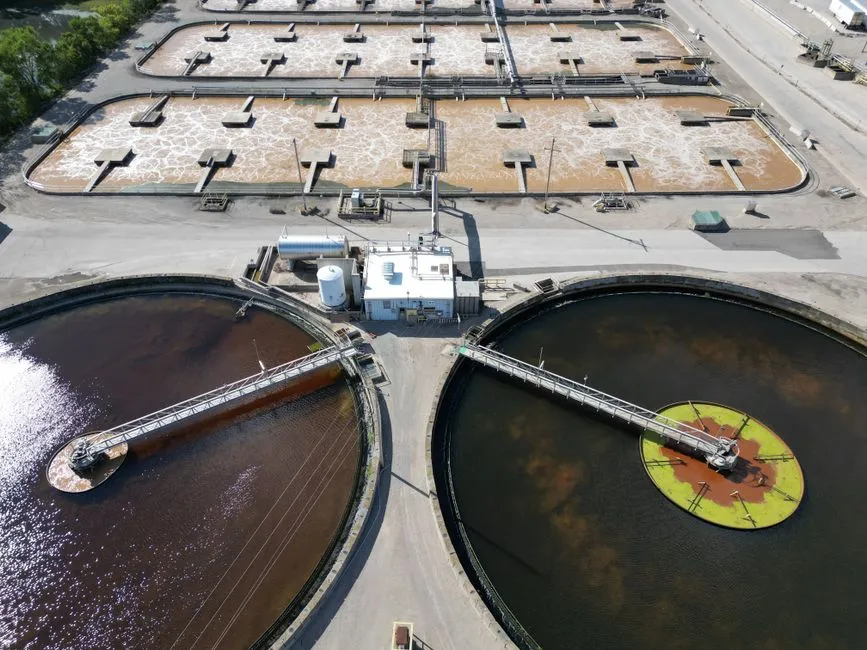
The decision rule below comes from the hydropurewater.com Prattville guide (2026) and is the framework to walk into a vendor meeting with. Run it in order; the first rule that fires wins, and if two or more fire, the answer is a hybrid train.
- Metal-finishing rinse with coolant emulsion, FOG >50 mg/L → DAF first, then clarifier or filter. Emulsified oil blinds the clarifier surface and forms a floating layer that escapes over the weir; DAF strips FOG upstream to <10 mg/L.
- Aggregate wash, crusher spray, or high settleable grit → lamella or conventional clarifier. High-density grit sinks below the DAF bubble-contact zone and recirculates as bottom sediment, blinding the saturator within weeks.
- Flotation-circuit tailings water with reagent residue → DAF as primary. Reagent-coated fines become buoyant in the tailings-pond chemistry that a clarifier cannot lift.
- Post-lime precipitation of metal-finishing wastewater → lamella clarifier with a downstream polish filter. Dense hydroxide sludge thickens economically, and residual TSS is what filtration removes, not flotation.
- Arsenic-bearing etch or pickling blowdown → ferric coagulation at Fe:As ≥3:1 and pH 7–8, then DAF or lamella depending on the rest of the stream, often with a polish (membrane or ion exchange) for tight arsenic limits.
| Prattville Stream Signature | Unit Choice | Reason |
|---|---|---|
| Metal-finishing rinse + coolant emulsion, FOG >50 mg/L | DAF first, then clarifier/filter | Emulsified oil blinds clarifier surface; DAF strips it upstream |
| Aggregate wash or crusher spray, high settleable grit | Clarifier (lamella or conventional) first | High-density grit settles fast; DAF saturator fouls on sand |
| Flotation-circuit tailings water with reagent residue | DAF as primary | Reagent-coated fines are buoyant in tailings-pond chemistry |
| Post-lime precipitation of metal-finishing wastewater | Lamella clarifier → polish filter | Dense hydroxide sludge thickens economically; residual TSS needs filtration |
| Arsenic-bearing etch or pickling bath blowdown | Ferric coagulation at pH 7–8 → DAF or clarifier → polish | Arsenic removal needs Fe:As ≥3:1; downstream separation is the variable |
Why Most Prattville Metals Plants Actually Run a Hybrid Train
For Prattville metal finishers and mineral processors with multi-constituent wastewater, the binary DAF-vs-clarifier framing is misleading because the answer is a process train, not a single unit (hydropurewater.com Prattville guide, 2026). The configuration most Alabama metals plants actually run — and the one that consistently satisfies ADEM-administered NPDES limits for Pb, Zn, Cu, and As — is equalization → pH adjustment and coagulation (ferric sulfate or PAC) → skid-mounted DAF system → lime or NaOH precipitation reactor → lamella clarifier → multimedia polish filter → NPDES outfall or POTW discharge.
The DAF belongs upstream of precipitation for a specific reason: oils and emulsified coolants left in the stream will blind the clarifier surface, re-emulsify under the mixer's shear, contaminate the underflow, and ruin downstream sludge dewatering. A properly sized DAF first strips FOG to under 10 mg/L, and the clarifier can then do what it does best, which is settle dense floc fast. Chemistry is dosed by an automatic coagulant and pH dosing system tied to influent flow and pH probes, and Alabama plants extend the same control philosophy to polymer feed on the clarifier underflow. At the back end, the clarifier underflow at 2–5% solids and the DAF float at 3–6% solids go to a plate-and-frame filter press for dewatering to 25–35% dry solids, and the multimedia polish filter with anthracite over sand over garnet drops residual TSS to under 10 mg/L — the safety margin ADEM expects on a metals discharge DMR.
2026 Capex, Opex, and Lead Time in Prattville: DAF vs Lamella vs Hybrid
Capex for industrial-grade DAF systems typically ranges from $150,000 to over $1.5 million depending on flow and materials of construction, with a 20–30% premium over base-model municipal units for heavy-duty sludge handling on high-solids mineral loading (wastewatermachinery.com, 2026). A skid-mounted DAF in the 10–50 m³/h range carries higher capex than a comparably rated clarifier because of the pressurization skid, recycle pump, air saturator, SS316 wetted parts, and integrated scraper. Opex is moderate: compressed air, a recycle pump running 5–10% of forward flow, polymer consumption, and periodic nozzle inspection; a 30 m³/h unit fits inside a single 12 m × 3 m skid envelope.
A conventional circular or rectangular clarifier carries the lowest equipment capex in the comparison, but the civil cost (concrete basin, underfloor piping, sludge scraper mechanism) often dominates. Lamella designs cut that footprint 3–5x at modest incremental cost for the plate pack, and opex is the lowest of any technology here: a sludge pump, occasional polymer, and labor to monitor sludge blanket level — no compressed air, no saturator, no high-pressure piping. On lead time, a skid-mounted DAF is typically 2–4 weeks from purchase order to commissioning once the civil pad and power are in place; a concrete lamella clarifier is 8–16 weeks including civil work, plate-pack installation, and startup; the hybrid DAF + clarifier + filter train is 12–20 weeks end-to-end on a typical Prattville site (hydropurewater.com Prattville guide, 2026).
| Unit / Train | Capex Band (2026) | Civil / Schedule | Dominant Opex Drivers |
|---|---|---|---|
| Skid-mounted DAF (10–50 m³/h) | $150,000 to >$1.5 M (wastewatermachinery.com, 2026), with 20–30% premium for heavy-duty sludge handling on mineral streams | Small pad; 2–4 weeks from PO to commissioning once power is in place | Compressed air, VFD-driven recycle pump at 5–10% of flow, polymer, nozzle inspection |
| Lamella / conventional clarifier | Lowest equipment capex; civil cost often dominates | Concrete basin + underfloor piping; 8–16 weeks including civil work and startup | Sludge pump, occasional polymer, no compressed air |
| Hybrid DAF + clarifier + polish filter | Sum of components; 12–20 weeks end-to-end | Equalization basin + DAF skid + clarifier civil + filter pad | Combined: coagulant/pH dosing, polymer, recycle-pump energy, polish-filter backwash |
The 2026 Lifecycle Argument: Why Prattville Is Tilting Toward Automated DAF
Two 2026 factors are pushing Prattville plants toward automated DAF even when a clarifier would technically hit the TSS number: rising Alabama Power industrial electricity rates across 2024–2025 rate cases, and the binding constraint of operator availability at most 1–50 MGD sites (hydropurewater.com Prattville guide, 2026). An automated DAF with PLC, VFD on the recycle pump, online effluent TSS probes, and auto-sludge discharge runs reliably with one shift visit per day; a passive clarifier needs an operator to watch sludge blanket, scrape carryover, and adjust polymer manually. When you run the lifecycle math at 2026 labor and energy rates, the DAF often wins on 10-year TCO even on streams where the clarifier is technically sufficient on removal — which is why the lifecycle line item, not the capex line, should drive the Prattville spec.
For a vendor selection framework, the technical specifications that matter are hydraulic surface loading rate at the lower end of the design range, saturation pressure ≥5 bar, VFD on the recycle pump, SS316 wetted parts, PLC control with effluent TSS monitoring, and a guaranteed effluent TSS/FOG limit written into the purchase contract (wastewatermachinery.com, 2026). A vendor that will not put a number on effluent performance is not a vendor you want defending a Prattville capex decision in front of ADEM. Engineers comparing site pretreatment logic across the Southeast can cross-reference the 2026 mining pretreatment sewer discharge guide for the POTW-discharge path, the 2026 mining/metals DAF vs clarifier factory selection guide for the generic train argument, and the 2026 mining and metals pretreatment compliance playbook for how peer plants have framed the same ADEM-equivalent case.
Frequently Asked Questions
Does a DAF system remove dissolved metals like Pb, Zn, Cu, or As?
No. DAF removes particulate, colloidal, and emulsified metals — it does nothing to dissolved ionic species. To drop dissolved Pb, Zn, Cu, or As, a Prattville plant must add precipitation chemistry (lime, caustic, or sodium sulfide) upstream of either a DAF or a clarifier, then let the unit operation float or settle the resulting floc (hydropurewater.com Prattville guide, 2026).
What TSS target can a lamella clarifier realistically hit on Prattville streams, and when is DAF the better pick?
With proper coagulant dosing, sludge recirculation, and consistent upstream chemistry, a well-operated lamella clarifier consistently reaches 20–50 mg/L TSS on metal-finishing and aggregate wash streams. A DAF can drive TSS below 30 mg/L on the same streams but at higher chemical and energy opex; the DAF advantage shows up on streams with oil, FOG, or fine colloids that a clarifier cannot remove efficiently.
Do DAF or clarifier installations require an ADEM permit modification, and what about the Autauga County Water Authority?
Yes. Both are typically classified as treatment-works modifications under the ADEM-administered NPDES program, and either installation triggers permit re-issuance or modification. Plants discharging to the Autauga County Water Authority POTW also need pretreatment approval from the POTW before construction, per the authority's industrial pretreatment ordinance (hydropurewater.com Prattville guide, 2026). Confirm scope and timing with ADEM and the POTW before locking the procurement schedule.
What lead time and capex should a Prattville buyer plan for in 2026?
A skid-mounted DAF unit is typically 2–4 weeks from purchase order to commissioning once the civil pad and power are in place; a concrete lamella clarifier is 8–16 weeks including civil work, plate-pack installation, and startup; the hybrid train is 12–20 weeks end-to-end on a typical Prattville site (hydropurewater.com Prattville guide, 2026). Capex for industrial DAF systems spans $150,000 to over $1.5 million depending on flow and materials of construction, with a 20–30% premium over base-model municipal units for heavy-duty sludge handling on mineral loading (wastewatermachinery.com, 2026). For a defensible 2026 budget line, request a budgetary quotation from each shortlisted vendor tied to your specific flow (m³/h), TSS, and FOG profile, and ask the vendor to quote the DAF, the chemical conditioning skid, and the sludge-dewatering step as a single line so the sludge-handling saving is visible.