Why a Lubumbashi data center cannot copy a US water design
Lubumbashi sits at roughly 1,200 m elevation on the DRC copperbelt, with a tropical highland climate that pushes year-round cooling load hard against any design that worked in Council Bluffs, Iowa, or The Dalles, Oregon. The standard US narrative — Lawrence Berkeley National Laboratory's 2024 report puts US data center cooling water consumption at approximately 17 billion gallons in 2023, a figure the same lab expects to double or quadruple by 2028 — is the benchmark any new African facility will be measured against for WUE, but the constraints that produced that number do not transfer. The source water is mining-influenced, the municipal supply is intermittent, the discharge permitting framework is thin, and the grid cannot be relied on to feed a parasitic cooling load.
Cooling architecture is the single biggest determinant of the wastewater envelope. Valicor's industry analysis, citing the Google Environmental Report, contrasts two reference sites: the Council Bluffs facility, which uses evaporative cooling and consumed roughly 1 billion gallons of water in 2024, and a Storey County, Nevada site running air cooling that consumed about 1.5 million gallons over the same period — a factor of nearly 700 from one design choice. A 100 MW closed-loop facility may use only about 8,000 gallons per day, versus 400,000 to 550,000 gallons per day for an evaporative design, because evaporative cooling exploits the phase change of water to reject heat with roughly 10 percent less energy than air-cooled alternatives.
Three local realities rewrite the design basis for any Lubumbashi site. First, copperbelt source water carries elevated hardness, iron, and total dissolved solids, which compress the safe cycles of concentration. Second, municipal supply in Lubumbashi is intermittent and pressure-variable, so the site must carry its own raw-water and treated-water storage sized for outage days, not just peak hour. Third, Haut-Katanga has limited formal industrial discharge infrastructure, so the dual-stream problem — cooling tower blowdown (mineral-concentrated, low-volume) and sanitary wastewater from staff (low-concentration, higher-volume relative to load) — must be solved on or near the plot, not handed to a downstream municipal plant that may not accept either stream. Localized treatment guidance for comparable African sites, such as data center cooling blowdown treatment in Kumasi, Ghana and data center wastewater treatment in Mogadishu, Somalia, follows a similar tropical-and-intermittent-supply logic, but the copperbelt source chemistry is the variable that most differentiates Haut-Katanga from those coastal or savanna examples.
Source water characterization: what Lubumbashi actually delivers
Source water is the foundation for every downstream decision about treatment chemistry, cycles of concentration, and blowdown management. A facility drawing from hard, mineralized copperbelt groundwater faces different scaling risks than one using treated municipal supply, and a Lubumbashi campus will in practice take both — municipal supply when pressure and quality permit, and borehole or stored raw water for the balance. The design basis has to accept that blend, not pick one and ignore the other.
Mining-influenced surface and groundwater in the copperbelt typically carries elevated hardness (calcium and magnesium), iron and manganese from geological and mining activity, and total dissolved solids well above what a temperate US plant treats. Each of those parameters is a direct input to the maximum safe cycles of concentration in the cooling tower: hardness sets the calcium carbonate scaling risk, silica sets the upper bound once cycles climb, chloride and sulfate set the corrosion risk on heat exchangers, and iron fouls both membranes and tower fill. The makeup water chemistry is, by mass balance, the chemistry that determines whether the cooling loop runs clean or scales up within a season.
A defensible site water analysis must cover hardness, alkalinity, TDS, silica, chloride, sulfate, iron, manganese, pH, conductivity, and microbiological counts (heterotrophic plate count and Legionella where staff exposure is plausible). Without that data, no cycles target, no blowdown flow, and no discharge design is defensible to a lender, an insurer, or an enterprise customer running CDP water disclosure. Where intermittent municipal supply forces a switch to stored raw or borehole water, the analysis must be repeated for the alternate source — the two streams can differ enough that a single "design water" is a fiction.
Because both evaporation and blowdown losses must be replaced with makeup water, the chemistry of the makeup stream is the chemistry that determines cooling tower corrosion and scaling risk — a framing that should be carried explicitly into the design basis for any Lubumbashi project. The pragmatic move is to design the pretreatment and chemistry program against the worst credible makeup blend, not the average, so a switch from municipal to borehole during a supply interruption does not push the cooling loop past its scaling or corrosion envelope. Practical pretreatment equipment, beginning with a multi-media pretreatment filter and followed by an industrial water softener for cooling makeup, is sized against that envelope.
Pretreatment train for the cooling makeup stream
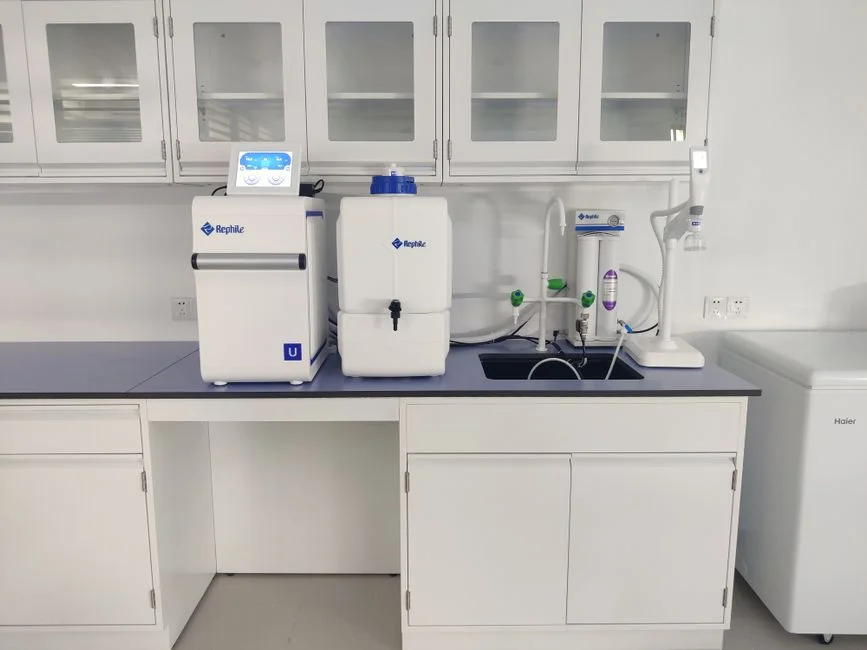
The pretreatment train for a copperbelt source has to drop turbidity, hardness, and any iron or manganese carryover before the water hits the cooling tower, while staying simple enough to run on intermittent supply and a thin operator roster. The sequence that consistently meets those conditions is multimedia filtration first, softening second, then chemical conditioning and disinfection ahead of the cooling tower.
Multimedia filtration handles turbidity and sediment reduction and, where SDI must be controlled for any downstream RO polishing or for closed-loop chemistry, achieves the SDI reduction that protects RO membranes. CRB Water's data center practice treats multimedia filtration as the standard first step for any makeup stream destined for RO or for cooling systems sensitive to particulate fouling. On copperbelt water, this stage also evens out the iron and manganese spikes that would otherwise carry through and foul the softener resin.
Softening — typically a sodium-cycle ion exchanger — drops hardness before the cooling tower, which is what unlocks higher cycles of concentration without calcium carbonate scaling. Without softening, the cycles target in Lubumbashi would have to sit at a level that wastes water and inflates blowdown; with softening, the operator can run more cycles, cut blowdown volume, and stay inside the cooling tower's scale window.
Automatic chemical dosing of coagulants, pH adjusters, and scale and corrosion inhibitors stabilizes feed chemistry and protects downstream membranes and heat exchangers, and a PLC-controlled chemical dosing system keeps that conditioning on setpoint even when makeup quality swings. CRB Water flags automated monitoring of conductivity, pH, ORP, and chemical feed as the mechanism that flags upset conditions before they propagate into the cooling loop. The final pretreatment step is disinfection upstream of the cooling tower — UV or chlorine-based — to control biofilm, which CRB Water identifies as one of the three failure modes (alongside scale and corrosion) that erode heat-transfer efficiency and uptime. A UV sterilizer for cooling makeup sidesteps the chlorination-versus-corrosion tradeoff that complicates tower dosing.
Cooling tower chemistry, cycles of concentration, and blowdown volume
Cycles of concentration is the ratio of dissolved minerals in the circulating water to dissolved minerals in the makeup water — the single number that sets scaling risk, corrosion risk, and blowdown volume together. Valicor's industry framing treats this ratio as the central operational lever for any evaporative cooling system, and CRB Water's data center practice is explicit that optimized cooling-water treatment supports WUE by allowing appropriate cycles and reducing unnecessary blowdown, while controlling scale, corrosion, and biofilm maintains heat-transfer efficiency and energy performance. The effect on WUE and PUE depends on cooling design, climate, and operating conditions, so the cycles decision in Lubumbashi is not transferable from a temperate, soft-water US site.
The mass balance behind blowdown is straightforward. As water evaporates from the cooling tower, dissolved minerals concentrate in the remaining volume; to keep that concentration inside the scaling and corrosion envelope, a fraction of the circulating water is discharged as blowdown and replaced with fresh makeup. Over time, evaporative losses account for roughly 80 percent of total makeup demand, and blowdown accounts for the remaining 20 percent, per Valicor's analysis of evaporative cooling systems. For a 100 MW evaporative design sitting near the upper end of the 400,000 to 550,000 gallons per day range, blowdown is therefore a meaningful — not trivial — flow that the rest of the plant must be sized to handle, on the order of tens of thousands of gallons per day rather than a few hundred.
Running cycles too low wastes water and inflates blowdown; running them too high accelerates scale and corrosion. The design optimum is set by the limiting species in the makeup water — typically calcium, silica, or alkalinity — and is the lever the operator adjusts to meet both WUE and discharge targets. The table below shows how cycles of concentration translate into blowdown share of makeup for a representative cooling loop, which is the relationship that drives the size of every downstream unit operation.
| Cycles of concentration | Approximate blowdown share of total makeup water | Implication for a Lubumbashi cooling loop |
|---|---|---|
| 2 | High — blowdown is a large fraction of makeup | Low scale risk, high water and discharge load; rarely optimal |
| 3–4 | Moderate — blowdown is a controlled fraction | Typical operating window for softened copperbelt makeup |
| 5–6 | Lower — blowdown shrinks as cycles climb | Approaches silica or alkalinity ceiling on untreated copperbelt water |
| 7+ | Low blowdown share, but scale and corrosion risk rise | Requires tight chemistry control and side-stream polishing |
Because the cycles decision sets the blowdown flow, the chemical program, and the discharge envelope simultaneously, it should be locked in the design basis rather than left for commissioning. A high-efficiency sedimentation tank ahead of any side-stream treatment, paired with the PLC-controlled chemical dosing system on the cooling loop, gives the operator the steady-state control needed to hold cycles on target through seasonal swings in makeup quality.
Treating the blowdown: reuse, discharge, or zero-liquid-discharge
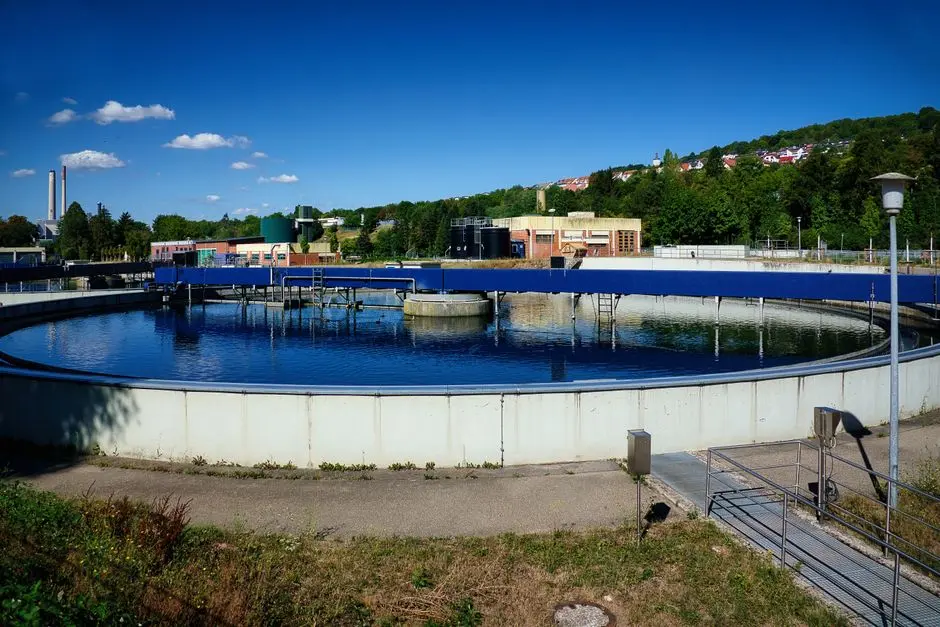
Blowdown from an evaporative cooling tower is mineral-concentrated, not heavily organic or biological, so the treatment train targets suspended solids, hardness carryover, residual treatment chemicals, and — if the water is being reused — microbiological control. Choosing the endpoint is the design decision that determines the rest of the train: a sewer or surface-water discharge, an on-site reuse loop, or a zero-liquid-discharge (ZLD) finish.
For a sewer or surface-water discharge, the standard train is lamella clarification or DAF for suspended solids and any carryover of treatment chemicals, followed by neutralization and disinfection. A DAF unit for cooling blowdown ahead of filtration drops the load on any downstream polishing stage and stabilizes the effluent against swings in chemical carryover. Local Congolese requirements must be verified rather than assumed from US EPA numbers; the absence of a mature industrial discharge permitting framework in Haut-Katanga means the design needs an early conversation with the provincial environment authority rather than a copied effluent spec.
Where discharge options are limited — which is the realistic base case for many Lubumbashi industrial plots — side-stream softening and RO on the blowdown can produce reuse-quality water for cooling makeup, with the RO concentrate sent to an evaporation pond or a small ZLD stage. An industrial RO system for blowdown reuse paired with a high-efficiency sedimentation tank upstream is the configuration that closes the loop, and a chlorine dioxide generator downstream handles the microbiological control needed before the water re-enters the cooling loop or is reused for toilet flushing or landscape irrigation.
Reporting pressure is part of the endpoint decision. Valicor's analysis notes that the CDP Water Security questionnaire drew 4,815 corporate respondents in 2023, up 23 percent year over year, and that Microsoft reports a WUE of 0.30 L/kWh in its newest facilities. Operators that can document a closed-loop or high-reuse scheme at a Lubumbashi site will be better positioned with international customers and investors who are themselves reporting against CDP. The table below sets out the three realistic endpoints for cooling blowdown at a Lubumbashi site and the unit operations each requires.
| Endpoint | Treatment train | Best fit on a Lubumbashi site when |
|---|---|---|
| Sewer or surface-water discharge | Lamella clarifier or DAF → neutralization → disinfection | A permitted outfall exists and provincial limits are documented |
| On-site reuse for makeup or irrigation | Clarifier → side-stream softener → RO → UV or chlorine dioxide | Discharge is unreliable and CDP-style reporting is a customer requirement |
| Zero liquid discharge | Clarifier → softener → RO → evaporation pond or mechanical ZLD | No discharge path and a water-positive or closed-loop commitment is required |
Sanitary and staff wastewater: the second stream
A data center campus in Lubumbashi will generate a continuous sanitary stream from on-site staff — typically low-strength and low-flow compared with the cooling loop, but still requiring treatment before discharge or reuse. Underestimating it is a common planning error: the sanitary stream runs 24/7 regardless of IT load, it carries biological loading that the cooling blowdown train is not designed to handle, and the operator must log flow and quality continuously to meet local and customer reporting requirements.
A packaged biological treatment unit — an MBR or an A/O contact oxidation system — is the standard fit: compact footprint, automated operation, and effluent quality suitable for on-site reuse in landscape irrigation, toilet flushing, or cooling-tower makeup blending. The choice between the two is usually plot and operator driven rather than effluent driven. An MBR sanitary wastewater treatment system delivers near-reuse-quality effluent with a footprint materially smaller than conventional activated sludge, which is useful where the available plot in a Lubumbashi industrial zone is constrained. Where a below-grade install is preferred to keep the surface free for cable runs and generator yards, a packaged underground sewage treatment unit is a practical alternative.
Disinfection of the sanitary effluent — UV or chlorine dioxide — is required before any reuse or surface discharge, and the same UV sterilizer used on the cooling makeup stream can be specified for the sanitary train to standardize spares and operator training across both packages. Continuous flow and quality logging is not optional: provincial inspectors and international customers will both ask for it, and the data is the same data the operator needs to optimize the plant.
Buyer decision framework: what to specify, in what order
The technical picture above collapses into four decisions that the procurement reader has to lock in writing before issuing an enquiry. Each one constrains the next, and the cost of getting any of them out of order is paid in equipment that has to be retrofitted or in a discharge path that does not exist.
Decision 1 is cooling architecture. Air cooling essentially eliminates cooling water demand — a 100 MW closed-loop facility may use only about 8,000 gallons per day per Valicor's analysis — but raises energy use by roughly 10 percent. On a Lubumbashi grid, that 10 percent energy penalty has to be weighed against the cost of a full pretreatment, chemistry, and blowdown package and the discharge headache that comes with evaporative cooling.
Decision 2 is the cycles of concentration target, set against local source-water chemistry and discharge limits rather than copied from US examples; this single number sizes the blowdown stream and the entire downstream train. Decision 3 is the blowdown endpoint — sewer or surface discharge versus on-site reuse versus ZLD — driven by local discharge infrastructure, the customer's water disclosure obligations, and lifecycle cost. Decision 4 is the sanitary stream, sized to the on-site headcount and shift pattern rather than to the IT load, with an MBR or packaged A/O and UV disinfection as the default configuration. The table below maps these four decisions to the equipment packages the enquiry should request, so suppliers quote against the same scope.
| Decision | What it locks in | Equipment package to specify |
|---|---|---|
| Cooling architecture | Makeup water demand, energy penalty, plot area for water plant | Cooling tower sizing, chiller redundancy, energy use at design wet-bulb |
| Cycles of concentration | Blowdown flow, chemical dose rates, scale and corrosion envelope | Multimedia filter, softener, chemical dosing, side-stream filtration |
| Blowdown endpoint | Discharge permitting path, reuse quality, ZLD capex | Clarifier or DAF, RO, disinfection, evaporation pond or ZLD stage |
| Sanitary stream | Footprint, reuse potential, reporting scope | MBR or A/O unit, UV or chlorine dioxide, flow and quality logging |
Specifying all four decisions up front prevents the common failure mode of treating blowdown as an afterthought — the exact pitfall Valicor names in its title. The supplier then has a defensible basis to quote, and the operator has a defensible basis to brief management and to discharge.
Frequently Asked Questions
How much should we budget for the water and wastewater treatment package on a Lubumbashi data center?
Budget depends on the four decisions in the framework above — cooling architecture, cycles of concentration, blowdown endpoint, and sanitary stream sizing — and on the source-water analysis the site has not yet completed. The first number to lock is the makeup water demand in gallons per day at design wet-bulb, because that number sizes the multimedia filter, softener, chemical dosing, and the blowdown train. Request a priced schedule of equipment and lifecycle chemical and discharge cost from each shortlisted supplier against the same design basis, and budget on that comparison rather than on a per-kilowatt rule of thumb.
What should we look for when selecting a supplier for a Lubumbashi project?
Look for a supplier with documented experience on mining-influenced source water, intermittent supply, and tropical highland cooling loads, and who can deliver a single integrated package — pretreatment, cooling chemistry, blowdown handling, and sanitary treatment — rather than four separate vendors to coordinate. Ask for reference sites in Sub-Saharan Africa with similar hardness and TDS in the makeup, and ask how the supplier handles the switch between municipal and borehole water without losing the cooling loop. Lead time and the ability to ship, install, and commission in Haut-Katanga under the current logistics constraints should be part of the same evaluation, not a separate conversation after the technical award.
Which cooling architecture is the right default for a Lubumbashi data center?
There is no universal default; the right answer depends on the relative cost and reliability of grid power versus the cost and permitting risk of the water and discharge package. Evaporative cooling uses roughly 10 percent less energy than air cooling, which is meaningful on a 100 MW load, but it commits the site to a full pretreatment, chemistry, blowdown, and discharge package sized for tens of thousands of gallons per day of mineral-concentrated reject. Air cooling eliminates most of that water plant but raises energy use and heat-rejection footprint. Many Lubumbashi sites will end up with a hybrid — air-cooled for the bulk IT hall and a small evaporative leg only where the heat density or the climate curve forces it.
What discharge and compliance risks should we plan for from day one?
The main risk is that the assumed discharge path does not exist or is not permitted. Haut-Katanga does not have a mature industrial discharge permitting framework comparable to the US Clean Water Act, and municipal wastewater plants in the region are not designed to accept mineral-concentrated cooling blowdown. The compliant path is to design the plant for on-site reuse or ZLD from the start, to verify provincial environment authority requirements in writing before commissioning, and to log flow and quality continuously so the data is available when the regulator or the customer asks for it. Treating discharge as a commissioning afterthought is the failure mode that turns a permitted project into a stranded one.