What "Air Ultra Filter Operation" Means in Industrial Wastewater
Air ultra filter operation, in an industrial wastewater context, refers to the controlled running of a hollow-fiber ultrafiltration (UF) bank that uses a periodic air-scour step rather than relying on water backwash alone. Feed water is pushed under pressure through 0.03 micron PVDF membranes; suspended solids, colloids, and bacteria are retained on the outside of the fibers while permeate exits the lumen. To keep the membrane surface from fouling irreversibly, the PLC cycles compressed air through the module (air scour), then reverses flow with permeate or treated water (backwash), and finally triggers a chemical CIP if differential pressure stays high. The system runs fully automatic.
The term needs a quick disambiguation, because "air ultra filter" reads like a HEPA or HVAC prefilter. Those are dry-stage particulate filters for indoor air; the Universitas Muhammadiyah Sidoarjo 2023 study on HEPA filters in air-conditioning ducting treats them as replaceable media that "need to be replaced periodically to maintain their performance" (UMSIDA, 2023). An industrial air-scour UF is the opposite philosophy — the same membrane is kept in service for years by mechanical and chemical cleaning, never swapped out as a cartridge.
The equipment covered in this article is a hollow-fiber UF module, typically polyvinylidene fluoride (PVDF), rated at 0.03 micron nominal pore size. Per the HydropureWater UF product catalog, this class of skid ships in capacities from 2,000 to 40,000 L/h and is designed to accept feed water with up to 300 ppm turbidity, running with automatic backwash plus air scour as standard features. Feed enters the shell side of the module and is pushed inward through the fiber wall; solids stay on the outside and are later lifted off by air scour and flushed out by backwash. Permeate, the cleaned water that passed through the membrane, collects inside the fibers and exits through one end header. The HydropureWater hollow-fiber UF system with automatic backwash and air scour is built around exactly this outside-in flow path.
Why Air Scour Is Used Instead of Water Backwash Alone
A hollow-fiber UF forms a cake on the shell side the moment feed contacts the membrane. That cake is a sticky, gel-like layer of colloids, organics, and biomass. A reverse-flow water backwash pushes the loose outer portion of the cake out to drain, but it does almost nothing to the layer that has compacted into the fiber bundle, where fibers are touching fibers and the cake is mechanically interlocked. Once that inner layer compacts, TMP (transmembrane pressure, the pressure difference across the membrane wall) starts to climb at constant flux, and a water-only backwash reaches a limit it cannot break through.
Air scour solves the problem by attacking the cake mechanically rather than hydraulically. The PLC stops the feed pump, opens the air-inlet valve at the bottom of the module, and pulses compressed air up through the shell side. The rising bubble column shakes the fiber bundle violently — fibers whip and collide — and the cake cracks apart. Only after that mechanical break-up does the subsequent water backwash actually carry the debris out to drain. In other words, air scour does the loosening and water backwash does the transport; the two steps are not redundant.
The maintenance analogy from the HEPA literature is useful here, even though the equipment is different. UMSIDA (2023) notes that HEPA filters "are effective in filtering out particles, but need to be replaced periodically to maintain their performance." A UF bank achieves the same renewed-performance outcome without media swap-out: scheduled air scour plus backwash restores flux repeatedly, and the membrane stays in service for years. The practical consequence is that a UF run on water backwash alone will reach its chemical-cleaning trigger much sooner, consume more CIP chemicals, and replace membranes more often, while a UF with air scour stretches the interval between CIPs and extends membrane life.
The Four Operating Modes of an Air-Scour UF Bank
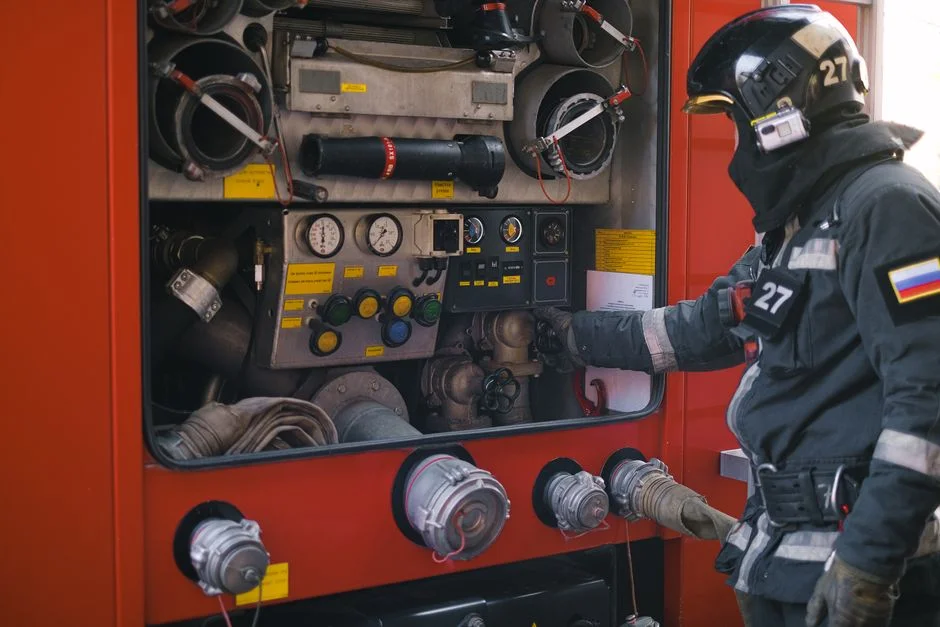
An industrial air-scour UF runs as a four-mode PLC cycle. The operator's job is to read the HMI, confirm the state, and verify the parameter set — Modes 1 through 3 are PLC-driven, and the HydropureWater UF product catalog describes the system as fully automatic. Mode 4 is the one a human usually has to authorize.
Mode 1 — Filtration. The feed pump runs, the permeate (outlet) valve is open, and every other valve on the skid is closed. Feed water is pushed from the shell side through the fiber wall, permeate flows out the lumen to the clean-water tank, and contaminants accumulate on the outside of the fibers. This is the productive state and runs for a fixed time or a fixed cumulative filtrate volume between cleaning cycles.
Mode 2 — Air Scour. The feed pump stops, the permeate valve closes, and a blower or compressed-air line pulses air into the bottom of the module. Duration is short — tens of seconds — and is the step unique to this class of UF. The PLC triggers it on a timer or on a preset volume of filtrate, not only on a pressure trip.
Mode 3 — Backwash. Permeate, or in some designs treated final water, is pumped in the reverse direction through the lumen and out the shell-side drain. The dislodged cake from Mode 2 is carried out with it. Volume per backwash is a set operating parameter, not an ad-hoc decision the operator makes on shift.
Mode 4 — Chemical CIP (clean-in-place). Triggered when TMP stays high after several air-scour and backwash cycles, or when permeate quality degrades. CIP chemicals (typically alkaline, then acidic, sometimes with a chlorine step on PVDF) are circulated through the module, soaking and dissolving the fouling that mechanical cleaning cannot remove. This is the only mode the operator usually has to start manually, and it is also the most expensive to run.
Operating Parameters an Operator Actually Monitors
The numbers below are the ones an operator reads off the HMI to know whether the skid is healthy. Specific numeric ranges (design flux window, backwash volume, CIP trigger pressure) are project-specific values set during commissioning, so the table calls out what each parameter is rather than supplying a generic range.
| Parameter | What it tells the operator | Trip condition to watch |
|---|---|---|
| Feed pressure | Head pressure from the feed pump at the module inlet | Sustained rise at constant flow → fouling |
| Permeate pressure | Pressure at the clean-water outlet (when permeate is pulled) | Sudden change → valve or piping fault |
| Transmembrane pressure (TMP) = feed pressure − permeate pressure | The driving force across the membrane wall; the master health indicator | Steady rise at constant flux → cake build-up or fouling |
| Instantaneous flux | Permeate flow per unit membrane area, reported in LMH (liters per square meter per hour) | Flux holds but TMP rises → fouling, not loss of pump capacity |
| Cumulative filtrate volume | Total permeate since last backwash; sets the cleaning interval | Exceeds design → expect Mode 2/3 to trigger |
| Feed turbidity | Upstream solids load on the membrane | Approaches 300 ppm design ceiling → shorten backwash interval (HydropureWater UF product catalog) |
| Permeate turbidity | Integrity indicator for the membrane and its seals | Creeping upward → broken fiber, failed potting, or O-ring leak |
Two of those parameters do most of the diagnostic work: TMP and permeate turbidity. TMP rising at constant flux means the membrane is fouling, the air-scour interval is too long, or pretreatment has slipped. Permeate turbidity climbing means the membrane itself is no longer intact, and the operator should run an integrity test rather than another backwash cycle.
Air Scour vs Water Backwash Only: What the Operator Gains
A buyer evaluating UF quotes will see a "with air scour" line item and should know what that line item is actually paying for. The qualitative trade-off is straightforward: air scour adds a blower or compressed-air supply, a few extra solenoid valves, and a larger skid footprint, so capex rises; opex falls because the membrane stays cleaner, CIP chemicals are used less often, and membrane replacement is pushed out.
| Aspect | Water backwash only | UF with air scour (plus water backwash) |
|---|---|---|
| Cleaning effectiveness on compacted cake | Limited; removes loose outer layer only | High; air pulse fractures the inner cake, then water flushes it out |
| CIP frequency | Higher; reaches CIP trigger sooner | Lower; mechanical cleaning carries more of the load |
| Membrane service life | Shorter; more chemical exposure and replacement cycles | Longer; less chemical and mechanical stress per cycle |
| Energy use | Lower per cycle (only a backwash pump) | Slightly higher (blower or compressed air in addition to pump) |
| Skid complexity and footprint | Simpler; smaller skid | More valves, air supply line, larger footprint, higher capex |
| Standard feature on the HydropureWater UF system | No | Yes — automatic backwash and air scour listed as standard (HydropureWater UF product catalog) |
Because automatic backwash and air scour are listed as standard features on the HydropureWater hollow-fiber UF system with automatic backwash and air scour, the supplier has already absorbed that design trade-off into the skid. The buyer's job is to confirm the air-supply specification, not to choose between the two architectures.
Troubleshooting Common Air Ultra Filter Operating Problems
The on-shift operator usually does not have time to call the supplier, so a symptom-to-cause map pinned next to the HMI is more useful than a manual on a shelf. Four symptoms cover most of the calls an operator will make.
TMP rises during filtration, falls back after backwash. Cause: normal cake build-up, exactly what the cycle is designed to handle. No action beyond confirming the air-scour frequency matches the design interval and that feed turbidity is within the envelope.
TMP stays high even after air scour plus backwash. Cause: fouling has moved past what mechanical cleaning can remove, or pretreatment upstream has changed. Action: trigger a chemical CIP, then walk the upstream chain — DAF, multi-media filter, and equalization — for a slip in performance.
Permeate turbidity creeps upward. Cause: compromised fiber integrity, almost never a process problem. A broken fiber, a failed potting at the module end cap, or a leaking O-ring lets feed bypass the membrane wall. Action: run an integrity test (pressure-hold or bubble-point), isolate the bank, and replace or repair the module. Pretreatment will not fix this.
Air scour looks weak — no visible agitation in the sight glass. Cause: the air pulse, not the membrane, is the fault. Check the compressor or blower output pressure, the air-line filter for blockage, and the valve states on the HMI before suspecting the module. A common cause is a sticky solenoid that did not open on the Mode 2 command.
Each of those symptoms is easier to diagnose when the upstream chain is doing its job. A properly sized HydropureWater DAF system ahead of the UF removes the floatable and emulsified load that would otherwise glue the cake together, and a HydropureWater multi-media filter takes out the fine suspended solids. With both in place, the air-scour interval becomes predictable instead of a daily fight.
Where an Air-Scour UF Bank Sits in a Wastewater Treatment Train
An air-scour UF is one stage in a chain, not a standalone box. The typical placement is coarse screening → equalization → DAF or primary clarifier → multi-media filter → air-scour UF → disinfection (UV or chlorine dioxide) or reverse osmosis. The UF goes after the bulk-solids stages because it is a membrane process, not a clarifier, and the upstream equipment does the heavy lifting on suspended solids.
The catalog feed tolerance is up to 300 ppm turbidity (HydropureWater UF product catalog), but running near that ceiling collapses the air-scour interval and the operator will spend the day in Mode 2. Pretreating the feed to a much lower turbidity is the standard practice, and it is the reason the multi-media filter sits immediately upstream of the UF in most P&IDs. With that arrangement, the air-scour UF either protects a downstream RO bank from fouling or acts as a reuse-quality polishing step before disinfection, depending on the plant's reuse goals. The downstream RO system or UV sterilizer sees a feed that the UF has already brought to a consistent, low-turbidity, low-SDI (Silt Density Index, a fouling-potential metric) state. For more on the upstream and downstream stages, the filter bed design and media selection guide and the micro-bubble flotation design criteria guide cover the equipment that sits on either side of the UF.
Frequently Asked Questions
What does "air ultra filter operation" actually mean in a plant?
It refers to the four-mode PLC cycle (filtration → air scour → backwash → CIP) of a hollow-fiber UF module, typically 0.03 micron PVDF, that uses a compressed-air pulse to break the membrane cake before each water backwash. The HydropureWater UF product catalog lists this class of skid as fully automatic, with air scour and backwash as standard features.
How much does an air-scour UF system cost, and what drives the price?
No published unit price is available in the research, so a buyer should request a quote with three inputs: design flow in L/h, feed-water turbidity, and target permeate quality. The HydropureWater UF product catalog defines the capacity range as 2,000 to 40,000 L/h and the feed tolerance as up to 300 ppm turbidity, so those are the two numbers the supplier will size the skid around. The blower's air-supply specification and the frame material are the usual line items that move the quote up or down.
How do I choose a UF supplier for an industrial wastewater project?
Confirm that the bid specifies PVDF 0.03 micron hollow fibers, lists automatic backwash and air scour as standard features (not as a paid upgrade), and states the feed-turbidity envelope. The HydropureWater UF product catalog meets all three points, which is a useful checklist against competing quotes. Ask for a reference plant running on a similar feed and request the CIP chemical consumption per month, not just the skid price.
What signals a membrane problem versus a process problem?
Rising TMP at constant flux, with permeate turbidity still low, is a process or pretreatment problem — fix upstream and shorten the air-scour interval. Permeate turbidity climbing is a membrane-integrity problem — run an integrity test, isolate the bank, and repair or replace the module. The two symptoms point at different parts of the system and call for different responses, which is why operators monitor both numbers on every shift.
Related Equipment
- HydropureWater RO and UF membrane elements — specifications, capacity range, and technical data