Why Textile Mills Are Moving to Packaged Sewage Treatment Plants
A package sewage treatment plant for the textile industry is a factory-built, skid- or container-assembled ETP that integrates screening, equalization, physico-chemical (typically DAF), biological (MBR, SBR, or A/O) and disinfection stages to treat 50-500 m³/day of dye-house effluent. Package STPs typically cut COD from 1000-3000 mg/L to under 250 mg/L and color from 500-2000 Pt-Co units to under 100, fitting CPCB/PCB or EU textile BREF limits without civil construction.
The procurement case is straightforward. In 2015 the textile industry discharged 1.84 billion tons of wastewater, ranking third among 41 key Chinese industries for five consecutive years, and emitted 206 kt of COD, ranking fourth (per PeerJ 2020). At the same time, textile water reuse ran below 70% versus an 80% national industrial average, and the printing and dyeing sub-sector reused only 30% of process water. That gap is exactly where on-site packaged ETPs with a reuse polish earn their CAPEX back.
Three forces are accelerating adoption in 2026. First, CPCB/SPCB consent renewals in India are tightening color (often 1/10 dilution equivalent), TDS, and chromium limits on dyeing units. Second, the EU IED textile BREF (in force from 2026) pushes ZLD in water-stressed basins. Third, Bangladesh and Vietnam are expanding EPR frameworks that penalize untreated discharge. A factory-assembled skid or container unit delivered ready to connect, as opposed to a civil ETP poured on-site, gives a mill shorter install time, lower civil cost, and the option to relocate, with the trade-off of less hydraulic flexibility at very large flows (typically above 500 m³/day per train). The reader's outcome is simple: pick a package configuration that reliably hits the local consent to operate, with room to expand capacity later. For a deeper regulatory walkthrough, see the textile wastewater treatment in Iran 2026 guide.
Influent Characteristics That Decide the Process Flow
Textile influent is not generic municipal sewage, and the package train must reflect that. Per Azanaw 2022 and PeerJ 2020, raw dye-house effluent typically lands in these ranges:
| Parameter | Typical range (raw textile effluent) | Source / note |
|---|---|---|
| pH | 6-10 | Azanaw 2022; reactive dye baths run alkaline |
| COD | 800-3000 mg/L | PeerJ 2020; printing and dyeing wash waters set the high end |
| BOD | 200-800 mg/L | Azanaw 2022; BOD/COD ratio 0.2-0.4 signals recalcitrant organics |
| TSS | 100-500 mg/L | Fibre loss, sizing residue |
| TDS | up to 5000 mg/L (mixed effluent) | Salt from reactive dye baths (NaCl, Na₂SO₄) |
| Color | 500-2000 Pt-Co units | Reactive and disperse dyes |
| Hydrosulfide / chromium (VI) | Traces to tens of mg/L | Azanaw 2022; inhibits biomass in biological stage |
A BOD/COD ratio of 0.2-0.4 is the tell: most organics are non-biodegradable dyes and auxiliaries, so the biological stage alone will not close the color loop. Physico-chemical pre-treatment and a polishing stage (carbon, ozone, or MBR with tight membrane cut-off) are non-negotiable. The hazardous sub-streams - reactive and disperse dye baths, sizing and desize liquor, printing wash, and bleach effluents - should be segregated at source so the equalization tank can be sized for 8-12 hours HRT and a single pH correction loop. Sizing rule of thumb: a dyeing/finishing mill generates 80-150 L of wastewater per kg of finished textile, so a 20 t/day finishing line drives a 1600-3000 m³/day design flow, with the package STP sized on the average dry-season flow plus a 1.2-1.4 peaking factor. Dumping untreated dye liquor into a package biological unit invites foam, bulking sludge, and biomass inhibition from hydrosulfides, so the upstream DAF unit for textile pre-treatment is the cheapest insurance on the skid.
Process Flow Inside a Textile Package STP
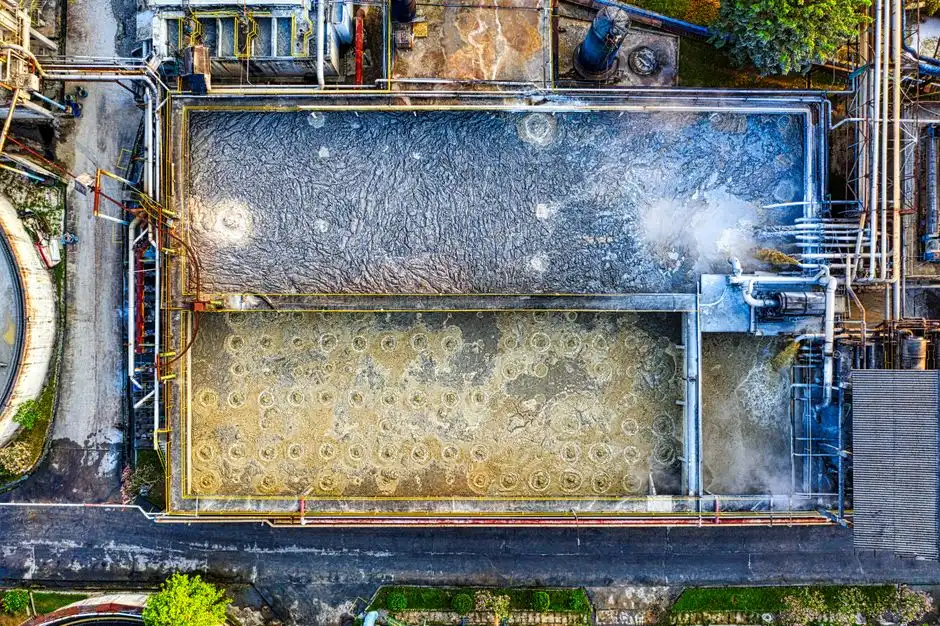
A standard 100-500 m³/day textile package skid is a six-stage train delivered as a factory-assembled unit with interconnecting piping and a single MCC.
- Headworks: coarse rotary bar screen (5-10 mm aperture) and grit chamber to protect downstream transfer pumps. In HydropureWater's standard packages this is a GX-series rotary screen sized to 110-130% of design flow.
- Equalization: 8-12 hours HRT, with mechanical mixing and a pH correction loop dosing NaOH or H₂SO₄ to hold pH 6.5-8.0 before biology.
- Physico-chemical: DAF for textile pre-treatment with coagulant (alum or PAC at 100-300 mg/L) and anionic polyacrylamide flocculant at 1-3 mg/L; typically strips 50-70% of TSS, 30-50% of COD, and 40-60% of color before the biological stage.
- Biological stage: one of three credible options - conventional activated sludge, A/O or SBR, or MBR (see next section for the head-to-head).
- Tertiary polishing: multimedia sand filter (5-10 µm nominal) plus activated carbon or ozone for residual color and refractory COD, then UV or chlorine dioxide for disinfection.
- Sludge handling: sludge thickener plus a sludge dewatering press producing 25-30% DS cake. This stage is the most often undersized element in package STPs; a 200 m³/day plant generates 250-400 kg DS/day of waste-activated sludge.
The block flow in plain text reads: Influent → Bar Screen → Equalization → DAF → Biological (MBR/SBR) → Sand Filter → Carbon/Ozone → UV → Treated Tank → Reuse/Discharge. Disinfection is typically a UV sterilizer for reuse loops or a chlorine dioxide generator when a residual is required for long pipelines. The whole train can be supplied as a single skid integrating the MBR package biological stage with upstream DAF and downstream polishing.
MBR vs SBR vs Conventional Activated Sludge for a Package STP
The biological stage is where most of the package-versus-civil decision is made, and where most vendor bids diverge. The table below is the practical comparison a mill engineer should carry into a vendor meeting.
| Criterion | Conventional Activated Sludge (CAS) | SBR (Sequencing Batch Reactor) | MBR (Membrane Bioreactor) |
|---|---|---|---|
| Typical COD removal | 60-80% | 80-90% | 90-95% |
| Color removal | Poor on reactive/disperse dyes | Moderate; depends on cycle | >95% with PVDF membrane cut-off |
| Effluent BOD (mg/L) | 20-30 | 10-20 | ≤10 |
| Effluent TSS (mg/L) | 20-40 | 10-20 | ≤5 |
| Footprint, 200 m³/day (m²) | ~250 | ~180 | ~110 (60% smaller than CAS, per HydropureWater MBR data, 2026) |
| Hydraulic shock tolerance | Low | Good (batch cycle) | High (membrane damps peaks) |
| Operator skill required | Low | Medium (cycle tuning) | Low-medium (membrane CIP routines) |
| Energy + membrane OPEX vs SBR | −10% | Baseline | +15-25% |
| Best fit | Low-strength effluent <800 mg/L COD, generous land | Medium-tight limits, skilled operators | Tight limits, reuse, congested sites |
Decision rule: choose MBR when reused water is needed for dyeing wash or when effluent BOD/COD must be under 30/100 mg/L; choose SBR for medium-tight effluent where skilled operators are available; choose CAS only for low-strength effluent (below 800 mg/L COD) and generous land. For skid integration, HydropureWater's DF-series flat-sheet MBR modules (80-225 m² per cassette) are a common pick for the biological stage because flat-sheet PVDF tolerates the higher TSS of textile mixed liquor and is easier to clean in place than hollow fiber. For a deeper trade-off, see the MBR vs conventional activated sludge trade-offs analysis.
Effluent Compliance Targets the Package Must Hit in 2026
Convert compliance from a slogan into numbers. The table below shows what a textile package STP must discharge to in 2026 across the major buying regions.
| Parameter | Influent (raw textile) | India CPCB / PCB (dyeing CETP) | EU IED Textile BREF (2024 rev., 2026 in force) | US EPA 40 CFR 410 | Bangladesh DoE | Vietnam QCVN 40:2011/BTNMT (Cat. A) |
|---|---|---|---|---|---|---|
| BOD (mg/L) | 200-800 | 30 | — (covered by COD) | 27-162 (subcategory-dependent) | 50 | 50 |
| COD (mg/L) | 800-3000 | 250 | <160 (direct discharge) | — | 200 | 150 |
| TSS (mg/L) | 100-500 | 100 | — | varies | 150 | 100 |
| Color (Pt-Co) | 500-2000 | 1/10 dilution equivalent | BAT-AEL tightened | visual / ADMI | — | 50 |
| pH | 6-10 | 6.5-8.5 | — | 6-9 | 6-9 | 6-9 |
| Chromium / sulfide | traces | Cr(VI) 0.1; sulfide 2 | BAT controlled | 0.5-2.0 (subcategory) | — | — |
| TDS (mg/L) | up to 5000 | 2100 (PCB-specific) | tighter in water-stressed basins | — | 2100 | — |
A well-designed MBR-based package typically delivers BOD ≤10, COD ≤50, TSS ≤5, and color ≤30 Pt-Co without a separate RO step - enough to meet India PCB, EU BREF, Bangladesh DoE, and Vietnam QCVN 40 limits on most parameters, with an RO polish only needed when TDS is the binding constraint. The 'reasonable reuse' clause now appearing in new Indian and Bangladeshi consents is best satisfied by routing 30-50% of the MBR permeate to a wash-water buffer, displacing fresh water. For the regional frame, the textile wastewater treatment in Iran 2026 guide walks through a similar compliance map for Middle-East buyers.
2026 Cost Benchmarks, Footprint and ROI for a Package Textile ETP
CAPEX anchors below are ex-works for a complete package STP (headworks, equalization, DAF, biological, tertiary, sludge dewatering, MCC) without civil building or site erection. Add 15-20% for installation and 10% for commissioning.
| Design flow | CAPEX range (USD, ex-works, 2026) | Footprint (m², including sludge handling) | Lead time (ex-works) |
|---|---|---|---|
| 50 m³/day | 55,000 - 90,000 | 60-90 | 8-10 weeks |
| 100 m³/day | 90,000 - 180,000 | 90-140 | 10-12 weeks |
| 200 m³/day | 170,000 - 300,000 | 150-220 | 12-14 weeks |
| 500 m³/day | 380,000 - 650,000 | 320-480 | 16-20 weeks (MBR included) |
OPEX benchmarks for a textile package STP land at USD 0.25-0.55 per m³ treated, split roughly as: 30-50% energy (blowers, transfer pumps, MBR permeate suction), 15-20% chemicals (coagulant, flocculant, NaOH, hypochlorite or ClO₂), 10% membrane replacement and spares, and the balance labor and sludge disposal. A 100 m³/day package STP feeding 50% reuse saves roughly 18,000 m³ of fresh water per year; at USD 1.5-3 per m³ of process water that repays the CAPEX delta versus a CAS-only design inside 2-3 years (HydropureWater field data, 2026). Sludge handling typically adds 15-25% to total installed cost, which is why bundling a sludge dewatering press into the package scope avoids a hidden second CAPEX. Cost drivers that move any quote ±20% are material of construction (SS304 vs SS316 vs carbon-steel rubber-lined), automation level (PLC+HMI vs full SCADA with remote telemetry), and local content versus imported equipment. Lead time is 8-14 weeks ex-works for standard packages and 16-20 weeks when MBR is included - roughly half the 8-12 months of a civil ETP. For a US benchmark on package plants, the package wastewater treatment plant cost and compliance piece gives a parallel 2025/2026 frame.
How to Evaluate and Select a Package STP Vendor
A short, hard-nosed checklist that protects the RFQ:
- Ask for a mass balance across the package at design flow and at 50% overload; guard against short equalization or DAF tankage.
- Demand reference plants in the textile sector and request a site visit or virtual walk-through of an installed MBR-based package.
- Validate the MBR membrane warranty: PVDF flat sheet should be warranted for 3-5 years under textile duty, hollow fiber for 2-3 years.
- Confirm the package includes sludge dewatering, not just biological treatment - a frequent buyer pitfall.
- Check the local service footprint, spare-parts stock for membranes and dosing pumps, and remote-monitoring capability.
- Insist on a single turnkey scope with a performance warranty tied to effluent parameters (BOD, COD, color), not just equipment warranty.
For a buried or low-footprint site, evaluate a compact factory-built package STP with A/O contact oxidation and integrated disinfection; for tighter discharge limits, pair it with the MBR skid, DAF, filter press, and chlorine dioxide train to deliver a turnkey textile ETP. Cross-check vendor claims against independent case studies such as the MBR vs conventional activated sludge trade-offs analysis and the DAF vs clarifier for industrial wastewater guide when validating the headworks choice.
Frequently Asked Questions
What capacity range does a package STP cover for a textile plant?
Package STPs for textile use cover 10-2000 m³/day, with the procurement sweet spot between 50 and 500 m³/day per train. Above 500 m³/day, most buyers switch to two parallel packages rather than one oversized unit (HydropureWater field data, 2026).
Can a package STP treat dyeing effluent to reuse quality?
Yes. An MBR followed by RO, or an MBR followed by UF plus ozone, consistently reaches under 50 mg/L COD and under 30 Pt-Co color, which is suitable for wash-water reuse in dyeing and finishing (per Azanaw 2022 polishing data).
How much does a 100 m³/day textile package STP cost in 2026?
USD 90,000-180,000 ex-works for the skid, plus 15-20% for installation and 10% for commissioning. Add another 15-25% if a full sludge dewatering line is bundled into the package.
What is the typical payback period?
2-3 years when 30-50% of fresh water demand is displaced by reuse and ZLD-related consent penalties are avoided (HydropureWater field data, 2026).
Which biological process is best for textile dyeing effluent?
MBR for the tightest discharge limits and reuse, SBR for medium-tight limits with skilled operators, and CAS only for low-strength effluent below 800 mg/L COD where land is not constrained.
Is a package STP suitable for zero liquid discharge (ZLD)?
The package STP handles the recycle loop to RO or UF, but true ZLD requires a multi-effect evaporator or mechanical vapor recompression unit downstream, which sits outside the standard package scope and is typically procured as a separate brine-concentrator line.