
Is It Really Bulking? The 30-Second Triage
Activated sludge bulking is diagnosed when the sludge volume index (SVI) climbs above 150 mL/g — and above 180 mL/g when filamentous organisms are the cause (per Wastewaterace). The first 30 minutes of troubleshooting should confirm bulking versus rising sludge or pin floc, then identify the filament type by microscopy before changing wasting rates, dissolved oxygen, or applying chlorination at 2–10 mg/L Cl₂ to the return activated sludge line. Misdiagnosis is a significant error during an upset — rising sludge and pin floc look similar at the clarifier surface, but their corrective actions are opposite.
Run a 30-minute settleometer test on a 1 L mixed-liquor sample before any process change. Bulking sludge will not compact — the interface stays high, supernatant stays cloudy, and the sludge blanket fails to consolidate within 30 minutes. Rising sludge appears as discrete clumps floating to the surface after 15–30 minutes of settling and is confirmed when average effluent nitrate exceeds 6–10 mg/L in warmer months (denitrification in the clarifier releases N₂ gas that lifts flocs). Pin floc looks like a cloud of pinpoint particles that never form a real blanket — a sign of old, endogenous sludge or toxic shock. Note the contrasting smell: healthy sludge is earthy/musty, bulking filamentous sludge is sweet or fruity, and septic/rising sludge smells of sulfide. Young sludge (high F/M, short SRT) and old sludge (long SRT, possible Nocardia foam) demand opposite wasting decisions — confirm direction before you change the wasting rate.
Filamentous vs. Non-Filamentous Bulking: What the Microscope Tells You
Microscopy separates the two bulking subtypes in roughly 10 minutes and dictates which corrective lever to pull next. Every upset leaves a morphological clue (per Wastewaterace).
Filamentous bulking: light brown, gray, or white sludge with filaments visibly extending from floc clumps, a sweet or fruit-like odor, and SVI ≥180 mL/g. Non-filamentous (flocculated) bulking: floc forms but is light and slow to compact because it traps bound water — a high-surface-area, underoxidized young sludge (per Wastewaterace). The corrective paths diverge: filamentous bulking responds to chlorination and SRT adjustment, while non-filamentous bulking typically resolves by raising DO and extending SRT to age the sludge.
Dominant filaments operators identify by phase-contrast microscopy at 100×:
- Type 021N, Sphaerotilus, Haliscomenobacter hydrossis — low DO, low F/M, septic influent
- Microthrix parvicella — long SRT, high FOG, cold mixed liquor (12–18 °C)
- Type 0041, Nocardia (now Mycolicibacterium) — long SRT, high FOG, foaming companion
The foundational identification key is the Jenkins, Richard & Daigger 2003 manual (via Wiley/Bitton 2010, Wastewater Microbiology Ch. 10), with the Martins et al. 2004 critical review in Water Research 38:793–817 as the standard taxonomic reference. By 2025, fluorescence in situ hybridization (FISH), 16S rRNA sequencing, and machine-learning image analysis allow species-level ID and earlier detection than wet microscopy alone (per ScienceDirect 2025 review, Advancing sludge bulking control in wastewater treatment).
Root-Cause Map: What's Actually Driving Your Bulking
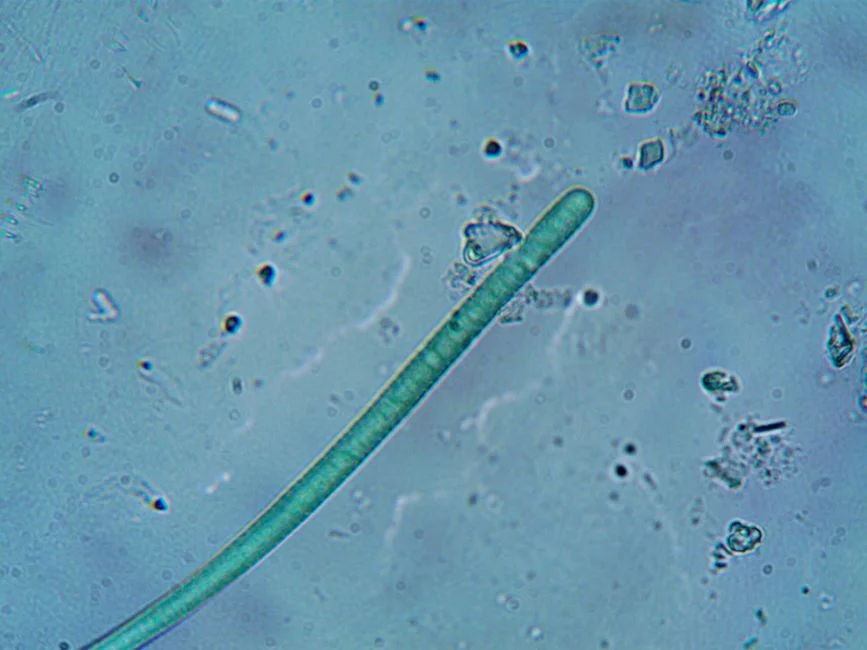
Connecting microscopic findings back to a controllable process parameter allows the operator to select the right corrective lever. The cause-to-action mapping below links SVI magnitude, dominant filament, and root parameter to a specific corrective action.
| Dominant filament / observation | Root parameter | Threshold | Corrective lever |
|---|---|---|---|
| Type 021N, Sphaerotilus, Haliscomenobacter | Low dissolved oxygen | DO < 1.0 mg/L sustained | Raise DO setpoint to 1.5–2.0 mg/L; check diffuser fouling and air-header pressure |
| Microthrix parvicella, Type 0041, Nocardia | Long SRT, high FOG | SRT > 15 days with FOG > 50 mg/L | Reduce SRT toward 8–12 days; improve FOG removal at headworks |
| Type 1851, Type 1701 | Low F/M (over-aged sludge) | F/M < 0.05 lb BOD/lb MLSS·d | Reduce SRT to freshen biomass; verify FOG is not the actual driver |
| Type 021N, Thiothrix | Septic influent / sulfides | S²⁻ > 1–2 mg/L in primary effluent | Pre-aerate influent or add ferric chloride to the headworks |
| Non-filamentous (flocculated) bulking | High F/M (young sludge) | F/M > 0.4 lb BOD/lb MLSS·d | Increase SRT or reduce WAS rate; verify aeration capacity |
| Any filament with cloudy effluent | Nutrient deficiency | BOD:N:P outside 100:5:1 | Dose N (urea) or P (phosphoric acid) only to hit the 100:5:1 ratio |
Hydraulic surges, temperature drops of 5 °C or more, and sulfide loading from long force mains can each trigger specific filaments within 1–3 SRTs (per Wiley/Bitton summary of the Eikelboom and Jenkins frameworks). The SRT operating band of 5–30 days (per Integratedwaterservices) is the master lever, with most causes tracing back to either "SRT too long" or "SRT too short."
Corrective Actions: From Non-Chemical Fixes to Targeted Chlorination
Work the playbook in order, as each step either buys time or removes the driver. Skipping ahead wastes chemicals and often worsens the condition.
- Restore DO first. Verify air-header pressure (typically 5–7 psi for fine-bubble grids), confirm the DO probe is calibrated against Winkler titration, and check for diffuser fouling — a 30 % loss in alpha-factor on fine-bubble diffusers over 3–5 years is common.
- Rebalance SRT. Adjust the waste-activated-sludge (WAS) rate to move SRT back into the 5–30 day band. Increasing WAS will not control filamentous bulking on its own — it thins the sludge but does not reduce SVI (per Wastewaterace).
- Correct nutrients only if measured C:N:P is off 100:5:1. Dosing nitrogen or phosphorus without a mass-balance measurement worsens the imbalance. Use PLC-controlled chemical dosing for nutrient and chlorine control to hold setpoints tight.
- Short-term clarifier aids. Polymer dosing or weighted settling aids buy 24–72 hours while the root cause is corrected (per Integratedwaterservices).
- Targeted RAS chlorination. Dose 2–10 mg/L Cl₂ as a Cl₂:MLSS ratio of roughly 0.003–0.01 kg Cl₂ per kg MLSS per day. Apply to the return activated sludge line — never to the aeration basin — for 5–30 minutes per cycle while the RAS line is in service. Track SVI daily; stop when SVI drops below 150 mL/g. This is a short-term fix; overdosing damages nitrifiers and can collapse the biological population.
- Chronic-plant diagnostic stack. For plants where bulking recurs every 6–12 months, deploy FISH or 16S amplicon sequencing to confirm the filament at species level, then apply a targeted biological or quorum-quenching intervention (per ScienceDirect 2025).
Worked example: a 10 MGD plant with RAS MLSS of 8,000 mg/L and RAS flow of 1.0 MGD targets a Cl₂:MLSS ratio of 0.005 kg Cl₂ per kg MLSS per day. Daily mass of MLSS in RAS = 8,000 mg/L × 1.0 MGD × 3.785 L/gal = 30.28 kg/day. At 0.005 kg Cl₂/kg MLSS, the required dose is 30.28 × 0.005 = 0.15 kg Cl₂/day = 150 g Cl₂/day, fed as a slug dose over a 30-minute window into the RAS line. Confirm with a residual chlorine measurement at the aeration-basin inlet — target 0.5–1.0 mg/L Cl₂ residual, never above 2.0 mg/L entering the basin.
MBR Plants: When Bulking Becomes Membrane Fouling
MBR operators see bulking as membrane fouling and often treat the wrong subsystem. In an MBR, high SVI reduces the effectiveness of air-scour at the membrane surface: the sludge becomes so viscous that the coarse-bubble air cannot keep the panel clean, and transmembrane pressure climbs long before effluent TSS does.
Hold tighter on MBRs: MLSS typically 8,000–12,000 mg/L, SRT 15–30 days, and routine in-situ microscopy of the mixed liquor to spot filament shifts before they reach the membrane. PVDF flat-sheet MBR modules with integrated aeration box are designed for continuous membrane scouring under variable MLSS loads and provide a wider operating window than cassette designs. Critical: never dose chlorine into MBR mixed liquor — it degrades PVDF and irreversibly damages the membrane. Chlorine, if used to control filamentous bulking upstream, must be applied before the bioreactor only, and the residual at the membrane tank must be held below 0.1 mg/L. For a deeper look at the MBR envelope, see the MBR effluent quality and removal-rate engineering guide.
Preventing the Next Episode: 2026 Best-Practice Controls
Proactive operating practices minimize SVI excursions before they become unmanageable.
- Hold DO ≥ 1.5–2.0 mg/L continuously with online cascade control on the aeration blower — manual setpoint drift is a common cause of chronic low-DO filaments.
- Trend SVI daily and treat a week-over-week rise of more than 20 % as a warning even when absolute SVI is still under 150 mL/g. Sludge rarely jumps from 130 to 220 overnight without leaving a 7–10 day fingerprint on the chart.
- Maintain a deliberate SRT target per process variant (5–30 day band per Integratedwaterservices), and re-tune after any influent change, temperature shift, or chemical program change. For headworks upgrades, a rotary mechanical bar screen for headworks screening reduces rag and FOG carry-over that feeds Microthrix and Nocardia.
- Run a quarterly filament-ID microscopy program so the operator knows which organism is dominant before bulking recurs. Knowing your baseline flora is the difference between a 4-hour fix and a 4-week episode.
Sludge handling downstream also matters: a bulking episode concentrates into the WAS stream, and poor dewatering turns a settleability problem into a hauling-cost problem. Pair your bulking playbook with a plate and frame filter press for waste activated sludge sized for the post-bulking solids load. For the full process map upstream of the aeration basin, see the primary vs secondary wastewater treatment parameter guide, and for downstream solids handling the municipal sewage sludge treatment process guide.
Frequently Asked Questions
What SVI value confirms activated sludge bulking?
Bulking is
Frequently Asked Questions
What SVI value confirms activated sludge bulking?
An Activated Sludge Volume Index (SVI) exceeding 150 mL/g is generally considered the threshold for identifying filamentous bulking. While plant-specific operational standards vary, an SVI consistently above 150 mL/g indicates poor settleability, while values exceeding 250 mL/g typically signal severe bulking that threatens solids carryover into the effluent.
How do you tell bulking from rising sludge in the clarifier?
Bulking sludge is characterized by a high SVI and a blanket that rises due to poor floc density and filamentous growth, whereas rising sludge is caused by denitrification. To distinguish them, observe for nitrogen gas bubbles (pin-point gas) rising to the surface; if bubbles are present, the issue is likely denitrification, which can be confirmed by measuring high nitrate levels in the secondary clarifier.
What is the correct chlorine dose for filamentous bulking control?
The standard dosage for chlorine application to return activated sludge (RAS) ranges from 1 to 10 pounds of chlorine per 1,000 pounds of mixed liquor volatile suspended solids (MLVSS) per day. Operators should initiate treatment at the lower end of this range and adjust based on microscopic examination of the filaments to avoid excessive toxicity to the nitrifying bacteria population.
Why does low dissolved oxygen cause filamentous bulking?
Low dissolved oxygen (DO) creates a competitive advantage for filamentous organisms like Type 021N or Sphaerotilus natans, which have a high surface-area-to-volume ratio and can effectively scavenge oxygen at concentrations below 0.5 mg/L. Maintaining a DO concentration of 2.0 mg/L or higher in the aeration basin typically suppresses these species by allowing faster-growing floc-forming bacteria to outcompete them.
Can you fix bulking by increasing the wasting rate?
Increasing the wasting rate can help if the bulking is caused by a low Mean Cell Residence Time (MCRT) or a young sludge age, but it is often counterproductive for filamentous bulking. If the bulking is caused by low DO or nutrient deficiency, higher wasting rates will decrease the biomass concentration, potentially worsening the Food-to-Microorganism (F/M) ratio and accelerating the proliferation of filamentous growth.