Why a 2026 NOV From the Local Sewerage Authority Is the Document That Reorders the Calendar
A Notice of Violation from the controlling Union County sewerage authority — not a federal inspection — is the document that reorders a Summit plant manager's calendar in 2026. When a food or beverage processor receives such a letter for elevated BOD, total suspended solids, or FOG, the clock starts on a 30–60 day window to submit a compliance plan with measurable effluent targets. Under the National Pretreatment Program, local authorities run permitting, sampling, and enforcement for indirect discharges into a POTW, which is why a single letter from the local sewerage authority carries the same operational weight as a federal order.
Four rule layers stack on top of each other, and a 2026 NOV cites all four. The Clean Water Act §307(b) authorizes EPA to set national pretreatment standards; those standards live in 40 CFR 403 (general pretreatment, applicable to all industrial users) and in 40 CFR 432 (categorical pretreatment for food and beverage point sources). EPA delegates day-to-day enforcement to approved state and local programs, meaning the controlling authority for a Summit facility is the Union County Utilities Authority (or the applicable regional sewerage authority operating under NJDEP delegation), acting under its own sewer use ordinance. Local limits can be stricter than the federal floor but never weaker (per 40 CFR 403.5), so the engineer who chases the EPA minimum is the engineer who gets the second NOV.
The 2026 Ceilings a Summit Plant Has to Beat
The numeric ceilings a Summit food or beverage plant has to beat depend on the subpart covering its SIC/NAICS code. 40 CFR 432 is split by subpart — meat products (432.1–432.10), dairy (432.21–432.30), grain mills (432.41–432.50), canned and frozen fruits and vegetables (432.61–432.70), and beverages (432.71–432.80). Each subpart defines pollutant parameters, daily maximums, and monthly averages. EPA's Attachment 3-1: Summary of Categorical Standards (December 2024) is the live index engineers should bookmark, since a Union County POTW local limit can sit below the federal floor but never above it.
Typical NJ POTW indirect-discharge limits and the categorical ceilings the engineer must compare against in a 2026 design review are summarized below.
| Parameter | Typical NJ POTW Indirect-Discharge Limit | 40 CFR 432 Reference (Subpart Ceilings Vary) |
|---|---|---|
| BOD₅ | 250–300 mg/L | 26–30 mg/L (30-day avg, existing sources) under 432 meat/dairy subparts |
| TSS | 250 mg/L | 40–45 mg/L (30-day avg) under 432 meat/dairy subparts |
| FOG / Oil & Grease | 100 mg/L | Categorical limits vary by subpart; meat/poultry FOG is the tightest |
| pH | 6.0–9.0 | 6.0–9.0 standard categorical range |
| Temperature | ≤ 40 °C (104 °F) at POTW headworks | Reporting requirement in most categorical subparts |
| Sulfide / Ammonia / TRC | Site-specific, called out in local permit | Monitored where categorical subpart applies |
New Jersey requires self-monitoring and discharge monitoring reports (DMRs), and the local ordinance typically asks for the categorical ceiling plus additional parameters not listed in the federal table. The practical rule is to engineer to the strictest number in the stack rather than chase the federal minimum — the floor you size against is the lowest of the federal subpart, NJDEP state program, and the Union County sewer use ordinance.
Stream Characterization: Why 'Food and Beverage Wastewater' Is Four Different Streams
Engineers who treat "food and beverage wastewater" as a single stream consistently oversize or undersize unit operations; the first design step is splitting the flow into four characteristically different streams and assigning each to the right piece of equipment. Process water from washing, cooking, cooling, and packaging carries the bulk of the BOD and suspended solids load — high organic strength, often 1,500–5,000 mg/L BOD₅ for a mid-size further-processing line — and it is the stream that sets the size of the equalization basin and the downstream biological stage. Summit dairies and further-processing operations should expect their process stream to sit in this band before any equalization.
CIP caustic and acid rinses drive pH swings that are the dominant reason equalization is non-negotiable: a fruit wash can leave the line at pH 3.5, the next CIP cycle can exit at pH 12, and any treatment program built around averages will fail at those moments. Cooling-water blowdown is generally lower in organics but can carry lubricants, trace metals, and heat; it is normally segregated and either discharged under a separate non-contact permit or screened and recombined upstream of biological treatment. Sanitation and floor wash is where the FOG load concentrates, and it is the stream a DAF unit is sized to capture before the load ever reaches the aeration basin. Routing matters as much as characterization: process and floor-wash flow typically feeds the DAF, CIP and process flow combines in equalization, cooling blowdown bypasses biological treatment when non-contact, and only the polished DAF + biological effluent goes to pH trim and discharge.
The Five-Stage Process Train a Summit Plant Engineers Around
The defensible 2026 train for a Summit food or beverage plant follows a five-stage sequence, allowing the engineer to justify each performance metric to the Union County sewerage authority during the NOV response.
- Stage 1 — Screening. A rotary mechanical bar screen with 3–6 mm bar spacing removes rags, plastics, seeds, and packaging debris that would otherwise rag up downstream pumps and plug DAF nozzles.
- Stage 2 — Equalization. A basin sized to 1.5–2× peak CIP flow, with mechanical or jet mixing, dampens the 3–5× flow surges and pH swings that would otherwise pin the biology downstream. A system sized on averages fails.
- Stage 3 — DAF. A dissolved air flotation system handles bulk FOG and colloidal TSS reduction, with a PLC-controlled coagulant and polymer dosing skid in front to condition the feed.
- Stage 4 — Biological treatment. A HydropureWater MBR system for tight-footprint, reuse-quality polish, or conventional activated sludge where land is available. The MBR vs conventional tradeoff is detailed in the submerged MBR cost and ROI guide.
- Stage 5 — Polishing & sludge handling. pH trim holds the discharge inside the 6.0–9.0 window the local ordinance requires, and a plate-and-frame filter press dewaters the DAF float and waste activated sludge to 20–25% cake solids.
Each sub-sector under 40 CFR 432 stresses a different stage, and identifying which stage is overloaded dictates where to add capacity. Meat and poultry plants carry the highest FOG load (often 800–2,000 mg/L in the raw stream) and overload the DAF. Dairy and cheese plants discharge protein-rich waste that overloads the biological stage. Beverage, brewery, and confectionery lines produce sugar- and starch-dominated waste that spikes BOD within hours of a batch and overloads equalization. Bakery, snack, and ready-meal plants carry high suspended solids from pulp, seeds, and grains that overload screening. Screen sizing for these solids-heavy lines is covered in the coarse screen inlet works design guide.
DAF or Lamella: The Selection Rule for a Summit Food and Beverage Plant
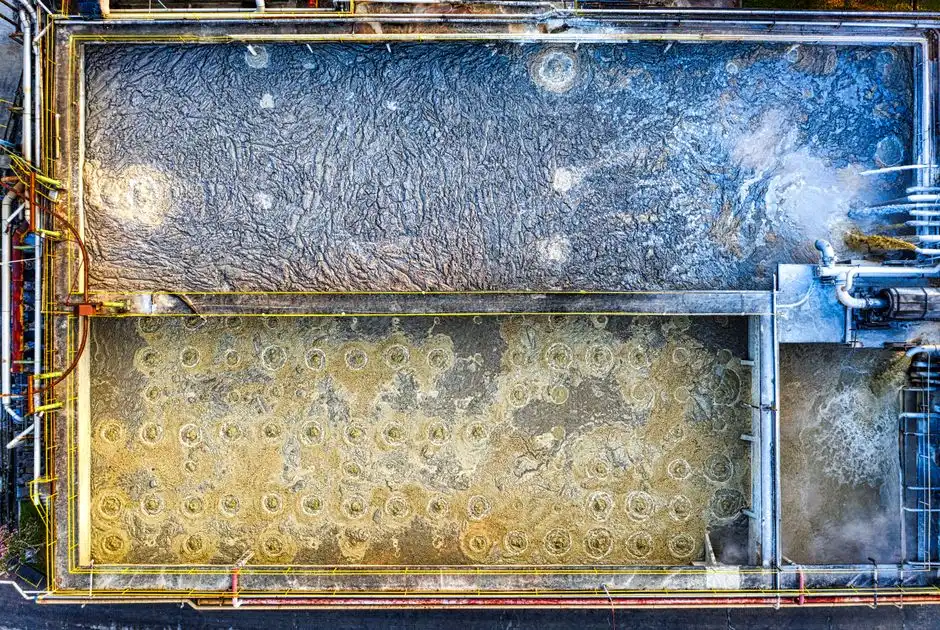
For the 10–100 m³/h envelope typical of mid-size Summit-area food and beverage plants, the primary-solids decision comes down to dissolved air flotation or a lamella clarifier. Both technologies are well-proven, but they solve different problems and the operating-cost delta is significant. The dissolved air flotation system spans 4–300 m³/h across 13 standard models, removes FOG and colloidal matter via micro-bubble flotation, and uses automatic skimming to handle the float layer. The high-efficiency sedimentation tank (lamella clarifier) operates at 20–40 m³/m²/h surface loading, achieves solids separation through inclined-plate settling, and can cut coagulant consumption by up to 30% compared with conventional clarifiers.
| Selection Criterion | Specify DAF | Specify Lamella Clarifier |
|---|---|---|
| Flow envelope | 4–300 m³/h, 13 standard models | 20–40 m³/m²/h surface loading |
| Primary target | FOG, emulsified oils, colloidal TSS | TSS-dominant, low-FOG streams |
| Trigger condition | FOG or emulsified oils > ~200 mg/L, or line is poultry/meat/dairy | TSS-dominant influent with chemical-OPEX sensitivity |
| Strength | Primary strength down to < 50 mg/L on conditioned feed | Up to 30% lower coagulant consumption vs. conventional clarifier |
| Risk profile | Chemical OPEX rises if FOG is over-driven | Cross-flow risk if influent FOG is not low |
The decision rule: specify DAF when FOG or emulsified oils exceed ~200 mg/L or when the line is poultry, meat, or dairy; specify a lamella clarifier when TSS is the dominant parameter and the plant's priority is minimizing coagulant and polymer OPEX. For most Summit-area F&B lines the FOG load tilts the decision toward DAF, with a lamella more commonly used as a polish stage after biological treatment. Pair the primary stage with an automatic chemical dosing skid to keep coagulant demand from drifting upward as feed composition changes. For a peer plant's decision walkthrough in a similar corridor, see the Bridgewater Twp pretreatment limits guide.
CAPEX, OPEX and the Cost of Not Pretreating
For a CAPEX defense memo, the most defensible framing is a flow-rate ratio rather than a full TCO model. Package DAF at the 10–100 m³/h scale typically runs in the low-to-mid five figures per m³/day of design flow; adding an MBR biological stage brings the installed cost to roughly 1.4–1.8× the DAF cost for a complete system (HydropureWater field data, 2026). OPEX is dominated by three line items: polymer and coagulant (which is exactly why the lamella's 30% chemical reduction is operationally meaningful), sludge-hauling cost per wet ton, and aeration power for the MBR or activated-sludge basin.
For sludge alone, plate-and-frame dewatering cuts disposal volume 75–80% versus lagooned float, which usually pays back the press inside 18–30 months at hauling rates typical of north-Jersey haulers. The financial risk of not pretreating is sized by the enforcement escalator: a first violation is typically a notice and fine, repeated violations add surcharges and increased monitoring, and a permit revocation can halt production. Temporary pretreatment bridges an 8–16 week permanent install when an NOV is active; a 70,000 gpd system has been delivered in 10 days on this kind of timeline (Mead & Hunt, 2024). For a comparison of how a neighboring corridor handles the same arithmetic, see the Tillamook pretreatment limits guide.
The Six-Step Defensibility Sequence for 2026
The defensibility sequence below is what the engineer hands to the Union County sewerage authority in response to an NOV, and what the auditor sees six months later.
- Baseline 24-hour composite sampling across at least five operating days.
- Jar testing and a DAF pilot on real plant water, not simulated feed.
- Written confirmation of local limits with the controlling Union County sewerage authority and any applicable NJDEP delegation.
- Final equipment selection and PO, anchored to the strictest number in the federal/state/local stack.
- Installation, sized for 1.5× average flow to absorb CIP surges.
- 90-day shakedown with monthly DMRs aligned to the 2026 permit renewal window.
Aligning these six steps with the 2026 permit renewal window is the difference between a clean audit and an enforcement order.
Frequently Asked Questions
What is the federal categorical rule for Summit food and beverage plants discharging to a Union County POTW?
40 CFR 432 sets categorical pretreatment standards for food and beverage point sources by sub-sector: meat products (432.1–432.10), dairy (432.21–432.30), grain mills (432.41–432.50), canned and frozen fruits and vegetables (432.61–432.70), and beverages (432.71–432.80). A Summit plant must match its SIC/NAICS code to the correct subpart and engineer against the strictest of 40 CFR 432, NJDEP, and the local sewer use ordinance.
What BOD and TSS ceiling does a typical NJ POTW indirect-discharge permit impose?
Most NJ POTWs, including Union County authorities, set indirect-discharge ceilings around BOD 250–300 mg/L and TSS 250 mg/L, with FOG 100 mg/L and pH 6.0–9.0. These are local limits and can be stricter than the federal categorical floor; the engineer should verify the exact numbers in the discharge permit before sizing any equipment.
When should a Summit food and beverage plant specify DAF instead of a lamella clarifier?
Specify the dissolved air flotation system when FOG or emulsified oils exceed ~200 mg/L or when the line is poultry, meat, or dairy. Specify a lamella clarifier when TSS is dominant and the plant's priority is minimizing coagulant and polymer OPEX. For most Summit-area F&B lines the FOG load tilts the decision toward DAF in Stage 3 of the five-stage train.
What sludge dewatering target should a Summit plant engineer to in 2026?
A plate-and-frame filter press dewatering the DAF float and waste activated sludge in Stage 5 typically reaches 20–25% cake solids, cutting disposal volume 75–80% versus lagooned float and usually paying back the press inside 18–30 months at north-Jersey hauling rates.