
Why Rainsville Food and Beverage Plants Face a Three-Layer Compliance Stack
Food and beverage plants near Rainsville, Alabama meet pretreatment limits by matching their wastewater to 40 CFR Part 405–411 categorical EPA standards, then satisfying stricter Alabama Department of Environmental Management (ADEM) and local DeKalb County POTW limits for BOD₅, TSS, oil & grease, and pH. Typical process trains combine rotary screening, equalization, dissolved air flotation (DAF) for FOG and suspended solids, biological treatment (MBR or activated sludge), and pH neutralization before sewer discharge.
The General Pretreatment Regulations at 40 CFR Part 403 set the umbrella rules that every industrial discharger into a U.S. POTW must follow, including prohibitions on pass-through and interference, and the categorical effluent guidelines in 40 CFR Parts 405–411 apply numeric ceilings to specific food and beverage sub-sectors. EPA currently regulates 59 industrial sub-categories with dedicated effluent limit tables, and food/beverage BOD routinely runs 10–20× higher than the domestic sewage baseline a POTW is designed around (Crystal Clean, 2025). That gap is precisely why a generic municipal discharge checklist fails any Rainsville plant on its first compliance audit.
On top of the federal floor, ADEM administers NPDES delegation and the state pretreatment program, and the DeKalb County sewer authority that serves Rainsville writes site-specific permit limits that typically sit below the EPA categorical numbers. As one industry framing puts it, "a facility in one jurisdiction can face different limits than an identical operation twenty miles away" (Crystal Clean, 2025). A northeast Alabama plant therefore has to engineer against three overlapping layers — EPA categorical, ADEM state, and DeKalb County local — and the equipment selection logic in the sections that follow flows directly from that stack. For a full cross-reference of the EPA subpart ceilings, see the EPA categorical pretreatment limits reference.
The Four Waste Streams a Rainsville Plant Must Characterize
Engineers who treat "food and beverage wastewater" as a single stream consistently oversize or undersize unit operations; the first design step is splitting the flow into four characteristically different streams and assigning each to the right unit operation.
Process water from washing, cooking, cooling, and packaging carries the bulk of the BOD and suspended solids load — high organic strength, often 1,500–5,000 mg/L BOD₅ for a mid-size further-processing line — and it is the stream that sets the size of the equalization basin and the downstream biological stage (Crystal Clean, 2025). CIP caustic and acid rinses drive pH swings that are the dominant reason equalization is non-negotiable: a fruit wash can leave the line at pH 3.5, the next CIP cycle can exit at pH 12, and any treatment program built around averages will fail at those moments (Crystal Clean, 2025). Cooling water blowdown is generally lower in organics but can carry lubricants, trace metals, and heat; it is normally segregated and either discharged under a separate non-contact permit or screened and recombined upstream of biological treatment. Sanitation and floor wash is where the FOG load concentrates, and it is the stream that a DAF unit is sized to capture before the load ever reaches the aeration basin.
Routing matters as much as characterization: process and floor-wash flow typically feeds the DAF, CIP and process flow combines in equalization, cooling blowdown bypasses biological treatment when non-contact, and only the polished DAF + biological effluent goes to pH trim and discharge. A Rainsville plant that draws this routing diagram before talking to vendors avoids the most common retrofit mistake — a DAF sized on total plant flow rather than on the FOG-bearing fraction.
Categorical EPA Limits That Apply to Rainsville Sub-Sectors
The numeric ceilings engineers have to beat depend entirely on the subpart that covers their SIC code. For northeast Alabama, the most relevant EPA effluent guidelines sit in 40 CFR Parts 405 (dairy), 406 (grain mills, common at co-located feed operations), 407 (canned fruits and vegetables, applicable to further-processing), 409 (sugar processing), 410 (textile foods), and 432 (meat products — the subpart that covers Alabama's poultry processors). Part 411 (cement) is irrelevant to a food and beverage plant and is listed only to confirm exclusion.
Existing-source limits at 40 CFR 405.63 set the dairy floor at 30 mg/L BOD₅ and 45 mg/L TSS as a 30-day average, the same order of magnitude other food subparts use as a baseline (HydropureWater, 2025). The table below captures the ceilings an engineer is most likely to compare against during a Rainsville-area design review.
| Subpart | Industry | BOD₅ ceiling (30-day avg) | TSS ceiling (30-day avg) | O&G / FOG | pH window |
|---|---|---|---|---|---|
| 40 CFR 405 | Dairy products | 30 mg/L | 45 mg/L | Case-by-case | 6.0–9.0 |
| 40 CFR 406 | Grain mills | 30 mg/L | 45 mg/L | Low | 6.0–9.0 |
| 40 CFR 407 | Canned fruits & vegetables | 30 mg/L | 45 mg/L | Process-dependent | 6.0–9.0 |
| 40 CFR 409 | Sugar processing | 38 mg/L | 54 mg/L | Low | 6.0–9.0 |
| 40 CFR 410 | Textile foods (limited) | Subpart-specific | Subpart-specific | Low | 6.0–9.0 |
| 40 CFR 432 | Meat & poultry products | 26 mg/L (existing) | 40 mg/L (existing) | Strict FOG limits | 6.0–9.0 |
Alabama's poultry processors fall under 40 CFR 432 and face some of the tightest FOG ceilings in the food sector, which is the operational reason DAF — not lamella — is the default primary stage for those plants. ADEM and the DeKalb County POTW can impose limits below the EPA categorical floor, and the practical rule of thumb is to engineer to the strictest number in the stack rather than chase the federal minimum (Crystal Clean, 2025).
DAF vs Lamella Clarifier: Which Pretreatment Stage Fits a 10–100 m³/h F&B Plant
For the 10–100 m³/h envelope typical of mid-size Rainsville-area food and beverage plants, the primary-solids decision comes down to dissolved air flotation or a lamella clarifier. Both technologies are well-proven, but they solve different problems and the operating-cost delta is significant.
An industrial DAF system in the DAF product line spans 4–300 m³/h across 13 standard models, removes FOG and colloidal matter via micro-bubble flotation, and uses automatic skimming to handle the float layer. A lamella clarifier operates as a high-efficiency sedimentation tank with a 20–40 m³/m²/h surface loading rate, achieves solids separation through inclined-plate settling, and can cut coagulant consumption by up to 30% compared with conventional clarifiers. The cross-flow risk in lamella is low when influent FOG is low; the DAF risk is mainly chemical OPEX when the FOG load is over-driven.
| Parameter | DAF | Lamella Clarifier |
|---|---|---|
| Flow envelope | 4–300 m³/h | 10–150 m³/h typical |
| Surface loading | 5–25 m³/m²/h | 20–40 m³/m²/h |
| FOG removal | Primary strength (down to <50 mg/L) | Limited; FOG <150 mg/L |
| Coagulant use | Baseline | Up to 30% lower |
| Sludge character | Thick float (3–5% DS) | Settled sludge (1–2% DS) |
| Best fit | FOG > 200 mg/L, poultry/meat/dairy | TSS-dominant, low-FOG, chemical-OPEX-sensitive |
Decision rule: specify DAF when FOG or emulsified oils exceed ~200 mg/L or when the line is poultry, meat, or dairy; specify a lamella clarifier when TSS is the dominant parameter and the plant's priority is minimizing coagulant and polymer OPEX. For most Rainsville-area food lines the FOG load tilts the decision toward DAF, and a lamella is more commonly used as a polish stage after biological treatment. Pair the primary stage with an automatic coagulant and polymer dosing skid to keep coagulant demand from drifting upward as feed composition changes (HydropureWater product catalog, 2026). For a peer plant's decision walkthrough, see the DAF vs clarifier decision for food and beverage plants case study.
Building the Process Train: Screening → Equalization → DAF → Biological → Polishing
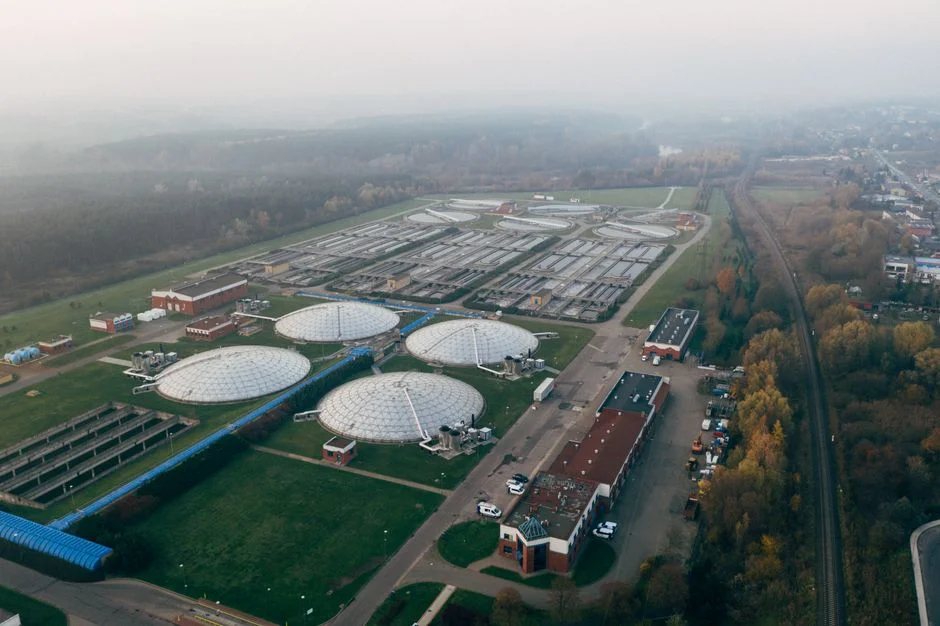
The full pretreatment train a Rainsville plant typically engineers around has five stages in series, each with a defined role. Stage 1 — Screening. A rotary mechanical bar screen removes rags, plastics, and large solids that would otherwise rag up downstream pumps and plug DAF nozzles; bar spacing is usually 3–6 mm for food lines. Stage 2 — Equalization. A basin sized to 1.5–2× peak CIP flow, with mechanical or jet mixing, dampens the pH and load swings that would otherwise pin the biology downstream; flow patterns during a washdown surge can be 3–5× the production average, and a system sized on averages will fail (Crystal Clean, 2025). Stage 3 — DAF. Bulk FOG and TSS reduction, with an automatic chemical dosing skid in front of it for coagulant/polymer conditioning.
Stage 4 — Biological. Either an MBR membrane bioreactor for plants that need reuse-quality polish on a tight footprint, or conventional activated sludge where land is available and reuse is not on the table. The MBR vs conventional tradeoff is detailed in the MBR vs conventional activated sludge comparison; the short version is that MBR delivers higher effluent quality at the cost of membrane replacement and aeration energy. Stage 5 — Sludge handling & polishing. A plate and frame filter press dewaters the DAF float and waste activated sludge to a 20–25% dry solids cake for off-site disposal, and a final pH trim stage holds the discharge inside the 6.0–9.0 window the POTW requires.
CAPEX and OPEX Framing for a Rainsville Pretreatment Retrofit
For a CAPEX defense memo, the most defensible framing is a flow-rate ratio rather than a full TCO model. Package DAF at the 10–100 m³/h scale typically runs in the low-to-mid five figures per m³/day of design flow; adding an MBR biological stage brings the installed cost to roughly 1.4–1.8× the DAF cost for a complete system (HydropureWater field data, 2026). OPEX is dominated by three line items: polymer and coagulant (which is exactly why the lamella's 30% chemical reduction is operationally meaningful), sludge-hauling cost per wet ton, and aeration power for the MBR or activated sludge basin.
For sludge alone, plate and frame dewatering cuts disposal volume by 75–80% versus lagooned float, which usually pays back the press inside 18–30 months at hauling rates typical of north Alabama. The alternative to building biological treatment is vacuum-truck offload of high-strength waste, which trades CAPEX for an ongoing per-gallon OPEX line and is most often used by smaller plants or as a temporary bridge during a retrofit (Crystal Clean, 2025). The financial risk of not pretreating is sized by ADEM's enforcement escalator: a first violation is typically a notice and fine, repeated violations add surcharges and increased monitoring, and a permit revocation can halt production (Crystal Clean, 2025). A Rainsville plant that frames CAPEX as "the cost of buying certainty against an ADEM and DeKalb County enforcement action" usually finds the internal hurdle rate is lower than the all-in OPEX of chronic surcharges.
Frequently Asked Questions
What 40 CFR subpart applies to a Rainsville-area poultry processor?
Poultry processors in Alabama fall under 40 CFR Part 432 (meat products), with 30-day average ceilings of 26 mg/L BOD₅ and 40 mg/L TSS for existing sources and strict FOG limits that drive the DAF selection (HydropureWater, 2025).
What pH window does the DeKalb County POTW typically enforce?
Most Alabama POTWs, including DeKalb County, enforce a pH 6.0–9.0 discharge window — outside that range, the wastewater can damage sewer infrastructure and disrupt the POTW's biological stage (Crystal Clean, 2025).
What is the smallest DAF flow rating a Rainsville plant should consider?
The industrial DAF system starts at 4 m³/h and spans 13 standard models up to 300 m³/h, covering any mid-size F&B plant in the 10–100 m³/h envelope (HydropureWater product catalog, 2026).
Who enforces pretreatment in the Rainsville area?
ADEM administers the state pretreatment program and NPDES delegation, and the DeKalb County sewer authority that serves Rainsville issues site-specific discharge permits with monitoring and reporting requirements that typically sit below the EPA categorical floor (Crystal Clean, 2025).