What an Effluent Treatment Plant in Leeds Must Achieve in 2026
An effluent treatment plant in Leeds in 2026 typically combines mechanical screening, DAF or lamella primary clarification, MBR or activated-sludge biological treatment, and a tertiary UF or RO polish to meet Yorkshire Water trade-effluent consent and EA permit limits. The site's job is to reduce a site-specific industrial wastewater stream to a quality that the receiving network or watercourse can absorb without breach.
Yorkshire Water operates the receiving Knostrop STW, which serves over 800,000 people and discharges treated effluent to the River Aire, then the Humber Estuary, then the North Sea (source: UtilityRadar, 2026). That single fact fixes the upstream discharge envelope any industrial ETP must respect: anything you send to sewer reaches Knostrop's biomass, and anything Knostrop cannot remove ends up in the Aire. UtilityRadar indexes 8 Yorkshire Water WwTWs in the Leeds area, with Barwick STW's 3,487 m³/day representing the largest single designed capacity in the index (source: UtilityRadar, 2026).
There are two consent pathways in 2026. The first is discharge to the Yorkshire Water sewer under a Trade Effluent Consent, which sets site-specific limits the industrial ETP must hit continuously. The second is discharge to surface water or off-site transfer under an EA Environmental Permitting Regulation (EPR) permit — the Leeds ultrafiltration facility at EPR/YP3832WS is a working precedent for the off-site option, treating up to 200,000 L/day of mixed industrial effluent to a 95% non-hazardous permeate (source: Oates Environmental, 2026). Choosing the pathway drives equipment selection, not the other way around.
Typical Leeds Industrial Influent Profiles and Consent Limits
Before sizing any unit operation, characterise the influent with 7-day composite samples taken across a full production week — single-shift grab samples consistently under- or over-state load. The bands below are the working envelopes most Leeds trade-effluent consents sit within; site-specific permits may tighten individual parameters to protect Knostrop's biomass.
| Parameter | Typical industrial influent band | Common consent ceiling |
|---|---|---|
| pH | 6–10 | 6–9 (typical consent window) |
| Temperature | ≤ 35 °C | ≤ 30–35 °C site-specific |
| COD | 250–5,000 mg/L | 500–1,000 mg/L |
| BOD | 150–2,000 mg/L | 300–500 mg/L |
| TSS | 100–1,000 mg/L | 200–400 mg/L |
| Oil & grease | ≤ 200 mg/L | ≤ 50 mg/L |
| Ammoniacal nitrogen | ≤ 100 mg/L | ≤ 25–50 mg/L |
| Heavy metals (Cu, Ni, Cr, Zn) | 1–10 mg/L each | 0.5–5 mg/L each (site-specific) |
| Sulphide, cyanide, phenols | Trace to low mg/L | Site-specific, often < 1 mg/L |
Yorkshire Water will typically impose additional site-specific limits on metals, phenols, cyanide, sulphide, and total toxicity where the receiving Knostrop catchment is sensitive. Textile and dyehouse wastewaters around the Aire Valley corridor are a common Leeds case where chemical dosing control — not extra tankage — drives compliance; the published methodology for textile ETP performance analysis found that poor chemical dosing, not inadequate hardware, was the dominant cause of consent failure (source: Khan et al., Chemical Engineering Research Bulletin 13(2), 2010, doi:10.3329/cerb.v13i2.3939). A four-parameter dose audit (coagulant, flocculant, pH corrector, biocide) on the existing plant usually beats a tankage retrofit on capex per mg/L removed.
Process Train Options for a Leeds Effluent Treatment Plant
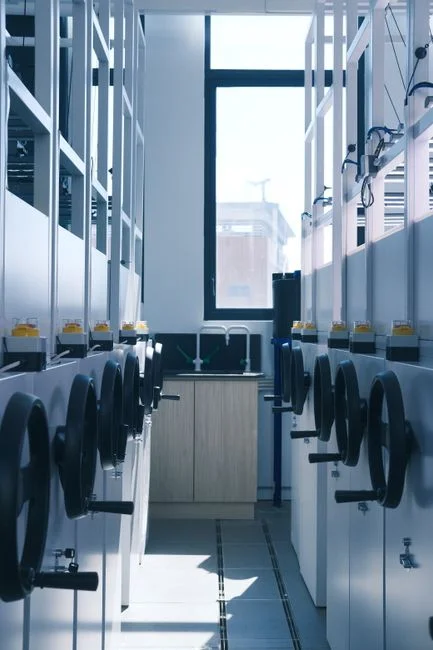
A 2026 Leeds industrial ETP is best understood as five sequential stages, each with a clear performance duty. Stages are added or dropped based on the consent ceiling and any reuse target, not on catalogue preference.
Stage 1 — Headworks. A rotary mechanical bar screen with 2–6 mm bar spacing removes gross solids; flow balancing smooths diurnal peaks before downstream units see a shock load; pH correction brings extreme inflows into the 6–9 band before they reach the biological stage. Skipping flow balancing is the most common reason a new Leeds ETP underperforms on day one.
Stage 2 — Primary clarification. A DAF system handles free oil, FOG, and colloidal TSS; surface loading on chemical and metalworking wastewaters typically sits between 5 and 25 m/h. Lamella clarifiers are the alternative where solids dominate over oil — the settled-sludge path suits mineral suspensions, while DAF suits emulsified streams.
Stage 3 — Biological treatment. A conventional activated-sludge package handles most general manufacturing loads at modest cost. An MBR membrane bioreactor (PVDF, 0.1 µm nominal pore) delivers a tighter effluent — typically TSS < 5 mg/L and BOD < 5 mg/L — and cuts the biological-stage footprint by roughly 60% compared with a settlement tank of equivalent duty (HydropureWater MBR field data, 2026). MBR also stabilises operation when the upstream load varies, which matters for Leeds sites with batch production.
Stage 4 — Tertiary polish. A PVDF ultrafiltration system (0.03 µm) provides reuse-grade TSS and bacteria removal for closed-loop recycling, cooling-tower makeup, or yard wash. Industrial RO is reserved for sites targeting potable-grade reuse or strict conductivity limits, with recoveries of 60–95% typical (HydropureWater RO field data, 2026). Direct nanofiltration is a credible polish where the consent ceiling is set by EU Water Framework Directive parameters rather than sewer discharge limits (source: Schrader, PhD thesis, University of Twente, doi:10.3990/1.9789036523325).
Stage 5 — Sludge handling. A plate and frame filter press or lamella thickener dewaters the wasted sludge to a handleable cake, closing the mass balance. For sites carrying pharmaceutical or trace organic loads, constructed-wetland or granular activated carbon polishing can be added downstream of the biological stage to target micropollutants (source: Lei, PhD thesis, Wageningen UR, doi:10.18174/575408).
Technology Comparison: Which Train Fits Your Leeds Site
Use the matrix below to shortlist two or three trains before going to market. The CAPEX and OPEX bands are 2026 planning envelopes for a UK industrial site — not quotations.
| Process train | Typical influent envelope | Achievable effluent | Footprint (relative) | CAPEX band | OPEX band | Reuse fit |
|---|---|---|---|---|---|---|
| DAF + activated sludge | COD < 2,000 mg/L, oil & grease < 200 mg/L | COD < 500 mg/L, TSS < 100 mg/L | Large | £ | £ | None |
| DAF + MBR | COD 1,000–5,000 mg/L, variable load | COD < 100 mg/L, TSS < 5 mg/L | Medium | ££ | ££ | Process water |
| MBR + UF | COD < 2,000 mg/L, low oil | TSS < 1 mg/L, NTU < 0.5 | Medium | ££ | ££ | Cooling / wash water |
| MBR + RO | COD < 1,000 mg/L after MBR | Conductivity < 50 µS/cm | Medium–large | £££ | £££ | Boiler feed / potable |
| UF only (off-site polish) | Pre-treated hazardous / non-hazardous | 95% non-hazardous permeate | Small (off-site) | Service contract | £ per m³ | None — off-site only |
For most general-manufacturing Leeds sites with a recycling target, a DAF + MBR + UF train is the 2026 default configuration. The Leeds ultrafiltration plant operating under EA permit EPR/YP3832WS — 200,000 L/day capacity, 95% non-hazardous permeate, 100% recyclability of input waste — is a real-world benchmark for treating mixed industrial effluent off-site when on-site capital is not justified (source: Oates Environmental, 2026). Reserve RO for sites with a strict conductivity, nitrate, or specific-ion limit; reserve nanofiltration for WFD-grade polish where the consent is set by EU water-quality parameters rather than sewer discharge limits (source: Schrader, 2026).
Permitting and Compliance in West Yorkshire: 2026 Pathway
Buying equipment before securing consent is the most expensive mistake a Leeds ETP project can make. Run consenting in parallel with engineering, not after it.
Step 1 — Pre-application. Site survey, full influent characterisation (7-day composite), and a sludge destination plan. Yorkshire Water and the EA will both ask where the waste activated sludge and any concentrate goes.
Step 2 — Trade Effluent Consent. Apply to Yorkshire Water with the characterisation data. The consent will name site-specific limits across flow, pH, temperature, COD/BOD, TSS, ammoniacal nitrogen, oil and grease, and the metals relevant to the site's process. Expect a 6–12 week determination for straightforward applications.
Step 3 — EA EPR permit. Required if the site discharges to surface water rather than sewer, or treats on-site hazardous waste above the EPR thresholds. The Leeds EPR/YP3832WS facility is a useful reference for the kind of waste types, monitoring, and 95% non-hazardous permeate benchmark a permit will name (source: Oates Environmental, 2026).
Step 4 — Commissioning and compliance. Define sampling frequency, on-line instrumentation (pH, conductivity, flow, turbidity), and a chain-of-custody for the composite sampler before the plant is signed off. Build the compliance reporting template into the same scope as the equipment order — retro-fitting it later is always more expensive.
Cost, Footprint and Reuse Economics for a 2026 Leeds ETP
Frame the budget as three flow bands, not as equipment line items. A 2026 planning envelope for an industrial effluent treatment plant in Leeds typically looks like this:
- 5–20 m³/h: £150k–£400k CAPEX, dominated by packaged MBR or DAF + activated-sludge skid.
- 20–100 m³/h: £500k–£2M CAPEX, typically DAF + MBR + UF, with civils roughly 25–35% of the total.
- 100–500 m³/h: £2M–£8M CAPEX, MBR + RO, with civils 30–40% of the total and a 12–18 month build.
OPEX is driven by energy, chemicals, and sludge. MBR aeration typically draws 0.3–0.6 kWh/m³ of treated flow; UF backwash water is 5–10% of throughput and should be returned to the headworks. Chemical dosing — coagulant, flocculant, pH corrector, biocide — is the variable line that benefits most from an automatic chemical dosing system, which typically cuts chemical consumption 15–25% versus manual dosing. Sludge haulage is the OPEX line most often under-estimated; price it on kg dry solids, not on volume.
Reuse economics change the OPEX profile materially. Pushing 60–95% recovery through an industrial RO system cuts incoming water and sewer discharge costs, but only if the site has a use for the permeate. Off-site treatment at the Leeds UF plant offers 100% recyclability as an upper-bound figure when on-site capex cannot be justified (source: Oates Environmental, 2026). For context, see our sludge treatment process guide for the dewatering chain that closes the mass balance, and our Effluent Treatment Plant in London: 2026 Buyer's Engineering Guide and Effluent Treatment Plant in Birmingham: 2026 Buyer's Engineering Guide for parallel consent and process economics in other English catchments. For the regulatory pressure driving consent tightening, see this Yorkshire Water sewage-discharge progress update (2026-09).
Frequently Asked Questions
Do I need a Trade Effluent Consent or an EA EPR permit for a Leeds site?
If you discharge to the Yorkshire Water sewer — the common route, since most Leeds industrial sites sit in the Knostrop catchment — you need a Trade Effluent Consent from Yorkshire Water. If you discharge to surface water or treat hazardous waste on-site above the EPR thresholds, you need an EA EPR permit. Many sites hold both: consent for the routine sewer discharge and an EPR permit for any on-site treatment of listed wastes.
What is the most common 2026 process train for a Leeds industrial ETP?
DAF + MBR + UF is the default configuration for general manufacturing with a process-water reuse target. It handles emulsified oils, variable COD, and metals, and produces an effluent clean enough for cooling-tower makeup or yard wash. RO is layered on only when a specific conductivity or ion limit applies.
How long does a Yorkshire Water Trade Effluent Consent take in 2026?
A straightforward application with complete influent characterisation typically takes 6–12 weeks to determine. Sites with metal finishing, pharmaceutical, or hazardous-waste streams should plan for 3–6 months, including pre-application dialogue with Yorkshire Water's trade-effluent team and, where relevant, EA pre-application for the EPR permit.
What CAPEX should I budget for a 50 m³/h Leeds ETP in 2026?
A DAF + MBR + UF train at 50 m³/h typically falls in the £1M–£1.8M CAPEX band as a 2026 planning envelope, with civils around 25–35% of the total. OPEX is dominated by energy (MBR aeration 0.3–0.6 kWh/m³) and sludge haulage; automatic chemical dosing usually cuts the dosing line 15–25%.