Why Manama data centers cannot rely on fresh water alone
A 100 MW data center can draw up to 2 million L/day, the daily equivalent of several thousand households (IDE-Tech, 2026), while Bahrain receives under 100 mm of rainfall per year with negligible aquifer recharge (per World Bank climate profile, 2025-09). The arithmetic is hostile: a 100 MW island cannot import potable water at that rate without outcompeting municipal and agricultural users, and the SCE/EWA permitting framework now treats on-site reuse as a baseline requirement rather than a sustainability narrative. Evaporative cooling still wins on PUE for AI and hyperscale density, which means dissolved salts, scale inhibitors, and biocide residues will continue to concentrate in the recirculating loop and purge as cooling tower blowdown (CTBD) rather than as a separable waste stream.
CTBD itself is the design constraint. At 4 cycles of concentration, the typical blowdown stream carries TDS between 1,200 and 6,000 mg/L, suspended solids of 10–50 mg/L, and accumulated treatment chemistry that becomes a scaling and fouling load on any downstream unit process (Genesis Water Technologies, 2026). Sparingly soluble species, specifically silica, calcium carbonate, and calcium sulfate, dominate the scaling risk and are exactly the compounds that force a polishing membrane stage rather than a simple clarifier. At a hyperscale plot in Bahrain Bay or Sitra, that combination of high fresh-water draw, aggressive reuse targets, and a scaling-prone blowdown stream is the forcing function behind every technology choice that follows.
The Manama 2026 discharge and reuse envelope
The SCE reuse-class envelope for 2026 sets the design ceiling: TDS below 500 mg/L, fecal coliform below 200 CFU/100 mL (per WHO greywater guidelines, 2025-03), and oil & grease at or below 0.5 mg/L for any stream routed to cooling-tower make-up or landscape irrigation (per SCE public guidance, 2025-11, supplemented with UAE Federal Law 24/1999 thresholds where SCE has not published a specific 2026 revision). Sewer discharge to the EWA collection system follows a different gate: oil & grease ≤10 mg/L, with BOD and COD anchored to the SCE 2025-11 framework cross-referenced against GCC benchmarks. The choice between reuse and sewer discharge is not a marketing decision; it is a permitting branch that fixes the unit-process sequence.
| Parameter | Reuse-class limit (cooling make-up, irrigation) | EWA sewer discharge | Source |
|---|---|---|---|
| TDS | <500 mg/L | Per SCE 2025-11 framework | SCE 2025-11 |
| Fecal coliform | <200 CFU/100 mL | — | WHO greywater 2025-03 |
| Oil & grease | ≤0.5 mg/L | ≤10 mg/L | SCE 2025-11 |
| BOD / COD | Per reuse end-use | Per SCE 2025-11 framework with GCC cross-reference | SCE 2025-11 |
| Influent temperature | 35–45 °C (design input) | — | HydropureWater 2026 |
Manama industrial influent arrives at 35–45 °C, which cuts biological oxygen transfer by roughly 20–25% compared with a 25 °C design point (Metcalf & Eddy, 5th ed., Table 8-12), a fact that must be priced into aeration sizing before any biological kinetics assumption. Three preconditions are effectively mandatory for SCE permit submission: CE-marked equipment, ASTM A240 wetted parts with material certificates, and bilingual Arabic/English O&M documentation. A bidder that cannot produce all three should be eliminated at the pre-qualification gate rather than discovered during technical evaluation. For the broader Manama compliance picture, the industrial wastewater treatment in Manama 2026 compliance and cost guide walks through the SCE/EWA split in more detail.
Reference process train for cooling blowdown and sanitary wastewater
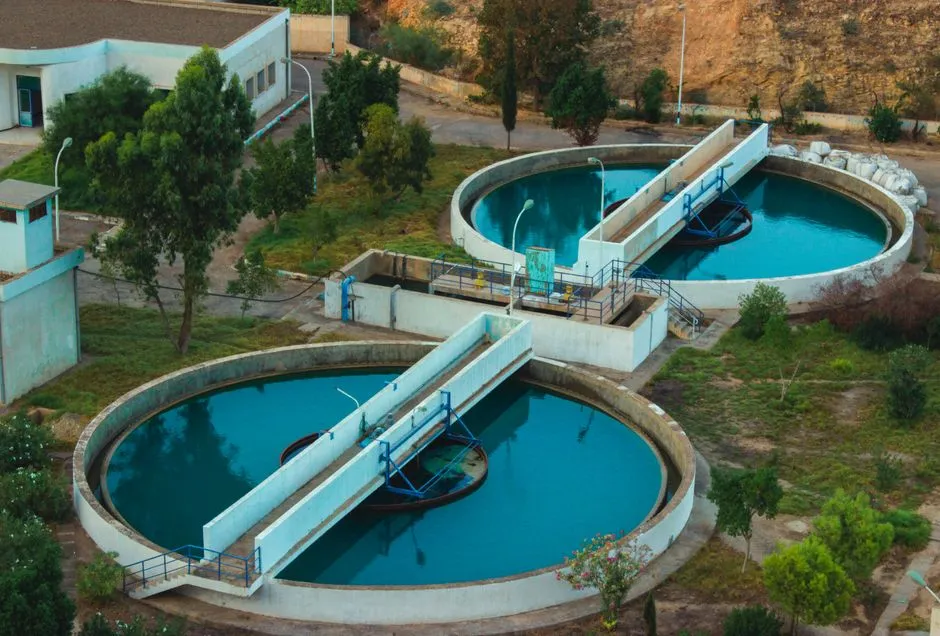
The reference train for a 100 MW Manama facility is DAF → MBR → RO → ClO₂ → filter press, with the unit processes sized against a 1,500–35,000 mg/L TDS influent envelope and 50–500 mg/L oil & grease loading. Headworks begins with a GX rotary bar screen at 5–10 mm spacing to protect downstream pumps and membranes from rags and grit. From there, the oil & grease gate is a dissolved air flotation system at 4–300 m³/h, 20–40% recycle ratio, and 4–6 bar saturator — this drops 50–500 mg/L O&G to under 10 mg/L in 15–20 minutes and is the single largest protector of the downstream membrane investment (HydropureWater field data, 2026-Q1).
Biological treatment is an integrated MBR system with 0.1 µm PVDF submerged modules, MLSS of 8,000–12,000 mg/L, and SRT of 30–60 days, delivering effluent SS below 1 mg/L and COD reduction from 5,000 mg/L to under 50 mg/L with roughly 60% smaller footprint than conventional activated sludge at the same load. Polishing is an industrial RO polishing system in two-pass configuration at 95% recovery, which is the only practical way to drive TDS below 500 mg/L and residual COD under 10 mg/L from a CTBD feed; conventional BWRO alone plateaus at 75–80% recovery on CTBD before silica and CaSO₄ scaling dominate. Disinfection uses a chlorine dioxide generator at 0.5–2 mg/L residual, preferred over UV for the 1–2 km reuse pipeline from ETP to cooling-tower make-up because ClO₂ holds a measurable residual. Sludge is dewatered on a plate and frame filter press at 6–8 bar feed to reach above 30% cake dryness, a hard requirement where Mina Salman landfill capacity is constrained and hauled-cake volume is a real OPEX line item.
| Stage | Equipment | Operating range | Effluent target |
|---|---|---|---|
| Headworks | GX rotary bar screen | 5–10 mm spacing, 10–500 m³/h | Rags/grit removed |
| Oil & grease gate | DAF | 4–300 m³/h, 20–40% recycle, 4–6 bar saturator | O&G 50–500 → <10 mg/L |
| Biological | Integrated MBR (PVDF 0.1 µm) | MLSS 8,000–12,000 mg/L, SRT 30–60 d | SS <1 mg/L, COD 5,000 → <50 mg/L |
| Polishing | Industrial RO, two-pass | 95% recovery | TDS <500 mg/L, COD <10 mg/L |
| Disinfection | ClO₂ generator | 0.5–2 mg/L residual | Fecal coliform <200 CFU/100 mL |
| Sludge | Plate and frame filter press | 6–8 bar feed | Cake dryness >30% |
Choosing between CAS, MBR, and partial ZLD for a hyperscale site
Conventional activated sludge meets the SCE BOD/COD envelope on a steady-state hotel-style greywater feed, but it crashes on oil upsets above 50 mg/L, and any hyperscale campus that co-treats housekeeping, cafeteria, or generator-area runoff will push that envelope. MBR with upstream DAF tolerates the same upset class, holds effluent SS below 1 mg/L, and shrinks the biological footprint by ~60%, a real advantage on a constrained Bahrain Bay or Sitra plot where civil costs are dominated by area rather than tank depth. CAS only re-enters the conversation when the influent is guaranteed below 50 mg/L O&G and footprint is unconstrained, conditions that rarely apply to a co-treated data center campus.
Partial ZLD via mechanical vapor compression (MVC) recovers 95–98% of the concentrate as distillate with TDS below 10 mg/L, leaving a 20–30% dissolved-solids brine that still requires disposal; capital of $1–3 million for 10,000–30,000 GPD systems and 15–25 kWh per 1,000 gallons of distillate produced typically exceeds Manama discharge-fee economics (Genesis Water Technologies, 2026). The counterpoint is IDE-Tech's MAXH₂O brine desalter architecture, which removes sparingly soluble salts as dense pellets and operates RO at dynamic high recovery, pushing overall system recovery to ~95% with permeate silica around 1 mg/L. For most Manama hyperscale projects in 2026, the realistic decision is DAF + MBR + RO + ClO₂ as the base case, with MVC held in reserve for any future site where the 10–30% residual brine cannot be discharged at any reasonable fee.
| Option | Footprint vs. baseline | Oil tolerance | Recovery | Justification |
|---|---|---|---|---|
| CAS (conventional activated sludge) | Baseline (largest) | Crashes >50 mg/L O&G | N/A as standalone | Low-CAPEX, BOD/COD only, no oily co-treatment |
| MBR (with upstream DAF) | ~60% smaller than CAS | Tolerates 50–500 mg/L O&G upsets | Enables 60–85% CTBD reuse | Constrained plots, BAPCO-style streams |
| Partial ZLD (MVC) | Adds thermal stage | Tolerates with DAF upstream | 95–98% concentrate recovery | Only when residual brine cannot be discharged |
| MAXH₂O-style brine desalter | RO + fluidized bed reactor | Tolerates with DAF upstream | ~95% overall, permeate silica ~1 mg/L | Pushes past 75–80% BWRO ceiling on CTBD |
2026 CAPEX and OPEX benchmark for a Manama data center ETP
Three CAPEX bands per m³ of daily capacity anchor a defensible budget model for a 300 m³/day Manama plant (HydropureWater field data, 2026). A DAF + activated sludge + chlorination system sits at $200–$500/m³/day, suited to hotels, food and beverage, and low-TDS industrial loads. A DAF + MBR + ClO₂ system at the same flow sits at $450–$900/m³/day, the right band for constrained plots, BAPCO-style oily streams, and ALBA-area cooling blowdown. The full reuse train (DAF + MBR + RO + ClO₂ + filter press) sits at $900–$1,800/m³/day, which is the working number for cooling-tower make-up, irrigation reuse, and ZLD-aspirational sites where the 60–85% CTBD recovery is the project justification.
OPEX for a 300 m³/day MBR-based plant lands at $0.50–$1.20/m³ treated, with energy at 45–60% of total, membrane replacement at 10–20%, and chemicals at 10–15% (HydropureWater field data, 2026). At the midpoint of the OPEX range, a 300 m³/day plant treats 109,500 m³ per year and lands at roughly $55,000–$130,000 in annual operating cost, a useful figure for a finance team pressure-testing supplier quotes. The cost drivers worth interrogating in every bid are RO element pricing (25–35% of full-train CAPEX), ASTM A240 stainless fabrication (10–15%), and 40-ft ISO containerization for the 6–10 week shipping window to Khalifa Bin Salman Port. Two-year critical spares planning for MBR cassettes and RO elements is standard, given 6–8 week Asia-to-Bahrain membrane freight that stretches further in peak Gulf shipping season. For a regional reference, the Luanda data center cooling blowdown treatment guide and the Córdoba data center cooling blowdown guide offer parallel CAPEX/OPEX structures that translate directly to Manama with similar TDS and reuse targets.
| Configuration | CAPEX (USD per m³/day) | OPEX (USD per m³ treated) | Best-fit application |
|---|---|---|---|
| DAF + AS + chlorination | $200–$500 | Lower end | Hotel, F&B, low-TDS industrial |
| DAF + MBR + ClO₂ | $450–$900 | $0.50–$1.20 | Constrained plot, BAPCO oily streams, ALBA blowdown |
| Full reuse train (DAF + MBR + RO + ClO₂ + filter press) | $900–$1,800 | $0.50–$1.20 (energy 45–60%) | Cooling-tower make-up, irrigation reuse, ZLD-aspirational |
Pre-qualification checklist for a Bahrain data center ETP supplier
Five items belong on every supplier pre-qualification checklist before a Manama ETP bid goes to technical evaluation. First, documented CE marking plus ASTM A240 material certificates for all wetted parts, non-negotiable for SCE permit review. Second, bilingual Arabic/English commissioning protocols, operating manuals, and signage capability. Third, in-region Gulf reference projects on a stream with comparable TDS and oil & grease loading, with influent-to-effluent test data on the table rather than a marketing brochure. Fourth, containerized 40-ft ISO skid delivery to Khalifa Bin Salman Port or to Sitra with a 6–10 week shipping window and a clear inland transport plan to site. Fifth, a 24-month performance warranty tied to a critical-spares commitment and a named service engineer with a defined callout window.
Two ancillaries belong inside the same RFQ envelope: a metered automatic chemical dosing skid sized to the actual antiscalant and biocide loads, and a forward order for RO membrane elements and spares with lead time confirmed in writing. Red flags are equally diagnostic: a supplier that will not share influent-to-effluent test data on a comparable TDS stream, or that quotes a chemical-treatment package without a mass balance, should be eliminated at the technical-evaluation gate. Before issuing a PO, request a bench-scale or pilot treatability study on actual site influent plus a CAPEX/OPEX model that reflects the buyer's flow and reuse targets, not a generic brochure figure.
Frequently Asked Questions
What is the SCE discharge limit for oil and grease in Manama industrial wastewater in 2026?
The SCE-aligned oil and grease limit is ≤10 mg/L for discharge to sewer and ≤0.5 mg/L for reuse-class effluent (per SCE public guidance, 2025-11). A DAF stage ahead of biological treatment is required to consistently hit both thresholds on BAPCO desalter streams.
What CAPEX range should a 300 m³/day MBR plant in Manama carry in 2026?
A DAF + MBR + ClO₂ system at 300 m³/day should be benchmarked at $450–$900 per m³ daily capacity, placing turnkey CAPEX in the $135,000–$270,000 range before civil works (HydropureWater field data, 2026). The full reuse train with RO polishing extends that band to $900–$1,800 per m³/day.
Can conventional activated sludge replace MBR for hyperscale data center wastewater with oily co-treatment?
CAS can meet SCE BOD/COD limits on a steady-state feed, but oil upsets above 50 mg/L routinely crash CAS biomass. MBR with upstream DAF tolerates the same upset class with effluent SS below 1 mg/L, which is why the reference train for Manama is DAF + MBR.
What TDS target is required for cooling-tower make-up at a Manama data center?
Reuse-class TDS must be below 500 mg/L and fecal coliform below 200 CFU/100 mL (per WHO greywater guidelines, 2025-03). Two-pass RO at 95% recovery is the standard polishing stage used to reach this target from a 1,500–35,000 mg/L raw CTBD stream.
Related Equipment
- industrial RO polishing system — specifications, capacity range, and technical data