
Start with the Real Sewage Flow, Not the Brochure Number
Design sewage flow for a 3-5 star hotel in Kigali runs 180-250 litres per guest per day, with the upper end of that range applying to properties that include restaurants, pools and laundry on-site (HydropureWater field data, 2026). Add staff load at 40-60 L per staff shift and laundry at 50-80 L per room serviced, and the daily flow climbs fast — supplier brochures that quote a "per-room" figure almost always miss this back-of-house contribution. A defensible peak design flow then applies a 1.2-1.5× peaking factor to absorb Kigali's tourism-season occupancy surges and meal-time peak loads.
Worked example for a 150-key property: 150 rooms × 200 L = 30 m³/day guest sewage; adding 25% for back-of-house, restaurant and laundry brings the average to ~38 m³/day. With a 1.3× peaking factor, the design flow to specify is ~50 m³/day. By comparison, an installed 200-bed 5-star reference in a regional hospitality market was sized at 250 m³/day (imemflo, commercial reference) — useful as a sanity check for larger properties. Suppliers will quote capacity interchangeably as KLD (kilolitres per day) or m³/day; they are identical, and 1 KLD = 1 m³/day. Lock the design flow into the enquiry so every supplier prices the same envelope.
Rwanda Compliance Gates the Plant Must Clear
The plant must satisfy four sequential compliance gates before it can legally discharge in Rwanda: Rwanda Standards Board (RSB) effluent quality, Rwanda Environment Management Authority (REMA) reuse thresholds where applicable, City of Kigali inspection, and a documented operating logbook at handover. RSB discharge limits to surface water are BOD ≤30 mg/L, TSS ≤30 mg/L, COD ≤80 mg/L, faecal coliform ≤10 CFU/100 mL, pH 6-9 (per RSB RS EAS 12:2018 referenced in REMA guidance). REMA reuse thresholds are tighter — BOD <10 mg/L and turbidity <5 NTU — and apply the moment treated water feeds toilet flushing, landscape irrigation or cooling towers. Kigali city inspectors require an on-site effluent test report and the operating logbook before sign-off; MBR permeate clears RSB discharge limits on BOD and TSS routinely, and BOD <5 mg/L with near-zero TSS is achievable as a permeate baseline (per studiomatrx, 2026). For any reuse path, MBR permeate alone is not enough — disinfection is non-optional and RO is required for guest-contact reuse. The WHO 2006 Guidelines for the Safe Use of Wastewater, Excreta and Greywater remain the reference framework for hospitality reuse risk assessment even where not legally binding in Rwanda.
| Parameter | RSB discharge limit | REMA reuse threshold | Typical MBR permeate |
|---|---|---|---|
| BOD | ≤30 mg/L | <10 mg/L | <5 mg/L |
| TSS | ≤30 mg/L | — | Near-zero |
| COD | ≤80 mg/L | — | <30 mg/L |
| Faecal coliform | ≤10 CFU/100 mL | — | <10 CFU/100 mL with disinfection |
| Turbidity | — | <5 NTU | <1 NTU |
| pH | 6-9 | 6-9 | 6.5-7.5 |
Anatomy of a Packaged MBR Built for a Hotel
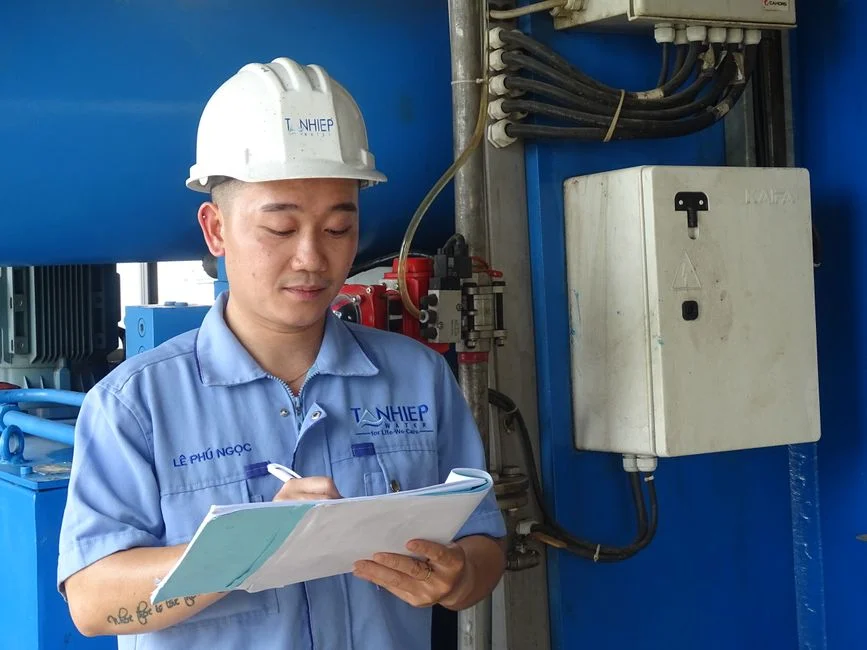
A packaged MBR sewage treatment plant is a skid-mounted, containerised train of five stages: bar screening to ~1 mm → grit and FOG removal → flow equalisation → anoxic/aerobic bioreactor → submerged MBR cassette → UV or chlorine disinfection. The membrane module is the heart of the system — submerged PVDF membranes at 0.1 µm pore size act as an absolute physical barrier, replacing the secondary clarifier that conventional activated sludge plants rely on. For a 30-100 m³/day Kigali hotel, the DF series cassette in an 80-225 m² configuration produces 32-135 m³/day per cassette (HydropureWater DF module datasheet, 2026), which lets the specifier right-size the membrane area without oversizing the skid.
The bioreactor runs at 8,000-12,000 mg/L MLSS — two to three times denser than a conventional activated sludge plant at 3,000-4,000 mg/L — which shrinks reactor volume and overall footprint by 40-60% versus an equivalent ASP or SBR. The effluent is near-reuse-grade and a clean, low-SDI feed to RO for hotels targeting full recycling. A reader should expect the quotation to list: PLC control panel, level probes, DO probe, TMP trending, automated backwash, and a CIP (clean-in-place) skid. If any of those six items are missing or described as "optional," ask why — each one protects either the membranes or the operator's ability to keep them clean. A packaged MBR wastewater treatment system integrates all five stages on a single skid frame for fast Kigali delivery and commissioning, while a DF series flat-sheet MBR module can be specified for retrofit into an existing bioreactor where civil tanks are already in place.
Hollow-Fibre vs Flat-Sheet: Which Membrane for a Kigali Hotel
Membrane choice for a hotel MBR is between hollow-fibre (HF) at ~0.04 µm pore and flat-sheet (FS) at 0.1 µm pore. HF packs more membrane area per cubic metre of cassette and is the established choice for ≥100 m³/day stable-load hotels — the imemflo 200-bed 5-star reference at 250 m³/day uses HF. FS modules integrate an aeration box beneath the panel that continuously scours the membrane surface, making them more tolerant of intermittent operation, hair and fibre fouling, and rougher influent — which is exactly the duty cycle of a 30 m³/day boutique property with seasonal occupancy. The DF series flat-sheet module draws 10-20× less air-scour energy than external cross-flow designs (HydropureWater DF datasheet, 2026), a material difference on Kigali sites where the diesel-grid tariff can swing power cost by 30-50%.
| Decision axis | Hollow-fibre (HF) | Flat-sheet (FS) |
|---|---|---|
| Pore size | ~0.04 µm | 0.1 µm |
| Footprint per m³/day | Smaller at high load | Comparable at low load |
| Replacement cycle | 7-10 years | 7-10 years |
| Operator skill for CIP | Higher (delicate fibres) | Lower (rigid panel) |
| Tolerance to hair/fibre fouling | Lower | Higher |
| Best-fit Kigali hotel | ≥100 m³/day, year-round load | ≤50 m³/day, seasonal occupancy |
Pretreatment is Non-Negotiable: What to Put in Front of the MBR
MBR membranes fail most often because pretreatment was undersized, not because the membranes themselves were bad. Specify a fine bar screen to 1-2 mm — a rotary mechanical bar screen is the standard for this duty and is sized to the package plant's peak flow. Add a dissolved air flotation system or automatic grease trap for oil and grease; laundry effluent and kitchen waste are the dominant FOG sources in hotels and a single grease slug can blind a cassette in 48 hours. The equalisation tank should hold 25-40% of daily flow to absorb meal-time and laundry surges that would otherwise spike the bioreactor beyond its design F/M ratio. The operational rule: a single rag reaching the membrane can cost a year of CIP chemicals — the pretreatment envelope is cheaper than the consequence. For broader maintenance planning across the plant, the industrial wastewater equipment maintenance protocols guide sets out the inspection cadence that protects membrane life.
Lifecycle Cost You Can Defend to a Hotel Owner
Capex for a packaged MBR at 30-50 m³/day is typically 1.6-2.2× the cost of an equivalent MBBR or SBR skid; that premium is the cost of the membrane cassettes, the CIP skid and the higher-grade controls. Opex is dominated by power — MBR is the most energy-hungry of the common STP technologies because continuous air scouring runs on top of biological aeration, and on a Kigali diesel-backed site that line item moves with the tariff. The single largest scheduled cost is membrane replacement every 7-10 years; build it into the financial model from day one rather than treating it as a surprise at year eight. Quantify the reuse dividend against that lifecycle: offsetting 30-50% of municipal water by reusing MBR permeate for toilet flushing and landscaping typically delivers a 4-6 year payback on the MBR premium, and the MBR's 90-95% removal of harmful substances (imemflo) makes the reuse water safe enough for guest-facing non-potable applications. The same lifecycle logic applies across packaged plant geographies; a packaged wastewater treatment plant specification framework walks through comparable capex/opex lines for the UK market, and the MBR system engineering guide for tropical hospitality markets benchmarks ROI data in a similar hospitality context.
Selecting a Packaged MBR Supplier: Eight Checks Before You Sign
Convert the technical discussion into a procurement scorecard before issuing the enquiry. Require a reference list with at least one hotel installation of similar capacity and ask for operating data — effluent test reports, TMP logs, CIP records — not marketing photos. Demand membrane OEM transparency: the supplier should name the membrane brand (HydropureWater, Suez, Toray, Mitsubishi, DuPont) rather than hide it, and back it with a 3-5 year pro-rata membrane warranty and a 10+ year warranty on the skid structure. Confirm a local service footprint in East Africa or a Kigali-based commissioning partner — a supplier that cannot be on site within 72 hours is a liability when a cassette fails. Specify a PLC with remote telemetry, not just a local HMI, so the property does not need a full-time plant operator. Require a documented CIP procedure and chemical kit supplied at commissioning, plus a 24-month spare parts package (cassette O-rings, blower spares, DO probe). Finally, ask for a compliance documentation pack ready for REMA submission — the supplier who delivers this pre-formatted saves the consultant a week of formatting work.
Frequently Asked Questions
What size packaged MBR does a 100-room Kigali hotel need?
Plan for 30-50 m³/day at average load, using the 180-250 L per guest per day rule plus back-of-house and laundry. Apply a 1.2-1.5× peaking factor, which puts design flow at roughly 40-65 m³/day for a 100-key 3-5 star property.
What are the REMA discharge limits for hotel wastewater in Rwanda?
RSB discharge limits require BOD ≤30 mg/L, TSS ≤30 mg/L, COD ≤80 mg/L, faecal coliform ≤10 CFU/100
Frequently Asked Questions
How do I size a packaged MBR STP for a hotel in Kigali?
Sizing is determined by the total peak design occupancy multiplied by the average daily water consumption per guest, typically ranging from 150 to 250 liters per person per day for luxury hotels. You must also account for laundry, kitchen, and landscaping loads, applying a peak factor of 1.2 to 1.5 to ensure the system handles high-flow periods during morning and evening hours.
What are the REMA effluent standards for hotels in Rwanda?
The Rwanda Environment Management Authority (REMA) mandates that treated effluent must meet specific discharge limits, including a Biological Oxygen Demand (BOD5) of less than 30 mg/L, Chemical Oxygen Demand (COD) below 100 mg/L, and Total Suspended Solids (TSS) under 30 mg/L. Furthermore, for direct discharge into sensitive water bodies or for irrigation, fecal coliform levels should be maintained below 100 MPN/100ml.
Should I choose hollow-fibre or flat-sheet MBR membranes for a small hotel?
For small hotel applications, flat-sheet membranes are generally preferred due to their superior resistance to fouling from high-strength hotel wastewater and their ability to operate with simpler maintenance protocols. While hollow-fibre membranes offer a higher surface area-to-volume ratio, they are more susceptible to clogging from hair and debris common in hotel greywater, requiring more rigorous pre-screening systems.
Can MBR treated water from a hotel be reused for toilet flushing without RO?
Yes, MBR permeate is generally of sufficient quality for toilet flushing and non-potable reuse without the need for Reverse Osmosis. Because MBR technology provides a physical barrier with pore sizes typically between 0.03 and 0.4 microns, it effectively removes bacteria and suspended solids, provided the system includes a secondary disinfection stage—such as UV sterilization or chlorine dosing—to ensure residual protection in the distribution piping.
How often do MBR membranes need to be replaced and what does it cost?
Under optimal operating conditions with regular chemical clean-in-place (CIP) cycles, MBR membranes typically have a service life of 5 to 8 years. Replacement costs vary based on the manufacturer and the specific membrane surface area, but operators should budget approximately 15% to 25% of the initial STP capital expenditure for a full membrane module replacement, factoring in logistics and specialized labor costs for installation in Rwanda.