Why Batesville Food and Beverage Plants Need a Smarter Primary Separator
Batesville sits inside the Indiana–Ohio–Kentucky food manufacturing corridor, where dairy, meat processing, frozen-baked-goods, and beverage plants discharge wastewater that consistently overwhelms a traditional clarifier. Typical food streams carry 1,000–5,000 mg/L BOD, 500–4,000 mg/L TSS, and 200–1,500 mg/L FOG (per industry wastewater characterization compiled in McIlvaine's food industry tracking, 2017-08), and the colloidal, emulsified fraction of that load is exactly what a gravity clarifier removes slowly and inefficiently. Federal effluent guidelines for the two dominant subcategories here — 40 CFR 405 for dairy products and 40 CFR 432 for meat and poultry products — set categorical limits that Indiana DEM enforces through delegated NPDES permits, and FOG/BOD excursions are the most common cause of noncompliance in this corridor. With IDEM tightening local limits and corporate sustainability teams pushing toward water reuse, choosing the wrong primary separator in 2026 means a guaranteed retrofit within 3–5 years. The realistic decision for most Batesville plants is a DAF system for FOG and TSS knockdown, a lamella clarifier as a polisher or low-FOG alternative, or a DAF-plus-lamella hybrid that captures the strengths of each.
How a DAF and a Clarifier Actually Treat Food Wastewater
A dissolved air flotation system works by pressurizing a side stream of clarified effluent to 60–90 psig in a saturator, then releasing that stream through needle valves into the main flotation cell, where the pressure drop nucleates a cloud of 20–50 µm microbubbles (dafcorp.com; clearwaterind.com, 2026-04). Those bubbles attach to oil droplets and flocculated solids, lowering the bulk density of the particle-bubble aggregate so it rises to the surface in 10–30 minutes, where a paddle skimmer sweeps the float into a sludge hopper. The DAF family covers 4–300 m³/h across 13 models, with documented duty on food processing, dairy, and brewery streams (HydropureWater product data, 2026).
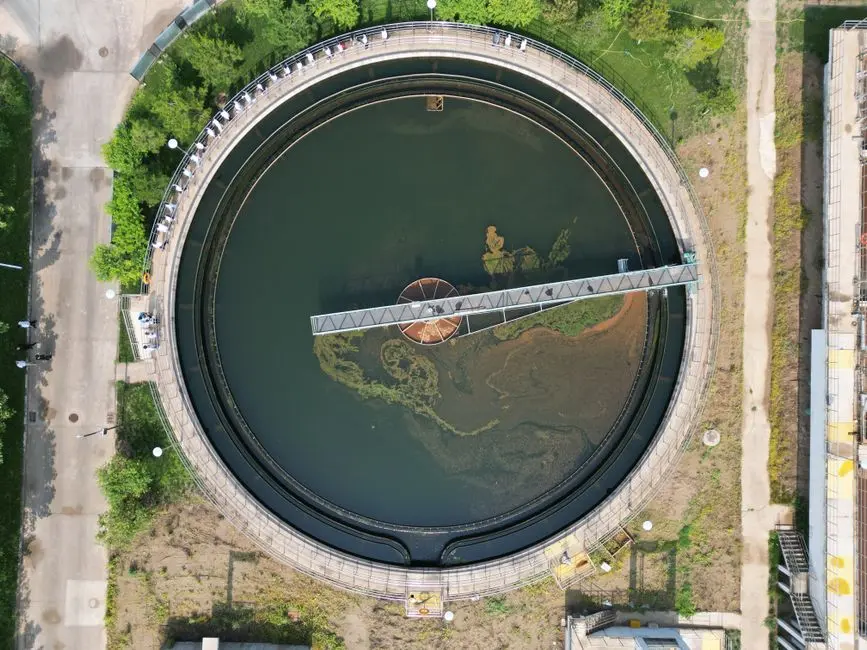
A clarifier — including a HydropureWater lamella clarifier — relies on gravity settling of suspended solids in a sludge blanket or between inclined plates spaced at 50–60°, compressing footprint by 5–10× versus a conventional clarifier at surface loadings of 20–40 m/h. FOG and light colloids do not settle efficiently in a clarifier: oils form a thin scum layer that escapes over the effluent weir, and emulsified or sub-100 µm droplets simply ride the overflow. That is the central physical reason a clarifier alone fails in a meat or dairy plant. Both technologies almost always require upstream coagulant and flocculant chemistry; the standard front-end pairing is a automatic chemical dosing system sized to the hydraulic load and solids flux.
DAF vs Clarifier: 2026 Performance and Operating Comparison
Food-plant engineers should size equipment from the table below, not from generic vendor curves. DAF Corp's published FC Maximizer data gives 92–98% TSS removal and thickened sludge at 2–4% consistency (dafcorp.com), while SigmaDAF reports 30–50 µm microbubbles and standard 304SS construction (clearwaterind.com, 2026-04). HydropureWater's lamella clarifier is rated at 20–40 m/h surface loading and up to 30% lower polymer demand than a conventional clarifier (HydropureWater product data, 2026).
| Parameter | DAF (HydropureWater / FC Maximizer class) | Lamella Clarifier |
|---|---|---|
| TSS removal | 85–98% (dafcorp.com) | 50–80% (HydropureWater product data, 2026) |
| FOG removal | 70–95% (HydropureWater field data, 2026) | <30% without upstream DAF |
| BOD reduction | 60–85% | 30–55% |
| Hydraulic retention time | 10–30 min | 1–3 h |
| Footprint (m² per 10 m³/h) | 3–6 | 5–10 (conventional); 1.5–3 (lamella) |
| Surface loading | 5–25 m/h equivalent | 20–40 m/h (HydropureWater product data, 2026) |
| Key geometry | 20–50 µm microbubbles (dafcorp.com; clearwaterind.com, 2026-04) | 50–60° inclined plates, 50–80 mm spacing |
| Sludge dryness | 2–4% dry solids (dafcorp.com) | <1% dry solids |
| Polymer demand | 5–15 mg/L typical | 3–10 mg/L (up to 30% lower than conventional, per HydropureWater product data, 2026) |
| FOG tolerance | Up to 1,500+ mg/L influent | Fails above ~100 mg/L FOG |
The two largest drivers of DAF performance variability on a food line are microbubble size distribution and flocculation chemistry: a generator holding 20–40 µm with no coarse bubbles (dafcorp.com) plus a matched automatic chemical dosing system is the difference between 95% and 75% TSS removal on the same influent. A lamella clarifier's FOG removal tops out under 30% without a preceding DAF or equivalent — and that is the single biggest reason the hybrid DAF-plus-lamella architecture has become the 2026 default for meat and dairy plants across Indiana.
Matching the Right Separator to Your Food or Beverage Stream
Stream composition should drive the technology choice, not vendor preference. Meat and poultry processors face 40 CFR 432 categorical limits on FOG, BOD, and TSS, and the influent FOG of 500–1,500 mg/L is incompatible with clarifier-only operation; DAF is required, with a lamella polish optional where discharge TSS limits drop below ~30 mg/L. Dairy plants under 40 CFR 405 see similar FOG and BOD strength from cheese whey, fluid milk spills, and CIP chemistry, and a DAF front-end with optional lamella polish is the standard 2026 specification. Brewery and distillery duty is split: spent-yeast and FOG streams respond well to DAF, while a polishing clarifier or MBR is often added before reuse — see the DAF system brewery wastewater cost guide and the DAF configuration for brewery spent yeast water articles for the sizing logic. Snack, frozen, and baked-goods plants typically run a DAF primary with a clarifier as a backup polishing step. Fruit and vegetable wash water with low FOG and high TSS is the one stream where a lamella clarifier alone often hits IDEM limits at lower CAPEX and simpler operation than a DAF.
| Stream Type | Regulatory Driver | Primary Separator | Polish Step |
|---|---|---|---|
| Meat & poultry processing | 40 CFR 432 | DAF required | Lamella or MBR if <30 mg/L TSS needed |
| Dairy (fluid milk, cheese, ice cream) | 40 CFR 405 | DAF required | Lamella polish common |
| Brewery / distillery / spirits | IDEM NPDES | DAF for yeast & FOG | Clarifier or MBR for reuse |
| Snack / frozen / baked goods | IDEM NPDES | DAF primary | Clarifier as backup |
| Fruit & vegetable wash | IDEM NPDES | Lamella clarifier often sufficient | DAF only if wash chemicals create FOG |
2026 CAPEX, OPEX, and ROI for Batesville Plants
North American food-industry water treatment CAPEX is a sustained, multi-billion-dollar category, and Batesville plants sit inside the U.S. cluster that drives that spend — McIlvaine tracked seven of the global top ten food manufacturers as U.S.-based and projected food-industry IIoT and Remote O&M spend rising from $9B in 2016 to $56B by 2030 at a 13% CAGR (McIlvaine, 2017-08). For 2026 equipment decisions, a packaged DAF typically falls in the $25,000–$90,000 per 10 m³/h range as a stainless, skidded, PLC-controlled unit, while a lamella clarifier of the same hydraulic capacity runs 20–40% lower in bare CAPEX; stainless construction, automated skimming, and integrated chemical packages can swing pricing 30–60% either way (HydropureWater field data, 2026). The OPEX story is where DAF pulls ahead: polymer at 5–15 mg/L, a saturated-air pump at 3–7 kW per 10 m³/h, and sludge hauling tied to DAF's 2–4% thickened sludge versus clarifier sludge at <1% that requires downstream dewatering through a plate and frame filter press before haul-off.
| Cost Driver | DAF (10 m³/h) | Lamella Clarifier (10 m³/h) |
|---|---|---|
| Packaged CAPEX (304SS, skid, PLC) | $25,000–$90,000 | $18,000–$65,000 |
| Polymer consumption | 5–15 mg/L | 3–10 mg/L (up to 30% lower, per HydropureWater product data, 2026) |
| Saturated-air pump energy | 3–7 kW | None |
| Sludge dryness off the unit | 2–4% (dafcorp.com) | <1% |
| Downstream dewatering load | Often direct to haul | Plate and frame filter press typically required |
| Typical payback driver | Avoided FOG surcharge, avoided NPDES excursion, lower hauling | Lower CAPEX, simpler operation |
A simple 2026 payback frame: a DAF CAPEX premium of $20,000–$40,000 over a clarifier is typically recovered in 12–30 months through avoided FOG surcharges on the IDEM permit, avoided NPDES excursion penalties, and reduced biosolids hauling volume from 2–4% thickened sludge versus <1% clarifier underflow (HydropureWater field data, 2026).
Three-Question Vendor Checklist Before You Buy
Procurement should walk into any 2026 DAF or clarifier bid carrying exactly three questions, because sticker price is the least reliable signal on a food line. First, ask for documented FOG and TSS removal on a wastewater sample from your plant — jar tests or a 30-day pilot, not generic curves from a catalog. Second, ask for guaranteed microbubble size distribution (target 20–50 µm) and the air-to-solids ratio at design loading, drawing on the dafcorp.com and clearwaterind.com (2026-04) specifications, because a generator drifting above 60 µm collapses removal efficiency. Third, ask for full skid scope — chemical conditioning package, PLC with trending, and sludge discharge matched to your downstream dewatering, typically a plate and frame filter press sized to the DAF's 2–4% sludge or the clarifier's <1% underflow. Insist on remote monitoring or IIoT hooks in the control architecture; the McIlvaine 2017-08 forecast for food-industry IIoT and Remote O&M rising from $9B to $56B by 2030 is now visible in plant-level expectations, and any vendor without a roadmap here is a risk to your 5-year automation plan. For a deeper look at the control layer, see the guide to SCADA systems for industrial wastewater treatment plants.
Frequently Asked Questions
Is a DAF or clarifier better for a meat or dairy plant in Batesville, Indiana?
A DAF system is the correct primary separator for meat and dairy plants subject to 40 CFR 432 and 40 CFR 405 categorical limits, because influent FOG of 200–1,500 mg/L and colloidal solids overload any clarifier above ~100 mg/L FOG. A DAF typically achieves 85–98% TSS and 70–95% FOG removal in 10–30 minutes, which a lamella clarifier cannot approach for FOG alone.
When does a lamella clarifier make sense as the primary separator in a food plant?
A lamella clarifier is the right choice when influent FOG stays consistently below ~100 mg/L — for example, fruit and vegetable wash water with low oil and high TSS — or when the clarifier is used as a polish step behind a DAF. At 20–40 m/h surface loading, a lamella clarifier hits discharge TSS limits at lower CAPEX and simpler operation than a DAF in those low-FOG streams.
What is the typical 2026 payback for choosing DAF over a clarifier at a Batesville food plant?
A DAF CAPEX premium of $20,000–$40,000 over a clarifier at 10 m³/h is typically recovered in 12–30 months through avoided FOG surcharges on the IDEM NPDES permit, avoided excursion penalties, and 50–75% lower biosolids hauling volume from DAF's 2–4% thickened sludge versus clarifier underflow under 1% (HydropureWater field data, 2026).
What regulatory limits drive the DAF choice in Batesville food plants?
Federal categorical limits under 40 CFR 405 for dairy products and 40 CFR 432 for meat and poultry products are enforced in Indiana through delegated IDEM NPDES permits. Both subcategories set FOG, BOD, and TSS limits that a clarifier alone cannot reliably meet on raw food-plant influent, which is the regulatory driver behind the DAF-first specification across the Indiana food corridor.