
SCADA for wastewater plants is an industrial control architecture that monitors field sensors, aggregates process data, and issues supervisory commands to pumps, valves, blowers, and chemical feeders. In an industrial plant it typically covers screening, equalization, biological treatment, clarification, filtration, disinfection, and sludge handling. Operators use the system to hold setpoints, document effluent quality, and intervene when process or equipment limits are approached.
What is SCADA for wastewater plants?
SCADA for industrial wastewater treatment collects real-time sensor data and issues supervisory commands to pumps, valves, and chemical feeders. Operators track pH, flow, dissolved oxygen, COD, and TSS on a central HMI. Local PLCs or RTUs run fast control loops while the supervisory layer logs history, manages alarms, and enables secure remote access.
Unlike a single-line manufacturing controller, a plant-wide SCADA spans the full treatment train and often remote pumping or monitoring points. Core measured variables commonly include pH, flow rate in m3/h (US gpm), dissolved oxygen in mg/L, COD, and TSS. Control actions include start/stop of pumps, valve modulation, and chemical feed rate changes when influent load or effluent quality shifts.
Key Components of a SCADA System for Wastewater Plants
A wastewater SCADA architecture links field devices, controllers, networks, and supervisory servers so operators can see and adjust the process from one place.
HMI (Human-Machine Interface)
The Human-Machine Interface presents plant schematics, equipment status, live tags, trends, and alarm lists on operator screens. Typical displays show pH, dissolved oxygen, and flow alongside pump and valve status. Operators acknowledge alarms and change setpoints or modes through the same screens, which shortens response time when a basin or dosing skid drifts off target.
RTUs (Remote Terminal Units) and PLCs (Programmable Logic Controllers)
PLCs and RTUs sit at the process edge and execute local control logic against sensors and actuators. PLCs usually handle deterministic loops on a reactor, filter skid, or dosing package, reading pressure, level, and analytical signals and driving motor starters or valves. RTUs are common on remote lift stations or influent monitors where longer-distance links and harsher sites matter. Both convert analog and digital field signals into data for the supervisory system and convert supervisory commands into electrical outputs.
Communication Infrastructure
Communication links carry tag data and commands between controllers and supervisory hosts across the plant and to remote assets. Wired Ethernet and fiber are typical on site for bandwidth and noise immunity; industrial wireless or cellular may serve distant pumps. Interoperability often relies on Modbus TCP/IP, OPC UA, DNP3, or EtherNet/IP so mixed vendor equipment can share the same SCADA network.
Supervisory Computers/Servers
Supervisory servers run the SCADA application, poll or receive data from PLCs and RTUs, process alarms, and store historians. They also host HMI clients, reporting tools, and backup services used for shift decisions and longer performance reviews. Without this layer, local controllers still run loops, but plant-wide visibility and audit trails are limited.
Benefits of SCADA in Industrial Wastewater Operations
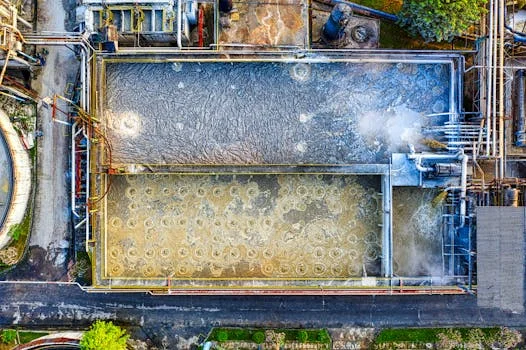
Plant teams adopt SCADA to tighten process control, strengthen compliance records, and cut unplanned downtime on critical rotating equipment.
Optimized Process Control and Efficiency
Continuous tags for pH, dissolved oxygen (DO), ORP, COD, and TSS support dynamic aeration, chemical dosing, and pumping schedules. Holding DO near the process target in mg/L at the design temperature reduces blower over-run. Feedback dosing of coagulants, flocculants, and pH adjusters limits both chemical waste and under-treatment when influent strength rises.
Enhanced Regulatory Compliance and Reporting
Automated logging of process and effluent metrics such as BOD, COD, TSS, and metals creates auditable records for permit reviews. Plants use these archives to show how discharge limits set by bodies such as the US EPA or applicable EU directives were monitored during each reporting period. Consistent digital records reduce manual transcription errors during inspections.
Predictive Maintenance and Uptime
SCADA trends on motor temperature, vibration where instrumented, current draw, and run-hours flag degrading pumps, blowers, and mixers before hard failure. Maintenance can then be scheduled around production windows instead of after a trip that risks permit exceedance. Extending asset life depends on calibrated sensors and clear alarm limits, not on the software alone.
Remote Monitoring and Control
Secure remote HMI or mobile access lets operators view live data, receive alarms, and adjust selected parameters off site. This matters for multi-site industrial parks and night coverage when staffing is thin. Remote write access should stay behind strong authentication and network controls so convenience does not open the OT network.
Data Analysis and Decision Making
Historians store months or years of tag data for trend review, root-cause work, and energy or chemical intensity studies. Engineers compare aeration kWh per m3 treated or polymer dose per kg dry solids under stated load conditions. Those comparisons guide setpoint changes and capital priorities with plant-specific evidence.
Improved Security and Safety
Process alarms and interlocks reduce exposure to chemical spills, confined spaces, and unsafe manual overrides during upsets. Physical security contacts can also feed the same alarm console. According to US EPA guidance (2024), community water systems serving more than 3,300 people must address cybersecurity in Safe Drinking Water Act section 1433 risk and resilience assessments. The same assessments must cover emergency response plans for electronic and automated systems. EPA recommends wastewater systems use the same cybersecurity gap-assessment approach.
According to EPA (2024), priority practices include cutting public-internet exposure of OT assets and changing default passwords before equipment enters service. Multi-factor authentication should protect remote OT access at minimum. OT and IT asset inventories should be reviewed at least quarterly, with configuration backups tested on a restore drill. Earlier plant practice often treated SCADA security as a local IT task. The 2024 EPA checklist frames it as an operations resilience duty aligned with CISA resources.
How does SCADA optimize plant energy use?
SCADA optimizes wastewater plant energy use mainly by controlling aeration, pumping, and dewatering against live process demand rather than fixed schedules. Dissolved oxygen control in mg/L at a stated basin temperature cuts excess blower power when load is low. Pump staging on wet-well level and flow in m3/h (US gpm) avoids unnecessary parallel operation. Advanced process control layers can trim recycle and sludge wasting once MLSS and nutrient tags are stable, which is a common UK and EU plant upgrade path when electricity is a top operating cost.
How do SCADA alarm notifications work?
SCADA alarm notification systems rank process and equipment events by severity, then route messages to on-call staff through HMI lists, SMS, email, or voice gateways. A high-high pH or DO low alarm should state the tag, limit, timestamp, and affected unit so the first response is unambiguous. Deadbands, delay timers, and shelving rules limit nuisance floods during known maintenance. For food-processing pretreatment plants, the same alarm path supports rapid response when pH or FOG load threatens downstream biology, which complements site food-safety procedures without replacing them.
SCADA vs. Traditional Control Systems: Why Upgrade?
Traditional plant control relies on local panels, manual rounds, and limited paper or spreadsheet logs, so action often starts after an upset is visible on the floor. SCADA centralizes real-time acquisition, automation, and remote supervision across the whole train. The upgrade case rests on faster diagnosis, fewer missed setpoints, and scalable addition of sensors or unit processes without rebuilding every panel.
Scalability is a second driver. Rigid hardwired panels need major rework for each expansion, while SCADA tags and screens can absorb new PLCs, analyzers, or skids when protocols are planned. Capital cost is usually higher at day one; labor, chemical, energy, downtime, and fine exposure often dominate life-cycle cost. Facilities reviewing a smart monitoring upgrade typically weigh those operating savings against license, integration, and cybersecurity scope.
| Feature | Traditional Control Systems | SCADA Systems |
|---|---|---|
| Monitoring | Manual, localized, infrequent | Real-time, comprehensive, centralized |
| Control | Manual, local panels, reactive | Automated, remote, proactive, precise |
| Data Logging | Manual records, limited, often paper-based | Automated, digital, historical trends, extensive |
| Troubleshooting | Reactive, on-site inspection, trial-and-error | Diagnostic tools, data analysis, remote assistance |
| Scalability | Limited, difficult to expand | High, flexible integration of new assets |
| Labor Needs | High, constant on-site presence | Reduced, remote management, optimized staffing |
| Cost Implications | Lower initial, higher operational/maintenance | Higher initial, significant long-term savings |
Integrating SCADA with HydropureWater Wastewater Treatment Solutions
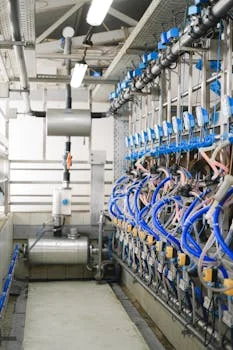
SCADA delivers the most value when unit processes expose clean tags and accept closed-loop setpoints from the supervisory layer. HydropureWater equipment packages are commonly specified with PLC interfaces that map into plant SCADA for dosing, biology, solids separation, and disinfection.
Automated Chemical Dosing Systems
For precipitation, neutralization, or disinfection duty, SCADA pairs with HydropureWater's PLC-controlled automatic chemical dosing systems using pH, ORP, or turbidity feedback. The loop raises or lowers coagulant, flocculant, or caustic/acid feed as influent quality changes. That feedback limits chemical spend while protecting compliance during shock loads.
Integrated Biological Treatment (e.g., MBR, A/O)
Activated sludge, A/O, and MBR trains are sensitive to DO, MLSS, sludge age, and nutrient residuals. On HydropureWater's fully automated WSZ series integrated sewage treatment plants, SCADA can trim blower speed, recycle ratio, and waste activated sludge rate to hold biology in range. With advanced MBR membrane bioreactor systems, the same platform can schedule membrane backwash and track integrity-test results.
Filtration and Clarification
DAF units, multimedia filters, and lamella clarifiers need turbidity, flow, and differential pressure tags for stable solids capture. SCADA can start filter backwash on high differential pressure or elapsed run time so media is not left packed. Clarifier loops may adjust flocculant dose and sludge withdrawal to hold blanket depth within the design band.
Disinfection Systems
UV reactors and chlorine dioxide generators need residual or dose feedback tied to flow. SCADA adjusts generator or dose rate to meet the discharge residual target while limiting excess chemical use. UV lamp-hour totals can trigger maintenance before disinfection credit is lost.
Sludge Dewatering Control
Belt presses and screw presses respond to sludge consistency, polymer dose, and motor load. SCADA can trim polymer to raise cake solids percent while watching for overload. Stable dewatering cycles cut hauling mass and reduce polymer spikes during dilute feed.
Implementation Considerations and Cost Factors for SCADA in Wastewater
A SCADA project succeeds when scope, instrumentation, network security, and operator training are sized together before hardware is ordered.
Project Planning and Scope
Start with an inventory of processes, existing PLCs, analyzers, and reporting needs, then define which loops move from local-only to supervisory control. Many industrial plants phase critical basins and dosing first, then expand to sludge and remote pumps. Clear scope prevents under-instrumented tags that look complete on a screen but cannot support closed-loop control.
Hardware and Software Costs
Hardware usually includes PLCs or RTUs, sensors for pH, DO, flow, level, turbidity, and ORP, HMI stations, and industrial networking gear. Software covers SCADA licenses, historians, and any analytics add-ons. Cost scales with I/O count, redundancy, and vendor platform choices rather than plant hydraulic capacity alone.
Installation and Integration
Budget for sensor wiring, panel work, fiber or copper plant network, protocol gateways for legacy gear, and commissioning. Integration engineering often rivals hardware cost when older PLCs or proprietary instruments need mapping. Factory acceptance and site acceptance tests should prove alarms, interlocks, and historian retention under stated load scenarios.
Training and Maintenance
Operators need HMI navigation, alarm response, and basic fault isolation training before cutover. Ongoing spend covers patches, antivirus or allow-listing policy, sensor calibration, and spare controllers. Cyber hygiene now sits beside mechanical PM: according to EPA (2024), MFA for remote OT access and tested configuration backups are baseline expectations for water and wastewater OT.
Selection Checklist and ROI
Before awarding a SCADA package, confirm required tags and control modes for each unit process. Also confirm the alarm notification path, on-call matrix, OT network segmentation, and remote-access method. Check historian retention in months, permit report templates, spare I/O for near-term expansion, and a named owner for cybersecurity updates. ROI usually comes from labor coverage, chemical and aeration savings, avoided downtime, and fewer permit events. Detailed small-plant capital ranges are covered in the SCADA system wastewater treatment plant cost guide.
Who this is for
Plant engineers, EPC teams, and procurement managers comparing plant-wide SCADA to panel-only control are the primary audience for this industrial wastewater guide. Single-skid OEM HMI buyers with no plant historian or remote alarm path should look at package-level controls instead. Teams scoping dosing, MBR, or integrated packaged plants with supervisory tags can align I/O lists and control narratives with a plant SCADA standard during design.
Frequently Asked Questions

What is the SCADA system for wastewater treatment?
A SCADA system for wastewater treatment is the supervisory layer that collects sensor data and coordinates control of pumps, valves, blowers, and chemical feed across the plant. Local PLCs or RTUs still run fast loops; SCADA adds centralized HMI, alarming, historian storage, and reporting. Plants use it to hold treatment setpoints, document effluent quality, and respond faster when load or equipment condition changes.
What is the function of SCADA in a water treatment system?
SCADA centralizes monitoring and supervisory control of water or wastewater unit processes from one operations environment. Typical functions include quality tagging for pH and turbidity, flow and level control, chemical dosing automation, filter or membrane backwash logic, and compliance reporting. The goal is stable treated-water quality with fewer manual rounds and clearer audit trails than paper logs provide.
What are the four types of SCADA systems?
The four general SCADA architecture generations are monolithic, distributed, networked, and web-based or IoT-connected systems. Monolithic systems were early standalone masters with limited networking. Distributed systems shared functions over LANs. Networked systems used WAN and open IP protocols across sites. Web-based and IoT designs add browser or cloud access and broader data integration, which raises cybersecurity design requirements.
Are BMS and SCADA the same?
No. Building management systems focus on HVAC, lighting, and facility access inside buildings. SCADA focuses on industrial process trains such as wastewater treatment, with higher emphasis on continuous process integrity, interlocks, and utility network control. The platforms can exchange selected tags, but a BMS is not a substitute for process SCADA on a treatment plant.
What cybersecurity steps matter most for plant SCADA?
According to EPA guidance published in 2024, priority steps start with limiting OT exposure to the public internet and changing default passwords. Multi-factor authentication should cover remote OT access, with an OT and IT asset inventory kept current. Incident response plans need practice drills and tested backups. EPA, CISA, and FBI summarize these as top cyber actions for securing water systems. Industrial wastewater plants should apply the same OT controls even when SDWA section 1433 does not directly apply.
Further Reading
This section provides in-depth articles on related wastewater treatment topics: