Introduction: The Legacy Automation Dilemma
Across the industrial wastewater treatment sector, thousands of facilities are running automation systems designed and installed 10, 15, or even 20+ years ago. These legacy systems — typically built around proprietary PLCs, hardwired I/O, dedicated SCADA workstations, and serial communication protocols — were state-of-the-art when installed. They have, in many cases, provided reliable service for years.
But the world around them has changed dramatically. Industry 4.0 and the Industrial Internet of Things (IIoT) have introduced capabilities that legacy systems simply cannot provide: remote access from anywhere, cloud-based analytics, machine learning for predictive maintenance, mobile-first operator interfaces, and seamless integration with enterprise IT systems.
The question facing wastewater plant managers and engineers is not whether to modernize — the operational and competitive pressures make that inevitable — but how to modernize in a way that minimizes risk, controls cost, and avoids extended process disruptions.
This article provides a practical, phased approach to migrating legacy wastewater automation from PLC-centric architectures to cloud-connected modern systems.
Assessing Your Current System: Where Do You Stand?
The Automation Maturity Spectrum
Legacy wastewater automation systems exist on a spectrum from "barely automated" to "fully automated but isolated." Understanding where your facility sits on this spectrum determines the appropriate modernization strategy.
Level 1: Manual with Basic Instrumentation
Operators manually start and stop equipment based on local instrument readings (panel-mounted gauges). No PLC or automated control. Common in small facilities installed before 2000.
Modernization path: Skip PLC-era technology entirely; go directly to cloud-native IoT controllers.
Level 2: PLC-Based Automation with Local HMI
A PLC (Allen-Bradley SLC/MicroLogix, Siemens S7-300, or similar vintage) controls pumps, blowers, and valves based on sensor inputs. An HMI touchscreen at the control panel provides operator interface. No remote access. Data logging is limited to HMI memory (often overwritten weekly).
Modernization path: Add an edge gateway for cloud connectivity while retaining the PLC for real-time control. Replace HMI with web-based dashboard.
Level 3: SCADA System with Historian
A full SCADA system (Wonderware/AVEVA, Ignition, WinCC, or FactoryTalk) provides centralized monitoring and control across multiple PLCs. A data historian stores months or years of process data. Remote access may exist via VPN but is often unreliable or restricted.
Modernization path: Integrate SCADA data into a cloud platform via OPC-UA or MQTT. Add cloud-based analytics and mobile access while preserving the SCADA for local operations.
Level 4: Connected but Fragmented
The facility has modern PLCs, a capable SCADA system, and some cloud connectivity, but the systems were added incrementally and don't communicate well. Multiple protocols, duplicate sensors, and inconsistent data create a confusing operational picture.
Modernization path: Implement a unified data architecture with a cloud platform as the single source of truth. Standardize communication protocols.
The Migration Architecture: Edge + Cloud
Why Edge Computing Is the Bridge
The most successful PLC-to-cloud migrations use an edge computing architecture as a bridge between legacy field equipment and modern cloud platforms. The edge gateway performs several critical functions:
- Protocol translation: Converts legacy serial protocols (Modbus RTU, DF1, MPI) to modern IP-based protocols (MQTT, OPC-UA, REST API)
- Data buffering: Stores data locally during internet outages, ensuring no data loss
- Local processing: Runs time-critical control algorithms locally, independent of cloud connectivity
- Security boundary: Provides a managed, secured connection between the operational technology (OT) network and the internet, with firewall, encryption, and access control
Reference Architecture
A typical edge + cloud architecture for wastewater treatment looks like this:
| Layer | Components | Function |
|---|---|---|
| Field | Sensors, actuators, VFDs, analyzers | Physical measurement and control |
| Control | Existing PLC (retained) or new IoT controller | Real-time process control (ms-level response) |
| Edge | Industrial edge gateway (Moxa, HMS, Advantech, or software-based on industrial PC) | Protocol conversion, data buffering, local analytics, security |
| Network | 4G/5G cellular, fiber, or dedicated VLAN | Secure data transport to cloud |
| Cloud | SaaS platform or IaaS deployment | Data storage, analytics, dashboards, reporting, AI/ML |
| User | Web browser, mobile app | Operator interface, management dashboards |
Phase 1: Connect Without Changing (Weeks 1-4)
The Non-Invasive First Step
The golden rule of legacy system modernization is: first connect, then optimize, then replace. Phase 1 should not modify any existing PLC programming, wiring, or control logic. The goal is to gain visibility into the existing system without touching it.
Step 1: Identify available data points
Audit your PLC register map to identify all available data points — sensor readings, equipment status, setpoints, alarm states, counters, and timers. Many legacy PLCs have hundreds of available registers that were never exposed to operators because the original HMI only displayed a subset.
Step 2: Install an edge gateway
Connect an edge gateway to the PLC communication port. For older PLCs with serial-only interfaces (RS-232/485), use a serial-to-Ethernet converter or a gateway with built-in serial ports. Configure the gateway to poll the PLC registers at appropriate intervals (typically 1-10 seconds for process data, 100ms for alarm-critical data).
Step 3: Establish cloud connectivity
Configure the edge gateway to transmit data to your chosen cloud platform via MQTT or HTTPS. Use cellular connectivity (4G/5G) for the fastest deployment, or leverage existing facility internet if available and IT-approved.
Step 4: Build initial dashboards
Create cloud dashboards that mirror and extend the information available on the local HMI. Add trend charts, alarm logs, and basic KPIs (uptime, flow totals, energy consumption) that were not available in the legacy system.
At this point, you have not changed any control behavior. The existing PLC and HMI continue to operate exactly as before. But you now have remote visibility, data logging, and the foundation for everything that follows.
Phase 2: Add Cloud-Based Intelligence (Weeks 4-12)
Analytics and Optimization Without Control Changes
With data flowing to the cloud, you can now implement analytics that the legacy system could never provide:
Energy Analytics: Correlate energy consumption (from power meters or VFD data) with process variables (flow, load, temperature) to identify inefficiencies. Many facilities discover that their aeration system consumes 20-30% more energy than necessary due to fixed-speed operation or conservative DO setpoints.
Process Performance Benchmarking: Calculate and track key performance indicators like specific energy consumption (kWh/m³), specific chemical consumption (kg/m³), sludge yield (kg MLSS/kg COD removed), and nutrient removal efficiency. Compare against design values and industry benchmarks.
Alarm Pattern Analysis: Analyze the frequency and timing of alarm events to identify chronic issues. A pump that trips every Tuesday afternoon might correlate with a specific production batch from an upstream process.
Predictive Indicators: Track equipment performance trends (pump discharge pressure, blower discharge temperature, motor current) to identify developing problems before they cause failures. For dissolved air flotation (DAF) systems, monitoring saturator pressure trends, recycle pump performance, and float solids characteristics can predict performance degradation weeks before it becomes visible in effluent quality.
Phase 3: Implement Cloud-Directed Control (Months 3-6)
Closing the Loop
This phase is where the cloud platform begins to actively improve process performance by sending optimized setpoints back to the on-site PLC. This requires careful planning and testing.
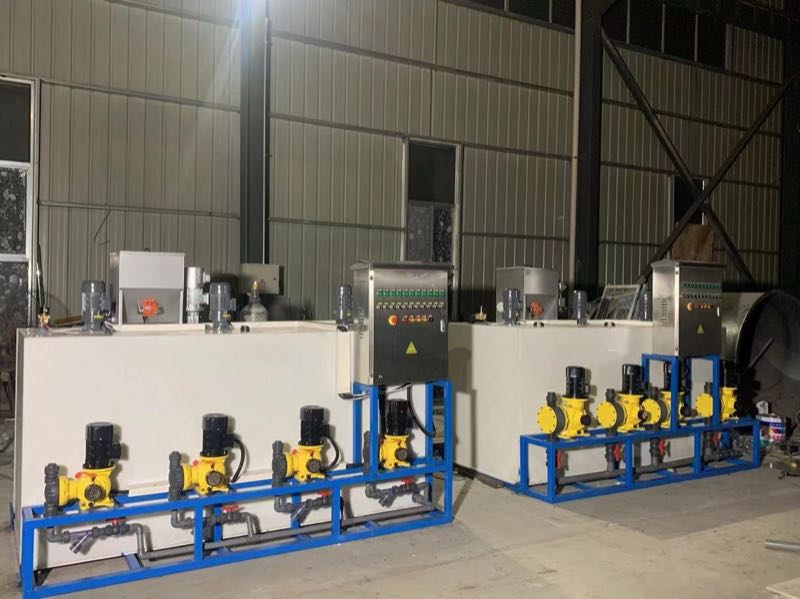
Start with non-critical loops: Begin with control loops where incorrect setpoints cause inefficiency, not process failure. Chemical dosing rate optimization is an ideal starting point — the automatic chemical dosing system can receive optimized dose rates from the cloud platform based on historical data analysis and real-time influent quality, with the PLC maintaining local safety limits that prevent overdosing regardless of cloud commands.
Implement supervisory, not direct control: The cloud platform should send setpoint adjustments to the PLC, not directly command field devices. The PLC retains responsibility for safety interlocks, equipment protection, and real-time response. The cloud optimizes; the PLC protects.
Use A/B testing: Run the new cloud-optimized setpoints in parallel with the old fixed setpoints, alternating periods to quantify the improvement. This builds operator confidence and provides documented evidence of optimization benefits.
Phase 4: Hardware Refresh Where Justified (Months 6-18)
Strategic PLC and Instrument Upgrades
With cloud connectivity established and optimization opportunities identified, Phase 4 addresses hardware that limits further improvement:
Replace end-of-life PLCs: If your PLC is from a discontinued product line (Allen-Bradley PLC-5, SLC 500; Siemens S5; GE Series 90-30) with no available spare parts, replacement becomes a reliability imperative. Modern PLCs (CompactLogix, S7-1500, M580) offer Ethernet connectivity, built-in web servers, and easier cloud integration.
Add online analyzers: Legacy systems often relied on daily grab samples for water quality data. Adding online COD, ammonia, and phosphorus analyzers provides the continuous data that enables real-time process optimization.
Upgrade VFDs: Replace fixed-speed starters with variable frequency drives on pumps and blowers. VFDs with Ethernet connectivity can report energy data, operating parameters, and diagnostic information directly to the cloud platform.
Modernize chemical dosing: Replace manual or timer-based chemical feed with modern DAF systems with integrated automation and flow-proportional automatic chemical dosing systems that respond to real-time demand.
Risk Management: What Can Go Wrong
Common Pitfalls and How to Avoid Them
- Trying to do everything at once: The phased approach described above exists for a reason. Facilities that attempt to simultaneously replace PLCs, install new instruments, and deploy a cloud platform almost always experience extended downtime and budget overruns. Be patient; each phase delivers standalone value.
- Underestimating cybersecurity: Connecting previously isolated OT systems to the internet introduces real cybersecurity risk. Implement defense-in-depth: network segmentation (IT/OT firewall), encrypted communications, role-based access, regular patching, and intrusion detection. Follow IEC 62443 or NIST 800-82 frameworks.
- Ignoring the human factor: Operators who have spent years mastering the existing SCADA system may resist change. Invest in training, involve operators in dashboard design, and demonstrate clear personal benefits (less manual data entry, better work-life balance from remote monitoring, reduced alarm fatigue).
- Choosing a platform that doesn't support your legacy protocols: Before committing to a cloud platform, verify that its edge gateway supports the specific PLC communication protocol you need (not just "Modbus" but your specific variant and register mapping).
- Neglecting local failover: Never design a system where loss of internet connectivity stops the treatment process. The on-site PLC must always maintain autonomous operation capability.
Cost Comparison: Rip-and-Replace vs. Phased Migration
| Approach | Capital Cost | Duration | Downtime Risk | Value Realization |
|---|---|---|---|---|
| Full rip-and-replace | $150,000 - $500,000 | 6-12 months | High (weeks) | All at once (month 12) |
| Phased migration | $40,000 - $150,000 | 12-18 months | Minimal (hours per phase) | Incremental (from month 1) |
The phased approach typically costs 30-50% less than full replacement because it retains functional equipment, avoids large-scale system integration projects, and spreads investment over multiple budget cycles. More importantly, it begins delivering ROI from Phase 1, whereas rip-and-replace delivers no value until the complete new system is commissioned.
Future-Proofing: Building for What Comes Next
As you modernize, design your architecture to accommodate emerging technologies:
- Digital twins: Cloud platforms with sufficient data density can create digital twin models of your treatment process, enabling what-if analysis and operator training without affecting real operations
- AI/ML optimization: Machine learning models trained on your historical data can identify non-obvious correlations and optimize multi-variable control problems that exceed human intuition
- Augmented reality (AR): Field technicians using AR headsets can overlay real-time data, procedures, and remote expert guidance on physical equipment during maintenance
- Autonomous operation: The ultimate goal — treatment systems that self-optimize with human oversight only for exception handling and strategic decisions
Frequently Asked Questions
Our PLC is 15 years old but still works fine. Why should we invest in modernization now?
Functional obsolescence and strategic risk are the primary reasons. Your PLC may run reliably today, but if it fails tomorrow, can you get replacement parts? For many legacy platforms (PLC-5, SLC 500, S7-300), spare parts are increasingly scarce and expensive. More importantly, every year you delay cloud connectivity, you miss the compounding benefits of data-driven optimization — energy savings, chemical optimization, predictive maintenance, and staffing efficiency. The phased approach lets you add cloud capabilities for $20,000-$40,000 without replacing the PLC, preserving your working automation while gaining modern capabilities.
How do we justify the investment to management when the current system "works"?
Build the business case on three pillars: (1) Risk reduction — quantify the cost of a PLC failure (uncontrolled discharge, regulatory penalties, emergency procurement at premium prices). (2) Operational savings — project the annual savings from remote monitoring (reduced overtime, staffing optimization), energy optimization (10-20% reduction in aeration energy is common), and chemical optimization (15-30% reduction). (3) Competitive advantage — for industrial facilities, demonstrating advanced environmental management to customers, auditors, and regulators strengthens your operating license and market position.
Can cloud-directed control be as responsive as local PLC control?
Cloud-directed control operates at a supervisory level — adjusting setpoints, switching operating modes, and modifying control parameters — not at the real-time loop level. A PLC executes control loops in 10-100 milliseconds; cloud round-trip latency is typically 100-500 milliseconds. For wastewater treatment, where process dynamics are measured in minutes to hours, cloud supervisory control is more than adequate for optimization. Safety-critical functions (interlock, emergency shutdown, equipment protection) must always remain in the local PLC.
What about cybersecurity? Isn't connecting to the cloud dangerous for critical infrastructure?
Cybersecurity risk is real but manageable. The key is architectural security: the edge gateway creates a one-way or strictly controlled two-way data path between the OT network and the internet, with no direct IP connectivity between the PLC and the cloud. Implement IEC 62443 zone/conduit security architecture, use encrypted communications (TLS 1.3), enforce multi-factor authentication, and maintain regular security patching. Many facilities are actually more secure after modernization because the legacy SCADA system (running on Windows XP with no patches) is replaced or supplemented with modern, supported software with active security monitoring.