
Why the STP Housing Decision Hits Differently at a Semiconductor Fab
A fab utilities engineer rarely gets to choose a "domestic sewage" treatment plant. The same sewer that carries canteen and locker-room flow also receives fluoride-bearing HF/BHF rinses and silica-laden CMP slurry overflow, so the STP design basis is a blended envelope, not a single stream. CMP wastewater alone runs silica 500-2,000 mg/L, alumina 200-800 mg/L, COD 300-1,500 mg/L, TSS 500-3,000 mg/L, and pH 2-11, while HF rinse lines add 10-100 mg/L F⁻ that any biological stage will not survive without precipitation (HydropureWater field data, 2025). Domestic sewage adds another 200-400 mg/L BOD and routine surfactants on top. Diurnal swings of 3-5× occur when fab shifts change, and the combined effluent must hit SEMI S23-0719 (COD <100 mg/L, TSS <30 mg/L, pH 6-9) and EPA 40 CFR Part 469 (COD <120 mg/L, TSS <30 mg/L) on a single outfall. That envelope is what forces the housing choice before anyone argues about CAPEX, and it is why the rinse wastewater treatment systems 2026 guide treats fluoride precipitation as a prerequisite, not an option.
| Stream entering the STP | Key parameters | Pre-treatment implication |
|---|---|---|
| HF / BHF rinse | 10-100 mg/L F⁻, low flow, low COD | CaCl₂ or Ca(OH)₂ precipitation to <10 mg/L F⁻ before any biological stage |
| CMP slurry overflow | SiO₂ 500-2,000 mg/L; Al₂O₃ 200-800 mg/L; COD 300-1,500 mg/L; TSS 500-3,000 mg/L; pH 2-11 | Equalization + DAF or UF to protect membranes and biomass |
| Domestic sewage (canteen, locker rooms, admin) | BOD 200-400 mg/L, surfactants, diurnal | Standard biological treatment; sets hydraulic base load |
| Cleanroom sweeps (TMAH, NH₃, IPA) | COD peaks >1,500 mg/L during pad conditioning | Equalization volume of 4-8 h peak flow |
Influent Envelope: What Actually Enters the STP at a CMP Fab
Size any STP, packaged or concrete, off the blended envelope rather than off the domestic line alone. Silica at 500-2,000 mg/L and alumina at 200-800 mg/L will blind biological media and grit clarifiers if not DAF-clarified upstream; fluoride at 10-100 mg/L must be dropped to <10 mg/L pre-biologics via CaCl₂ or Ca(OH)₂ at 1.2-2.0× stoichiometric dose with rapid mix, since biological toxicity from F⁻ begins around 10-15 mg/L for most activated-sludge consortia. TMAH, NH₃, and IPA from cleanroom wipes push COD to 300-1,500 mg/L baseline with peaks above 1,500 mg/L during pad conditioning (HydropureWater field data, 2025). Particle size sits at 0.1-10 μm with roughly 90% under 5 μm, which disqualifies conventional primary clarifiers and pushes pretreatment toward DAF or UF. UPW make-up at 10-100 L/wafer means any water-recovery credit earned at the STP offsets $0.50-$1.50/m³ of fresh UPW cost, a number the CFO will recognize.
| Parameter | Typical range (blended influent) | Design implication |
|---|---|---|
| Silica (SiO₂) | 500-2,000 mg/L | DAF or ceramic UF upstream; protect RO from 20-40% flux decline |
| Alumina (Al₂O₃) | 200-800 mg/L | Coagulant dosing 0.5-2 mg/L surfactant; pH 6.5-8.5 |
| COD | 300-1,500 mg/L baseline; >1,500 mg/L peaks | Equalization + A/O biological stage + MBR polish |
| TSS | 500-3,000 mg/L | DAF or UF primary separation |
| Fluoride (F⁻) | 10-100 mg/L | CaCl₂/Ca(OH)₂ precipitation to <10 mg/L pre-biologics |
| pH | 2-11 swings | Equalization 4-8 h; pH adjust 6.5-8.5 before biology |
| Particle size | 0.1-10 μm; ~90% <5 μm | Conventional clarifiers inadequate; DAF or MF required |
Packaged STP: What a Skid-Mounted Unit Actually Delivers
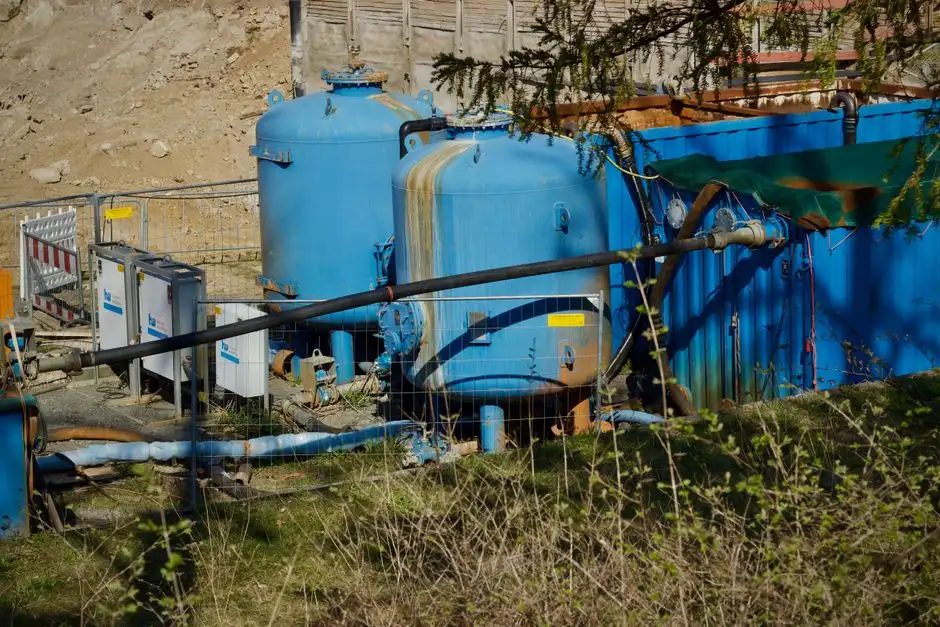
A WSZ-series underground packaged STP integrates A/O biological treatment, sedimentation, and disinfection into a single buried or slab-mounted skid rated 1-80 m³/h, fully automatic and unattended. Paired with an integrated MBR system using DF-series flat-sheet modules at 0.1 μm pore size (32-135 m³/day per cassette), the same skid train can polish effluent to SEMI S23-0719 reuse specs without a separate clarifier. Footprint runs roughly 60% smaller than cast-in-place for the same daily flow because the A/O and clarification stages share tankage. Lead time is 8-12 weeks ex-works versus 6-12 months for poured concrete, which is decisive when a new tool is being commissioned on a fast-track schedule. Siting options include below-grade burial, slab-on-grade, or trailer-mounted mobile deployment, useful for splitting Phase 1 and Phase 2 fab capacity. Indoor siting is feasible because packaged units are fully enclosed and PLC-controlled, eliminating the open-tank VOC and odor concerns that block indoor concrete basins, and they pair naturally with the indoor-siting constraints of a fab sub-fab.
Cast-in-Place Concrete STP: Where It Earns Its Place
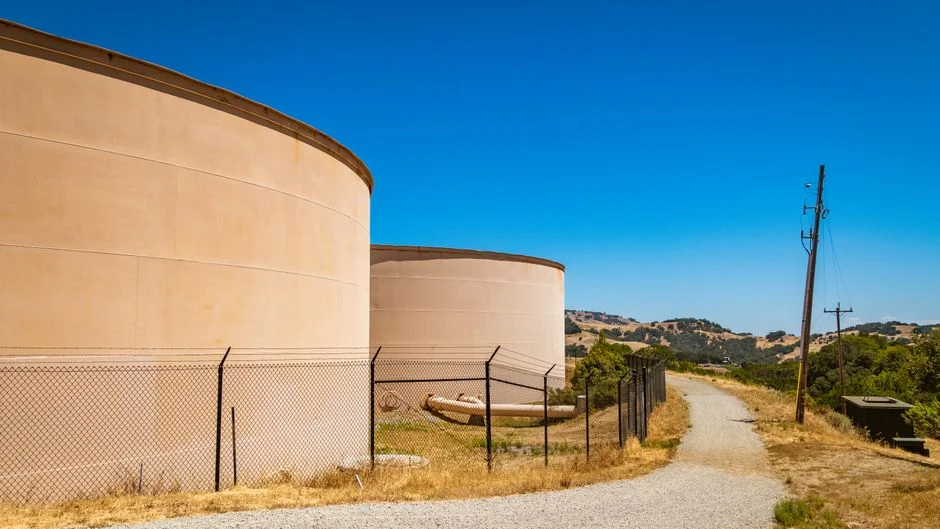
Concrete basins become the right call above roughly 500 m³/day, when equalization volume must exceed 4-6 hours of peak flow, or when the site sits in seismic Zone 4 (Taiwan, parts of Japan, US West Coast), where buried packages can float or shift in high water-table + seismic events. Properly dosed concrete delivers 25-30 years of design life versus 10-15 years for packaged steel or FRP before liner or membrane replacement. Concrete tolerates HF vapor carryover and accidental acid dumps better than coated steel, and the alkalinity of the concrete itself buffers pH excursions. Future expandability is the sleeper argument: a cast-in-place basin can accept a third or fourth compartment without replacing the structure, whereas a packaged unit is a forklift-out replacement. The trade is real, though. On-site civil crews, QA/QC for water-stops, rebar cover, and crack control add 6-12 months to the schedule and a 15-25% cost premium versus the package equivalent, which is why concrete loses on fast-track fab builds even when it wins on lifecycle.
Head-to-Head: Packaged vs Cast-in-Place Concrete STP
Build the comparison across the eight attributes that actually move a procurement decision: CAPEX, OPEX, lead time, footprint, design life, seismic suitability, indoor siting, and ZLD compatibility. Use the 2026 cost bands as anchors: $600K-$1.5M for chemical precipitation + MBR (typically packageable) versus $1.2M-$2.5M+ for DAF-RO-MBR in concrete (HydropureWater field data, 2026). OPEX sits at $0.50-$2.50/m³ for both options; packaged wins on labor, concrete wins on membrane and liner replacement cycles. Packaged CAPEX payback via avoided civil works typically lands at 18-30 months at fab hourly labor rates. The scoring rule is straightforward: packaged wins below 50 m³/h and on fast-track; concrete wins above 200 m³/h, in seismic Zone 3-4, or with on-site civil crews already mobilized. Both must run a DAF system or UF system upstream; the WSZ skid does not replace pretreatment, only the biological and clarification stages. Most 2026 fabs end up hybrid: packaged skid for Phase 1, concrete basin extension for Phase 2+.
| Attribute | Packaged STP (WSZ + MBR) | Cast-in-Place Concrete STP |
|---|---|---|
| CAPEX (100 m³/day, precipitation + MBR or DAF-RO-MBR) | $600K-$1.5M | $1.2M-$2.5M+ |
| OPEX | $0.50-$1.50/m³ (labor-light) | $0.80-$2.50/m³ (membrane/liner cycles) |
| Lead time | 8-12 weeks ex-works | 6-12 months with civil works |
| Footprint | ~60% smaller (shared tankage) | Larger basins; configurable |
| Design life | 10-15 years before liner/membrane replacement | 25-30 years |
| Seismic Zone 4 suitability | Risk of float/shift in high water table | Cast-in-place engineered for seismic load |
| Indoor siting | Enclosed, PLC-controlled; no open-tank odor | Open basins problematic indoors |
| Expandability | Forklift-out replacement | Add compartments in existing basin |
| HF / fluoride tolerance | Coated steel; vulnerable to vapor carryover | Concrete alkalinity buffers pH excursions |
| ZLD compatibility | RO add-on feasible; skid-mountable | Concrete buffer tanks ideal for RO/crystallizer |
Integrating Fluoride, CMP, and Domestic Streams into One STP
The process train is the same regardless of housing; only the tank material changes. Step 1 is fluoride precipitation with CaCl₂ or Ca(OH)₂ at 1.2-2.0× stoichiometric dose in a dedicated rapid-mix tank fed by an automatic chemical dosing system, targeting <10 mg/L F⁻ in the clarified overflow. Step 2 is equalization for 4-8 hours to dampen pH 2-11 spikes and COD peaks above 1,500 mg/L during pad conditioning. Step 3 is DAF or ceramic MF for silica and TSS; chemical precipitation + MBR alone hits only 80-90% COD removal and will not reliably meet SEMI S23-0719 on a fab effluent. Step 4 is the A/O biological stage (WSZ A/O compartment or concrete basin) with MBR flat-sheet polishing to <50 mg/L COD and <30 mg/L TSS (HydropureWater field data, 2025). Step 5 is optional RO for water reuse credit at $0.50-$1.50/m³, which offsets 20-50% of OPEX. Sludge handling across the train runs 0.2-0.5 kg dry solids per cubic meter, dewatered via a plate-and-frame filter press for disposal.
CAPEX, OPEX, and ROI by STP Choice
For a 100 m³/day packaged STP built on chemical precipitation + MBR, the 2026 CAPEX band is $600K-$1.5M and OPEX runs $0.50-$1.50/m³. The same flow in cast-in-place DAF-RO-MBR concrete lands at $1.2M-$2.5M CAPEX and $0.80-$2.50/m³ OPEX. If the fab is targeting ZLD or >85% water reuse with a ceramic MF + RO train, CAPEX climbs to $1.5M-$3M regardless of housing, because membrane cost dominates. Recovered UPW at $0.50-$1.50/m³ offsets 20-50% of OPEX on both options, so it does not swing the housing decision (HydropureWater field data, 2026). Energy sits at 0.3-1.2 kWh/m³; a packaged MBR with submerged flat-sheet modules runs 10-20× lower aeration energy than external cross-flow systems. RO membrane replacement runs $15K-$30K/year, and a properly designed UF stage upstream cuts RO cleaning frequency by roughly 60%, a saving that is equal for both housing types. Payback framing for the CFO: packaged wins on avoided civil works (18-30 months), concrete wins on membrane and liner replacement avoidance across a 25-year horizon. The OPEX gap is small enough that schedule and seismic risk usually decide it.
| Cost line (100 m³/day) | Packaged STP (precipitation + MBR) | Cast-in-Place Concrete STP (DAF-RO-MBR) | ZLD hybrid (ceramic MF + RO) |
|---|---|---|---|
| CAPEX | $600K-$1.5M | $1.2M-$2.5M | $1.5M-$3M |
| OPEX | $0.50-$1.50/m³ | $0.80-$2.50/m³ | $1.00-$2.50/m³ |
| Energy | 0.3-1.0 kWh/m³ | 0.5-1.2 kWh/m³ | 0.8-1.2 kWh/m³ |
| RO membrane replacement | $15K-$30K/year | $15K-$30K/year | $15K-$30K/year |
| UPW reuse credit | $0.50-$1.50/m³ (offsets 20-50% OPEX) | $0.50-$1.50/m³ (offsets 20-50% OPEX) | $0.50-$1.50/m³ (offsets 20-50% OPEX) |
| Civil works lead time | 8-12 weeks ex-works | 6-12 months | 6-12 months |
Decision Tree: Which STP Wins for Your Fab Profile
Four conditions cover most fab builds. If flow is ≤50 m³/h, the fab is fast-track (<12 months to commissioning), and the seismic zone is low, a packaged WSZ + MBR skid wins on every dimension. If flow is ≥200 m³/h, the fab is seismic Zone 3-4, or the design life must exceed 20 years, cast-in-place concrete wins. If ZLD or >85% water reuse is mandated, the housing choice is secondary to the RO train; either option works as long as the upstream DAF or UF is correctly specified and paired with an industrial RO system. If a Phase 1 fab is being built and Phase 2+ is funded, a hybrid is the common 2026 answer: packaged skid for Phase 1, concrete basin extension for Phase 2. Fluoride pretreatment is non-negotiable in either path and must be sized at 1.2-2.0× stoichiometric Ca dosing with rapid mix. Compliance with SEMI S23-0719 and EPA 40 CFR Part 469 is the gate; both options pass when properly designed, so the choice is operational and financial, not regulatory. For a deeper read on Phase-2 fab wastewater planning, the GaN wastewater treatment 2027 guide walks the same decision logic for GaN-on-Si lines.
Frequently Asked Questions
Does a packaged STP need fluoride pretreatment, or can biological treatment handle HF rinse on its own?
No. Fluoride at 10-100 mg/L from HF/BHF rinses must be precipitated to <10 mg/L before any biological stage, because activated-sludge consortia show toxicity starting around 10-15 mg/L F⁻. CaCl₂ or Ca(OH)₂ at 1.2-2.0× stoichiometric dose in a rapid-mix tank is the standard fix and applies whether the downstream STP is a packaged skid or a concrete basin. Skipping it is the fastest path to SEMI S23-0719 noncompliance.
What flow rate should trigger a switch from packaged to cast-in-place concrete at a fab?
Use 50 m³/h as the rough break-point. Packaged WSZ + MBR skids cover 1-80 m³/h and stay cost-effective up to about 100 m³/day; above roughly 200 m³/day, equalization volume and basin count push the design toward cast-in-place. Seismic Zone 4 and design life >20 years can override the flow trigger and force concrete even at lower flow rates (HydropureWater field data, 2026).
Can a packaged STP meet SEMI S23-0719 and EPA 40 CFR Part 469 on a blended CMP-plus-domestic influent?
Yes, when paired with upstream fluoride precipitation, DAF or UF, and MBR flat-sheet polishing. SEMI S23-0719 sets COD <100 mg/L, TSS <30 mg/L, pH 6-9; EPA 40 CFR Part 469 sets COD <120 mg/L, TSS <30 mg/L, pH 6-9. A WSZ A/O + MBR train consistently hits both on blended fab effluent, as detailed in the 2026 CMP wastewater treatment guide and the rinse wastewater treatment systems 2026 guide.
Is indoor siting of a concrete STP realistic for a fab sub-fab?
Rarely. Open concrete basins release VOCs and odor that conflict with fab HVAC envelope and cleanroom pressure cascades, and they need make-up air handling that packaged enclosed skids do not. If indoor siting is forced by footprint, the packaged skid is the only practical option. Concrete basins stay outdoors with covers and dedicated odor control, which is the more common 2026 layout.
How does the housing choice interact with a future ZLD upgrade?
Housing is secondary once ZLD is on the table; the RO and crystallizer train drive CAPEX and OPEX either way. A packaged skid can host the RO add-on, while concrete offers larger buffer tanks that smooth the brine stream into a crystallizer. Plan the ZLD upgrade when sizing equalization, because retrofitting 4-8 hours of equalization into an existing packaged skid is harder than pouring a new concrete basin.