Why Spokane Petroleum Plants Are Rethinking Primary Clarification in 2026
40 CFR Part 435 sets the binding federal floor for petroleum refinery discharges, and Washington's Department of Ecology is tightening the local ceiling at the same time. Refinery process water in Spokane is now measured against 30-day average effluent limits for oil and grease, total suspended solids, and dissolved metals that leave little room for a marginal primary unit. At the same time, the state's produced-water reporting rules and the broader push toward on-site oil recovery mean that the float or sludge leaving a clarifier is no longer a waste to discard — it is a feedstock to capture, and the choice of unit operation determines how much of that value reaches the haul truck.
For a 2026 retrofit, the decision reduces to two technologies: dissolved air flotation (DAF) and inclined-plate / lamella gravity clarifiers, almost always sitting downstream of an existing API separator. The API separator removes the bulk of free oil and settleable solids; what follows determines whether the rest of the refinery pre-treatment train — equalization, biological polishing, and the final carbon and multimedia filters — can hold 30-day averages inside the new envelope. For Spokane operators, the 2026 question is no longer whether to install primary clarification, but which one to install when the influent is hot, oily, intermittent, and watched by both a federal inspector and a Spokane POTW.
How DAF and Clarifiers Actually Treat Oily Refinery Water
Dissolved air flotation (DAF) works by pressurizing a side stream of clarified water with air in a saturator vessel, then releasing that stream into the main flotation tank at atmospheric pressure. The dissolved air comes out of solution as a dense cloud of 20–80 micron micro-bubbles that attach to oil droplets, emulsified FOG, and fine suspended floc, lifting them to the surface in minutes. A rotating scoop or chain-and-flight skimmer removes the resulting float layer, which typically runs 2–4% dry solids on refinery streams. The mechanism is buoyant and largely independent of particle density, which is why it handles emulsified oil and light FOG so efficiently.
A lamella clarifier is essentially a gravity settler multiplied by inclined plates. Wastewater flows upward between closely spaced plates at 55–60° from horizontal; settleable solids drop onto the plate face and slide into a sludge hopper, while clarified water exits over a weir at the top. Oil removal is incidental, not engineered — anything buoyant tends to ride the upward flow rather than separate. Per a 2026 Ecologix comparison, a food/oil case study showed 95% DAF oil removal versus 70% for a clarifier on the same stream (Ecologix, 2026). For the typical packaged DAF system sized to 4–300 m³/h and a similarly rated lamella package, the two technologies handle the same flow rate, but the clarifier needs roughly 2–3× the plan area to do it.
Spokane Stream Characteristics: Why Petroleum Water Is Not a Generic Industrial Case
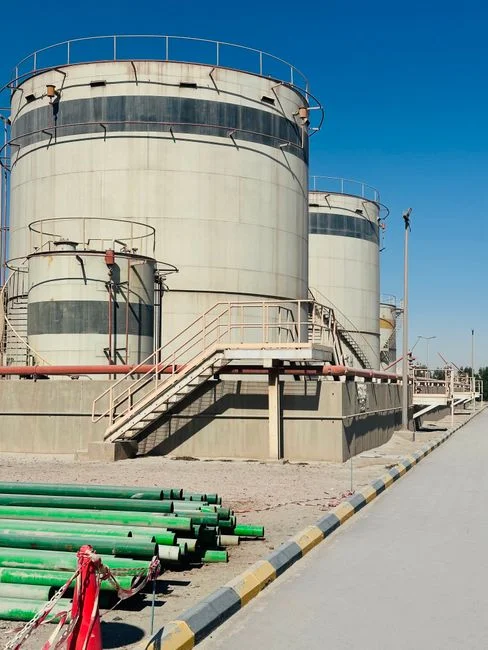
Refinery desalter effluent and API overflow in Eastern Washington typically runs 100–1,000 mg/L oil and grease, 200–2,000 mg/L total suspended solids, pH 5–9, and 40–60 °C. Temperatures matter more than Spokane operators expect: cold winter intake water dropping to 4–8 °C raises water viscosity and slows gravity settling in a lamella clarifier, while the micro-bubble mechanism in DAF is far less viscosity-sensitive. Field jar tests on Spokane streams consistently show DAF removal holding within a few percentage points of summer performance when influent cools, while clarifier TSS removal degrades by 10–15 points under the same swing.
The second local wrinkle is slug loading. Upstream API separators on Spokane's petroleum pads tend to receive batch discharges from desalter wash cycles, tank draws, and stormwater run-off during spring thaw. Those slugs push free oil above 500 mg/L for 30–90 minutes at a time. DAF recovers to baseline performance inside one residence time (15–25 minutes); a clarifier needs several hours of low-loading flow to re-establish a clean sludge blanket. When the influent also carries emulsified oil from chemical cleaning campaigns, an automatic chemical dosing skid feeding coagulant ahead of DAF will routinely break that emulsion, where a clarifier would simply pass it through.
DAF vs Clarifier: Head-to-Head Comparison for Petroleum Wastewater
The engineering case for DAF on oily refinery streams is built on five measurable parameters. The table below summarizes what an engineer at a Spokane pad will actually see on the daily operating log.
| Parameter | DAF (dissolved air flotation) | Lamella / inclined-plate clarifier |
|---|---|---|
| Oil & FOG removal | 90–95% free oil; 85–95% emulsified with coagulant | ~70% free oil; poor on emulsified FOG |
| TSS removal | 85–98% | 80–90% on heavy-solids streams; lower on light floc |
| Footprint at 100 m³/h | ~12 m² packaged tank | ~30–35 m² plan area incl. plate pack |
| Energy intensity | Air compressor + recycle pump; ~2–4 kWh/m³ | No aeration; ~0.3–0.5 kWh/m³ |
| Chemical demand | Coagulant + flocculant ahead of cell; polymer for float | Polymer for sludge thickening only |
| Sludge / float | 2–4% dry solids float, oil-rich, easy to dewater | 1–2% underflow, water-heavy, lower oil content |
| Recovery from slug load | 15–25 min | 2–6 h |
| Capital cost reference | EPA NEiS Section 2.8 (DAF cost curves) | EPA NEiS Section 2.2.2 (clarification cost curves) |
Removal efficiency dictates downstream performance. Where DAF hits 90–95% oil removal, the downstream biotreatment train receives a feed well under 50 mg/L oil — comfortable for an activated sludge or MBBR polishing stage sized to 40 CFR Part 435 limits. A clarifier at 70% removal can leave 200–300 mg/L oil reaching the biological stage, which forces over-sizing of aeration basins and risks periodic permit excursions during slug events. The EPA's 1998 NEiS document provides cost curves for both DAF (Section 2.8) and clarification (Section 2.2.2) broken out above and below 20 GPM, and those remain the standard escalation baseline for 2026 budget work. Engineers comparing footprints for a constrained Spokane pad should also note that a high-efficiency sedimentation tank package still requires significant plan area versus a comparably rated DAF skid.
Spokane-Specific Selection Framework for 2026
Apply the following rule on the next skid drawing review:
| Site condition | Choose | Reason |
|---|---|---|
| Free oil > 100 mg/L after API separator | DAF | Clarifier cannot break 70% removal ceiling on free oil |
| Footprint constrained (< 1.5× DAF footprint available) | DAF | Lamella needs 2–3× plan area for same flow |
| Sludge must be dewatered on-site via filter press | DAF | 2–4% float feeds a plate and frame filter press efficiently |
| Stream dominated by heavy inorganic solids, oil < 50 mg/L after API | Lamella clarifier | Gravity settling is cheaper and sufficient |
| Cold-climate operation (intake < 10 °C winter) | DAF | Micro-bubble separation is viscosity-insensitive |
| Slug loads from desalter wash cycles | DAF | Recovers in one residence time vs hours for clarifier |
The 2026 default train for a Spokane refinery or re-refinery discharging to POTW is API separator → DAF → biological polishing (typically MBBR or SBR) → sand/carbon filtration. The hybrid case — API → lamella → DAF — only makes sense where the existing lamella is already in place, the operator wants to defer full replacement, and the upstream API is regularly sending the clarifier below 50 mg/L oil. For new builds, the DAF Corp product line offers a useful sizing benchmark: the FC Maximizer (circular) covers 48–11,000 GPM at 92–98% TSS removal, and the RC UniMax (rectangular) covers 10–1,000 GPM at 85–90% TSS removal (dafcorp.com, 2025). Most Spokane pads fall inside the 100–500 GPM band where both packages are available as skid-mounted units that shorten retrofit shutdowns by weeks versus field-built concrete.
Capital, Operating Cost, and ROI Snapshot for a Spokane Plant
The EPA NEiS capital and O&M cost curves (EPA 821-R-98-016, December 1998) remain the only public cost dataset that places DAF and clarification on a common baseline, and they are still used in 2026 escalations after applying a Chemical Engineering Plant Cost Index (CEPCI) factor. Section 2.8 covers DAF (capital, land, O&M broken out for flows above and below 20 GPM) and Section 2.2.2 covers clarification across the same flow split. For a 100 GPM (22.7 m³/h) Spokane skid, the EPA curves place DAF capital roughly 1.3–1.6× the equivalent clarifier once both include sludge handling — but DAF's higher oil recovery routinely offsets polymer, hauling, and biosludge disposal costs downstream.
Two practical ROI levers matter on a Spokane retrofit. First, skid mounting: pre-assembled DAF packages from 48 GPM upward ship with all piping, valves, and controls wired, which compresses a refinery shutdown that would otherwise tie up a tank farm for a month of concrete work. Second, pairing any primary unit with a sludge dewatering step controls lifetime hauling cost. DAF float at 2–4% dry solids feeds a plate and frame filter press at 18–25% cake, which the EPA Section 4 cost curves show as the lowest-cost disposal path per pound of dry solids. Operators evaluating life-cycle cost should escalate the 1998 EPA baseline with CEPCI and add a Spokane-specific contingency for civil work and electrical upgrade — those two line items typically drive more of the 2026 installed cost than the unit operation itself. Broader wastewater resource recovery market trends through 2030 suggest that the recovered oil credit alone will shorten DAF payback further as off-spec recovered product pricing tightens.
Frequently Asked Questions
Is DAF or a clarifier the right primary unit for an oily refinery stream in Spokane?
DAF is the stronger default for 2026 Spokane petroleum service: it delivers 90–95% oil/FOG removal versus ~70% for a lamella clarifier, recovers from slug loads in 15–25 minutes, and produces a float that dewaters cleanly on a filter press. Choose a lamella clarifier only when the upstream API separator is already pushing oil below 50 mg/L and the stream is dominated by heavy inorganic solids.
How do 40 CFR Part 435 and Washington DOE rules affect the 2026 decision?
40 CFR Part 435 sets the federal floor on oil and grease, TSS, and trace metals for refinery discharges, and Washington DOE's 2026 30-day average tightening on TSS and oil & grease narrows the compliance margin at the Spokane POTW. A clarifier at 70% oil removal rarely leaves enough headroom for the biotreatment stage to hold those averages during a slug; a DAF at 9
Frequently Asked Questions
What is the best primary clarifier for a petroleum refinery in Spokane in 2026?
For a modern 2026 petroleum facility in Spokane, a Dissolved Air Flotation (DAF) unit is generally considered superior to traditional gravity-based primary clarifiers for oil-water separation. While conventional API separators are limited by Stokes' Law, DAF systems utilize micro-bubbles to accelerate the rise rate of oil droplets, achieving removal efficiencies for particles as small as 20 to 50 microns that gravity clarifiers often miss.
How much oil and grease can a DAF remove compared to a clarifier?
A properly operated DAF system can achieve oil and grease removal efficiencies between 85% and 99%, depending on chemical coagulation and flocculation dosage. In contrast, a standard gravity clarifier typically achieves 50% to 70% removal for free oil, struggling significantly with emulsified oil or lighter hydrocarbons that remain suspended due to density similarities with process water.
Does a DAF system meet 40 CFR Part 435 discharge limits on its own?
No, a DAF system is rarely sufficient as a standalone unit to meet 40 CFR Part 435 effluent limitation guidelines for petroleum refining. While DAF effectively reduces Oil & Grease (O&G) and Total Suspended Solids (TSS), compliance with federal standards usually requires a multi-stage treatment train consisting of primary oil-water separation (API), secondary treatment (DAF or Induced Gas Flotation), and tertiary biological treatment or activated carbon polishing.
How much does a dissolved air flotation system cost for a mid-size refinery?
For a mid-size refinery, capital expenditure for a complete DAF system—including saturation pumps, air compressors, and flocculation tanks—typically ranges from $450,000 to $1.2 million, depending on throughput capacity and material specifications such as 316L stainless steel construction. Operational costs, including polymer dosing and power for the saturation system, generally add $0.15 to $0.45 per 1,000 gallons of treated wastewater.
Can a lamella clarifier handle emulsified oil from a refinery desalter?
A lamella clarifier is generally ineffective at treating emulsified oil from a refinery desalter without extensive upstream chemical pre-treatment. Because desalter wastewater contains high concentrations of stable emulsions, the lamella plates will quickly foul with oil and sludge; effective treatment requires the addition of de-emulsifying agents or acid cracking prior to the clarifier to break the emulsion, followed by DAF to capture the released oil droplets.