Why Hot Springs Chemical Plants Are Rethinking Clarification in 2026
For Hot Springs, Arkansas chemical factories in 2026, a DAF system is the better first stage when wastewater carries emulsified oils, surfactants, or low-density organic solids above ~200 mg/L, while a lamella clarifier is more cost-effective for high-density inorganic TSS and metals precipitation. Compliance with 40 CFR 414 and APCEC Regulation 8 still dictates the final design, and many sites will run a DAF–clarifier train in series.
Hot Springs' industrial base — concentrated along the Albert Pike corridor and the southwest industrial parks — runs more specialty-chemical, coatings, and personal-care product manufacturing than the county's tourism profile suggests, and every one of those facilities discharges to the city sewer through the Davidson Drive Wastewater Treatment Plant. That plant is mid-upgrade under a Max Foote Construction contract: a new chemical-feed building, all new 200 HP blowers, upgraded UV, a 100-ft secondary clarifier, and a 2,500 kW standby generator, with substantial completion scheduled for April 2026 (per City of Hot Springs, 2025-04). When the new headworks and clarifier come online, the POTW will tighten the practical ceiling on what it accepts, and pretreatment surcharges will be levied more rigorously against noncompliant loads.
The federal floor for these facilities is 40 CFR Part 414 — the Organic Chemicals, Plastics, and Synthetic Fibers (OCPSF) point-source category — which sets BAT and BCT effluent limits for BOD, TSS, COD, and a long list of priority pollutants. The binding Arkansas ceiling, however, is APCEC Regulation 8, operating in tandem with Hot Springs POTW local limits that typically surcharge TSS above 250 mg/L and oil & grease above 100 mg/L. In 2026, those surcharge triggers are being applied more strictly, and EPA's 2024–2026 PFAS and hexavalent chromium effluent guidance is pushing specialty-chemical sites toward treatment trains rather than single-unit solutions. The practical effect: a 2026 DAF-vs-clarifier decision in Hot Springs is no longer a single-vessel choice.
How DAF and Lamella Clarifiers Actually Work in a Chemical Plant
Dissolved air flotation (DAF) clarifies by floating contaminants rather than settling them. Pressurized recycle water is saturated with air at 4–6 bar in an external saturator, then released back into the flotation cell through needle valves or specialized nozzles; the pressure drop generates 10–100 micron microbubbles that attach to floc particles, oil droplets, and colloidal organics, lifting them to the surface as a floated layer for mechanical skimming (per RTW DAF engineering reference, 2026). Hydraulic retention time in a DAF cell typically runs 15–30 minutes, and the unit is compact — most chemical-plant DAFs are 2.0–2.5 m tall, which simplifies retrofit into low-bay Hot Springs industrial buildings.
A lamella clarifier achieves the opposite physics: gravity settling at high effective surface area. Inclined plates at 55–60° reduce the effective settling depth, allowing surface loading rates of 20–40 m/h — roughly 20× higher than a conventional 1–2 m/h clarifier — because particles only need to fall the short perpendicular distance between plates before sliding down the inclined face to a hopper. Lamellas handle dense, readily settleable solids (metal hydroxides, calcium carbonate, biological floc) efficiently and cheaply, with no compressed-air system and modest polymer demand.
Floc chemistry choices overlap for both technologies — aluminum sulfate (alum) at 30–150 mg/L, ferric chloride at 20–100 mg/L, and cationic polymers at 0.5–5 mg/L are standard. USU Logan DAF research identified 30 mg/L alum as the optimum dose for fine particle capture in a high-TSS lagoon effluent, which translates well to chemical-plant DAFs operating on similar colloidal loads (per USU Elder thesis, 2011). Where chemical streams differ from food or mining streams is in the matrix: pH swings of 2–12 across batches, residual solvents that disrupt floc, surfactants that emulsify otherwise separable phases, and reactive organics that consume coagulant. Those factors routinely push Hot Springs operators toward pH adjustment plus a two-stage coagulant–flocculant dosing scheme before either clarifier technology.
Matching Equipment to Your Influent: A Parameter-by-Parameter View
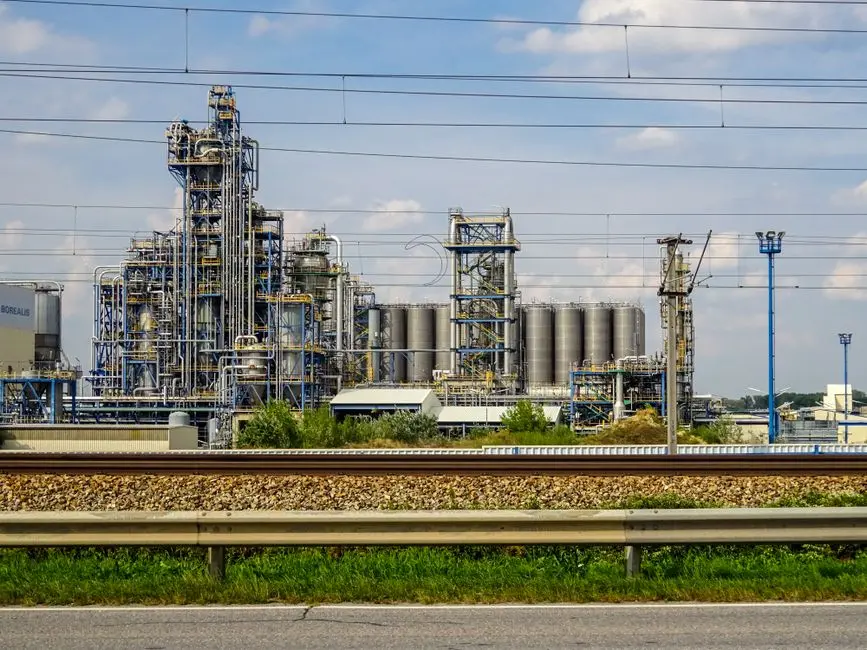
The DAF-vs-clarifier decision is driven by influent, not by vendor preference. The table below maps the dominant chemical-plant wastewater parameters in the Hot Springs service area to expected removal performance and best-fit technology, drawing on 2026 Ecologix industrial benchmarks and HydropureWater field data.
| Influent Parameter | Typical Hot Springs Range | DAF Removal | Lamella Clarifier Removal | Best-Fit Technology |
|---|---|---|---|---|
| TSS (fine/colloidal) | 200–2,000 mg/L | 80–92% | 60–85% | DAF above 500 mg/L with fines |
| FOG (fats, oils, grease) | 100–1,500 mg/L | 90–95% | 50–70% | DAF (per Ecologix 2026 food-plant benchmark) |
| Emulsified oils / surfactants | 50–800 mg/L | 85–94% | 40–60% | DAF — bubble attachment outperforms gravity |
| Heavy metals (Cr, Ni, Zn, Cu) post-pH adjustment | 1–50 mg/L | 70–85% | 85–95% | Lamella — dense hydroxide floc settles fast |
| Hexavalent chromium (after reduction to Cr(III)) | 0.1–10 mg/L | 75–90% | 90–98% | Lamella after FeSO₄ reduction at pH 8.5–9.0 |
| pH < 3 or > 11 | Process excursions | Stable with alloy wetted parts | Stable in concrete/FRP, but floc chemistry fails | DAF in extreme pH service |
| Temperature 30–60 °C | Hot process discharges | Performs; recycle pre-cooling often needed | Performs well; viscosity helps settling | Either; DAF preferred if oil-laden |
The single clearest rule: if the stream is dominated by oils, surfactants, and low-density organics, DAF wins on removal efficiency regardless of CAPEX. If the stream is dominated by precipitated metal hydroxides and dense inorganic TSS, the lamella clarifier hits higher removal at lower cost. The harder cases — surfactant-rich specialty chemical plants that also pickle metals — are exactly the Hot Springs plants running a HydropureWater dissolved air flotation system ahead of a lamella polishing step.
Compliance Map: 40 CFR 414, APCEC Reg. 8, and Pretreatment Limits
40 CFR 414 Subpart B and C set BAT and BCT effluent limitations for OCPSF facilities — daily maximum and monthly average limits for BOD₅ (typically 26–86 mg/L daily max), TSS (37–95 mg/L daily max depending on subcategory), COD, and a long priority-pollutant scan including benzene, toluene, xylenes, and several SVOCs. Hexavalent chromium carries a 0.10 mg/L daily max in many subcategories, and the 2024 EPA effluent guidance is pushing stricter PFAS monitoring for facilities using fluorosurfactants — a relevant trigger for Hot Springs personal-care product manufacturers.
Arkansas APCEC Regulation No. 8 (Operating Air Permit Program) and the Hot Springs POTW pretreatment ordinance sit on top of the federal floor. Local surcharge thresholds typically trigger at TSS > 250 mg/L, O&G > 100 mg/L, and any pH excursion outside 5.0–10.0. PSES (Pretreatment Standards for Existing Sources) versus PSNS (Pretreatment Standards for New Sources) materially change the math for any 2026 plant expansion in Hot Springs — PSNS limits are tighter, often by 30–50%, and apply to new or significantly modified process lines. EPA's 2024–2026 guidance on PFAS and Cr(VI) is already reflected in APCEC enforcement priorities, and APC&EC has signaled in 2025 enforcement summaries that surfactant-rich and Cr(VI)-reduction streams should be treated by a multi-stage train rather than a single clarifier. The practical compliance read: a single lamella is rarely enough in 2026; a DAF-plus-clarifier train, or a DAF with a chemical dosing skid, is becoming the default pretreatment architecture for Hot Springs specialty-chemical facilities.
CAPEX, OPEX, and Footprint: The 2026 Cost Reality
For 50–500 m³/day chemical flows — the dominant range for Hot Springs specialty-chemical and personal-care plants — installed CAPEX in 2026 runs $180–$420k for a DAF skid and $90–$260k for a packaged lamella clarifier, including tanks, pumps, controls, and initial chemical dosing. These figures are illustrative; site-specific sizing depends on hydraulic profile, influent loading, and materials of construction. A PLC-controlled coagulant and polymer dosing skid is typically add-on ($25–$60k) for either technology and is essentially required for streams outside pH 6–9.
OPEX for DAF runs 15–25% higher than lamella at comparable flow, driven by air compressor power (typically 7–15 kW for a 100 m³/day unit), saturated recycle pump duty, and continuous polymer consumption. Lamella OPEX is dominated by sludge pumping and infrequent polymer top-up, with no compressed-air load. Where DAF wins back ground is sludge handling: DAF float is typically 3–6% dry solids versus 1–3% for clarifier underflow, which materially lowers downstream dewatering CAPEX when paired with a plate and frame filter press for cake solids > 25%.
| Cost / Footprint Factor | DAF (50–500 m³/day) | Lamella Clarifier (50–500 m³/day) |
|---|---|---|
| Installed CAPEX (2026, USD) | $180,000–$420,000 | $90,000–$260,000 |
| OPEX (power + chem, $/m³ treated) | $0.45–$0.85 | $0.30–$0.65 |
| Air system power draw | 7–15 kW at 100 m³/day | None |
| Footprint (relative floor area) | 0.6–0.7× (lamella baseline) | 1.0× baseline |
| Sidewall height | < 2.5 m (retrofit-friendly) | 3.5–5.5 m (taller basin) |
| Sludge dry solids | 3–6% | 1–3% |
| Typical polymer dose | 2–8 mg/L | 0.5–3 mg/L |
DAF's shorter sidewall height — often under 2.5 m versus a lamella's 3.5–5.5 m basin — is the single biggest retrofit advantage in Hot Springs, where many plants operate out of pre-existing single-story industrial sheds with limited ceiling clearance.
Decision Framework: Choosing DAF, Clarifier, or Both for Your Plant
Use this four-step rule on your own influent data before the next CAPEX review:
- FOG + emulsified organics > 150 mg/L and TSS < 1,000 mg/L → DAF first stage. You will not match that oil removal with a lamella, and the polymer economics favor DAF for the float fraction.
- Dominant load is precipitated metals or high-density inorganic TSS → lamella clarifier first stage. Metal hydroxide floc settles fast and cheaply; DAF just consumes more polymer for the same outcome.
- Stream contains both (very common in Hot Springs specialty chemical plants) → DAF for oil/surfactant removal, then clarifier for metals polishing, with pH adjustment and a coagulant dosing step between them. The Davidson Drive WWTP's 2026 headworks is designed to receive this kind of staged influent.
- Flows under 20 m³/day or batch operations → packaged lamella clarifier with chemical dosing skid, keeping installed CAPEX under $80,000 and avoiding compressed-air maintenance.
For plants running DAF first, the HydropureWater dissolved air flotation system integrates the saturator, recycle pump, and skimmer in a single skid. For lamella-only or polishing duty, the HydropureWater lamella clarifier ships as a factory-assembled plate pack. For a sister-facility comparison in central Arkansas, see the sister chemicals-wastewater guide for nearby El Dorado, Arkansas.
Frequently Asked Questions
When should a Hot Springs chemical plant pick DAF over a lamella clarifier in 2026?
Choose DAF when FOG and emulsified oils exceed 150 mg/L, when surfactants are present at > 50 mg/L, or when TSS is dominated by low-density colloidal organics above 500 mg/L. Under those conditions, DAF achieves 85–95% oil removal versus 50–70% for a lamella clarifier, per the 2026 Ecologix industrial benchmark.
What 40 CFR 414 limits drive equipment selection for an OCPSF facility?
40 CFR Part 414 Subpart B/C sets BAT limits for BOD₅, TSS, COD, and priority pollutants including hexavalent chromium at 0.10 mg/L daily max in many subcategories. Compliance with the tighter PSNS limits is required for any Hot Springs plant expansion in 2026, and that usually forces a multi-stage train rather than a single clarifier.
How does the Davidson Drive WWTP upgrade affect my 2026 pretreatment decision?
The Davidson Drive plant's April 2026 completion — including new chemical feed, UV, and a 100-ft secondary clarifier — tightens the practical ceiling on what Hot Springs POTW will accept, and local surcharge triggers at TSS > 250 mg/L and O&G > 100 mg/L are being applied more strictly. A DAF-first train is increasingly the lowest-risk pretreatment architecture for surfactant and oil-bearing discharges.
What is the realistic installed CAPEX for a 50–500 m³/day chemical plant in 2026?
For 50–500 m³/day chemical flows, DAF installed CAPEX runs $180,000–$420,000 and lamella clarifier $90,000–$260,000 in 2026, with site-specific sizing and alloy selection driving the spread. DAF OPEX runs 15–25% higher due to air compressor and polymer demand, but produces 3–6% dry-solids float versus 1–3% clarifier underflow.