Newport Food and Beverage Plants Should Default to DAF in 2026
For Newport, Rhode Island food and beverage factories in 2026, choose a dissolved air flotation (DAF) system over a gravity clarifier as the primary solids-removal step: DAF removes 92-97% of total suspended solids and up to 95% of fats, oils, and grease on a footprint 20-25% the size of a clarifier, while producing 3-5% float solids versus 1-2% clarifier underflow. A clarifier only wins for heavy inorganic grit, sub-5 m³/h side streams, or sites reusing an existing serviceable basin.
The decision rule is concrete: default to a DAF system for any Newport food and beverage stream above 5 m³/h with FOG above 200 mg/L, and revert to a lamella clarifier only for grit, low flow, or an existing-basin retrofit. The headlining performance gap comes from HydropureWater's 2025 framework: 92-97% TSS and up to 95% FOG on DAF versus 40-70% TSS and under 50% FOG on a clarifier treating the same stream (HydropureWater, 2025). The Ecologix 2026 update confirms the split in a paired case — 95% oil and grease removal on DAF versus 70% on a clarifier for a high-oil food plant, while a heavy-sediment mining stream did the inverse and hit 90% TSS on a clarifier at lower cost (per ecologixsystems.com, 2026).
The single most decisive site constraint for Newport is surface loading rate. DAF operates at 5-15 m/h versus less than 2 m/h for a clarifier, which collapses a 50 m³/h dairy or distillery wash stream from a 200 m² concrete basin down to roughly a 15 m² skid (HydropureWater, 2025). That gap determines whether a retrofit fits on an existing Newport pad near the sewer tie-in or whether civil work blows the capital budget.
What Newport Wastewater Actually Looks Like
Raw influent at a Newport food or beverage plant runs 200-3,000 mg/L FOG and 500-5,000 mg/L TSS, with hourly swings driven by CIP cycles, cook dumps, and rendering release events (HydropureWater, 2025). The local mix is unusual: seafood processors, craft distilleries, breweries, sauce and dressing lines, and bakeries all discharge into the same Narragansett Bay Commission service area, and each one punishes a clarifier differently.
Newport seafood streams — lobster, squid, finfish — run cool, often below 12 °C through the October-April window, and carry a high brine fraction that swings pH and conductivity. That overlay is the same one the Pacific salmon-stream case exposed, where temperature and brine invalidate any generic DAF-vs-clarifier guide written for a Fresno dairy or Midwest meat plant (HydropureWater, 2025). Distillery and craft brewery duty adds high-BOD slug loads during cook and ferment CIP, plus yeast and grain solids that float rather than settle — the canonical low-density-solids case a clarifier cannot reach within practical retention. Sauce, dressing, and bakery streams contribute emulsified oil, egg solids, and starch that exhibit the same float-not-settle behavior; force-settling those on a clarifier requires 3-5x the polymer dose a DAF would need and accepts a much larger sludge volume (HydropureWater, 2025).
The regional quirk is that Narragansett Bay seafood processors face the same cold-stream and brine overlay as Pacific salmon plants, and the design response — temperature-derated saturation pressure and a high-chloride SS316 wetted path — is identical. The Pacific reference is useful for sizing, but the local permit authority is different; see the plastics and rubber DAF vs clarifier guide for a comparable industry overlay on a different municipal regime.
Newport Permit Drivers and Pretreatment Economics in 2026
The DAF-versus-clarifier choice is being forced by local surcharges and federal categorical standards, not by preference. The local surcharge authorities are the Narragansett Bay Commission (NBC) sewer use ordinance, the Narragansett Bay Estuary Program, and the parallel Rhode Island DEM industrial wastewater program; FOG and TSS surcharges across these schedules escalated into 2026 and are the single largest avoidable cost line on a Newport food and beverage plant's monthly sewer bill.
The federal ceiling is set by 40 CFR Part 133 secondary treatment standards and 40 CFR 408 canned, preserved, and seafood processing categories, which define the categorical pretreatment backdrop the regional programs enforce (HydropureWater, 2025). For Newport seafood specifically, 40 CFR 408 is the right reference rather than the generic food-processing language used for Midwest plants.
Three operating realities force a temperature-corrected and chemistry-corrected design. First, winter effluent at 8-12 °C carries substantially less dissolved air than summer effluent at 25-35 °C at the same saturation pressure, so a DAF sized at nameplate flow without a temperature derate will underperform October through April in Newport (HydropureWater, 2025). Second, high-CIP-caustic streams and seafood brines routinely push pH above 9, which collapses cationic flocculant performance; the 6.5-8.5 pH band is a hard precondition, not a guideline (HydropureWater, 2025). Third, brine and chlorides push the material spec toward SS316 or higher alloys for Newport seafood and distillery duty, not the SS304 baseline that most vendor proposals default to. For pretreatment chemistry and dosing controls, see the chemical dosing cost optimization guide for a related industry framing.
DAF vs Clarifier: The Head-to-Head Matrix
The matrix below is the artifact to screenshot and paste into the next capital request memo. Numbers reflect typical operating bands for Newport food and beverage streams and should be verified against jar testing and vendor proposals before a P&O is locked.
| Parameter | DAF | Gravity Clarifier |
|---|---|---|
| FOG removal | 90-95% (HydropureWater, 2025) | <50% on FOG; 40-70% on heavy inorganics only (HydropureWater, 2025) |
| TSS removal | 92-97% (HydropureWater, 2025) | 40-70% on inorganics; <50% on floatable solids |
| Surface loading rate | 5-15 m/h | <2 m/h |
| Footprint (50 m³/h) | ~15 m² skid | ~200 m² concrete basin |
| Energy | 0.2-0.5 kWh/m³ (recycle pump + air compressor) | Minimal pumping, no aeration |
| Polymer dose (forced FOG removal) | Baseline (jar-test target) | 3-5x DAF dose (HydropureWater, 2025) |
| Sludge dryness | 3-5% float solids | 1-2% underflow |
| CAPEX band (50 m³/h) | $120,000-$180,000 SS304 skid with PLC + dosing (HydropureWater, 2025) | $50,000-$500,000 new basin; lower if existing concrete is serviceable |
| OPEX driver | Polymer + energy; sludge hauling offset | Sludge hauling (large dilute volume) + overdose polymer penalty |
| Best-fit stream | FOG, protein, fiber, low-density solids, food and beverage duty | Heavy inorganic grit, low-flow side streams, retrofit on existing basin |
The Ecologix 2026 paired case anchors the matrix with a real-world citation: 95% O&G on DAF versus 70% on a clarifier for a high-oil food plant, and the inverse — 90% TSS on a clarifier at lower cost — for a heavy-sediment mining stream (per ecologixsystems.com, 2026). The retrofit DAF-as-polish configuration ahead of an existing lamella clarifier often reaches compliance at roughly half the CAPEX of full replacement, and pairs downstream with a plate-and-frame filter press to push float from 3-5% to 25-35% cake solids.
How a DAF Actually Removes What a Clarifier Cannot
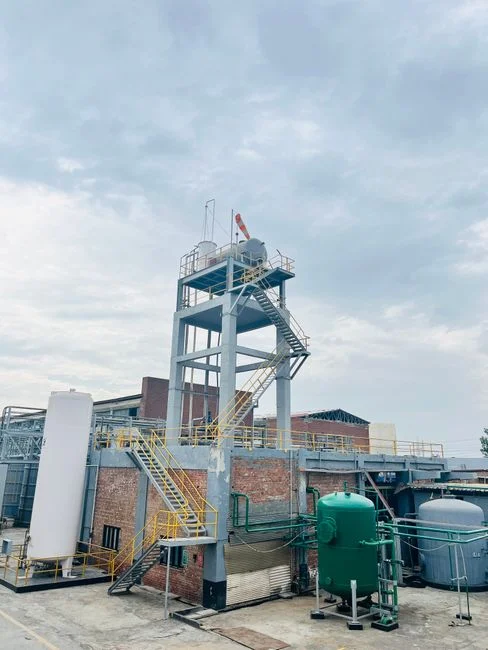
A DAF presses micro-bubbles onto flocculated particles and floats them upward; a clarifier waits for gravity to pull them down. Inside a DAF, 10-30% of clarified recycle is pressurized in a saturation vessel at 4-6 bar to 85-95% air saturation efficiency, then released through needle-valve orifices. The dissolved air comes out of solution as 20-100 μm micro-bubbles; the 30-50 μm band is the engineering target because it gives the right surface-area-to-buoyancy ratio without violent rising velocity (HydropureWater, 2025). Bubbles nucleate on pre-formed flocs, and the air-filled aggregate rises to the surface in minutes, where a paddle skimmer removes it at 3-5% solids.
A conventional gravity clarifier relies on Stokes' law. For FOG, fruit pulp, blood proteins, and fine cellulose — all with specific gravity at or below 1.0 — that settling requires hours, which is why clarifier retention sits at 2-4 hours and surface loading rates stay below 2 m/h. To force a clarifier to remove FOG, operators overdose coagulants — typically 3-5x the polymer a DAF system would need — and accept both the OPEX penalty and the larger sludge volume.
The four operating dials an operator turns on a DAF are recycle ratio, saturation pressure, polymer charge and dose, and pH, held in the 6.5-8.5 window where most cationic flocculants perform. An automatic chemical dosing skid locks that pH band and the polymer dose to the jar-test target. The cold-stream implication is direct: saturation efficiency drifts season to season, so a Newport DAF must be sized for real peak plus a temperature derate, not nameplate flow (HydropureWater, 2025).
DAF Sizing Rules for a Newport Food or Beverage Plant
The matrix tells you what a DAF does; the spec table below tells you what to put on the requisition. The 2026 update is a wider flow band and broader automation, but the underlying sizing rules have not changed.
| Spec parameter | Value | Why it matters for a Newport food plant |
|---|---|---|
| Flow band | 4-300 m³/h across 13 standard models | Covers a craft brewery line through a large seafood processor (HydropureWater, 2025) |
| Sizing basis | Peak hourly flow, not nameplate | Undersizing causes float carryover; oversizing wastes CAPEX (HydropureWater, 2025) |
| Material | SS304 standard; SS316 mandatory for high-chloride seafood, hot washwater, distillery cook condensate, and rendering condensate; PP and higher alloys on request | Brine and chlorides push the spec past SS304 baseline |
| Temperature derate | Size for real peak plus winter 8-12 °C correction | Winter effluent carries less air than summer effluent at the same saturation pressure |
| Upstream screen | Rotary mechanical bar screen required | Hair, fish solids, and packaging fragments reach the DAF within hours without screening; clogged recycle nozzles are the #1 unplanned shutdown cause (HydropureWater, 2025) |
| Automation | PLC-controlled skimmer, polymer dose, and pressure setpoint package with remote alarming | Required for 2026 multi-site Newport operators running labor-light shifts |
The standard DAF system ships with the PLC and dosing architecture above as standard options. Pair the skid with a rotary mechanical bar screen upstream and an automatic chemical dosing skid on the floc line, and the unit will hold its spec band across the October-April cold window.
Worked Payback: 50 m³/h Newport Distillery or Seafood Plant
The example below uses a representative 50 m³/h distillery or seafood washwater stream at 1,500 mg/L TSS and 600 mg/L FOG — typical of a mid-sized Newport craft distillery or finfish processor (HydropureWater, 2025). A 50 m³/h mid-range SS304 DAF unit with PLC and dosing skid typically lands between $120,000 and $180,000, with a 1.5-3 year payback from sludge-disposal savings and avoided NBC FOG and TSS surcharges.
| Line item | Calculation | Annual range |
|---|---|---|
| CAPEX (50 m³/h, SS304, PLC + dosing) | DAF mid-range with automation | $120,000-$180,000 (HydropureWater, 2025) |
| Energy OPEX | 0.2-0.5 kWh/m³ × 50 m³/h × 8,000 h/yr × $0.18-$0.22/kWh (2026 New England industrial tariff) | $14,400-$44,000/yr |
| Polymer OPEX | 0.5-5 mg/L × 50 m³/h × 8,000 h = 200-2,000 kg/yr × $4-$8/kg | $800-$16,000/yr |
| Sludge disposal (DAF float at 3-5% solids) | ~50-70% lower volume than clarifier underflow | $40,000+/yr savings vs. clarifier case (HydropureWater, 2025) |
| Payback window | Sludge savings − energy − polymer, divided into CAPEX | 1.5-3 years; compresses further with avoided NBC FOG/TSS surcharges |
The gap between the best-case and worst-case polymer OPEX is wider than most mid-sized Newport plants' entire annual maintenance budget, so a jar test on the actual influent should always precede the polymer dose lock. Downstream, a plate-and-frame filter press pushes DAF float from 3-5% to 25-35% cake solids, cutting hauled volume another 80-85% beyond the DAF float alone.
When a Clarifier Still Wins in Newport
Credibility comes from naming the cases where DAF is overkill. A clarifier remains the better answer for: heavy inorganic grit (e.g., a distillery grain-handling line with soil and abrasive carryover) — clarifier settles 40-70% on heavy inorganics where DAF struggles; very low-flow side streams under 5 m³/h with low FOG, where the CAPEX per cubic meter of a DAF skid does not amortize and a small lamella clarifier is cheaper; an existing serviceable concrete basin, where a retrofit DAF-as-polish ahead of the clarifier is the right path and full replacement is not; and a Newport plant layout constraint with no usable pad near the sewer tie-in and no way to add a chemical dosing skid upstream of the basin (HydropureWater, 2025).
Outside these four cases — and outside small-flow, low-strength side streams — DAF wins on every metric that matters to a Newport operator: removal efficiency, footprint, sludge dryness, and pretreatment surcharge exposure.
2026 Permit-Readiness Checklist for a Newport DAF Project
Convert the article into an action list to hand to a vendor or to operations: pull a 7-day composite influent sample for FOG, TSS, pH, temperature, and chloride to baseline NBC surcharge exposure before sizing; jar-test the polymer and dose on the actual influent — do not accept a vendor default (HydropureWater, 2025); confirm peak hourly flow, not nameplate, and apply a temperature derate for the October-April cold-stream window; specify SS316 wetted path for any seafood, distillery cook condensate, or high-CIP-caustic stream; require an upstream rotary mechanical bar screen, an automatic chemical dosing skid, and PLC alarming in the requisition (HydropureWater, 2025); and plan dewatering with a plate-and-frame filter press to push DAF float from 3-5% to 25-35% cake solids, cutting hauled volume another 80-85%.
Frequently Asked Questions
DAF or clarifier for a Newport food or beverage plant in 2026?
Default to a DAF system for any Newport food and beverage stream above 5 m³/h with FOG above 200 mg/L — DAF delivers 92-97% TSS removal and up to 95% FOG removal on a footprint 20-25% the size of a clarifier. A clarifier only wins for heavy inorganic grit, very low-flow side streams, or sites reusing an existing serviceable basin.
Can a DAF polish an existing clarifier instead of replacing it?
Yes. A retrofit DAF-as-polish configuration ahead of an existing clarifier often reaches compliance at roughly half the CAPEX of full replacement, which is the dominant real-world scenario for older Narragansett Bay plants with a serviceable basin.
What flow band does the DAF cover?
The DAF line spans 4-300 m³/h across 13 standard models, covering a craft brewery line through a large seafood processor (HydropureWater, 2025).
Is SS304 enough for seafood brine?
No. Brine and chlorides push the material spec toward SS316 or higher alloys for Newport seafood and distillery duty, not the SS304 baseline.
What is the typical payback for a 50 m³/h Newport DAF?
A 50 m³/h mid-range SS304 DAF unit with PLC and dosing skid typically lands between $120,000 and $180,000, with a 1.5-3 year payback from sludge-disposal savings and avoided NBC FOG and TSS surcharges (HydropureWater, 2025).