Why Bainbridge Island Chemical Plants Are Re-Evaluating Primary Treatment in 2026
Federal categorical standards under 40 CFR Part 414 — covering the Organic Chemicals, Plastics, and Synthetic Fibers (OCPSF), Inorganic Chemicals, Soap & Detergent, Fertilizer, and Petroleum Refining subcategories — set BPT, BAT, PSES, and PSNS effluent limits that any chemical-manufacturing categorical discharger must meet before discharge to a POTW (per EPA 40 CFR Part 414). For a Bainbridge Island chemical plant, King County Industrial Waste Program local limits are routinely more stringent than the federal floor, particularly for metals, FOG, and pH excursions on slug discharges. Layered on top of that, EPA's 2024 PFAS and 1,4-dioxane listings and Washington State Department of Ecology's 2024–2026 Chemical Action Plan have moved both compounds into routine monitoring triggers at the plant-side headworks — making the primary removal stage (DAF or clarifier) the first compliance gate, not the polishing step it used to be (per Washington State Department of Ecology, 2024).
Logistics on a Puget Sound island are not abstract. Skids and concrete tanks must come off a Washington State Ferry or a barge terminal, and haul-off of dewatered sludge is constrained by the same ferry schedule that constrains inbound chemical delivery. That reality pushes Bainbridge Island plants toward factory-tested, skid-mounted units with small footprints and minimal operator attendance. The local engineering community has documented experience with both DAF and clarifier optimization: Randal W. Samstag, PE, BCEE, based on Bainbridge Island, presented CFD modeling of clarifier feedwell geometry and DAF nozzle/air-introduction design to the University of Washington Department of Civil and Environmental Engineering on 7 April 2016, citing Amato & Wicks (2009) on DAF capacity headroom and Samstag et al. (2010, 2014) on radial-flow clarifier feedwell optimization. For a 2026 retro-fit, that local CFD bench strength is worth leaning on. Operators scoping a 2026 expansion can review the parallel chemical-plant 2026 pretreatment compliance guide for the regulatory frame that drives both CapEx and OPEX decisions.
Influent Checklist: What Your Chemical Plant Wastewater Actually Looks Like
Choosing a DAF or a clarifier without a current influent profile is how plants buy the wrong unit. The minimum parameter set a chemical-plant engineer should have on a 7-day composite before any vendor meeting:
- TSS (mg/L) and TDS (mg/L) — sets whether the contaminant will float or sink.
- FOG (mg/L) and oil droplet size distribution — droplets < 20 µm are typically emulsified and need chemical demulsification ahead of either technology.
- COD / BOD (mg/L) and pH (range, not just average) — slug discharges from specialty batch reactors will swing pH 2–12 within an hour.
- Temperature (°C) — viscosity at 5 °C winter conditions on Bainbridge Island is meaningfully different from 25 °C summer bench data.
- Emulsification (Y/N) and density difference (Δρ, kg/m³) between the dispersed phase and water.
Typical Bainbridge Island chemical sub-streams map cleanly to the technology decision. Specialty-coatings washwater carries high FOG, emulsified oils, and organic solvents — a classic DAF feed. Water-treatment-chemical production (ferric chloride, alum, polymer flocculants) generates metal-hydroxide and dense salt slurries with minimal oil — a clarifier feed. Biotech and specialty-batch chemical reactors generate variable-pH, low-volume slug discharges that violate a steady-state clarifier's hydraulic assumptions, which is why a skid-mounted DAF with buffer equalization tends to be the default for those lines.
Two pre-selection tools are reliable: bench-scale jar testing (which quantifies floc chemistry, dose response, and settle-vs-float behavior) and CFD modeling of the proposed vessel (which quantifies hydraulic short-circuiting, dead zones, and achievable capacity). Komline-Sanderson's published DAF product literature states that "lab or pilot testing is often the best way to determine the correct separation characteristics of a given waste stream" and that "DAF pilot units are available for rental for testing at customer facilities" (per Komline-Sanderson DAF product bulletin). For a chemical plant that needs both floc chemistry and hydraulic confidence, a paired jar + pilot rental is the cheapest insurance against a six-figure re-spec. Coagulant and flocculant doses should be controlled by a HydropureWater automatic chemical dosing skid sized to the peak hourly flow, not the average.
How DAF and Clarifiers Each Work in a Chemical Plant
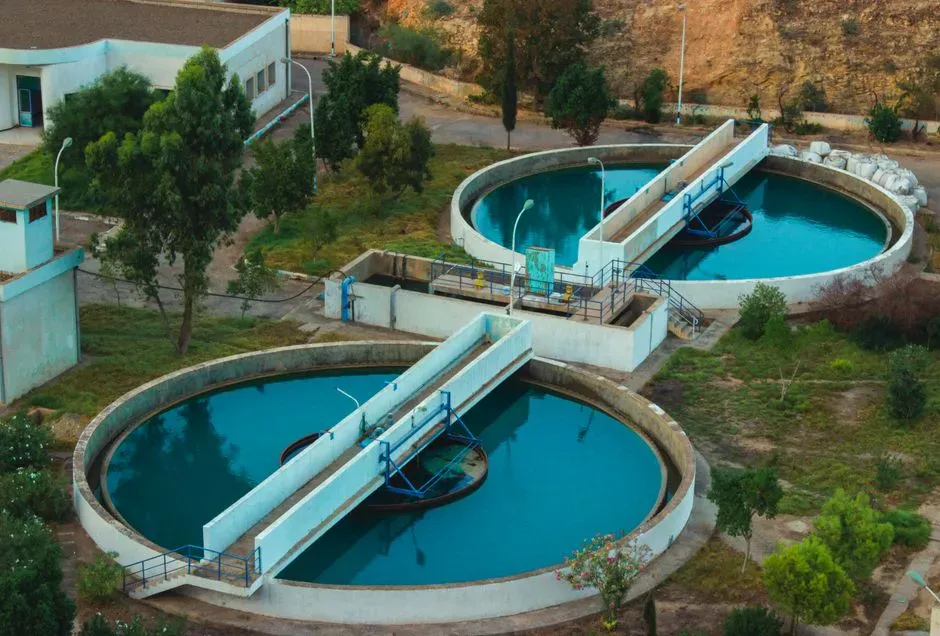
DAF works by attaching microbubbles to particles so that the effective density of the particle-bubble aggregate is less than water. The Komline-Sanderson DAF product bulletin describes the mechanism: "dissolve air into water under pressure and then reduce the pressure of the solution. As the pressure is reduced, the air comes out of solution in the form of microbubbles," and that this attachment "reduces the density of the particle resulting in increased buoyancy, thus affecting flotation" (per Komline-Sanderson). Typical microbubble diameters fall in the 10–100 µm range, which is small enough to attach to emulsified oil droplets and to fine, low-density suspended solids that would not settle in any reasonable time horizon. Float is skimmed by a top-collector assembly to a discharge hopper, and "bottom collectors are sometimes used to remove solids that might settle at the bottom of the tank" — a design feature that lets one DAF handle the settleable fraction of a mixed stream (per Komline-Sanderson).
A clarifier works by gravity sedimentation. A circular or rectangular basin holds the wastewater long enough for settleable solids to fall to a sludge blanket at the bottom; clarified effluent overflows a peripheral launder. A lamella (inclined-plate) clarifier inserts a stack of plates at 55–60° inside the tank, which dramatically increases the effective settling area inside the same footprint. The catalog spec for the HydropureWater dissolved air flotation system and the HydropureWater lamella clarifier places lamella surface loading at 20–40 m/h, with up to 30% lower coagulant/flocculant consumption than a conventional clarifier handling an equivalent flow (HydropureWater catalog, 2026).
CFD is the bridge between these two unit operations and a defensible design margin. Samstag's UW presentation documents that CFD "can compute three-dimensional velocity fields and follow interactions of reactants and products through a tank" and that for a DAF, the technique is used for "prediction of absolute maximum capacity (typically 10–20% above design max)" and for "comparison of nozzle design and air introduction" (per Samstag 2016 UW presentation, citing Amato & Wicks 2009). For a clarifier, the same presentation shows CFD being used to optimize feedwell geometry, inlet configuration, and depth — work Samstag published with Wicklein in 2014. A Bainbridge plant that needs to defer a tank expansion can use CFD to defend a 10–20% hydraulic uprate to King County rather than pouring new concrete.
Side-by-Side: DAF vs Clarifier for Chemical Wastewater Streams
Below is the matrix a chemical-plant engineer can take into a vendor meeting. The DAF removal figures are anchored to the 2026 Ecologix industrial selection guide, which cites a food-processing case at 95% FOG removal for DAF vs 70% for a clarifier on the same stream; the clarifier dense-solids figure is anchored to the same source's mining case at 90% TSS reduction at lower OPEX (per Ecologix, 2026 update). For a Bainbridge Island chemical plant, the dense-solids row is the most decision-relevant because metal-hydroxide and salt-slurry streams are common.
| Removal target / stream type | DAF performance | Clarifier (lamella) performance | Recommended choice |
|---|---|---|---|
| FOG & light oils (coatings washwater, specialty batch) | ~95% FOG removal; handles 10–100 µm droplets | ~60–70% FOG; poor on emulsified oil | DAF |
| Dense inorganic / metal hydroxide / salt slurries | Underperforms — particles already denser than water | ~85–90% TSS reduction; lower OPEX | Lamella clarifier |
| Emulsified organics, latex, solvent micro-droplets | Standard with coagulant/demulsifier pretreatment | Underperforms without upstream chemical break | DAF (often paired with polishing lamella) |
| Variable pH, slug discharges, low flow | Compact skid, 4–300 m³/h envelope, fast recovery | Footprint scales with surface area; lamella mitigates | DAF (skid) or hybrid |
| Mixed streams (oil + dense solids + slugs) | Handles float; bottom collectors capture settleables | Handles settleables; poor on free and emulsified oil | Hybrid DAF → lamella (2026 default) |
The hybrid row is the one that matters most for a 2026 chemical-plant retro-fit on Bainbridge Island. Komline-Sanderson's design note confirms that "bottom collectors are used in a DAF to remove any portion of the influent solids that settle rather than float," and that the DAF can be supplied as "a complete system" including "chemical pretreatment tanks, mixers, and pumps" and "concentrated float dewatering equipment" (per Komline-Sanderson). For more on micro-bubble sizing and the 10–20% capacity uprate case, the 2026 micro-bubble flotation engineering guide is the technical deep-dive.
2026 Footprint, CapEx, and OPEX for Bainbridge Island Flow Rates
Convert the technology decision into numbers a plant manager can defend. The DAF OPEX benchmarks from the 2026 DAF OPEX breakdown and ROI data place energy at $0.01–$0.04/m³ and polymer at $0.005–$0.04/m³ for a chemical-plant feed; clarifier OPEX is dominated by polymer and sludge-handling rather than energy. Sludge handling often dominates 5-year TCO because a DAF float is typically thicker and easier to dewater, while a clarifier underflow is wetter and drives higher HydropureWater plate and frame filter press cycle OPEX.
| Item (5-yr TCO driver) | DAF (skid, 10–50 m³/h) | Lamella clarifier (10–50 m³/h, alloy) |
|---|---|---|
| CapEx envelope (2026) | Moderate–high (skid, saturator, recycle pump, dosing) | Lower for carbon-steel circular; approaches DAF when 2205/SS-clad for chloride service |
| Energy OPEX | $0.01–$0.04/m³ (air compressor, recycle pump) | ~$0.005–$0.015/m³ (rake/sludge pump only) |
| Chemical OPEX | $0.005–$0.04/m³ polymer + coagulant | Lower dose; ~20–30% saving vs conventional clarifier (HydropureWater catalog) |
| Sludge solids (typical) | 3–6% float; easier dewatering | 1–3% underflow; wetter cake |
| Footprint | 4–300 m³/h envelope in a single skid; small pad | Larger pad; lamella mitigates ~3–5× vs circular |
| Bainbridge logistics factor | Factory-tested skid wins on ferry freight + schedule | Field-built concrete tank inflates both cost and schedule |
Ferry-freight cost is a real Bainbridge Island line item, not a theoretical one. A 12 m³ DAF skid and a 50 m³/h lamella clarifier both fit on a single standard ferry barge, but a field-built 8 m × 4 m × 4 m concrete tank does not. For 2026 capex, factory-tested skids win on schedule risk as well as dollar cost — which is why the hybrid DAF + lamella default is also a logistics default on the island.
Decision Framework: Which Should Your Bainbridge Chemical Plant Pick in 2026?
Five steps, in order, before any purchase order is signed:
- Measure. Pull a 7-day composite of FOG, TSS, droplet size, density difference, pH range, and temperature from the worst-case stream (not the average).
- Identify the dominant contaminant. Oil/grease → DAF. Dense inorganic solids → lamella clarifier. Mixed → hybrid.
- Match to the comparison matrix above. If two rows apply, run jar tests on both chemistries.
- Run jar tests and CFD. Use Samstag-style CFD (per his 2016 UW presentation) to defend any 10–20% hydraulic uprate, and a Komline-style pilot rental to confirm the DAF removal number before sizing. The same matrix and reasoning applies on a mainland site, as the parallel Mojave chemicals-wastewater DAF vs clarifier 2026 guide demonstrates.
- Confirm local compliance. King County Industrial Waste Program discharge limits, your 40 CFR Part 414 subcategory, and Washington State Ecology's PFAS/1,4-dioxane monitoring triggers (per the 2024 Chemical Action Plan) all need to be cleared at the primary-removal step.
One-line rule of thumb: float what floats, settle what sinks; chemistry decides the rest. The 2026 default pretreatment train for a new chemical-plant expansion on Bainbridge Island is DAF primary → lamella polish → biological or AOP for residual organics, with sludge dewatered on a filter press. PFAS and 1,4-dioxane are not removed at this stage to any meaningful extent — they require downstream carbon adsorption or AOP, which is why the primary treatment decision is about protecting downstream unit operations and meeting the categorical limits, not about chasing PFAS at the headworks.
Frequently Asked Questions
For a chemical plant on Bainbridge Island, is a DAF or a clarifier better for FOG removal?
A DAF. The 2026 Ecologix industrial benchmark puts DAF at ~95% FOG removal versus ~60–70% for a clarifier on the same stream, and the 10–100 µm microbubbles generated by a pressurized saturator attach to emulsified oil droplets that a gravity settler cannot capture in any reasonable residence time. Choose the technology by the dominant contaminant — float what floats, settle what sinks.
Which federal and local rules govern this decision in 2026?
40 CFR Part 414 sets the federal categorical standards (BPT, BAT, PSES, PSNS) for chemical-manufacturing subcategories including OCPSF and Inorganic Chemicals (per EPA). King County Industrial Waste Program local limits are typically more stringent than the federal floor for FOG, metals, and pH. Washington State Department of Ecology's 2024 Chemical Action Plan layers on PFAS and 1,4-dioxane monitoring triggers that are now part of routine headworks sampling. Primary removal (DAF or clarifier) is the first compliance gate, not the last.
What footprint and chemical savings does a lamella clarifier offer on Bainbridge Island?
The HydropureWater lamella clarifier catalog spec is 20–40 m/h surface loading rate with up to 30% lower chemical consumption than a conventional clarifier at the same TSS load (HydropureWater catalog, 2026). For a chemical plant on a constrained island pad, that translates to roughly 3–5× smaller footprint than a circular clarifier of equivalent capacity, plus a meaningful OPEX reduction on coagulant and flocculant dose.
What if my chemical plant has both oil and dense solids in the same stream?
Use a hybrid DAF + lamella clarifier. DAF primary removes FOG, free oil, and low-density suspended solids (with bottom collectors handling the settleable fraction per the Komline-Sanderson design note); a downstream lamella polishes residual TSS and captures dense inorganic carryover. This is the 2026 default for new chemical-plant pretreatment trains. For OPEX modeling, the 2026 DAF OPEX breakdown and ROI data article is the working reference.
Should I pilot-test before buying a DAF or clarifier?
Yes. Komline-Sanderson explicitly offers DAF pilot units for rental for testing at customer facilities, and a jar-test program should be paired with the pilot to bracket floc chemistry, dose response, and settle-vs-float behavior (per Komline-Sanderson). For a Bainbridge Island chemical plant facing ferry-freight logistics on a 5–10 m³/h skid, a 2–4 week pilot rental is the cheapest insurance against a six-figure re-spec.