Why Vernal Mining Plants Face a Different DAF-vs-Clarifier Question
For Vernal, USA mining and metals plants in 2026, the DAF-vs-clarifier question lives inside a constraint set that generic guides ignore. The Uinta Basin sits at roughly 1,500 m elevation, with winter lows dropping below -20°C and freeze events that shut down exposed clarifier launders, DAF recycle lines, and equalization basins for days at a time (NOAA NCEI 2024-2025 climate normals for Vernal, USW00094195). The mining mix is unusually diverse for a single basin: potash solution mining (legacy Intrepid-era operations), vanadium and uranium recovery from oil-shale byproducts, frac sand wash water, copper concentrate trans-load stormwater, and aggregate wash circuits — each producing a distinct suspended-solids and reagent profile. The shared compliance lens is EPA 40 CFR 440, covering TSS, pH, and total recoverable Cu, Pb, Zn, Ni, Cd. Utah DEQ NPDES permits in the Basin tend to tighten those limits rather than relax them, especially for discharges to the Green River drainage or to on-site Class V UIC disposal wells. Real mining-adjacent DAF feed streams documented in South Africa's Midvaal case carried 3,497-4,693 mg/L TSS and 2,457-4,880 NTU turbidity — figures that are unusually high for drinking-water work but normal for mineral-processing effluents (Janse van Rensburg et al., Water SA, 2019-07). A Vernal engineer designing equalization for a 2026 retrofit should expect influent inside that band, not the 200-800 mg/L range that municipal DAF quotes assume. The freeze-risk math is the part that breaks the generic S2 cost table: buried or insulated tanks and heat-traced airlines add 5-10% to installed cost, and that premium is not optional in Uintah County between November and March.
The Four Contaminant Classes That Drive the 2026 Decision
Most 2026 DAF retrofit failures in the Basin trace back to vendors who quoted on flow capacity without reading the influent. The feed drives the technology, and mining feeds split into four working classes. Class 1 — suspended metal-hydroxide flocs (Fe, Mn, Al, Cu, Zn) precipitate at near-neutral pH with specific gravities inside the ±5% gravity window where settling stalls (HydropureWater field data, 2025). A conventional clarifier simply cannot pull these out reliably. Class 2 — abrasive silica and ore grit >200 µm destroys DAF air-release nozzles and recycle pumps unless a rotary mechanical bar screen sits upstream to remove coarse debris before it reaches the flotation cell. Class 3 — residual flotation reagents (xanthates, dithiophosphates, fatty acids) are hydrophobic and attach readily to micro-bubbles, which skews the comparison toward DAF whenever the mill uses a froth circuit upstream. Class 4 — process oils from mill lubrication float readily and again favor DAF, but a coalescer or oil-skim polish is required downstream if BOD loading to the NPDES outfall is high. The dynamic stress on top of those four classes is severe: pH swings 6-11 as lime, caustic, or sulfuric acid doses shift across a single mill shift, and hydraulic flow routinely varies 2:1-4:1 as mills ramp up or bypass streams recycle (HydropureWater field data, 2025). Any 2026 spec that treats the influent as steady-state will fail the first Utah DEQ inspection.
How Each Technology Actually Separates Solids
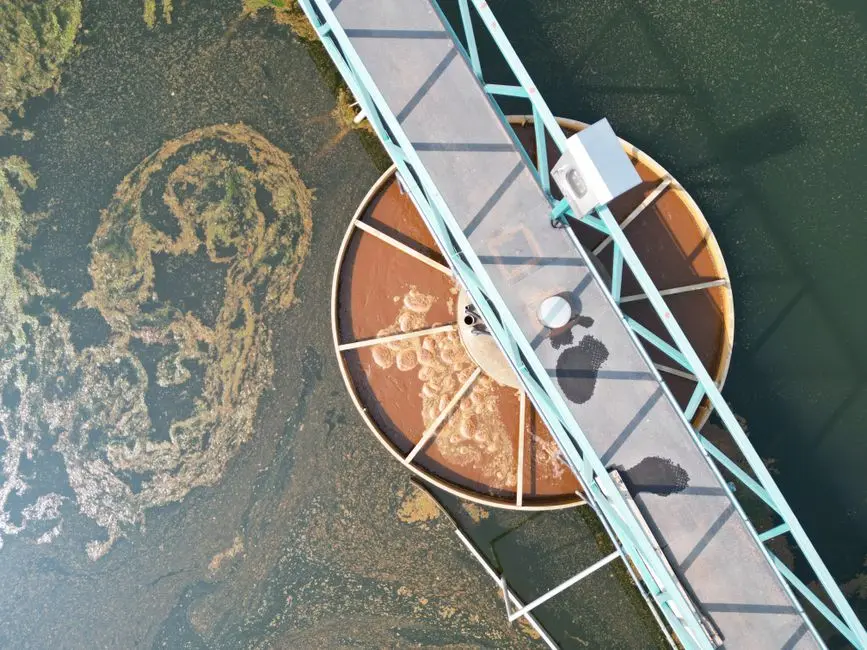
A conventional clarifier is a passive gravity vessel — water enters a center well, flows radially outward, and particles denser than water settle over a 2-4 hour retention period. The only adjustable levers are sludge withdrawal rate and scraper RPM; surface loading typically runs 1-3 m/h. DAF is active. A pressurized recycle stream equal to 10-30% of clarified effluent is saturated with air at 4-6 bar (85-95% saturation efficiency), then released at atmospheric pressure inside the flotation tank. The pressure drop nucleates 20-100 µm micro-bubbles that attach to conditioned flocs and lift them to the surface, where a skimmer sweeps them into a hopper. Surface loading on DAF runs 5-15 m/h — roughly 5× a clarifier — which is why DAF footprints are typically a quarter of the equivalent clarifier (HydropureWater field data, 2025). The engineering intuition that matters for a Vernal procurement meeting: bubble buoyancy beats gravity for any particle with SG near 1.0, and the difference between a working float layer and a collapsed one is polymer conditioning — typically 0.5-5 mg/L of anionic or cationic polyacrylamide dosed through an automatic chemical dosing skid tied to flow proportional control. Energy footprint is the OPEX pivot: DAF at 0.2-0.5 kWh/m³ versus clarifier near zero active power, with the tradeoff paid back through drier sludge and smaller equalization basins.
Side-by-Side Comparison: DAF vs Clarifier on Mining Streams
The table below is the artifact a procurement lead can paste into a 2026 project memo. Ranges reflect the spread between SS304 retrofits and full SS316 mining builds at 4-300 m³/h (HydropureWater field data, 2025).
| Parameter | DAF | Conventional Clarifier |
|---|---|---|
| TSS removal (mining feed) | 92-97% | 40-70% on light solids; 70-90% on dense grit only |
| Surface loading rate | 5-15 m/h | 1-3 m/h |
| Footprint vs clarifier baseline | ~0.25× | 1× baseline |
| Hydraulic surge tolerance (2:1-4:1 swing) | High — active aeration tunable | Low — effluent quality degrades |
| Sludge dryness | 3-5% solids float | 1-2% solids underflow |
| Tolerance to abrasive grit >200 µm | Low without upstream screening | High |
| Polymer requirement | 0.5-5 mg/L routine | Coagulant only on colloidal feeds |
| Energy use | 0.2-0.5 kWh/m³ | Near zero active; underflow pumping only |
| Dominant OPEX driver | Polymer + compressed air | Sludge hauling volume |
| CAPEX band (4-300 m³/h, 2026) | $50,000-$500,000 | 30-50% lower equipment cost; civil cost often closes the gap to 10-25% |
| Best-fit feed | Metal hydroxides, oils, reagent residue | Coarse silica, sulfide tailings, ore >200 µm |
Three takeaway lines for the 2026 memo: DAF wins on footprint, sludge dryness, and surge tolerance — the three OPEX-heavy parameters that hit a Vernal plant hardest because long-haul disposal to the nearest permitted UIC well runs into six figures annually. Clarifier equipment cost is 30-50% lower, but the installed-cost gap shrinks to 10-25% once civil and foundation work are counted, and a DAF system occupying a quarter of the area requires significantly less concrete in a basin where ready-mix delivery already carries a winter surcharge (HydropureWater field data, 2025).
Vernal-Specific Decision Matrix: Which Technology Fits Your Mine
The four-cell matrix below translates the comparison into a self-select artifact. Pick the row that matches your feed.
| Feed Profile (2026) | Recommended Primary | Polishing / Secondary |
|---|---|---|
| Emulsified oils + reagent residue + fine metal hydroxides (SG ≈ 1.0) + flow variability >2:1 | DAF system | Optional lamella clarifier polish for TSS <30 mg/L reuse |
| Dense abrasive silica grit + sulfide tailings + coarse ore >200 µm + low organic loading | Conventional clarifier | Upstream rotary mechanical bar screen for grit removal |
| Mixed feed: precipitates + grit + reagent residue, NPDES TSS <30 mg/L or water-reuse target | DAF first | Lamella clarifier polish, then ion exchange or chemical precipitation for metals per 40 CFR 440 |
| Pure grit-removal duty at primary crushing or mill circuit with a downstream thickener | Clarifier | Repurpose existing thickener as primary clarifier |
The 2026 default for mixed Vernal streams — potash crystallizer blowdown, vanadium precipitation raffinate, frac sand wash, copper concentrate stormwater — is a DAF system as the primary clarification stage, with a lamella clarifier polish where the discharge or reuse spec demands TSS <30 mg/L. A standalone conventional clarifier remains the correct call only when the feed is dominated by coarse, dense solids and the operator already has a thickener downstream (HydropureWater field data, 2025).
2026 CAPEX and OPEX Anchored to Vernal Logistics
The 2026 equipment-only band for DAF is $50,000-$500,000 across 4-300 m³/h. The DAF-003 at 3 m³/h, 1,500 kg dry weight, sits at the ~$50K low end; DAF-120 at 120 m³/h, 10,000 kg dry, runs $400K+ for full SS316 with PLC and VFD recycle pump (HydropureWater field data, 2025). Three Vernal-specific deltas sit on top of the generic band. First, materials: SS316 is preferred over SS304 for chloride-rich oil-shale brines, and the upgrade typically adds 10-15% to the tank and skid price. Second, freeze protection: heat-traced airlines, insulated launders, and buried equalization piping add 5-10% to installed cost, but they are not optional in Uintah County where January lows drop below -20°C. Third, remote-site freight: the nearest major fabrication hub to Vernal is Salt Lake City at roughly 175 mi, and overland freight typically adds 3-6% to equipment cost on a flatbed. The OPEX case is where the decision breaks toward DAF on a 50 m³/h plant. DAF float at 3-5% solids versus clarifier underflow at 1-2% solids means 50-70% less waste volume hauled off-site; at Uinta Basin disposal-well tipping fees plus a 40-80 mile haul to the nearest permitted UIC well, that reduction typically saves more than $40,000 per year (HydropureWater field data, 2025).
| Cost Line (2026, USD) | DAF (50 m³/h) | Clarifier (50 m³/h) |
|---|---|---|
| Equipment (SS316, PLC, VFD) | $280,000-$400,000 | $150,000-$230,000 |
| Civil, foundation, equalization | $40,000-$70,000 | $120,000-$200,000 |
| Freeze protection (heat trace, insulation, burial) | $20,000-$45,000 | $25,000-$55,000 |
| SLC → Vernal freight @ ~175 mi | $10,000-$25,000 | $6,000-$15,000 |
| Installed CAPEX (typical) | $350,000-$540,000 | $300,000-$500,000 |
| Annual hauling + tipping (50 m³/h) | ~$25,000-$40,000 | ~$70,000-$110,000 |
| Energy + polymer OPEX | $15,000-$22,000 | $3,000-$6,000 |
| Payback vs clarifier | 1.5-3 years | — |
Pairing the DAF with an automatic chemical dosing skid upstream and a plate and frame filter press downstream captures the full disposal-cost reduction by dewatering the float to a 25-35% cake before it ever hits a haul truck. Operations with significant water-reuse credit or reagent recovery hit the short end of the 1.5-3 year ROI band (HydropureWater field data, 2025).
Pre-Spec Checklist Before You Sign a 2026 Purchase Order
- Mandate on-site jar testing across copper and zinc concentrate streams — switching streams can shift optimal polymer charge and dose by an order of magnitude within a single shift (HydropureWater field data, 2025).
- Three non-negotiables for any DAF install in Vernal: a rotary mechanical bar screen to remove debris and grit >2-3 mm, pH adjustment to 6.5-8.5 to keep the polymer active, and PLC-controlled flow-proportional chemical dosing through an automatic chemical dosing skid.
- Vet vendors on guaranteed effluent TSS band and on-site jar testing capability, not on flow capacity alone — the latter is the most common reason 2026 DAF retrofits underperform in the Basin.
- Confirm the 40 CFR 440 metals envelope (Cu, Pb, Zn, Ni, Cd) with the current Utah DEQ permit before locking the polishing train; DAF alone rarely meets single-digit ppm metals limits without ion exchange or precipitation downstream (per EPA 40 CFR 440).
Frequently Asked Questions
What TSS removal can a DAF realistically hit on a Vernal mining stream in 2026?
A properly conditioned DAF delivers 92-97% TSS removal on Vernal mining feeds carrying Fe, Mn, Al, Cu, and Zn hydroxide flocs, with effluent typically inside the 15-40 mg/L band before downstream polishing (HydropureWater field data, 2025). For tighter reuse targets below 30 mg/L, follow the DAF with a lamella clarifier polish rather than oversizing the flotation cell.
What is the realistic 2026 CAPEX range for a 50 m³/h DAF installed in Vernal?
Equipment-only runs $280,000-$400,000 for a 50 m³/h SS316 unit with PLC and VFD; installed CAPEX with civil, freeze protection, and Salt Lake City freight typically lands at $350,000-$540,000, which closes the gap to a clarifier install to roughly 10-25% rather than the headline 30-50% equipment delta (HydropureWater field data, 2025).
What pH window must be held for DAF polymer to work on a metals-precipitation stream?
Hold pH between 6.5 and 8.5 across the DAF cell. Outside that band, cationic and anionic polyacrylamide charge density collapses, floc bridging fails, and the float layer drops out of the hopper as a watery slurry (HydropureWater field data, 2025). Pair the DAF with an automatic chemical dosing skid and a pH probe on the feed line.
Does DAF alone meet 40 CFR 440 metals limits for a Vernal NPDES outfall?
No. DAF reliably removes the TSS that carries adsorbed metals but rarely drives Cu, Pb, Zn, Ni, or Cd to single-digit ppm on its own. Lock in ion exchange or chemical precipitation as the polishing step, and confirm the metals envelope against the current Utah DEQ permit before signing the PO (per EPA 40 CFR 440).
How do Vernal winters actually change the DAF-vs-clarifier spec?
Below -20°C ambient, exposed clarifier launders and DAF recycle lines freeze without heat trace and insulation; budget 5-10% of installed cost for freeze protection, bury equalization piping below frost line, and require heated enclosures for the air-saturation vessel and polymer skid (NOAA NCEI Vernal climate normals, 2024-2025). For a deeper look at how DAF actually flows through the unit, see the DAF process flow walkthrough.